Learn Before You Invest Big
By Larry Betz | Prepared Not Paranoid https://www.preparednotparanoid.com/
Most people don't find out what their backup battery can and can't do until the lights are already out. That's the worst time to learn. A small portable power station is the smartest place to start: it's affordable, it's easy to use, and it teaches you how much power you actually need before you spend serious money on a bigger system.
In the Introduction, we looked at what stops working when the power goes out and the options for keeping it running. This post is where most families should start.
Why Start Small
If you're new to backup power, don't jump into a big investment. Start with a compact countertop power station. It's great for low-wattage essentials:
Phone chargers
Wi-Fi router or mobile hotspot
Water purifier
Laptop
LED lights
A CPAP machine
Small appliances, like a coffee maker, if the station is big enough
Using one at home, on a normal day, teaches you three things you can't learn from a box: how many watt-hours your gear really uses, how long the battery actually lasts, and how your setup works when nothing is on the line. That way, when the power goes out, you already know your system. You're not guessing under pressure.
What a Typical Day Looks Like
If you just want to stay connected, charged, and caffeinated, a small power station can do a lot. Here's what that looks like.
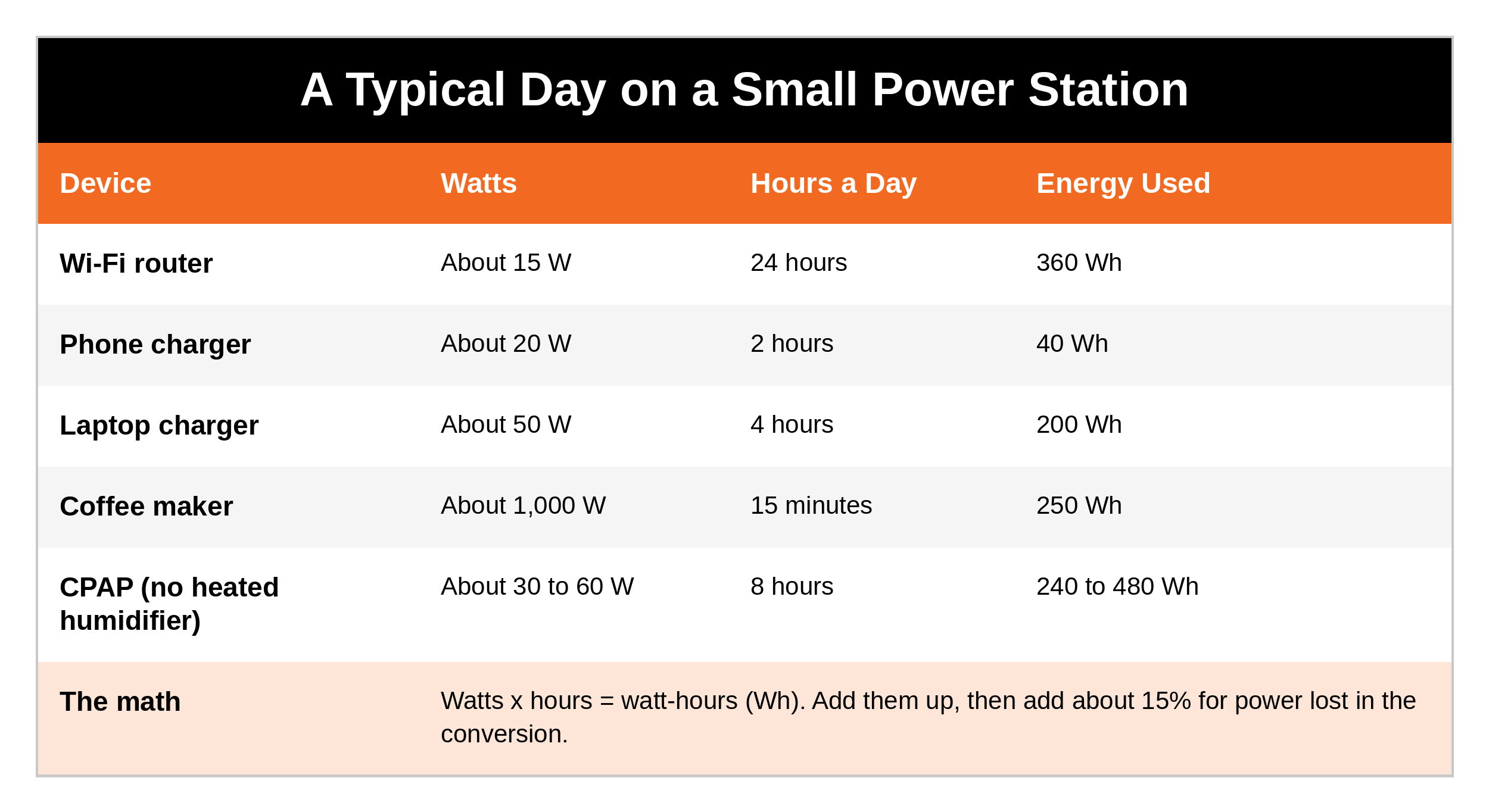
The Wi-Fi router, phone, laptop, and coffee maker add up to about 850 watt-hours for the day. Add a CPAP machine overnight and you're at roughly 1,100 to 1,300.
A note on CPAP machines: Most use about 30 to 60 watts without the heated humidifier, and a lot more with it. Check the label on your power supply, and talk to your equipment supplier about running it on battery. Many make a battery or DC adapter just for outages.
The Two Numbers That Matter
Every power station has two numbers on the box, and you need to understand both:
Capacity (watt-hours, Wh) is how long it lasts. It's the size of the gas tank.
Output (watts, W) is what it can run at one time. It's the size of the engine.
Here's where people get caught. A coffee maker pulls about 1,000 watts. A power station with a 500-watt limit can't run it at all, no matter how full the battery is. And a station that can run it will burn through a big chunk of its capacity in 15 minutes. You need enough of both.
Can a Small Power Station Handle It?
Here's how three popular models stack up against that 850 watt-hour day.
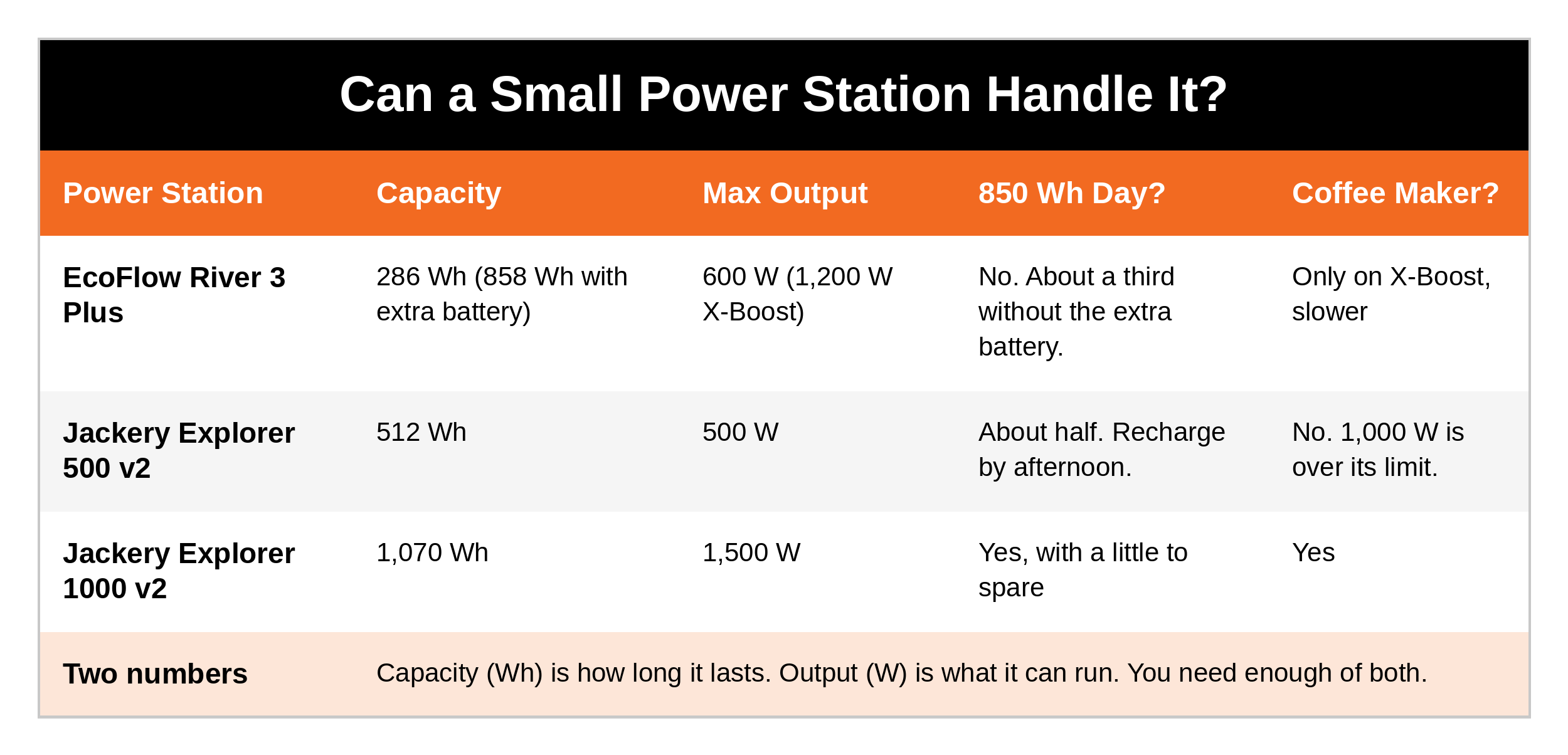
Small Power Station Options
EcoFlow River 3 Plus
Capacity: 286 Wh, expandable to 572 or 858 Wh with an add-on battery
Output: 600 W (up to 1,200 W in X-Boost mode for some appliances)
Weight: about 10.4 lbs
Battery: LiFePO4
Good for: phones, Wi-Fi, lights, and a CPAP. The add-on battery lets it grow with you.
Jackery Explorer 500 v2
Capacity: 512 Wh
Output: 500 W (1,000 W surge)
Weight: about 12.6 lbs
Battery: LiFePO4
Good for: a full evening of phones, Wi-Fi, lights, and a laptop. Too small for a coffee maker.
Jackery Explorer 1000 v2
Capacity: 1,070 Wh
Output: 1,500 W (3,000 W surge)
Weight: about 23.8 lbs
Battery: LiFePO4
Good for: the whole 850 Wh day, including the coffee maker, with a little to spare. A great first "real" backup.
You'll find these and the other gear I recommend in my Backup Power Amazon store, linked at the bottom of this post.
Take It Everywhere
Small power stations aren't just for the house. If you ever have to evacuate, shelter somewhere else during a storm, or sleep in your vehicle, a small station keeps your critical gear running: phones, communication gear, GPS units, and hotspots. It's one of the most useful things you can grab on the way out the door. I covered vehicle readiness in the Mobile Command Center series.
Run a Practice Weekend
Here's the best way to learn your system: pick a weekend evening and run your essentials on the power station for a few hours. Plug in the Wi-Fi, charge the phones, run a lamp, and make the morning coffee if your station can handle it. Then check what's left.
You'll find out more in one evening than from any spec sheet: how fast the battery drops, what you forgot to plan for, and whether you need something bigger.
What to Look for in Your First Power Station
LiFePO4 battery (lithium iron phosphate). It lasts thousands of charge cycles and is more stable than older lithium-ion batteries.
Pure sine wave AC outlets, which are safe for laptops, CPAP machines, and other sensitive electronics.
UPS or pass-through charging with a fast switchover (20 milliseconds or less). It can stay plugged in and take over the moment the power drops.
Solar input, so you can recharge when the grid is down. Part 4 covers solar.
Expandability, if you think you'll want more capacity later.
A weight you can carry. Pick it up in the store, or check the weight before you buy.
Want the complete plan? A power station is one piece of being ready for an outage. The Family Safety Toolkit gives you 20 checklists covering every area of family safety and preparedness, from your go bag and your vehicle to first aid and home safety. Print them, check them off, and keep them with your gear. [Get it here: https://www.preparednotparanoid.com/family-safety-toolkit]
Storing and Caring for Your Power Station
Keep it charged. Top it off every few months, even if you haven't used it. EcoFlow and Jackery both recommend recharging about every 3 months in storage.
Store it indoors in a cool, dry place. Extreme heat and cold shorten battery life, so don't leave it in a hot car or garage all summer.
Charge it in an open area, away from anything that can burn, and follow the manufacturer's instructions.
Test it twice a year, when you check the rest of your emergency gear.
Coming Up Next
In Part 2, we'll size a system for your whole kitchen: the refrigerator, freezer, and the essentials, with the simple math to figure out exactly how big a power station you need.
Ask Yourself
What are the 3 or 4 things my family would need powered first?
How many watt-hours would that take for one day?
Have I ever actually tested a backup battery before I needed it?
Remember
Start small, test it under normal conditions, and get to know your gear. Capacity is how long it lasts. Output is what it can run. You need enough of both, and the best time to find out is on a quiet weekend, not in the dark.
Get Started Today
FREE GUIDE: Lights Out, The Prepared Not Paranoid Blackout Plan. What to do in the first 30 minutes, the first 24 hours, and beyond when the power goes out, plus what to power first, generator safety, and a blackout supply checklist. [CTA: Comment or DM "KEYWORD" / or download it here: LINK]
Go Deeper
The Family Safety Toolkit. This post helps you choose and test your first power station. The Toolkit gives you 20 checklists covering every area of family safety and preparedness, all for $19.99. [Get it here: https://www.preparednotparanoid.com/family-safety-toolkit]
The Family Emergency Preparedness Manual is coming soon.
Tools I recommend: The power stations, solar panels, and lighting I recommend are in my Backup Power Amazon store. https://link.amazon/B0aqcCOsk
Related reading:
Backup Power, Introduction: Staying Powered Up When It Goes Dark https://www.preparednotparanoid.com/pnp-library/alternative-power
Backup Power, Part 2: Size Your System https://www.preparednotparanoid.com/pnp-library/alternative-power-lesson2
Setting Up Your Mobile Command Center, Part 5: Navigation and Communications https://www.preparednotparanoid.com/pnp-library/mobile-command-navigation-communications
References
EcoFlow. RIVER 3 Plus specifications.
Jackery. Explorer 500 v2 and Explorer 1000 v2 specifications.
FEMA / Ready.gov. Power Outages.
U.S. Food and Drug Administration. Using medical devices during a power outage.
Disclaimer
These suggestions are intended to help you and your family build awareness, confidence, and safer decision-making habits. No safety plan, checklist, or training can guarantee 100% protection. This article is for general informational purposes only. Specifications are from the manufacturers as of October 2026 and can change. If you depend on a medical device, talk to your doctor and equipment supplier about your backup power plan. Always follow the manufacturer's instructions. Affiliate disclosure: I've linked to products from my Amazon store that I personally recommend. As an Amazon Associate, I earn from qualifying purchases, at no extra cost to you. Thank you for supporting my work.
If someone who depends on a medical device loses power and you can't restore it, call 911.
Awareness gives you time. Time gives you options.
The prepared protector is someone who's decided that loving someone means being ready for them, not just hoping things go fine.
Prepared Not Paranoid. Protecting the Most Vulnerable Among Us.