Automatic Backup, Transfer Switches, and How Long Food Stays Safe
By Larry Betz | Prepared Not Paranoid https://www.preparednotparanoid.com/
A full freezer is hundreds of dollars of food on a timer, and the clock starts the second the power goes out. If you're home, you can do something about it. If you're at work, asleep, or on vacation, you may not even know it happened. Here's how to keep the fridge running during a power outage, even when nobody's there to flip a switch, and how to tell what's still safe to eat if it can't.
In Part 2, we did the math: the fridge alone is about two-thirds of a typical outage day. Now let's make sure the power actually gets to it.
The Problem With Most Power Stations
Most portable power stations are built to be turned on and plugged in by hand. That's fine if you're home and awake. It doesn't help at 3 a.m. or when you're two states away.
Many current large power stations solve this with pass-through power, sometimes called UPS mode. The power station stays plugged into the wall, and your fridge stays plugged into the power station. When the grid is on, power passes straight through. When the grid fails, the power station switches to its battery on its own, with little or no interruption. No wiring, no switch to flip, and nobody has to be home.
Three Ways to Keep the Fridge Running
There are three common setups, from simple to fully wired. Here's how the three setups compare.
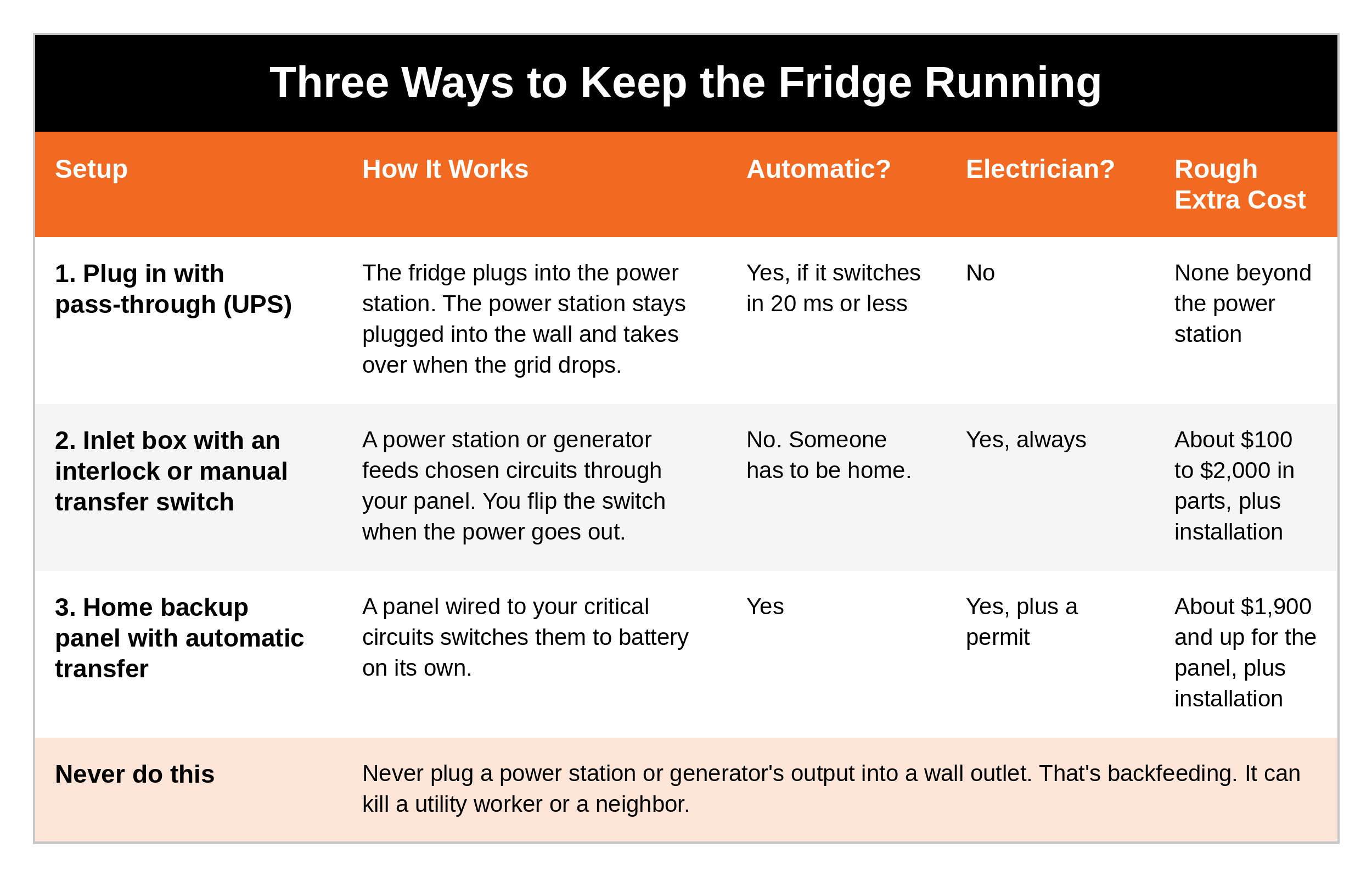
1. Plug In With Pass-Through (UPS)
This is where most families should start. Here's the setup:
Plug the power station into a wall outlet using its own charging cord.
Plug the refrigerator or freezer into the power station's AC outlet.
When the grid is on, power passes through and the battery stays full.
When the grid fails, the power station takes over automatically.
Check the manual for the switchover time. Look for "UPS," "zero transfer," or a switchover of 20 milliseconds or less. A fridge handles that easily. Plug the fridge straight into the power station, or use a short, heavy-duty extension cord rated for appliances. Skip the cheap power strip.
2. An Inlet Box With an Interlock or Manual Transfer Switch
An electrician installs an inlet box on the outside of your house and either an interlock kit or a manual transfer switch at your electrical panel. When the power goes out, you connect your power station or generator to the inlet box and flip the switch. Now it powers the circuits you chose, like the fridge, freezer, furnace fan, and a few lights, through your home's own wiring.
It's a great setup for running more than one appliance. The drawback: it isn't automatic. If you're on vacation, it won't help.
3. A Home Backup Panel With Automatic Transfer
This is the fully automatic version. An electrician wires a backup panel to your most important circuits, and it switches them to battery power on its own when the grid drops. Some power station makers sell their own, like the EcoFlow Smart Home Panel 2 (12 circuits, for EcoFlow's DELTA Pro line) and the Anker SOLIX Home Backup Kit (for the F3800 and F3800 Plus). Gas generators use a similar device called an automatic transfer switch (ATS). Expect a permit, and plan on professional installation. Part 5 covers whole-house battery systems, and Part 6 covers standby generators.
Never Backfeed. Ever.
Here's the one rule that matters more than any other. Never connect a power station's or generator's output to a wall outlet with a "double male" cord or any other trick. That's called backfeeding. It sends power backward through your home's wiring and out onto the power lines, where it can electrocute a utility worker fixing the lines, or a neighbor. It can also start a fire. It's dangerous, and in most places it's illegal.
To be clear: plugging your power station's charging cord into the wall is fine. That's how pass-through works. What never goes into a wall outlet is the output. The only safe way to power your home's wiring is through a transfer switch or interlock installed by a licensed electrician.
If You're Away From Home
Here's your vacation backup setup for the fridge and freezer:
A power station with pass-through and fast switchover, sized from Part 2.
The fridge or freezer plugged into it, or a dedicated circuit wired by an electrician.
The power station plugged into the wall, so it stays full until it's needed.
A portable solar panel (optional) to recharge it while you're gone. Part 4 covers solar.
A smart energy monitor or temperature sensor (like Sense or Emporia for energy, or a Wi-Fi fridge thermometer) for alerts on your phone.
One catch: when the power goes out, so does your Wi-Fi router, and your alerts go with it. Put the router on the power station too, or choose a sensor with its own cellular or battery backup. And ask a neighbor to check on things if an outage lasts more than a few hours.
Try the freezer test before you leave. Freeze a cup of water, then set a coin on top of the ice and put it back in the freezer. When you get home, if the coin is still on top, the freezer stayed frozen. If it's sunk to the bottom, everything thawed and refroze, and the food should go.
Medications That Need to Stay Cold
Insulin, some eye drops, certain antibiotics, and many injectable medicines need to stay cold. If someone in your home depends on one, the fridge isn't just about food. Ask your pharmacist how long that medication stays good at room temperature, and keep a small cooler and frozen gel packs ready as a backup to your backup.
This is what being a prepared protector looks like in real life. It isn't about saving the ice cream. It's about the person who depends on what's in that fridge, and making sure it's still good when they need it.
How Long Food Stays Safe
If the power does go out and your backup can't keep up, keep the doors closed and know your clock. Here are the USDA guidelines.
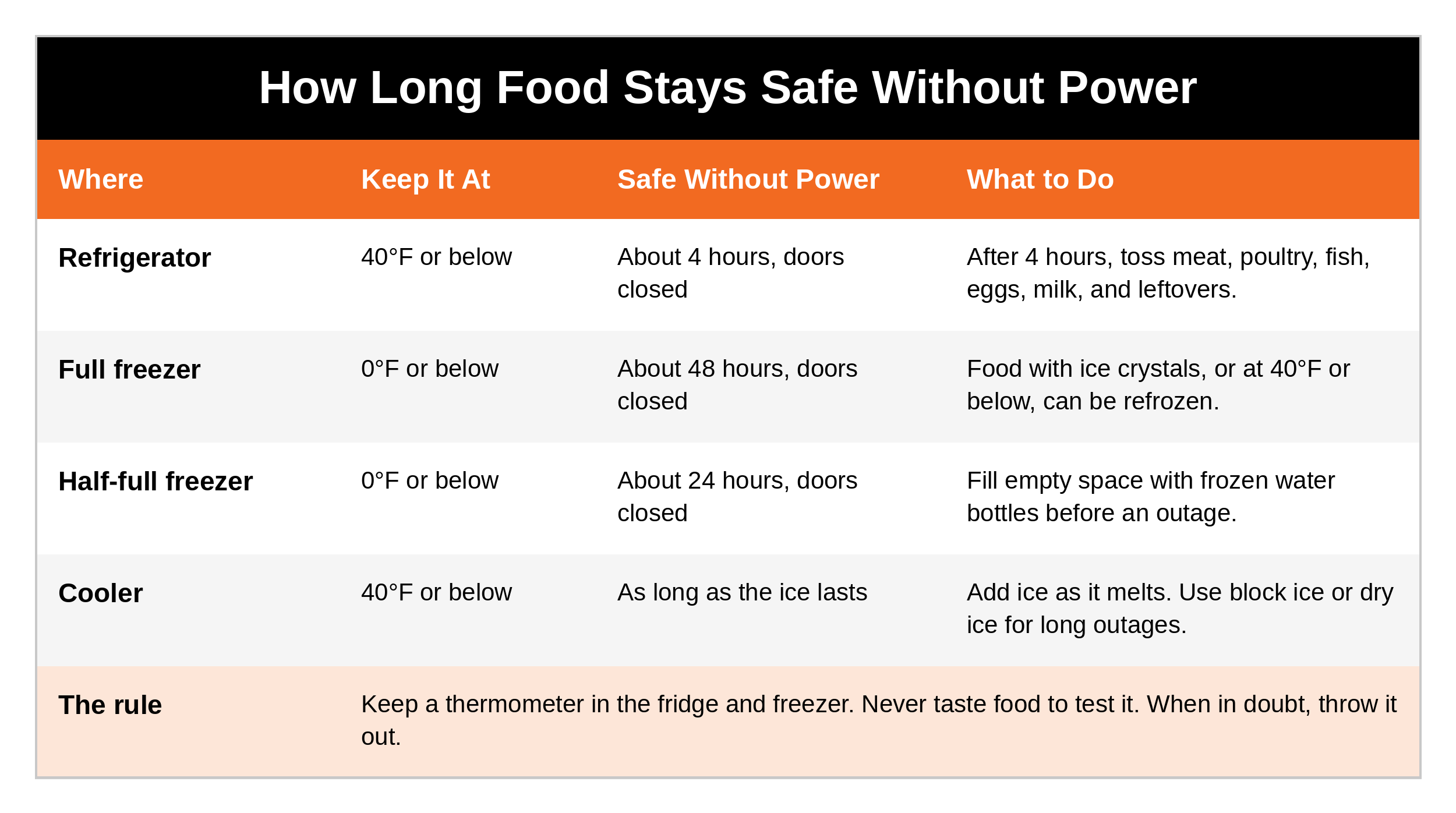
A few more rules from the USDA and food safety experts:
Toss perishable food that's been above 40°F for more than 2 hours.
Keep an appliance thermometer in both the fridge and freezer, so you're not guessing.
Never taste food to find out if it's safe. You can't see, smell, or taste the bacteria that make people sick.
For a long outage, use block ice or dry ice. Never touch dry ice with your bare hands, and don't let it touch food.
Coming Up Next
In Part 4, we'll recharge with solar: from portable panels for your power station to using your home solar and EV charger.
Ask Yourself
If the power went out while we were away, would anything keep the fridge and freezer running?
Does anyone in my home depend on a medication that needs to stay cold?
Do I have thermometers in the fridge and freezer right now?
Remember
The best backup for your fridge is one that works when nobody's home. A power station with pass-through is the simplest place to start. Anything connected to your home's wiring needs a transfer switch or interlock installed by a licensed electrician. Never backfeed. And when the power is out, keep the doors closed, know the 4, 48, and 24 hour rules, and when in doubt, throw it out.
Get Started Today
FREE GUIDE: Lights Out, The Prepared Not Paranoid Blackout Plan. What to do in the first 30 minutes, the first 24 hours, and beyond when the power goes out, plus how long food stays safe, generator safety, and a blackout supply checklist. Keep it on the fridge. [CTA: Comment or DM "KEYWORD" / or download it here: LINK]
Go Deeper
The Family Safety Toolkit. This post helps you protect your food and medications in an outage. The Toolkit gives you 20 checklists covering every area of family safety and preparedness, from your go bag and your vehicle to first aid and home safety, all for $19.99. [Get it here: https://www.preparednotparanoid.com/family-safety-toolkit]
The Family Emergency Preparedness Manual is coming soon.
Tools I recommend: The power stations, appliance thermometers, temperature sensors, coolers, and heavy-duty cords I recommend are in my Backup Power Amazon store. https://link.amazon/B0aqcCOsk
Related reading:
Backup Power, Part 2: Size Your System https://www.preparednotparanoid.com/pnp-library/alternative-power-lesson2
Backup Power, Part 4: Recharging With Solar https://www.preparednotparanoid.com/pnp-library/alternative-power-lesson4
Nutrition Basics, Part 16: Shop for Emergencies the Smart Way https://www.preparednotparanoid.com/pnp-library/nutrition-lesson-10
References
U.S. Department of Agriculture, Food Safety and Inspection Service. Keeping Food Safe During an Emergency.
FoodSafety.gov. Food Safety During Power Outages.
U.S. Consumer Product Safety Commission. Portable Generator Safety.
FEMA / Ready.gov. Power Outages.
EcoFlow. Smart Home Panel 2 specifications.
Anker SOLIX. Home Backup Kit for F3800 and F3800 Plus.
Disclaimer
These suggestions are intended to help you and your family build awareness, confidence, and safer decision-making habits. No safety plan, checklist, or training can guarantee 100% protection. This article is for general informational purposes only. Prices are rough 2026 estimates and vary by location and installer. Always follow the manufacturer's instructions, and use a licensed electrician for any connection to your home's wiring. Ask your pharmacist about storing your medications during an outage. Affiliate disclosure: I've linked to products from my Amazon store that I personally recommend. As an Amazon Associate, I earn from qualifying purchases, at no extra cost to you. Thank you for supporting my work.
If someone touches a downed power line or gets a shock from equipment, don't touch them. Call 911.
Awareness gives you time. Time gives you options.
The prepared protector is someone who's decided that loving someone means being ready for them, not just hoping things go fine.
Prepared Not Paranoid. Protecting the Most Vulnerable Among Us.