Caller ID Lies, Impersonation Scams, and What to Say
By Larry Betz | Prepared Not Paranoid https://www.preparednotparanoid.com/
A bank impersonation scam can look completely real: the right name on the screen, the right phone number, a caller who knows your details. Here's how these scams work, and the one move that beats every one of them.
Imagine this. Your mother's phone rings. The caller ID shows her bank's name and its real phone number. A polite, professional voice says there's suspicious activity on her account: a $2,400 charge in another state. The caller knows her name, her address, and the last four digits of her card.
"To protect your money," he says, "we need to move it to a secure account while we investigate. I'll stay on the line with you."
Everything about that call looks real. None of it is.
In Part 1, we covered the pattern behind almost every scam. Now let's look at the one that fools the most careful people: the impersonation scam.
Caller ID Is Not Proof
Criminals can make any name and number appear on a phone's screen. This is called spoofing, and the Federal Communications Commission warns about it. Caller ID shows what was sent to the phone. It doesn't prove who's calling.
The same goes for the details they know. Your name, address, bank, and even recent purchases can come from data breaches, social media, or public records. Knowing your information isn't proof of who they are.
Don't Try to Verify the Caller While You're on the Call
This is where good people get caught. They think, "I'll ask a few questions and see if he's legit."
A prepared criminal will have answers. A real bank employee also often can't discuss account details until you've been verified. So quizzing the caller doesn't work in either direction.
There's only one safe test: hang up and call the bank yourself.
What to Say
"I don't discuss my accounts on calls I didn't make. I'll contact the bank directly."
Then hang up. A real bank employee will understand. If the caller pushes you to stay on the line, that's your answer.
The Prepared Protector gives their parents permission to hang up. Many of our parents were raised to be polite to anyone who sounds official. Tell them out loud: hanging up on a stranger is never rude.
How to Contact the Bank Safely
Call the number on the back of your card
Use the phone number inside the bank's official app
Type the bank's web address yourself and use the contact page
Visit a branch if you're still unsure
Don't:
Call a number the caller, text, email, or voicemail gave you
Hit redial on the number in your recent calls
Use a phone number from a search ad
When you reach the real bank, ask:
"Did you try to contact me? Are there any alerts, pending transfers, new payees, or changes to my account?"
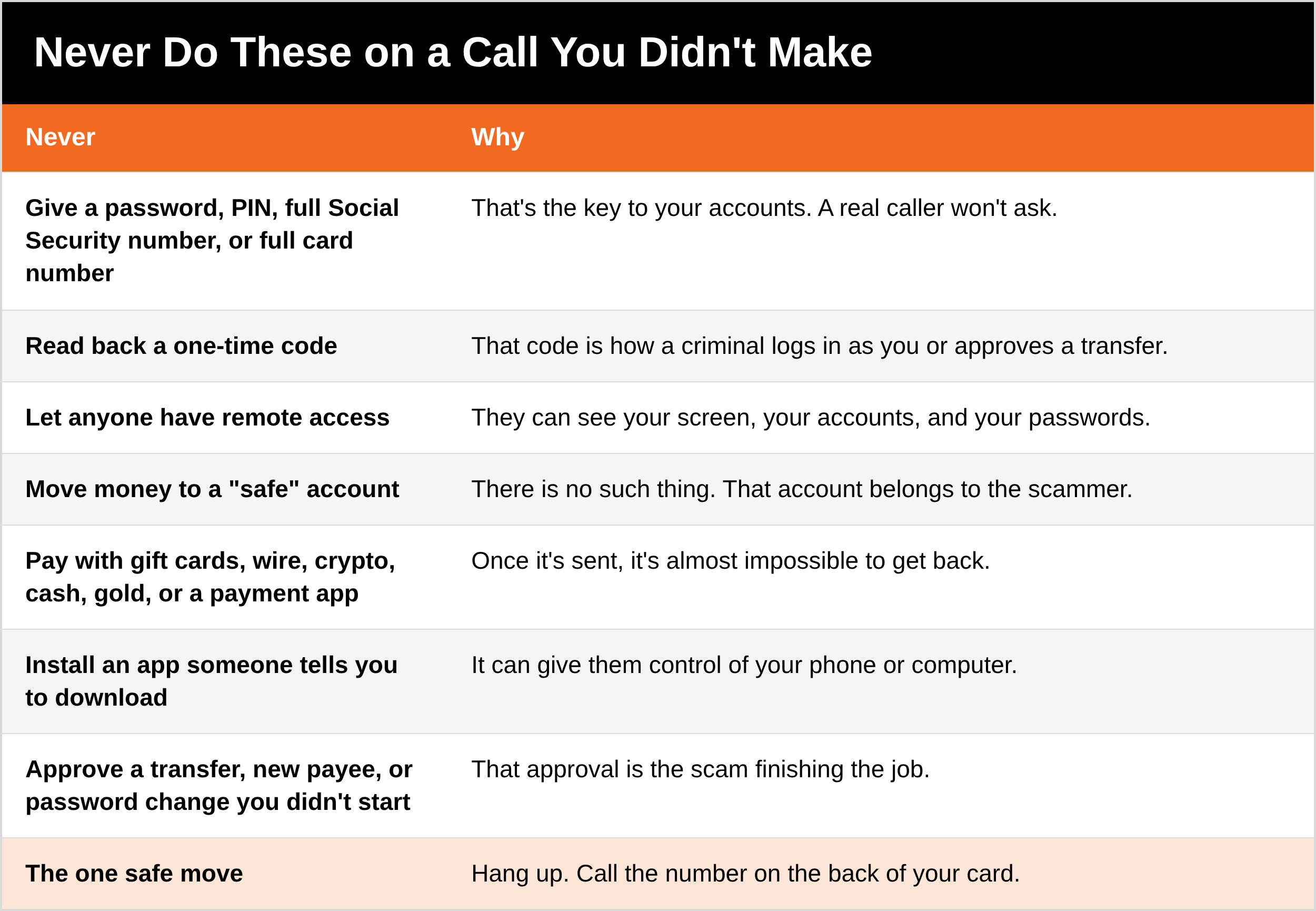
Never Do These on a Call You Didn't Make
Write this list down and keep it by the phone:
Give a password, PIN, full Social Security number, or full card number
Read back a one-time code that was texted or emailed to you
Let anyone have remote access to your phone, tablet, or computer
Move money to a "safe," "secure," or "protected" account
Pay with a gift card, wire transfer, cryptocurrency, cash, gold, or payment app
Install an app someone tells you to download
Approve a transfer, new payee, or password change you didn't start
No real bank, government agency, or police department will ever ask you to do any of these.
The Impersonation Scams to Know
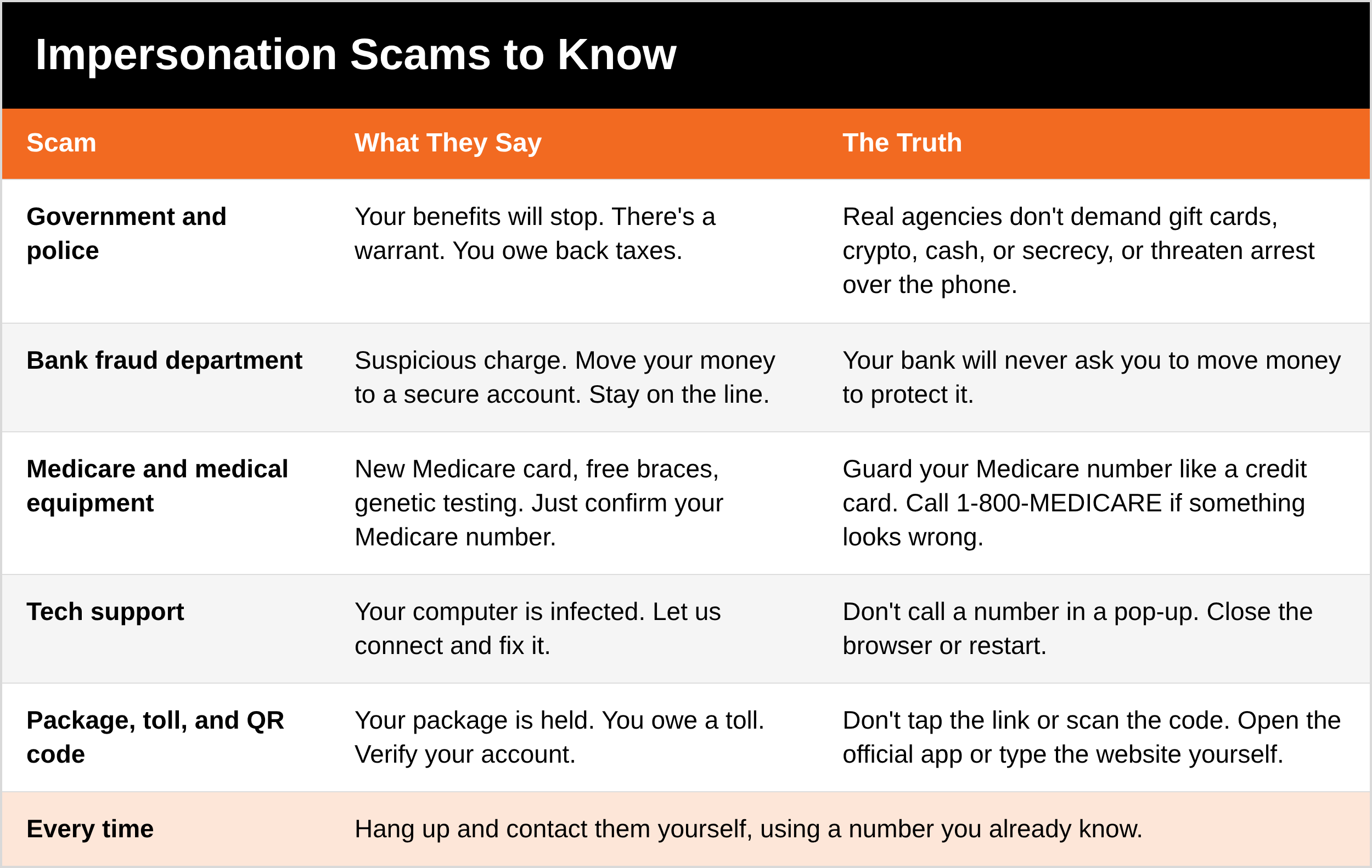
Government and Law Enforcement
The caller claims to be from Social Security, Medicare, the IRS, a court, or the police. Your benefits will stop. There's a warrant. You owe back taxes.
Why it works: Most of us were raised to respect authority. Scammers use that instinct to rush you past your questions.
The truth: Real agencies don't demand gift cards, cryptocurrency, cash, or secrecy, and they don't threaten immediate arrest over the phone.
Medicare and Medical Equipment
Callers offer a "new Medicare card," free braces, genetic testing, or help with enrollment, in exchange for your Medicare number.
Protect your Medicare number like a credit card number. Review your Medicare Summary Notices for services you never received, and call 1-800-MEDICARE if something looks wrong.
Tech Support and Computer Takeover
A pop-up or call says your computer is infected or your account was hacked. They ask to "connect" to your computer to fix it, or they show you fake bank activity.
What to do: Don't call a number in a pop-up. Close the browser or restart the computer. If you already gave someone remote access, disconnect from the internet, call a trusted technician, change your passwords from a different device, and call your bank activity.
Package, Toll, and QR Code Scams
A text says your package can't be delivered, you owe an unpaid toll, or your account needs to be "verified." The link steals your passwords or card number.
A newer trick: criminals put a fake QR code sticker right over a real one on a parking meter, restaurant table, or delivery notice. You can't tell where a QR code goes just by looking at it, and a fake one looks exactly like the real thing.
What to do: Don't tap the link or scan the code. Open the company's official app or type its website yourself. Forward scam texts to 7726 (SPAM).
Ask Yourself
Does everyone in my family know caller ID can be faked?
Where's the bank's real phone number? (Check: it's on the back of the card.)
Would my parents feel comfortable hanging up on someone who sounds official?
5 Quick Wins You Can Start Today
Practice the What to Say line out loud with your parent, so it comes out naturally under pressure.
Save the bank's real number in their phone, taken from the back of the card.
Turn on bank alerts for transfers, new payees, and password changes.
Put a note by the phone: "Hang up. Call the back of the card."
Forward the next scam text to 7726, then delete it.
Remember: Hanging up isn't rude. It's the one move a scammer can't beat.
Coming Up in Part 3
Scams That Pull at the Heart. The grandparent scam, AI voice cloning, romance scams, and the "investment opportunity" that starts with a wrong-number text.
Get Started Today
My free guide, Protecting Older Adults from Scams and Financial Exploitation, includes the "Never Do These" list and the exact words to say, ready to print and keep by the phone.
DM the word [KEYWORD] on Instagram or Facebook and I'll send it to you. [Get it here: LINK]
Go Deeper
Cyber Safety: A Beginner's Guide to Protecting Your Digital Footprint covers passwords, two-factor login, phishing, and what to do if your accounts are compromised. [Get it here: LINK]
The Family Safety Toolkit includes Senior Safety checklists you can work through together. This post gives you the rules. The Toolkit helps you put them in place, step by step. [Get it here: LINK]
Coming soon: the Senior Safety Guide. How to set up bank alerts and account protections, a step-by-step recovery plan if someone already gave access or sent money, how to spot recovery scams, and how to set up a senior-friendly phone that blocks scam calls.
Tools I recommend: call blockers, senior-friendly phones, and other tools to help older adults stay safe, secure, and independent at home, in my Senior Safety store. [SENIOR SAFETY STORE LINK]
The Full Series
Part 1: It's Not About Being Smart [LINK]
Part 2: "This Is Your Bank Calling" (you are here)
Part 3: Scams That Pull at the Heart [LINK]
Part 4: Build Your Family's Fraud Plan [LINK]
Related Reading
Red Cell Your Family, Part 4: Red Cell Your Digital Life [LINK]
The Fake Party Invitation Scam [LINK]
References
Federal Communications Commission, Caller ID Spoofing: https://www.fcc.gov/spoofing
American Bankers Association, #BanksNeverAskThat: https://www.banksneveraskthat.com
Medicare, Reporting Fraud and Abuse: https://www.medicare.gov/basics/reporting-medicare-fraud-and-abuse
Federal Trade Commission, How to Recognize and Avoid Phishing Scams: https://consumer.ftc.gov/articles/how-recognize-and-avoid-phishing-scams
Federal Trade Commission, Tech Support Scams: https://consumer.ftc.gov/articles/how-spot-avoid-and-report-tech-support-scams
Disclaimer: This article is for general informational and educational purposes only. It is not legal or financial advice. If you shared information or sent money, contact your bank's fraud department immediately using a verified number, and report it at ReportFraud.ftc.gov. These suggestions are intended to help you and your family build awareness, confidence, and safer decision-making habits. No safety plan, checklist, or training can guarantee 100% protection. There will always be people who try to exploit vulnerability, opportunity, trust, or positions of power. Laws and reporting rules vary, so check your state and county for the exact rules where you live. As an Amazon Associate, I earn from qualifying purchases.
Think an older adult has been scammed? Call the National Elder Fraud Hotline at 1-833-FRAUD-11 (1-833-372-8311). If you are in immediate danger, call 911.
Awareness gives you time. Time gives you options.
The Prepared Protector is someone who's decided that loving someone means being ready for them, not just hoping things go fine.
Prepared Not Paranoid. Protecting the Most Vulnerable Among Us.