Hear What First Responders Hear, in Real Time
By Larry Betz | Prepared Not Paranoid https://www.preparednotparanoid.com/
When something big is happening near you, the first place it shows up isn't the news. It's the radio. A police scanner lets you hear what firefighters, EMS crews, road crews, and sometimes police are dealing with right now, often well before an alert hits your phone. During a wildfire, a flood, or a major outage, that information can help you decide whether to stay, leave, or change your route.
In your family PACE plan, a scanner isn't a way to talk. It's a way to listen. It feeds your situational awareness, so every other decision gets better.
What Is a Police and EMS Scanner?
A scanner is a radio receiver that searches through many frequencies used by:
Police departments
Fire departments
EMS
Public works
Weather alerts (NOAA)
Search and rescue teams
Utility companies
Unlike a two-way radio, a scanner only listens. It can't transmit. That makes it an excellent tool for real-time local awareness during emergencies, disasters, road incidents, or civil unrest.
Why Scanners Are Valuable for Preparedness
A scanner can sharpen your situational awareness when it matters most:
Stay informed during disasters like wildfires, floods, and power outages, with updates straight from first responders and work crews
Track nearby incidents like car crashes, road closures, and police activity, often before they reach the news or public alerts
Get weather alerts, since many models also monitor NOAA weather broadcasts
Make faster, smarter decisions about sheltering in place, evacuating, or changing your travel route, based on accurate, unfiltered information
What You Can and Can't Hear
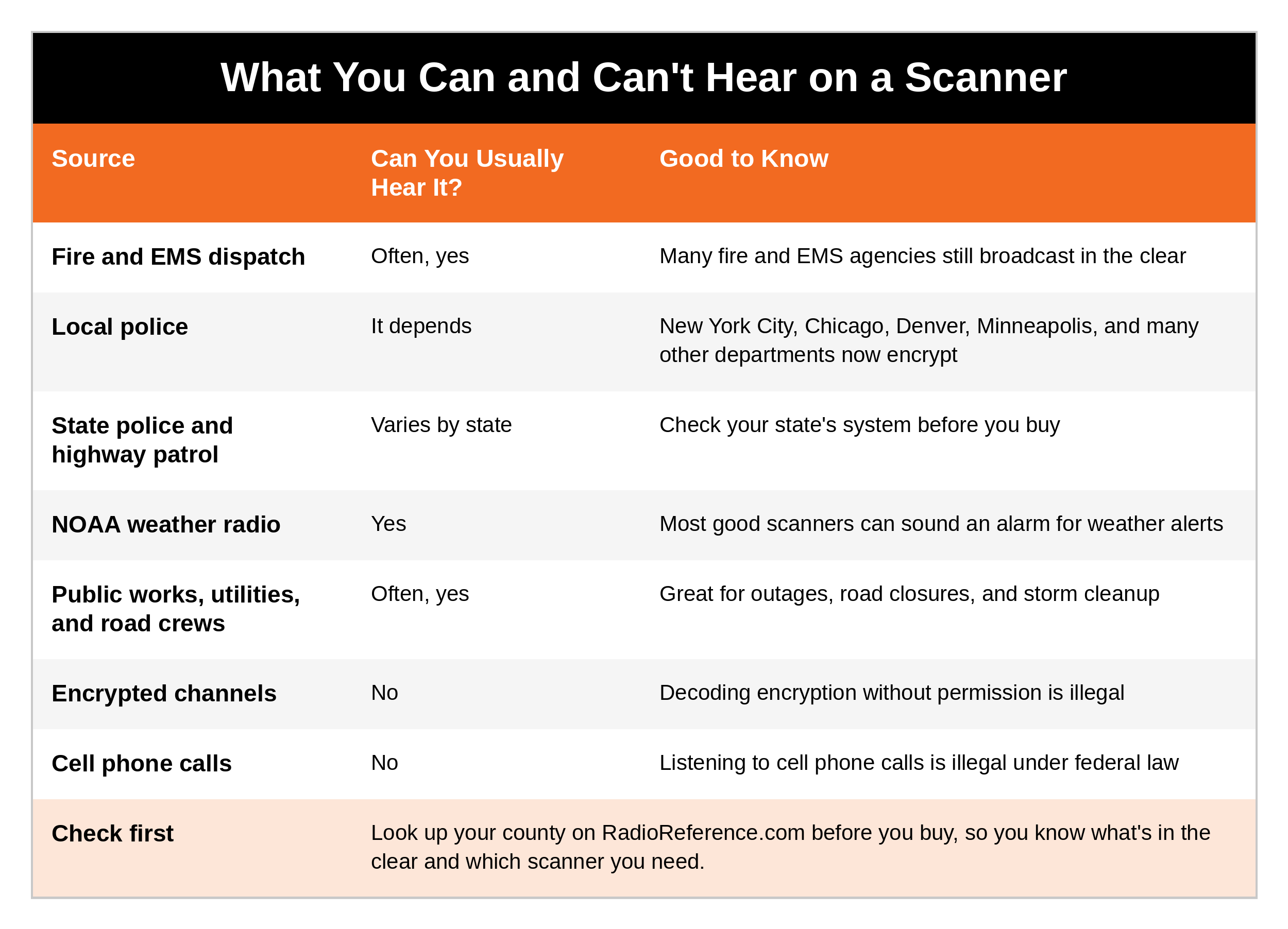
Here's something many people don't know: a growing number of police departments now encrypt their radios, which means a scanner can't hear them. New York City, Chicago, Denver, Baltimore, San Francisco, and Minneapolis are among the cities that have made the switch, and more are following. Officials point to officer safety and protecting people's private information. Chicago still streams its police radio online on a delay, while Minneapolis offers a call map with a 30-minute delay instead.
The good news: many fire departments, EMS agencies, road crews, and utilities still broadcast in the clear, and that's often the most useful information in a disaster anyway. Here's what to expect.
Digital vs Analog
Many public safety agencies now use digital trunked systems, such as P25 Phase I or Phase II.
You need a digital trunking scanner to hear those transmissions.
Analog-only scanners are increasingly limited, and in many areas they'll hear very little.
What's a Digital Trunked System?
A digital trunked radio system is a modern network used by many police, fire, EMS, and government agencies. In older systems, each department had its own fixed frequency. A trunked system lets many departments share a large pool of frequencies. A central computer assigns channels on the fly, much like a dispatcher managing several phone lines. It's efficient, cuts down on radio traffic jams, and lets different units talk to each other easily.
To follow those constantly shifting conversations, your scanner must be able to decode the system's digital control signals. Some agencies encrypt their traffic, especially police tactical and federal operations, but many fire, EMS, and highway departments still use unencrypted digital trunked systems. With the right digital scanner, you can hear those broadcasts in real time.
Choosing a Scanner
The most common mistake is buying a scanner that can't hear your area.
Check these six things before you buy.
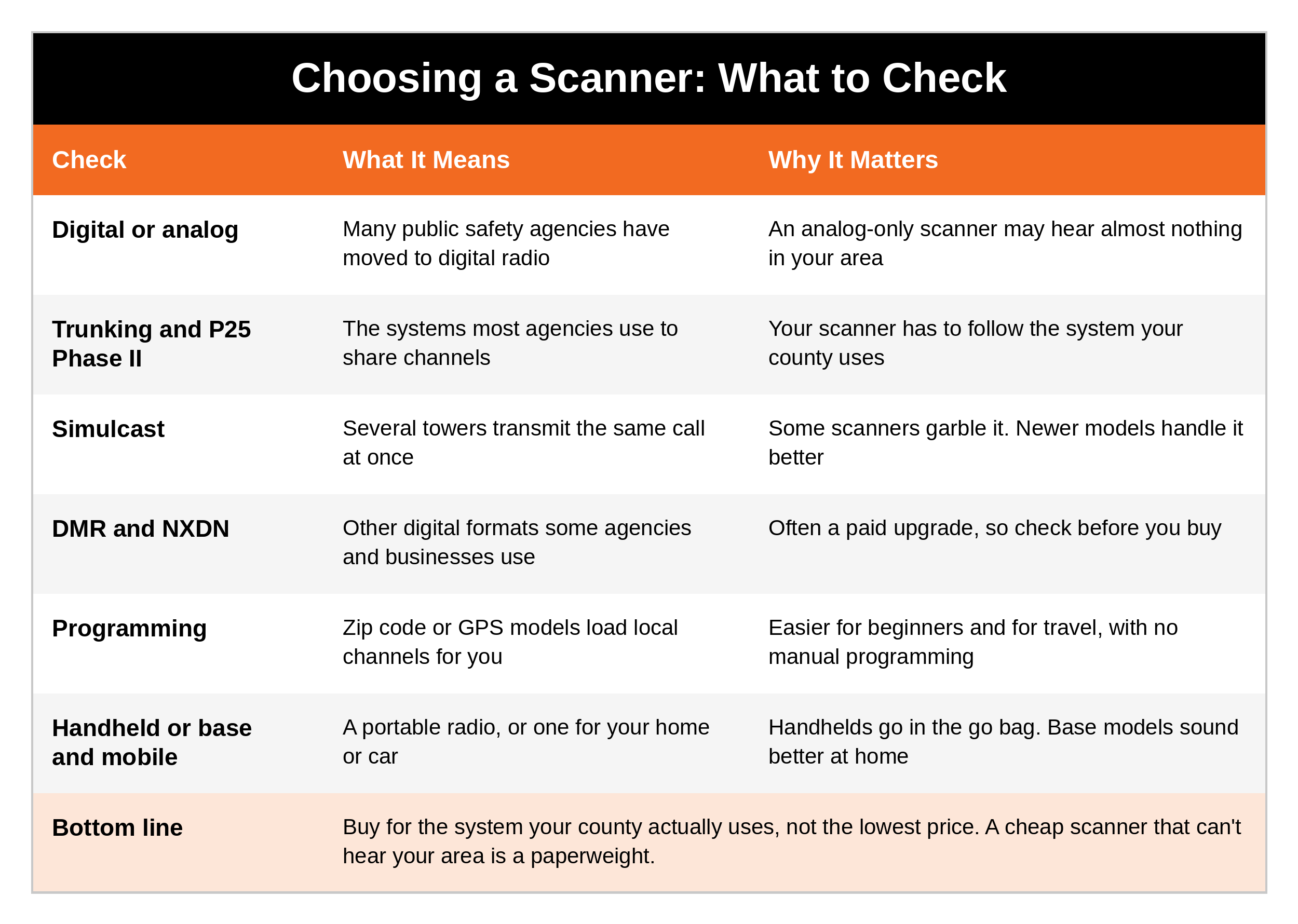
Start here: look up your county on RadioReference.com. It lists the radio systems your local agencies use, whether they're digital, and whether they're encrypted. Take that list to the store or the seller and ask, "Will this scanner hear these systems?"
Recommended Units
Current models that scanner dealers recommend:
Uniden SDS150 or SDS100 (handheld, digital, handles simulcast well, GPS or location-based programming)
Uniden SDS200 (base or mobile, same receiver as the SDS100, easier to listen to at home)
Whistler TRX-1 (handheld, digital) and Whistler TRX-2 (base or mobile, digital)
My original list included the Uniden HomePatrol-2 (easy touchscreen, GPS-ready), the Uniden BCD436HP (portable, digital, zip code entry), and the Whistler WS1040 (handheld, digital, budget option). These are older models. If you already own one or find one, check that it can follow your area's current system.
Capable digital scanners usually cost a few hundred dollars. Some digital formats, like DMR and NXDN, are a paid upgrade on certain models, so ask before you buy.
Using a Scanner on the Road
Taking a scanner on a road trip?
Here's what you need to know.
Mobile and handheld scanners can work across regions. Most modern digital scanners from brands like Uniden and Whistler support location-based scanning, using GPS or a zip code you enter. As you travel, the scanner can automatically switch to the frequencies used where you are.
Do you need to program it ahead of time? Yes and no. You have two options:
Pre-program the frequencies for each county or state along your route. It takes time, but it's precise.
Use a GPS or zip code model that loads the local frequency database for you as you move.
If you're using an older or analog-only scanner, you'll need to program frequencies for each area by hand.
Before you leave, check the scanner laws for every state on your route (see below).
Weather Alert Capabilities
Most good scanners include a built-in NOAA weather alert feature that:
Monitors your local NOAA weather channel around the clock
Sounds an alarm for severe weather, like tornadoes, flash floods, and blizzards
Works even when cell towers are down
You can also buy a dedicated NOAA weather radio, but a scanner with NOAA alerts gives you emergency services and weather updates in one device. We'll cover weather alerts in detail in Part 7.
What About Scanner Apps?
Apps and websites like Broadcastify stream scanner audio from volunteers over the internet. They're free and handy on a normal day. But they have real limits in an emergency:
They need cell service or internet, so they fail exactly when the network fails
Streams often run on a delay and can drop out
Not every agency in your area is streamed
A real scanner hears the radio directly, with no internet needed. An app is a convenience. A scanner is a backup.
Know the Law
Listening to unencrypted public safety radio is generally legal in the U.S. But there are important limits:
Some states restrict scanners in vehicles. Florida, Indiana, Kentucky, Minnesota, and New York limit mobile scanner use. Some of these states exempt licensed ham radio operators, members of the press, or people with a permit, but the exemptions differ from state to state.
Many states add penalties for using a scanner while committing a crime.
Federal law makes it illegal to listen to cell phone calls or to decode encrypted transmissions.
Laws change, so check your own state's current law and the law in every state you'll drive through.
Scanner Etiquette
Never drive to a scene you hear about. You can block emergency vehicles and put yourself and responders at risk.
Don't post what you hear about victims or addresses on social media. Those are real people having the worst day of their lives.
Treat what you hear as early information, not confirmed fact. First reports are often wrong. Wait for official alerts before acting on anything big.
Preparedness Tips for Scanner Use
Use a GPS or zip code model, which loads local frequencies automatically as you move.
Keep your frequency database updated, using sources like RadioReference.com.
Mount it in your vehicle or carry it as a handheld, depending on how you'll use it (and where it's legal).
Use headphones or an external speaker for clearer audio in noisy places.
Keep spare batteries or a way to charge it in an outage.
Know the scanner laws where you live and where you travel.
Coming Up Next
In Part 7, we'll look at weather alerts: how to get warnings you'll actually notice, how to beat alert fatigue, and the tools that keep working when the power and cell towers don't.
Ask Yourself
If a wildfire or flood were moving toward us, where would I get real-time information if the phones were down?
Do I know which agencies in my county still broadcast in the clear?
Is it legal to use a scanner in my car where I live and where we travel?
Remember
A scanner doesn't let you talk, but it lets you know. Check what your county still broadcasts, buy a scanner that can hear it, and keep it charged. Then use what you hear wisely: as early warning, not as a reason to go look. The prepared protector listens first and acts on facts.
Get Started Today
FREE GUIDE: Lights Out, The Prepared Not Paranoid Blackout Plan. What to do in the first 30 minutes, the first 24 hours, and beyond when the power goes out, including how to stay informed when the phones and internet go down. [CTA: Comment or DM "KEYWORD" / or download it here: LINK]
Go Deeper
The Family Safety Toolkit. This post helps you stay informed when it matters most. The Toolkit gives you 20 checklists covering every area of family safety and preparedness, from your go bag and your vehicle to first aid and home safety, all for $19.99. [Get it here: https://www.preparednotparanoid.com/family-safety-toolkit]
The Family Emergency Preparedness Manual is coming soon.
Tools I recommend: The scanners, weather radios, radios, and power banks I recommend are in my Backup Communications Amazon store. https://link.amazon/B09z0lfEb
Related reading:
Emergency Communications, Part 5: Ham Radio https://www.preparednotparanoid.com/pnp-library/emergency-communications-pgkcz
Emergency Communications, Part 7: Weather Alerts https://www.preparednotparanoid.com/pnp-library/emergency-weather
Mobile Command Center, Part 5: Navigation and Communications https://www.preparednotparanoid.com/pnp-library/mobile-command-navigation-communications
References
Axios Twin Cities. "Minneapolis police to encrypt radio calls" (April 22, 2025).
Seattle Police Department. "Seattle Police to Enhance Encryption to Radios in Early 2026" (June 17, 2025).
Zip Scanners. "Are Police Scanners Legal? State-by-State Guide" (2025) and "Best Police Scanner in 2026."
Scanner Master. "Best Police Scanners for 2026."
RadioReference.com. Frequency and radio system database.
Disclaimer
These suggestions are intended to help you and your family build awareness, confidence, and safer decision-making habits. No safety plan, checklist, or device can guarantee 100% protection. This article is for general informational purposes only and is not legal advice. Scanner laws vary by state and change over time, so check the current law where you live and travel. Never drive to an emergency scene, and follow the instructions of local officials during an emergency. Affiliate disclosure: I've linked to products from my Amazon store that I personally recommend. As an Amazon Associate, I earn from qualifying purchases, at no extra cost to you. Thank you for supporting my work.
In an emergency, call 911. If a call won't go through, try texting 911 where it's available, and include your location in the first message.
Awareness gives you time. Time gives you options.
The prepared protector is someone who's decided that loving someone means being ready for them, not just hoping things go fine.
Prepared Not Paranoid. Protecting the Most Vulnerable Among Us.