Home Fire Safety Essentials: Part 3
Your Home Fire Escape Plan, the Knox Box, and Calling 911
By Larry Betz | Prepared Not Paranoid https://www.preparednotparanoid.com/
Want the complete guide in one place? Download the free Home Fire Safety Essentials master guide, all four parts plus the Family Fire Escape Plan Worksheet: [LINK TO FULL GUIDE]
In Parts 1 and 2, we covered the gear: smoke and CO alarms, fire extinguishers, fire blankets, and escape ladders. But all the fire safety gear in the world won't help if your family doesn't know what to do when the alarm goes off.
Fires move fast. Today's synthetic furnishings and open floor plans mean that, according to the NFPA, you may have as little as two minutes to get out once the smoke alarm sounds.
One of the biggest lessons from my years as a Safety Director in the elevator industry: under stress, people don't rise to the occasion. They fall back on what they've practiced. Your family is no different. A well-rehearsed escape plan means everyone reacts quickly and confidently instead of freezing.
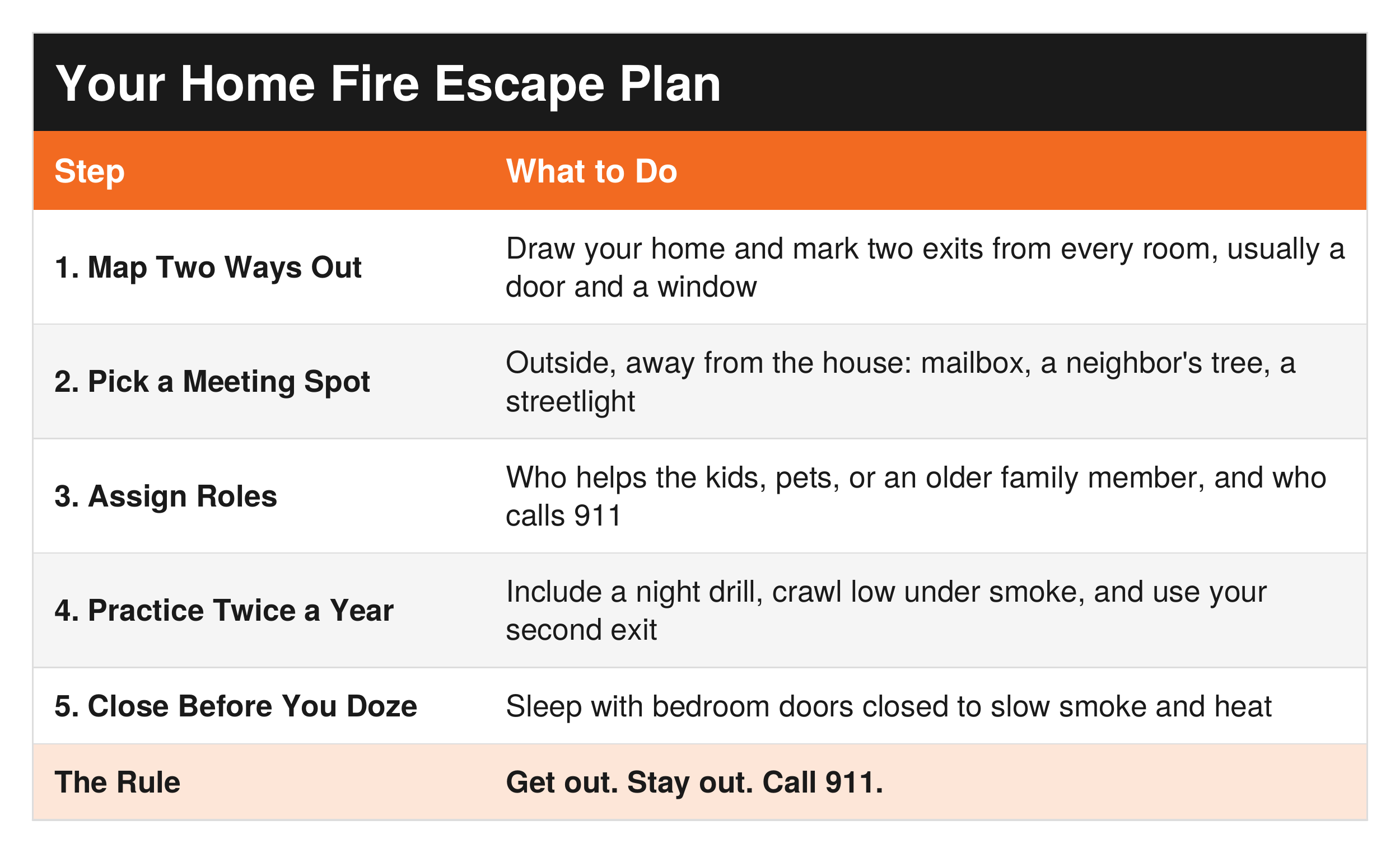
Create and Practice a Home Fire Escape Plan
Step 1: Map Two Ways Out
Draw a simple floor plan of your home showing every room, window, door, and possible exit. (The free worksheet linked at the end of this post has a grid for this.)
Mark two ways out of every room, usually a door and a window.
Make sure windows open easily from the inside, and that everyone knows how to open them.
The whole family should practice opening emergency escape windows, especially in the bedrooms. Check that screens and security bars have quick-release latches.
Step 2: Pick a Safe Meeting Spot
Choose a spot outside and away from the house where everyone will gather, like the mailbox, a neighbor's tree, or a streetlight.
Make sure it's visible, safe, and easy to reach.
The meeting spot is how you'll know, fast, who's out and who isn't.
Step 3: Assign Roles
Parents or adults: Account for the kids, pets, and any older or less mobile family members.
Older kids: Can help younger siblings get out, or call 911 once they're safely outside.
Everyone knows the rule: Never go back inside, for any reason. Tell firefighters if someone is missing.
Step 4: Practice the Plan, at Least Twice a Year
Run full fire drills, including at night and in bad weather.
Practice crawling low under smoke. The cleaner, cooler air is near the floor.
Practice the "back of the hand" door check: if a door, doorknob, or the crack around it is hot, use your second way out.
Simulate a blocked exit and use your second route.
Time it. Can everyone get out in under two minutes? Make it a challenge for the kids with a stopwatch, role-play, or a sticker chart.
Step 5: Close Before You Doze
Research from UL's Fire Safety Research Institute shows that a closed bedroom door can hold back smoke, heat, and flames and buy precious time. Sleep with bedroom doors closed. If you're trapped, keep the door closed, stuff towels or clothing in the gap, and signal from the window.
Important Message for Kids: Don't Hide. Get Outside.
Read this part to your kids, in your own words:
If there's ever a fire in our home, it's very important that you don't hide. Fires can be scary, and your first thought might be to hide under the bed or in a closet. But that makes it harder for firefighters to find you and help you. Instead, remember this: get out and stay out. Get outside as fast and as safely as you can, and go to our meeting spot.
And if you see a firefighter in full gear, with a helmet, a mask, and a big jacket, they might look and sound a little scary. Don't be afraid. They're there to help you and keep you safe. Even if they're crawling or calling your name through their mask, go to them. They're heroes doing their job.
Make it real: Many fire departments will let kids meet a firefighter in full gear. Ask your local station. Seeing it once, calmly, takes the fear away.
Don't Forget: The Details That Make a Plan Work
A plan on paper is a good start. These are the details families most often miss.
Kids Who Sleep Through the Alarm
Many children don't wake up to a standard smoke alarm, especially younger kids in deep sleep. Don't assume they will.
Assign an adult to each child who may need help waking up and getting out.
Test it: during a planned night drill, see who wakes up on their own.
Consider a voice alarm that lets you record your own voice. Research has found many children respond better to a parent's voice than to a standard beeping tone.
Family Members With Special Needs
If someone in your home has limited mobility, uses a wheelchair or walker, is hard of hearing, or is an aging parent:
Have them sleep on the ground floor, close to an exit, if possible.
Hard of hearing? Use smoke alarms with strobe lights and bed shakers.
Keep mobility aids, glasses, and hearing aids right next to the bed.
Assign a helper in the plan, and practice with them.
Let your local fire department know if someone in your home will need help getting out. Some departments keep a voluntary record for emergencies.
Pets
Never go back inside for a pet.
Include pets in your plan: who grabs the pet carrier or leash, only if it's safe on the way out.
Tell firefighters where your pet was last seen. They'll look.
The Bedside "Grab Spot"
Keep these right next to every bed so no one has to search in the dark:
Phone
Glasses (or contacts case)
Shoes
A flashlight
Car keys
Then teach the rule: grab only what's within arm's reach. Don't stop for anything else.
Babysitters, Grandparents, and Overnight Guests
Walk them through your plan the first time they stay: two ways out of their room, where the ladder is, and the meeting spot.
Leave your address and the plan posted on the fridge for babysitters, so they can tell 911 exactly where they are.
After the Fire
Getting out is the most important part, but have a plan for what comes next:
Where will your family stay? Agree on a relative, friend, or hotel ahead of time.
Out-of-area contact: Pick one person everyone checks in with.
Your home inventory and important papers: Keep copies of IDs, insurance policies, and your home inventory in a fireproof safe, and backed up off-site or in the cloud. It makes the insurance process far easier.
Put it all on paper. My free Family Fire Escape Plan Worksheet walks you through every step: your floor plan, two ways out of each room, roles, your meeting spot, special needs, and a drill log. [LINK TO WORKSHEET]
The Knox Box: Secure Emergency Access for First Responders
A Knox Box (the residential version is called the Knox HomeBox) is a heavy-duty, wall-mounted lockbox that holds a key to your home. Only your local fire department, or authorized EMS, holds the master key. That lets responders get inside during an emergency without breaking down your door.
Why It's Important
Faster entry: Seconds count in a fire or medical emergency.
Less property damage: No forced entry means no broken doors or locks.
Critical for seniors and people with special needs: It's ideal for anyone who may not be able to get to the door, like an aging parent living alone.
Security Considerations
Controlled access: Fire departments keep master keys under strict security.
Tamper-resistant: Made from hardened steel and designed to resist break-ins.
Placement matters: Mount it where responders can find it, but not where it stands out to every passerby.
Best Placement
Near your main entry, but not in plain view from the street.
About 4 to 6 feet off the ground for easy access by responders.
Bolted securely into masonry, brick, or another solid surface.
Coordinate With Your Fire Department
Call your local fire department before you buy or install one. Not every department participates, and those that do may have placement requirements or approved models.
Keep the key inside updated if you ever change your locks.
Calling 911 and Marking Your Home Clearly
Call 911 immediately in any fire or life-threatening emergency, from outside the home. Give your address first, then the nature of the emergency.
Teach everyone in your home, including older children, how to make the call and what to say.
Clearly mark your home. House numbers should be large, reflective, and visible from the street, day and night.
Clear, visible numbers help the fire department and EMS find you fast, especially at night or in smoke.
What to Say When You Call 911
Practice this with your kids:
"There's a fire at [your full address]. Everyone is out of the house." (Or: "My mom is still inside.")
Then stay on the line and do what the dispatcher tells you.
Pro Tip: A Knox Box paired with a well-practiced escape plan gives first responders the best possible chance to protect lives and property, even if you can't get to the door yourself.
Ask Yourself
Does every person in my home know two ways out of their bedroom?
When was the last time we actually practiced, at night?
Could a fire truck find my house numbers in the dark?
Remember
Fire safety doesn't have to be complicated. With the right tools, a little preparation, and regular practice, you can protect your home and the people you love. Most fires are preventable. When one does happen, being prepared makes all the difference. Teach your family, check your equipment, and review your plan.
Go Deeper
Free download: Family Fire Escape Plan Worksheet. Map two ways out of every room, assign roles, choose your meeting spot, and log your fire drills, all on one printable worksheet. [LINK TO WORKSHEET]
Free download: The complete Home Fire Safety Essentials guide. All four parts in one printable guide, plus the worksheet. [LINK TO FULL GUIDE]
Free download: My free Fire Safety Checklist walks you through smoke alarms, CO detectors, extinguishers, your escape plan, and emergency access, room by room. [CTA: Comment or DM "FIRESAFETY" / or download it here: LINK]
The Safest House on the Block is my complete home security manual, with a full chapter on Home Fire Safety Essentials plus doors, locks, cameras, safe rooms, and a full home security audit. [Get it here: LINK]
The Family Safety Toolkit includes 20 ready-to-use checklists for home, family, kids, travel, and preparedness, including the Fire Safety Checklist. [Get the Toolkit here: LINK]
Tools I recommend: You'll find the escape ladders, reflective house numbers, smoke alarms, and fire safety gear I personally recommend in my Amazon store. [AMAZON STORE LINK]
Related reading:
Home Fire Safety Essentials, Part 1: Smoke Alarms and CO Detectors [LINK]
Home Fire Safety Essentials, Part 2: Fire Extinguishers, Fire Blankets, and Escape Ladders [LINK]
Red Cell Your Family, Part 6: Train Your Team [LINK]
Home Fire Safety Essentials, Part 4: Fire Prevention: Stop Fires Before They Start [LINK]
References
National Fire Protection Association, Escape Planning: https://www.nfpa.org/education-and-research/home-fire-safety/escape-planning
UL Fire Safety Research Institute, Close Your Door: https://closeyourdoor.org
U.S. Fire Administration, Home Fire Escape Plans: https://www.usfa.fema.gov/prevention/home-fires/prepare-for-fire/escape-plans/
Knox Company, Knox HomeBox residential key box: https://www.knoxbox.com
Smith, G. A., et al. (2018). Comparison of a Personalized Parent Voice Smoke Alarm With a Conventional Residential Tone Smoke Alarm for Awakening Children. Pediatrics (Nationwide Children's Hospital).
Disclaimer
This article is for general informational and educational purposes only. It is not a substitute for guidance from your local fire department. Escape plans should fit your home, your family, and any special needs in your household. Affiliate disclosure: I've linked to products from my Amazon store that I personally recommend. If you purchase through these links, I may earn a small commission at no extra cost to you. Thank you for supporting my work.
In a fire, get out, stay out, and call 911 from outside.
Awareness gives you time. Time gives you options.
The prepared protector is someone who's decided that loving someone means being ready for them, not just hoping things go fine.
Prepared Not Paranoid. Protecting the Most Vulnerable Among Us.