Cardio Machine Buyer's Guide: Train Through Any Weather
By Larry Betz | Prepared Not Paranoid https://www.preparednotparanoid.com/
It's 110 degrees outside. Or it's icy. Or wildfire smoke has the air quality in the red. Or your knee is talking to you and today isn't a running day. Whatever the reason, the walk, jog, or ruck you planned isn't happening.
That's when a cardio machine at home earns its keep. Consistency is what builds fitness, and a machine in the garage or spare room means you never have to skip a session because of what's happening outside.
Up until this point in the series, we've covered aerobic training with little or no equipment. This post is the final part of the series. It covers the machines I think are worth having in a home gym, how they compare, and how to pick the right one for you.
Before You Buy: 5 Questions
What's your goal? Steady endurance, short hard intervals, or a little of both?
What do your joints say? If your knees, hips, or back have a history, low impact matters.
How much space do you have? Measure it, and leave room to get on and off safely.
Do you need it to work without power? Several of these machines run on your effort alone.
Will you actually use it? The best machine is the one you'll get on three times a week.
The Rower
If you're looking to add one low-impact machine to your home gym, I highly recommend the Concept2 RowErg. It's a top-of-the-line rowing machine, known for its durability, smooth operation, and full-body workout.
Full body. Rowing works your legs, core, back, and arms in every stroke. About 60% of the power comes from your legs, not your arms.
Low impact. Minimal stress on your joints, so it suits nearly every fitness level, including people coming back from injury.
Adjustable. You control the intensity with how hard you pull, and the damper adjusts the feel.
Easy to store. It separates into two pieces and has built-in wheels.
No outlet needed. The monitor runs on batteries, and the flywheel is powered by you.
Pair it with your other training. Alternate rowing and jogging days through the week. Rowing strengthens your upper and lower body together, which helps prevent muscle imbalances and overuse injuries.
Form tip: Legs, then body, then arms on the way back. Arms, then body, then legs on the way forward. Most beginners pull with their arms too early.
The SkiErg
Another great product from Concept2 is the SkiErg. It simulates the double-pole motion of Nordic skiing.
Upper-body focus. Where the rower is balanced, the SkiErg puts more emphasis on your shoulders, triceps, back, and core.
Standing work. Your legs and core stay engaged through the standing position, and you can add a hip hinge and knee bend for more power.
Great variety. It mixes up your cardio and challenges your body in a new way.
Small footprint. Mount it on the wall or use the floor stand.
No outlet needed. Same battery-powered monitor as the rower.
Good option if: your knees or hips don't love the rower's seated position, or you want to build upper-body endurance.
Air Bike vs. Stationary Bike
The Air (Fan) Bike
The air bike, often called an assault bike or fan bike, uses a large fan for resistance. The harder you pedal and push, the harder it gets. Moving handlebars let you work your upper and lower body at the same time.
Best for: high-intensity interval training (HIIT) and short, hard efforts.
Space: a bit more than a stationary bike, plus room for the arm swing.
No outlet needed.
Heads up: it's loud and it moves a lot of air. Some people love the fan in the summer.
The Stationary Bike
A stationary bike uses adjustable resistance, set by a knob or electronically, and focuses on your legs.
Upright bikes mimic outdoor cycling and take up less floor space.
Recumbent bikes have a reclined seat with back support. They're a great choice if balance, your lower back, or getting on and off is a concern.
Best for: steady cardio, longer sessions, and people recovering from injury.
Easy to track progress, because the resistance levels are fixed and measurable.
Bottom line: the air bike is the tougher, full-body interval machine. The stationary bike is the gentler, steady, easier-to-control choice.
Manual vs. Electric Treadmill
Manual Treadmill
A manual treadmill is powered only by you. The belt moves when you move, so you control the speed.
More work. Getting the belt moving takes more effort from your legs and core, which makes it great for intervals.
Smaller and lighter, usually less expensive, and easier to move.
No outlet needed.
Note: flat manual treadmills can feel stiff and awkward. Curved manual treadmills run smoother but cost more.
Electric Treadmill
An electric treadmill uses a motor to move the belt at a set speed.
Steady and consistent. Great for long walks, steady runs, and holding a pace.
Lots of options: incline, pre-set programs, heart rate, and more.
Bigger and heavier, and it needs a dedicated outlet.
Best for: walkers, and anyone who wants long, steady sessions indoors.
Treadmill Safety, Especially With Kids or Grandkids Around
Treadmills are one of the most common causes of exercise equipment injuries at home. In 2021, the U.S. Consumer Product Safety Commission issued an urgent warning about a popular treadmill after a child's death and multiple incidents of children being pulled under the machine.
Always use the safety key and clip it to your clothing.
Remove the key and unplug the treadmill when you're done, and store the key out of reach.
Keep kids and pets away while it's running, and never let them play on it.
Leave clear space behind it, about 6 feet, in case you slip off the back.
The Machines Side by Side
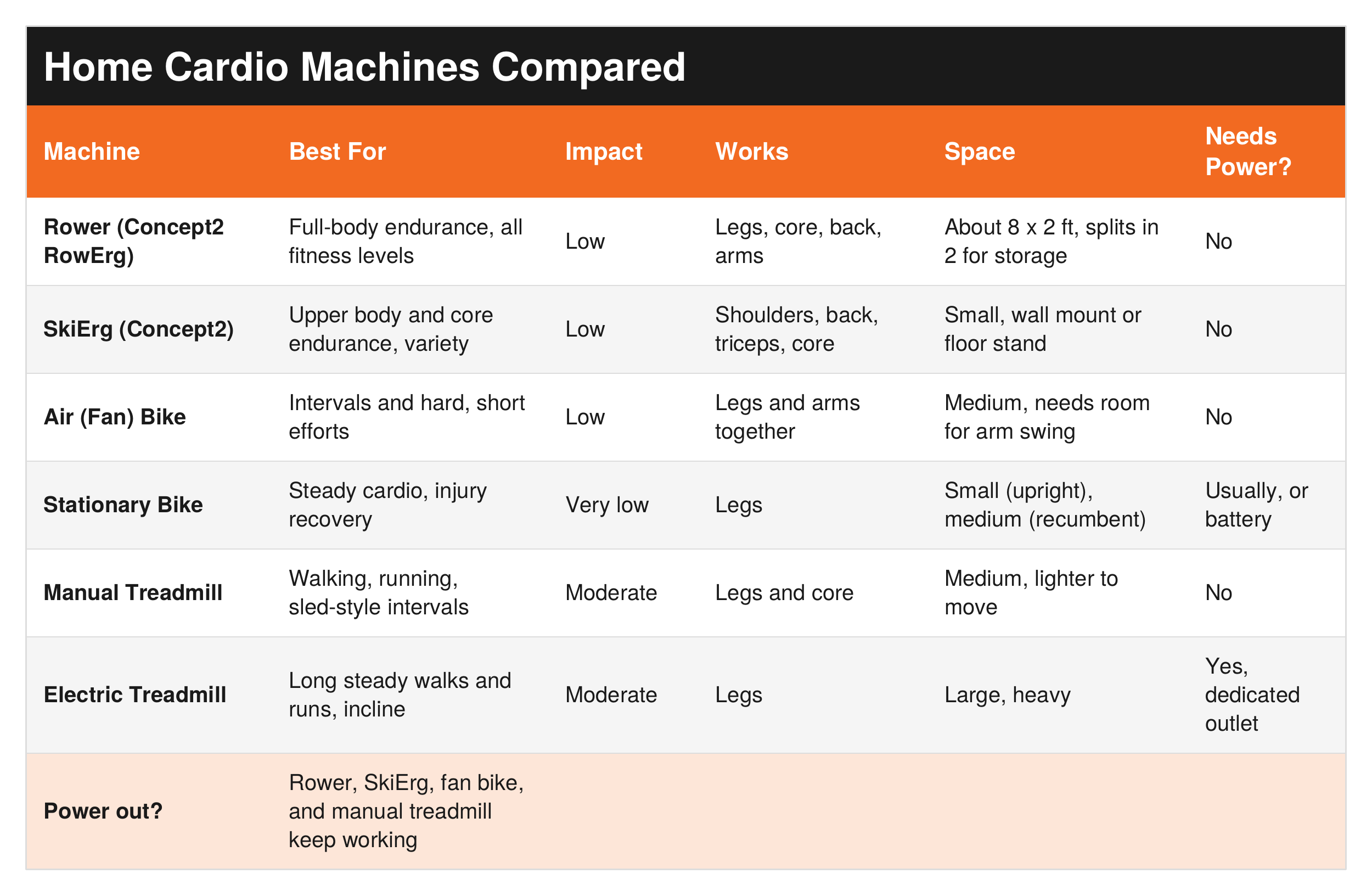
Here's how the main home machines compare on what matters most: what they're best for, how hard they are on your joints, what they work, how much space they take, and whether they need power.
The Preparedness Angle
Notice the last column. The rower, SkiErg, air bike, and manual treadmill all keep working when the power goes out. If you're building a home that's ready for anything, that's worth thinking about. During a long outage, a storm, or bad air days when you're stuck inside, you can still train.
Other Machines You'll See in the Gym
These are common in commercial gyms. They can work at home, but they usually cost more and take more space.
Elliptical. A smooth, gliding, low-impact motion that's easy on the knees and hips. Moving handlebars add upper-body work.
StairMaster. Continuous stair climbing that targets your glutes, quads, hamstrings, and calves. Tough, effective, and great for leg endurance.
Jacob's Ladder. A self-paced climbing machine set at an angle. A full-body, high-intensity workout that's easier on the lower back. Big footprint, high cost.
VersaClimber. A vertical climbing motion that works your upper and lower body together and raises your heart rate fast. Smaller footprint, but very intense and expensive.
Which Machine Fits You?
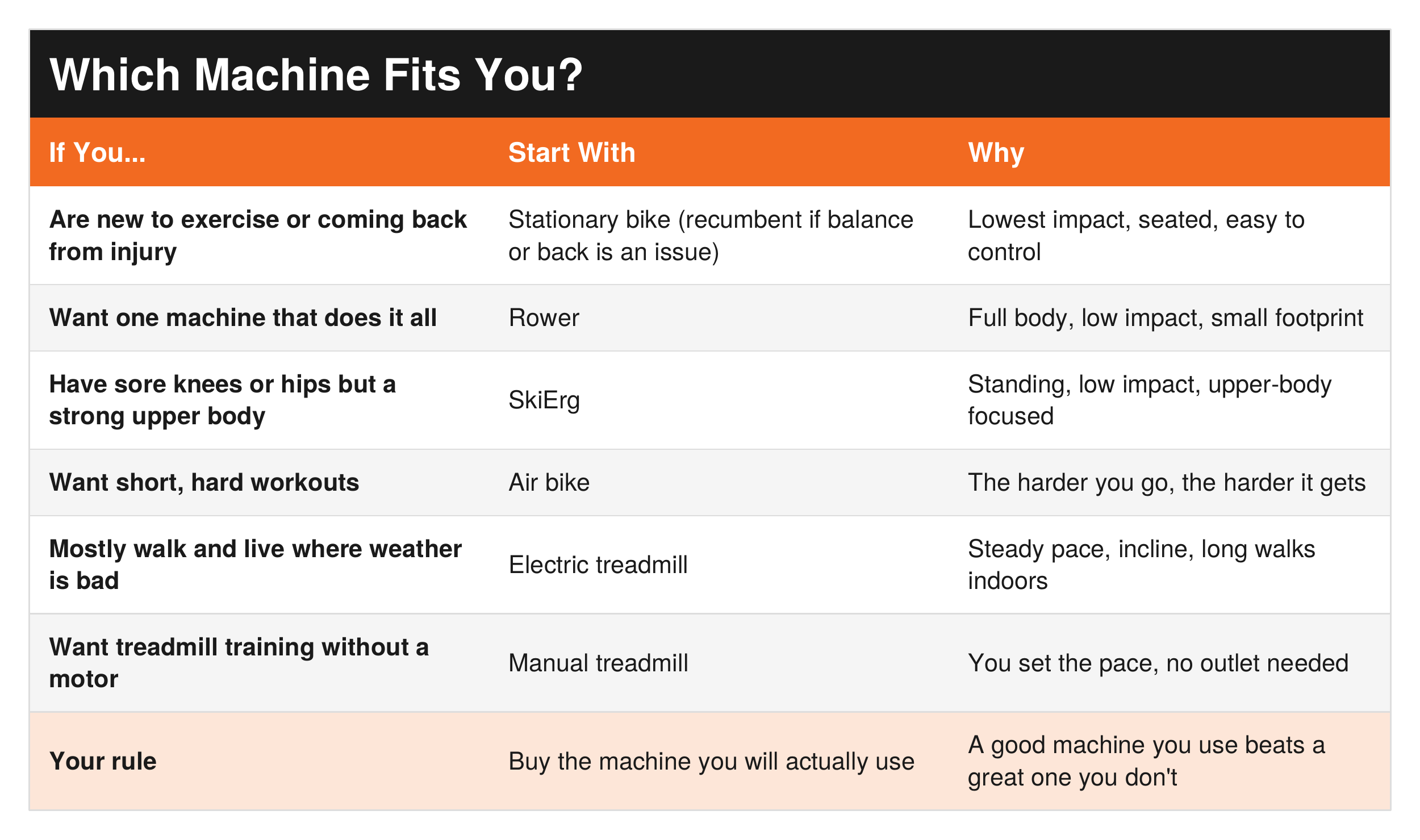
Use this guide to match a machine to your goals and your body.
Using a Machine With the 90-Day Program
Any machine on this list can stand in for a session in my free 90-Day Aerobic Fitness Program when weather or an old injury keeps you indoors. Keep it simple:
Same time, same effort. If the plan says a 30-minute walk at RPE 5, do 30 minutes on the machine at RPE 5.
RPE is your Rate of Perceived Exertion, from 0 to 10. Use the talk test: at RPE 5 you can talk but not sing.
For intervals, the air bike and rower are ideal. Try 20 to 30 seconds hard, then 1 to 2 minutes easy, repeated for 15 to 20 minutes.
Warm up first, just like any other session.
Safety First
Talk to your doctor first, especially if you have a heart condition, high blood pressure, joint problems, or past injuries.
Learn proper form before adding intensity, especially on the rower and SkiErg.
Start easy. Machines make it tempting to go hard on day one.
Respect old injuries. Pick the machine that doesn't bother them.
Stop for any chest pain, dizziness, or sharp joint pain.
Ask Yourself
If I couldn't train outside for a week, what would I do?
Which machine fits my goals, my joints, and my space?
Would my training survive a power outage?
Remember
The best cardio machine is the one you'll use. Pick the one that fits your goals, your joints, and your space, and you'll never have to skip a session because of the weather again.
Go Deeper
Free download: The 90-Day Aerobic Fitness Program. A complete 12-week plan for walking, rucking, jogging, agility, and strongman training, with check-ins and printable trackers. Use any machine here on the days you can't get outside. [Get it here: LINK TO 90-DAY PROGRAM]
Free download: Dynamic Warm-Up Guide. The 16-move warm-up to do before every session, on a machine or off. [Get it here: LINK TO WARM-UP GUIDE]
Coming Soon: The Prepared Not Paranoid Fitness and Nutrition Guide. A complete guide to training, eating and recovering so you’re ready when it matters. Join the email list to be the first to know when it’s here. [LINK TO EMAIL SIGNUP]
Tools I recommend: You'll find the Concept2 RowErg and SkiErg, air bikes, stationary bikes, and treadmills I recommend in my Amazon store. [AMAZON STORE LINK]
Related reading:
Aerobic Fitness: An Introduction [LINK]
Aerobic Fitness, Part 1: Walking and Rucking [LINK]
Aerobic Fitness, Part 4: Modified Strongman Training [LINK]
Garage Gym Essentials: The Complete Guide [LINK]
References
U.S. Department of Health and Human Services. (2018). Physical Activity Guidelines for Americans, 2nd edition. https://health.gov/our-work/nutrition-physical-activity/physical-activity-guidelines/current-guidelines
Gibala, M. J., Little, J. P., MacDonald, M. J., & Hawley, J. A. (2012). Physiological adaptations to low-volume, high-intensity interval training in health and disease. Journal of Physiology, 590(5), 1077-1084. https://doi.org/10.1113/jphysiol.2011.224725
Centers for Disease Control and Prevention. Measuring Physical Activity Intensity. https://www.cdc.gov/physical-activity-basics/measuring/index.html
Consumer Reports. Urgent Safety Warning Issued for Peloton Tread+ Treadmill. https://www.consumerreports.org/product-safety/peloton-plus-tread-treadmill-urgent-safety-warning-cpsc
Consumer Reports. How to Stay Safe on a Treadmill. https://www.consumerreports.org/health/treadmills/how-to-stay-safe-on-a-treadmill-a1909564642/
Concept2. RowErg and SkiErg product information. https://www.concept2.com
Disclaimer
This article is for general informational and educational purposes only. It is not medical advice and is not a substitute for guidance from your physician. Exercise equipment carries a risk of injury. Talk to your doctor before starting any new exercise program, especially if you have a medical condition, past injuries, or have been inactive. Follow the manufacturer's instructions and safety guidelines for any machine. Stop any activity that causes pain, dizziness, or chest discomfort. Affiliate disclosure: I've linked to products from my Amazon store that I personally recommend. If you purchase through these links, I may earn a small commission at no extra cost to you. Thank you for supporting my work.
If you have chest pain, severe shortness of breath, or feel faint while training, stop and call 911.
Awareness gives you time. Time gives you options.
The prepared protector is someone who's decided that loving someone means being ready for them, not just hoping things go fine.
Prepared Not Paranoid. Protecting the Most Vulnerable Among Us.