The Things You Can't Replace If You Leave Them Behind
By Larry Betz | Prepared Not Paranoid https://www.preparednotparanoid.com/
You can replace a tent, a flashlight, or a camp stove. You can't easily replace a birth certificate, the deed to your house, or a 90-day supply of your mother's heart medication. When a family evacuates, these are the things that cause the most stress later, often for months. This post gives you the emergency documents checklist, the cash plan, and the medication plan, so the things you can't replace are the first things ready to go.
Your Documents
Here is a detailed list of personal documents to keep easily accessible for emergencies. Some of these would be critical to have if you couldn't go home to get them for a long time, or ever. This is an extensive list, designed with that reality in mind.
Here's the complete list, by category.
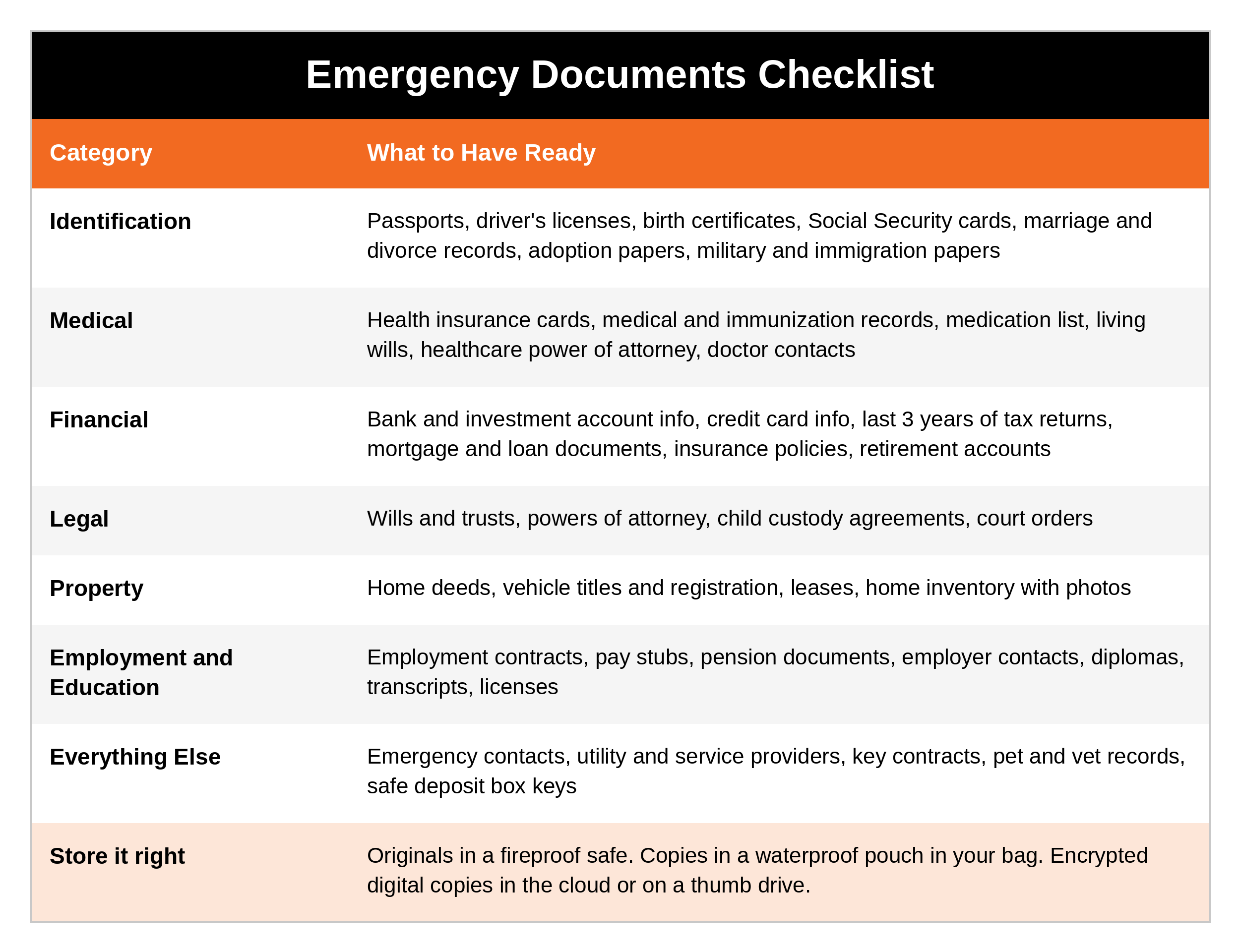
Identification Documents
Passports
Driver's licenses
Birth certificates
Social Security cards
Marriage certificate
Divorce decrees
Adoption papers
Military service records
Immigration and naturalization papers
Medical Documents
Health insurance cards
Medical records and immunization records
Prescription medication list
Living wills and advance directives
Power of attorney for healthcare
Contact information for healthcare providers
Financial Documents
Bank account information
Investment account statements
Credit card information
Tax returns (at least the last three years)
Property deeds and titles
Mortgage and loan documents
Insurance policies (health, home, auto, life, disability)
Retirement account information
Legal Documents
Wills and trust documents
Power of attorney documents
Child custody agreements
Court orders and legal judgments
Property Documents
Home and property deeds
Vehicle titles and registration
Rental agreements and lease contracts
Home inventory list with photos
Employment Documents
Employment contracts
Pay stubs, if applicable
Pension and retirement plan documents
Contact information for current and previous employers
Educational Documents
Diplomas and degrees
Transcripts
Professional certifications and licenses
Miscellaneous
Emergency contact information
Utility and service provider information
Copies of key contracts (phone, internet, utilities)
Pet identification and veterinary records
Safe deposit box keys and inventory
Store It Right: Originals, Copies, and Digital Copies
Not every document belongs in your bag. Here's how I'd split it up:
Originals of things that are hard to replace (birth certificates, Social Security cards, deeds, titles, wills) go in a fireproof and waterproof safe at home, or a safe deposit box.
Copies of your IDs, insurance cards, medication lists, and emergency contacts go in a waterproof pouch in your Bug-Out Bag.
Digital copies of everything go in secure cloud storage or on an encrypted thumb drive you can grab on the way out.
A great storage option for keeping it all together is the Savor All-in-One Desk Organizer. Having all your important documents in one spot is very convenient if you need to bug out quickly.
Protect the digital copies. A thumb drive with your Social Security numbers and bank accounts on it is a gift to an identity thief if it's lost. Use a password-protected or encrypted drive, use a strong password and two-factor authentication on your cloud account, and be careful who you share account numbers with. My book Cyber Safety walks you through protecting your digital information step by step.
Want it all in one place? The Family Readiness Binder (coming 2027) is built for exactly this: every document, account, contact, and medical detail your family would need, organized so the right person can find it fast.
Cash
Keep cash in small bills. Two weeks minimum is recommended. When the power is out or the network goes down, ATMs and card readers may not work, and you may need cash for fuel, food, or a place to stay.
Small bills. Ones, fives, tens, and twenties. Nobody can break a $100 bill after a disaster.
Split it up. Keep some in your Go Bag, some in your Bug-Out Bag, and some on each adult, so you don't lose it all at once.
Keep it dry. Store it in a zip-top or waterproof bag.
Keep it secret. Don't announce how much you're carrying or count it in public.
Refresh it. If you borrow from it, put it back. Check it every 6 months when you check your bags.
Medications
Having enough medication for yourself, your family, and your pets is one of the most important parts of any emergency plan.
Start with a list. Keep a detailed, written list of every prescription, over-the-counter medication, and supplement each family member and pet takes, including the dose and what it's for. Keep a copy in your bag and a digital copy with your documents.
Build a supply. Talk to your healthcare provider and your veterinarian about getting an extra supply of essential medications. A 30-day supply is a good starting point, and a 90-day supply is better if you can get it. Store medications in a cool, dry place, check expiration dates regularly, and rotate the stock.
Ask about early refills. Some states allow early refills when a state of emergency is declared. Florida, for example, requires insurers to allow early refills during a declared emergency. Rules vary by state and insurance plan, so ask your pharmacist ahead of time what your options are.
If Someone Needs Insulin or Refrigerated Medication
According to the FDA, insulin in its original vial or cartridge, opened or unopened, can be kept unrefrigerated between 59 and 86 degrees F for up to 28 days and still work. Some newer products have different rules, so check the label and ask your pharmacist.
Here in Arizona, 86 degrees doesn't last long in summer. A travel cooler made for insulin can be extremely helpful for traveling and for an emergency. The 4ALLFAMILY EXPLORER 72 Hours insulin cooler travel case is designed to keep medication cool for up to 72 hours using BIOGEL and a USB charger. It holds 1 to 7 insulin pens, works with USB power and freeze packs, and is compact enough for air travel too.
Spare Glasses and Contacts
If you rely on glasses or contacts, a backup pair is critical. Keep spare glasses in a sturdy, protective case in your emergency kit or a bag you use often. For contacts, keep extra lenses, solution, and a clean case. Keep a current copy of your prescription with your documents, and check your spares regularly to make sure the prescription is still current.
First Aid Basics and Pet Medications
Keep a supply of basic first aid items, such as bandages, antiseptics, and pain relievers. For pets, include any medications they need, plus basic first aid supplies like gauze and pet-safe antiseptics. (The First Aid and Trauma series covers kits in detail.)
Emergency Antibiotics
To keep necessary medications on hand, some families use services like Jase Medical. Jase Medical offers an emergency antibiotic kit that includes antibiotics such as amoxicillin-clavulanate, azithromycin, ciprofloxacin, doxycycline, and metronidazole, prescribed after an online evaluation by a physician and delivered to your home. You can contact the physician with treatment questions.
A word of caution: Antibiotics are prescription medications for a reason. They treat bacterial infections only, the wrong one can do more harm than good, and some people have serious allergies to them. Use them only as directed by a doctor, and keep the instructions with the kit.
Ask Yourself
If my house were gone tomorrow, could I prove who I am, what I own, and what insurance I have?
Does every person in my home have at least a 30-day supply of their medications, and a written list?
Do I have enough small bills for fuel, food, and a night or two in a hotel?
Remember
The things you can't replace go first. Originals in the safe, copies in the bag, digital copies protected, cash in small bills, and a written medication list for everyone in your home.
Get Started Today
Grab the free Preparedness checklist bundle: the Go Bag Checklist, the Mobile Command Center Checklist, and the First Aid and Trauma Checklist. Print them, check them off, and keep them with your gear. [CTA: Comment or DM "KEYWORD" / or download it here: https://www.preparednotparanoid.com/preparedness]
Go Deeper
The Family Safety Toolkit. This post gives you the documents, cash, and medication plan. The Toolkit's Go Bag Checklist includes the full Important Personal Documents pages, ready to print and check off, along with the Mobile Command Center Checklist, the First Aid and Trauma Checklist, and 17 more checklists covering every area of family safety, all for $19.99. [Get it here: https://www.preparednotparanoid.com/family-safety-toolkit]
The Family Emergency Preparedness Manual is coming soon.
Tools I recommend: The everyday carry gear, first aid kits, flashlights, and backup communications I recommend are in my Amazon store.
Everyday Carry: https://link.amazon/B08cbUYC1
First Aid: https://link.amazon/B01SD3sHS
Flashlights: https://link.amazon/B0giJW8RY
Backup Communications: https://link.amazon/B09z0lfEb
Related reading:
Go Bag and Emergency Bug-Out Bag, Part 3: Comprehensive Emergency Supply List https://www.preparednotparanoid.com/pnp-library/go-bag-lesson-3
Go Bag and Emergency Bug-Out Bag, Part 5: Bags for Kids, Seniors and Pets (coming soon)
Go Bag and Emergency Bug-Out Bag, Part 2: Preparing to Leave Your Home https://www.preparednotparanoid.com/pnp-library/go-bag-lesson-2
References
Ready.gov. Financial Preparedness.
Federal Emergency Management Agency and Operation HOPE. Emergency Financial First Aid Kit (EFFAK).
U.S. Food and Drug Administration. Information Regarding Insulin Storage and Switching Between Products in an Emergency.
Florida Department of Health. Early Prescription Refills Permitted Under State of Emergency.
Ready.gov. Build A Kit.
Disclaimer
This article is for general informational and educational purposes only. It is not medical, legal, or financial advice. Talk with your doctor or pharmacist before building an emergency supply of any medication, and never take antibiotics or other prescription drugs except as directed by a doctor. Affiliate disclosure: I've linked to products from my Amazon store that I personally recommend. As an Amazon Associate, I earn from qualifying purchases, at no extra cost to you. Thank you for supporting my work.
If someone is having a medical emergency, or you are in immediate danger, call 911.
Awareness gives you time. Time gives you options.
The prepared protector is someone who's decided that loving someone means being ready for them, not just hoping things go fine.
Prepared Not Paranoid. Protecting the Most Vulnerable Among Us.