Planning for the People (and Animals) Who Can't Carry Their Own
By Larry Betz | Prepared Not Paranoid https://www.preparednotparanoid.com/
Your evacuation plan is only as fast as the slowest person in your family. A toddler who can't walk a mile. A parent who uses a walker. A dog that panics in the car. Most go-bag lists are written for one healthy adult. This post is about everyone else, and how to build go bags for kids, seniors and pets that actually work for your family.
I shared in the Introduction that when a wildfire came close to our home last year, my wife had just had ACL surgery. Suddenly the question wasn't just what to pack. It was how to move her safely, along with everything else we needed. This is where the prepared protector thinks one step ahead: who in your house can't carry their own bag?
Here's the quick version, side by side.
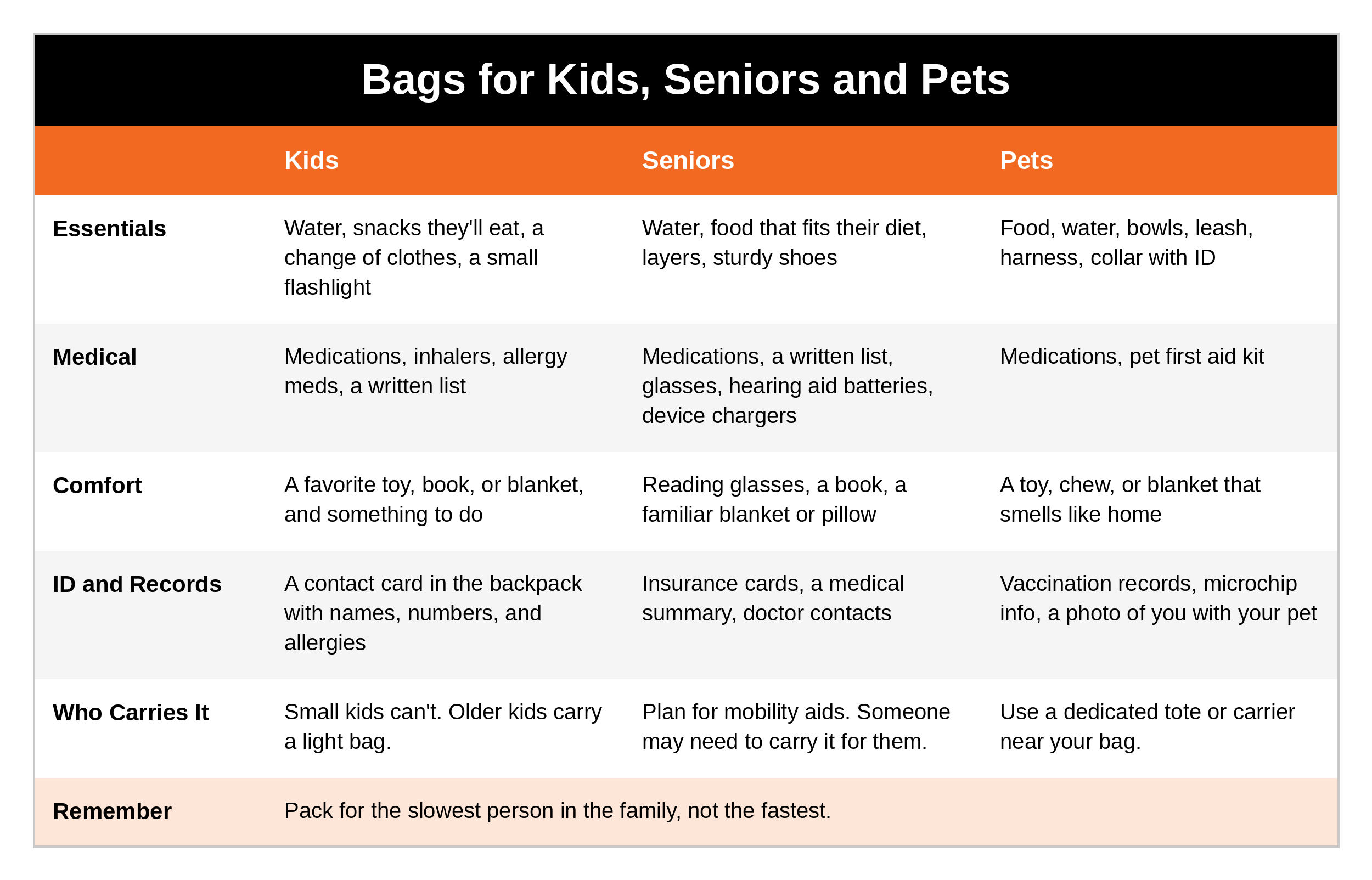
Bags for Kids
Children need their own supplies, and they need to feel safe. Build their bags by age.
Babies and Toddlers
They can't carry anything, so their supplies go in your bag or a dedicated diaper bag you can grab.
Formula, bottles, and baby food, plus clean water to mix it
Diapers, wipes, and diaper cream (more than you think you'll need)
A change of clothes and a blanket
A carrier or wrap, so your hands are free
Medications, and a written list with doses
A favorite comfort item
School-Age Kids
Give them a small backpack of their own. It helps them feel part of the plan.
A water bottle and snacks they'll actually eat
A change of clothes
A small flashlight
A book, game, or something to do. Books, games, and comfort items help ease stress in uncertain situations.
A contact card (more on that below)
Teens
Teens can carry more and help with younger siblings, but they need the plan too.
A full Go Bag of their own (see Part 1)
Phone, charger, and a power bank
Key phone numbers memorized, not just saved in their phone
Their role in the plan: who they help, and where they meet you
Every Child Needs a Contact Card
The CDC recommends making two contact cards for each child: one for their backpack and one for your wallet. Include:
Your child's name and date of birth
Any medical conditions or allergies
Contacts for their school or caregiver
Parent or guardian phone numbers
Emergency contacts who can be reached if you can't
Know the School's Plan
If disaster strikes during the school day, your kids may not be with you. Ask your child's school or childcare now: How will you notify us in an emergency or evacuation? Where would we pick up our child? Do you keep extra medications and supplies for my child, or should we send them? Review it every year.
One more note for kids: If wildfire smoke is a risk where you live, adult N95 masks don't fit most children correctly. Plan to limit their exposure by leaving early and keeping the car windows closed with the air on recirculate.
Bags for Seniors and Anyone With Medical or Mobility Needs
Older adults, anyone recovering from surgery, and family members with a disability often need the most planning and the most time.
What to Pack
Medications and a written list of each one, the dose, and what it's for (see Part 4)
Glasses, hearing aids, and spare hearing aid batteries
Dentures and denture supplies, if needed
Chargers and backup batteries for phones, hearing aids, and any medical devices
Incontinence supplies, if needed
Copies of Medicare, Medicaid, and other insurance cards
A short medical summary: conditions, allergies, doctors, and pharmacy
Food that fits their diet, and layers to stay warm or cool
Comfortable, sturdy shoes and a familiar blanket or pillow
Plan for Mobility
Ready.gov recommends planning how you'll bring assistive devices like a wheelchair, walker, or crutches if you evacuate. Ask yourself:
Does the device fit in the car along with everyone else?
Who helps them get in and out of the vehicle?
Who carries their bag?
Plan for Power
If someone relies on oxygen, a CPAP, a powered wheelchair, or refrigerated medication, power is a life-safety issue. Keep backup batteries charged, and ask your local utility and county emergency management whether they keep a list of residents who depend on medical equipment. (The Backup Power series covers medical devices in detail.)
Build a Support Network
Ready.gov recommends a support network of family, friends, caregivers, and neighbors. At least one person should have a spare house key, know where the emergency supplies are, and know how to give their medications.
Leave Early
Anyone who needs extra time should leave at the warning stage, not the order. In Ready, Set, Go! terms, they leave at "Set." (See Part 2.)
If You Care for Someone Who Lives Somewhere Else
If you help care for an aging parent or relative who doesn't live with you, decide now: Who gets them out, and how? Will you go to them, or will a neighbor bring them to you? Do they have their own bag, and does someone nearby have a key? Write it down and make sure they know the plan too.
Bags for Pets
If you're evacuating with pets, they need their own preparedness plan. Animals rely entirely on us in emergencies, and being ready with their supplies keeps them safe, comfortable, and healthy when conditions are unpredictable.
How Much to Pack
Every emergency is scenario-specific. A 3-day supply of pet food and medications is the minimum. Ten days is better. And as we've seen, some emergencies may require up to 30 days. Talk to your vet about getting a longer supply of any medications your pet depends on.
For water, plan on about 1 ounce per pound of your pet's body weight, per day. A 50-pound dog needs about half a gallon a day. Pack extra for hot weather, active dogs, and cleanup. When in doubt, round up.
Food and Water
Pet food (dry or canned), in the amount above
Portable, collapsible food and water bowls
A manual can opener, if you use canned food
Water, in the amount above
Shelter and Safety
Leash, harness, and collar with ID tags
A portable pet crate or carrier, labeled with your name and contact information
A pet bed, blanket, or crate pad
A muzzle, if required or helpful in high-stress environments
Medical and Sanitation
Copies of vaccination records and microchip information. Make sure the microchip is registered, your contact information is current, and the company is still in service.
Any medications or supplements, in the amount above
A pet first aid kit (bandages, tweezers, gloves, and similar)
Waste bags, litter, and a portable litter box for cats
Grooming wipes or towels
Comfort and Familiarity
Toys, chew items, or a comfort item from home
A recent photo of you with your pet, to help prove ownership if you're separated
Tip: Keep your pet's items in a dedicated tote or backpack near your own go-bag so you can grab both quickly.
Know Where Your Pet Can Go
Since the PETS Act passed in 2006 after Hurricane Katrina, disaster plans have to account for pets and service animals. But not every shelter accepts pets, and some require vaccination records, a crate, and your own food. Before you need it, find a few options outside your area:
Pet-friendly hotels along your evacuation routes
Friends or family who can take your pets
Boarding kennels or vets outside your area
Your county's pet-friendly shelter, if it has one
Never leave your pets behind. If it isn't safe for you, it isn't safe for them.
Planning for pets isn't just compassionate. It can prevent unnecessary stress, injury, or the heartbreaking risk of having to leave them behind. Pets are family, and preparing for them is an essential part of being truly ready.
Ask Yourself
Who in my home can't carry their own bag, and who's carrying it for them?
Does my child's school know who can pick them up, and do I know where they'd be taken?
If our county shelter doesn't take pets, where are we going with ours?
Remember
Pack for the slowest person in the family, not the fastest. Give kids their own small bags and contact cards, plan extra time and help for seniors, and give your pets their own tote, their own records, and a place to go.
Get Started Today
Grab the free Preparedness checklist bundle: the Go Bag Checklist, the Mobile Command Center Checklist, and the First Aid and Trauma Checklist. Print them, check them off, and keep them with your gear. [CTA: Comment or DM "KEYWORD" / or download it here: https://www.preparednotparanoid.com/preparedness]
Go Deeper
The Family Safety Toolkit. This post shows you how to plan for the kids, seniors, and pets in your home. The Toolkit gives you the complete Go Bag Checklist with its full Pets and Pet Supplies page, the Mobile Command Center Checklist, the First Aid and Trauma Checklist, and 17 more checklists covering every area of family safety, including child safety and senior safety, all for $19.99. [Get it here: https://www.preparednotparanoid.com/family-safety-toolkit]
The Family Emergency Preparedness Manual is coming soon.
Tools I recommend: The everyday carry gear, first aid kits, flashlights, and backup communications I recommend are in my Amazon store.
Everyday Carry: https://link.amazon/B08cbUYC1
First Aid: https://link.amazon/B01SD3sHS
Flashlights: https://link.amazon/B0giJW8RY
Backup Communications: https://link.amazon/B09z0lfEb
Related reading:
Go Bag and Emergency Bug-Out Bag, Part 4: Documents, Cash and Medications https://www.preparednotparanoid.com/pnp-library/go-bag-documents-cash-medications
Go Bag and Emergency Bug-Out Bag, Part 6: What You Can Actually Carry, and Practicing the Plan (coming soon)
Go Bag and Emergency Bug-Out Bag, Part 2: Preparing to Leave Your Home https://www.preparednotparanoid.com/pnp-library/go-bag-lesson-2
References
Centers for Disease Control and Prevention. Children and School Preparedness: Keeping Children Safe in an Emergency.
Centers for Disease Control and Prevention. Wildfire Smoke and Children.
Ready.gov. Older Adults.
Ready.gov. Pets and Animals.
Pets Evacuation and Transportation Standards (PETS) Act of 2006.
Rhode Island Department of Environmental Management. Pet Emergency Kit: water needs by pet weight.
Disclaimer
This article is for general informational and educational purposes only. It is not a substitute for professional emergency planning, training, or medical or veterinary advice. Talk with your doctor about emergency supplies for family members with medical needs, and with your vet about your pet's medications. Affiliate disclosure: I've linked to products from my Amazon store that I personally recommend. As an Amazon Associate, I earn from qualifying purchases, at no extra cost to you. Thank you for supporting my work.
If you are in immediate danger, or officials order an evacuation, call 911 or follow their instructions right away.
Awareness gives you time. Time gives you options.
The prepared protector is someone who's decided that loving someone means being ready for them, not just hoping things go fine.
Prepared Not Paranoid. Protecting the Most Vulnerable Among Us.