Understanding Your Vehicle and Dangerous Situations on the Road
By Larry Betz | Prepared Not Paranoid https://www.preparednotparanoid.com/
Road rage can turn an ordinary drive into a dangerous one in seconds. With your family in the car, the goal isn't to win. It's to get everyone home. This post shows you how to stay out of it, how to get out of it, and how to give yourself the room to do both.
"Remember, cars are coffins when they aren't moving." Byron Rogers, EP Specialist
Our primary goal is to live a long, healthy, and happy life. Crucial to meeting that goal is avoiding unnecessary conflicts, especially while driving. Unfortunately, some people go through a shift in personality once they get behind the wheel. They tailgate, speed past with obscene gestures, flash their lights, or lean on the horn. That's behavior they'd likely never show while walking through a local grocery store.
It's important to remember: you never truly know what someone else is going through. It's not your responsibility to correct another driver's behavior. Your responsibility is to you and your family. As the "Agent in Charge" of their safety and security, your job is to get everyone from point A to point B without incident.
Throughout this post, the emphasis is the same: stay calm, think clearly, and always look to de-escalate or exit the situation when possible.
Aggressive Driving vs. Road Rage
It helps to know what you're dealing with. The National Highway Traffic Safety Administration (NHTSA) draws a clear line: aggressive driving is a traffic offense. Road rage is a criminal offense, an assault with a vehicle or a weapon that starts with something on the road.
Aggressive driving is what we all see: speeding, tailgating, weaving, cutting people off. Road rage is when that anger turns on a person: forcing a driver off the road, ramming, throwing objects, or getting out to confront someone.
And it's common. In a national survey by the AAA Foundation for Traffic Safety, nearly 80% of drivers said they'd expressed significant anger, aggression, or road rage behind the wheel at least once in the past year. About 8 million drivers admitted to the extreme end, like ramming another car on purpose or getting out to confront another driver.
So you will run into it. The question is how you respond.
Keep Your Ego in Check
When someone cuts you off with your kids in the back seat, the first feeling is usually anger. That's normal.
What you do next is what matters.
Here's the line I want you to remember: you have 100% control over your emotions and 0% control over an aggressive driver.
Engaging with a road-raging driver can have severe consequences.
So:
Don't make eye contact. To an angry driver, a look can feel like a challenge.
Don't gesture, honk back, or yell. Every response gives them something to react to.
Don't brake-check or speed up to "teach them a lesson."
Breathe. A few slow, deep breaths bring your heart rate down and your thinking back.
Their behavior isn't a reflection of your driving or your character. It's about their own stress and their own issues. Letting them "win" the lane costs you nothing. Getting into it can cost you everything.
What to Do When Another Driver Loses It
If you run into an aggressive driver, the best strategy is to safely remove yourself from the situation. Slow down and let them pass, or change lanes when it's safe. If they keep at it, create more distance.
Don't speed up or drive recklessly to get away. That's how a road rage incident becomes a crash. Instead, look for a chance to exit the road or take a different route.
And if you do stop, never stop somewhere secluded. Aim for a well-lit, populated place.
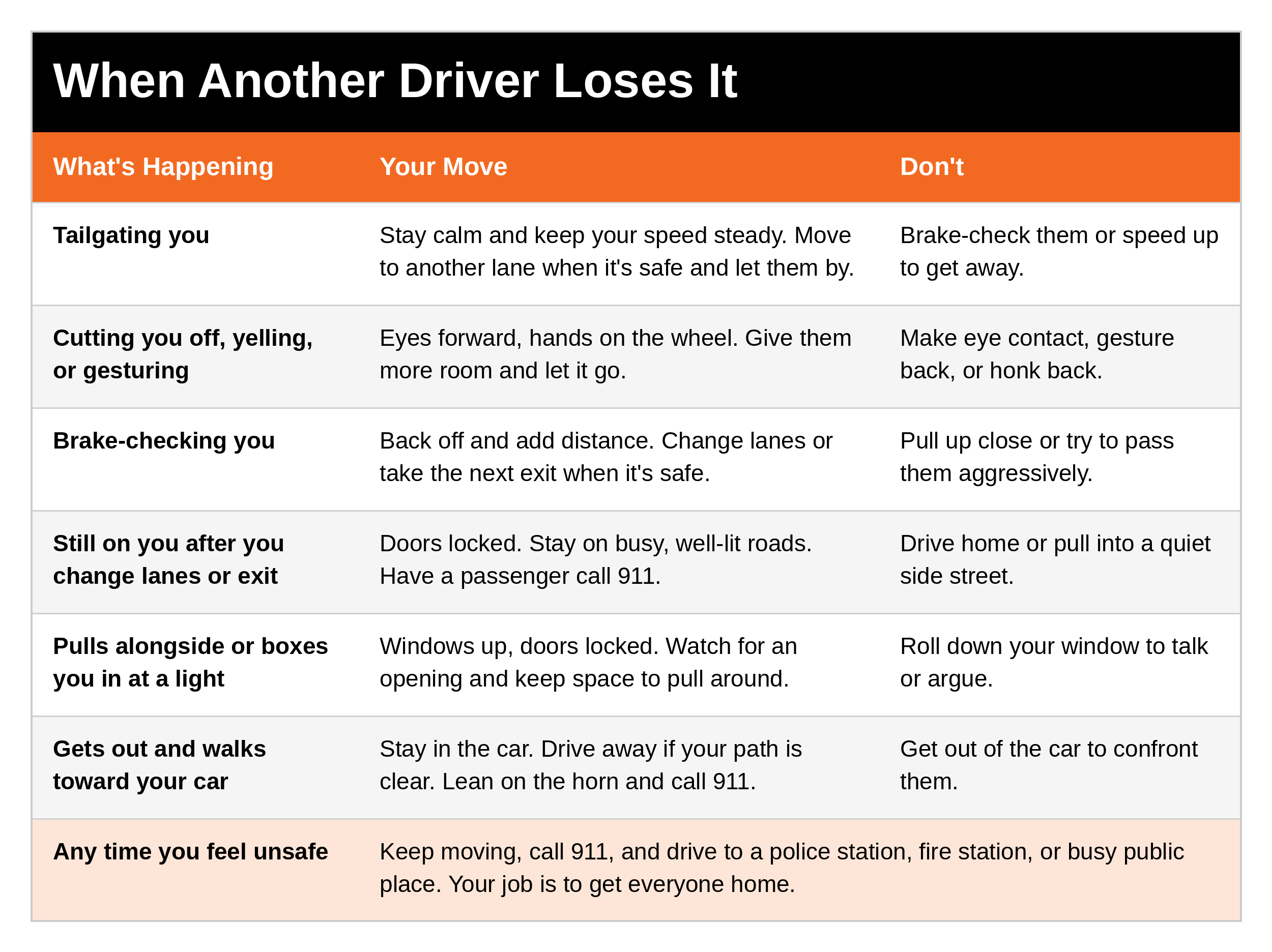
Most road rage situations fall into a few patterns.
Here's your move for each one.
If You Think They're Following You
Don't drive home. You don't want an angry stranger learning where your family lives. Keep your doors locked, stay on busy roads, and drive to a police station, fire station, or busy 24-hour business. Call 911 on the way, and know your road, your direction, and your last exit or cross street so help can find you. (Part 3 of this series covers what to do if you're followed home or blocked in your driveway.)
What to Say
In a road rage situation, most of what you "say" is to 911 and to your own family, not to the other driver.
Safe and non-engaging
Say nothing to the other driver. Eyes forward, hands on the wheel.
To your family: "We're going to let this car go."
Slow down, let them pass, change lanes.
Setting boundaries
Windows up, doors locked. Don't roll your window down to talk.
To your passenger: "Call 911 and put it on speaker."
To 911: "I'm being followed by an aggressive driver. I'm on [road], heading [direction], near [exit or cross street]. It's a [color, make, model], plate [number if you have it]."
If they persist
If they get out and walk toward your car: stay in the car, keep it locked, and drive away if your path is clear.
Lean on your horn to draw attention.
Through the closed window, loud and clear: "I'm calling the police."
Keep moving toward people, light, and help.
Your Passengers Have a Job, Too
Your family should know the plan before you ever need it. Talk about it once, calmly, the same way you'd talk about a fire drill.
The driver drives. Your only job is the road.
An older child or another adult calls 911 and handles the phone.
Everyone stays buckled and stays in the car.
Nobody reacts to the other driver. No faces, no gestures, no filming up close.
When kids know what to do, they're less scared. A plan turns panic into a job.
A Note for Those Who Carry
If you carry a firearm for self-defense, your standard is higher, not lower. Having a firearm in the car doesn't change the plan. Your goal is escape, not engagement. Your best tools are still distance, a locked door, a clear path, and the gas pedal.
Laws on carrying in a vehicle, displaying a firearm, and use of force vary a lot from place to place. Check the exact laws in your state and county, and get proper training. This note is education only, not legal advice.
Give Yourself Room
Space is what gives you options. A buffer between you and the vehicle ahead gives you time to react to sudden stops, makes close calls that set off angry drivers less likely, and gives you room to steer away from trouble.
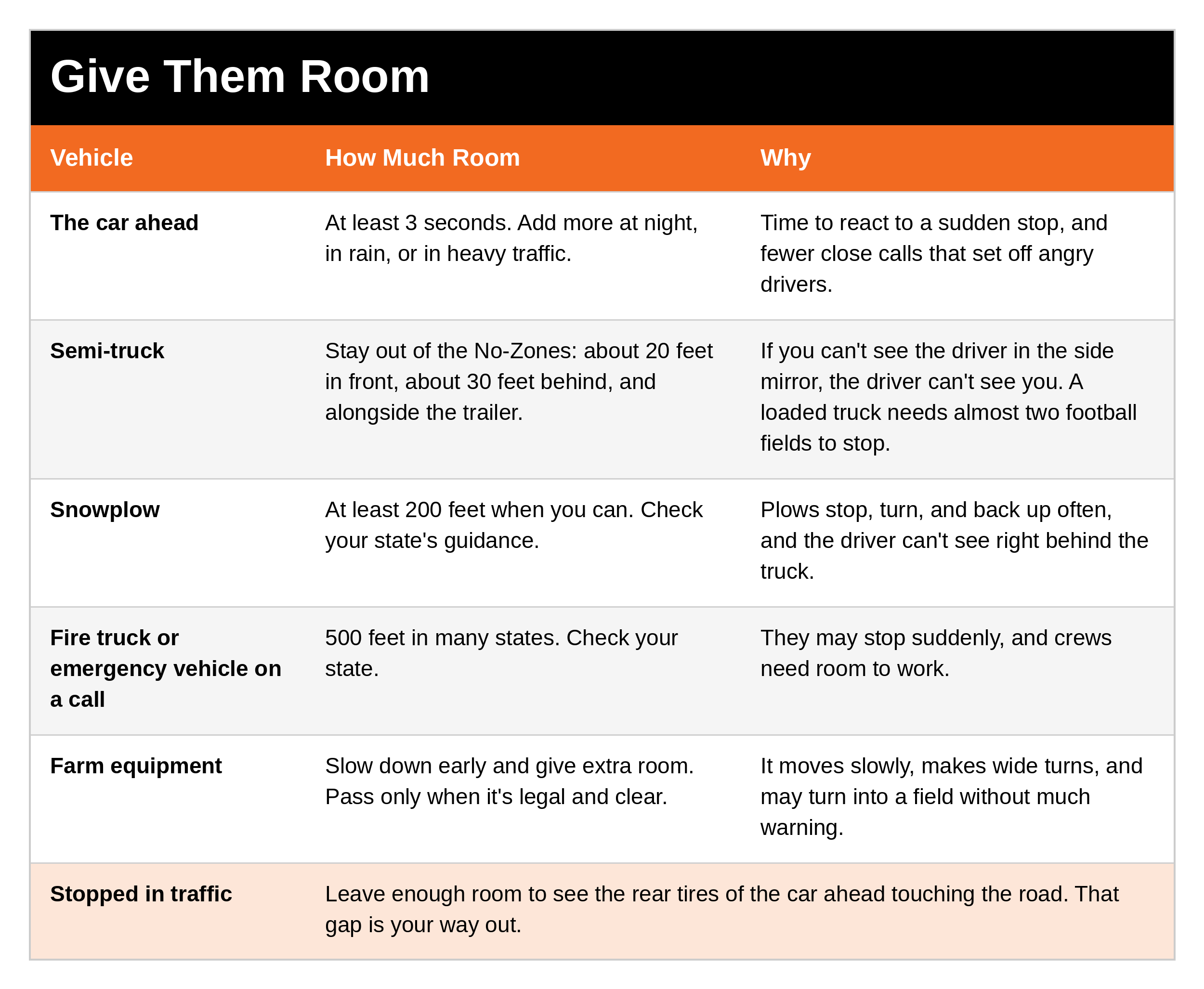
Different vehicles need different amounts of room. Farm equipment, snowplows, semi-trucks, and emergency vehicles all stop, turn, and see differently than your car does.
Here's how much room to give.
Semi-Trucks and Their No-Zones
The Federal Motor Carrier Safety Administration (FMCSA) calls a truck's blind spots No-Zones: about 20 feet in front of the cab, about 30 feet behind the trailer, one lane on the driver's side, and two lanes on the right side. If you can't see the driver in the truck's side mirror, the driver can't see you.
Pass on the left, pass quickly, and don't linger beside the trailer. Don't cut back in front until you can see the truck's headlights in your rearview mirror.
And give them room to stop. FMCSA says a fully loaded truck at highway speed needs almost two football fields to come to a stop. Cutting in front of one takes that room away.
Leave Yourself an Out at Every Stop
When you stop behind another car, leave enough room to see its rear tires touching the road. That gap gives you room to pull around it if you need to. A car pinned in by traffic has nowhere to go. That's what "cars are coffins when they aren't moving" means. Part 3 of this series goes deeper on this.
Know Your Vehicle: Cover vs. Concealment
Your car's roof pillars (A, B, C, and on bigger vehicles D) are the vertical supports that hold the roof up. Knowing them can help you think clearly in a dangerous moment. The short version: doors and windows can hide you, but they stop very little. The engine block and wheels are the most solid parts of a car. That's the difference between concealment (it hides you) and cover (it can actually stop something).
The book breaks down each pillar and how to use your vehicle if you ever have to get out of it in a hostile situation.
SCAN It
S, See your environment: Check your mirrors often. Notice the driver who's weaving, tailgating, or getting angry before they're next to you.
C, Create space: Leave a gap ahead, let aggressive drivers pass, and stay out of truck No-Zones.
A, Act deliberately: Change lanes, take an exit, drive to a safe public place, and call 911.
N, Never doubt your gut feelings: If a driver or a situation feels wrong, don't wait to find out. Move.
5 Quick Wins You Can Start Today
Use the 3-second rule. Count three seconds behind the car ahead, and add more at night or in bad weather.
See the tires. Every time you stop in traffic, leave enough room to see the rear tires of the car ahead.
Doors locked, windows up. Make it automatic as soon as you get in the car.
Know where you are. Road, direction, last exit or cross street.
Give your passengers their jobs. Tell them today who calls 911 and what everyone else does.
Ask Yourself
When someone cuts me off, what's my first reaction, and is that what I want my kids to learn?
If an angry driver followed me right now, do I know where the nearest police or fire station is?
Does my family know who calls 911 and what to say?
Remember
You can't control the other driver. You can control your speed, your space, your temper, and your next move.
Letting someone "win" the road isn't weakness. It's what a protector does. Your job is to get everyone home.
The Prepared Protector is someone who's decided that loving someone means being ready for them, not just hoping things go fine. On the road, that means keeping your ego in check and your family out of someone else's bad day.
Get Started Today
Get the free Travel Safety checklists. Simple, practical checklists for safer family trips, including the Rental Car Checklist. DM the word [KEYWORD] on Instagram or Facebook and I'll send them to you. [Get them here: LINK]
Go Deeper
Situational Awareness and Safe Family Travel Strategies. This post gives you the short version. The book gives you the full picture: the A, B, C, and D pillar breakdown and how to use your vehicle for cover, the complete list of aggressive driving behaviors to watch for, the semi-truck blind-spot rules of thumb, carjacking hot spots and warning signs, how to verify a police stop from an unmarked car, and what to do if you're followed home or blocked in your driveway. Then it takes those skills further, with protective strategies for family travel, hotels and Airbnbs, and traveling overseas. [Get it here: https://store.bookbaby.com/book/situational-awareness-and-safe-family-travel-strategies]
Tools I recommend: The travel and vehicle safety gear I recommend is in my Travel Safety Amazon store. https://link.amazon/B023guhPk
Related reading:
Mobile Command Center, Part 2: When Something Fails While You're Driving [LINK]
Situational Awareness, Part 7: De-Escalation [LINK]
Safe Family Travel, Part 2: Driving in Bad Weather and Road Hazards [LINK when posted]
Safe Family Travel, Part 3: Carjacking: Warning Signs and Prevention [LINK when posted]
References
AAA Foundation for Traffic Safety. (2016). Prevalence of self-reported aggressive driving behavior: United States, 2014. Traffic Safety Culture Index. https://newsroom.aaa.com/2016/07/nearly-80-percent-of-drivers-express-significant-anger-aggression-or-road-rage/
National Highway Traffic Safety Administration. Aggressive driving enforcement: Strategies for implementing best practices (DOT HS 809 707).
Federal Motor Carrier Safety Administration. Our Roads: Long stopping distances and No-Zone blind spot guidance. https://www.fmcsa.dot.gov/
National Safety Council. Three-second following distance guidance.
Texas Department of Transportation. Snowplow safety. https://www.txdot.gov/inside-txdot/division/traffic/safety/weather/snowplow-safety.html
Arizona Department of Transportation. Snowplow safety guidance. https://azdot.gov/
State laws on following fire apparatus, for example Minnesota Statutes 169.40 and Florida Statutes 316.2025.
Betz, L. Situational Awareness and Safe Family Travel Strategies (Lesson 2: Vehicle Safety and Situational Awareness on the Road).
Betz, L. Navigating the Red Zone and Beyond (SCAN framework).
Disclaimer
This article is for general informational and educational purposes only. It is not a guarantee of safety and is not a substitute for professional driver training, self-defense or firearms training, legal advice, or law enforcement guidance. Traffic and firearm laws vary by state and county, so always check the exact laws where you live and travel. Responsibility for violence always belongs to the offender. Prepared Not Paranoid and Larry Betz are not responsible for the content of third-party websites or resources linked here. Affiliate disclosure: I've linked to products from my Amazon store that I personally recommend. As an Amazon Associate, I earn from qualifying purchases, at no extra cost to you. Thank you for supporting my work.
If you're in danger right now, get to a safe place and call 911.
Awareness gives you time. Time gives you options.
The Prepared Protector is someone who's decided that loving someone means being ready for them, not just hoping things go fine.
Prepared Not Paranoid. Protecting the Most Vulnerable Among Us.