How Not to Look Like a Tourist, and How to Plan Like a Protection Detail
By Larry Betz | Prepared Not Paranoid https://www.preparednotparanoid.com/
Safe travel overseas starts long before you board the plane. A little research and a few simple habits can keep your family from standing out, and keep one lost passport or one wrong turn from derailing the whole trip.
Congratulations on deciding to take your dream vacation overseas! Once you've chosen your destination and started planning your itinerary, it's highly advisable to do some advance planning for your family's safety. This will take some research. Below is a guide to that planning.
It's also highly advisable to keep this information easy to reach. Print out a copy, because you may find yourself in an area where cell service is limited.
How Not to Look Like a Tourist
Embracing the local culture, being respectful, and showing an interest in your destination will help you blend in, and it makes the trip better, too. These tips help you avoid standing out, but staying aware of your surroundings comes first.
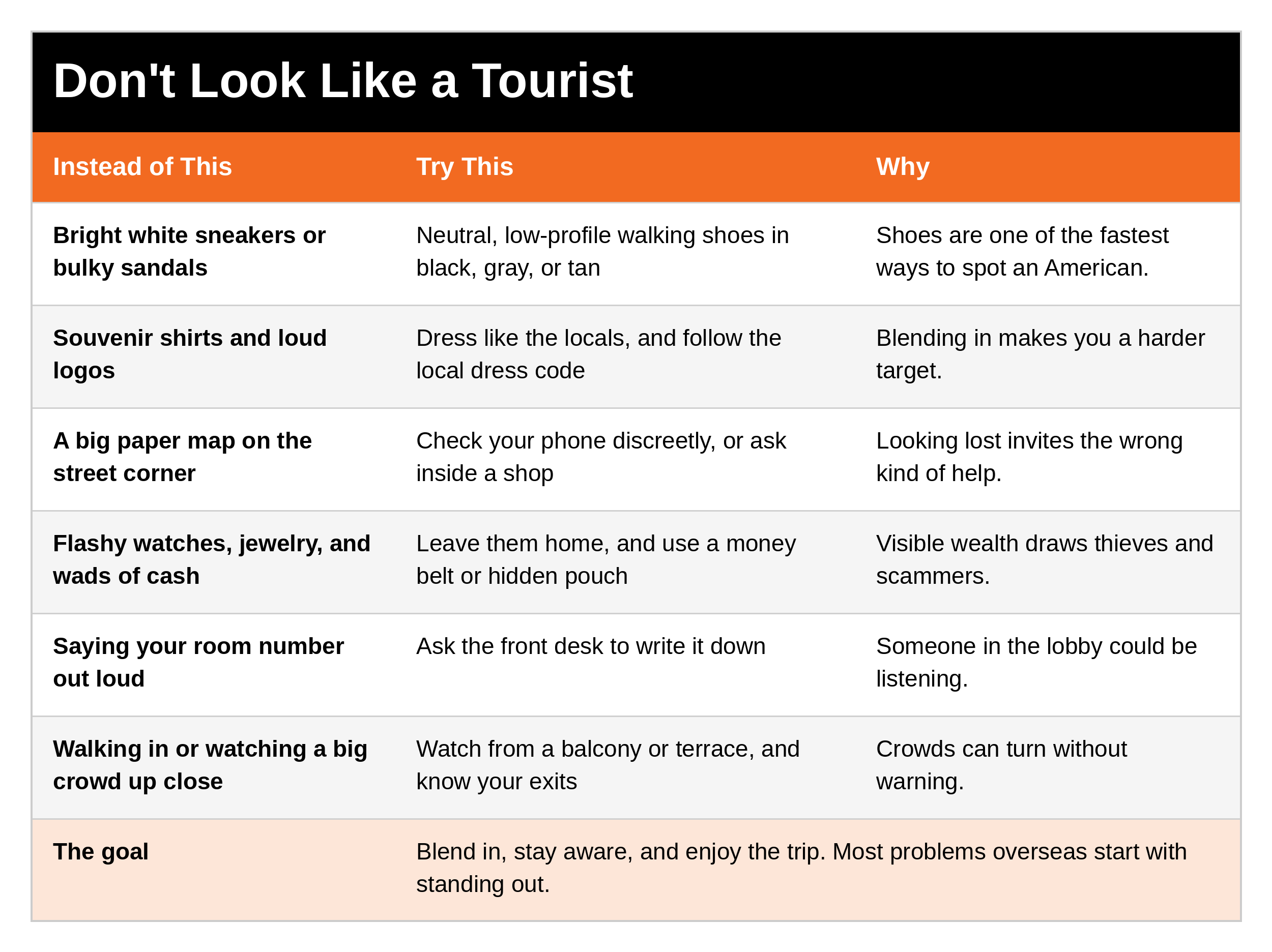
Standing out as a tourist overseas can make you more vulnerable to scams, theft, and unwanted attention. To blend in and reduce the chance of being targeted.
Here's the quick version.
Hotel Check-In
When you check into a hotel, limit the personal information you share. Be discreet, because people with bad intentions could be listening. Ask the front desk not to announce your room number out loud, and write down sensitive details instead of saying them.
If you're a woman traveling alone, you can mention that your husband will be arriving shortly. That small precaution can deter someone who's paying too much attention. (Part 8 of this series goes deeper on hotel security.)
Your Shoes Give You Away
One of the quickest ways to spot an American overseas is the shoes. In much of Europe and Asia, locals dress with a little more intention, even on long walking days. Bright white sneakers, oversized running shoes, and bulky sandals (especially with socks) are a dead giveaway.
Choose shoes that are comfortable and understated: low-profile walking shoes or leather sneakers in black, gray, or tan. Break them in before the trip. It's a small detail, but it's part of keeping a low profile.
Blend In, Stay Aware
Luggage: Lock it, and leave off anything that shows your nationality. A tracker like an AirTag helps you find a lost bag.
Dress: Research the local dress code and dress like the locals. Skip souvenir T-shirts and loud logos.
Language and customs: Learn a few basic phrases, like hello, please, and thank you. Respect local customs, from dress to table manners to greetings.
Money: Use local currency, and know the exchange rate so you aren't overcharged.
Valuables: Leave expensive jewelry and watches at home. Use a money belt or hidden pouch for documents and cash.
Move with purpose: Walk like you know where you're going, even when you're lost. If you need directions, ask inside a shop or restaurant, or ask a family or a mom with kids, not the stranger who walked up to you.
No shortcuts: Skip narrow alleys and poorly lit streets, and avoid walking alone at night.
Maps and cameras: Check your phone discreetly instead of unfolding a big paper map on the corner. Take your photos, but don't live behind the camera.
Research the Scams
Before you go, look up the common scams where you're headed: distraction thefts, overcharging, fake tour guides, and "helpful" strangers. If you're on a cruise or an organized tour, listen to the crew. They know the local tourist traps better than anyone.
Stay Away From the Crowd That's Turning
Avoid public demonstrations, civil unrest, and large political, religious, or celebratory gatherings. Even peaceful crowds can shift without warning, especially with alcohol, political tension, or police involved. If you want to see a cultural event, watch from a safe distance, like a hotel balcony or a restaurant terrace.
A wrong turn of just a few blocks can be the difference between a great day and a dangerous one. Always know your exits and have a plan to move quickly. (Situational Awareness, Part 11 covers crowds and large events.)
A Guide to Advance Planning
You are the Agent in Charge of your family's safety. Plan your trip the way an experienced protection detail would, and you'll be ready for most of what can go wrong.
Know Before You Go
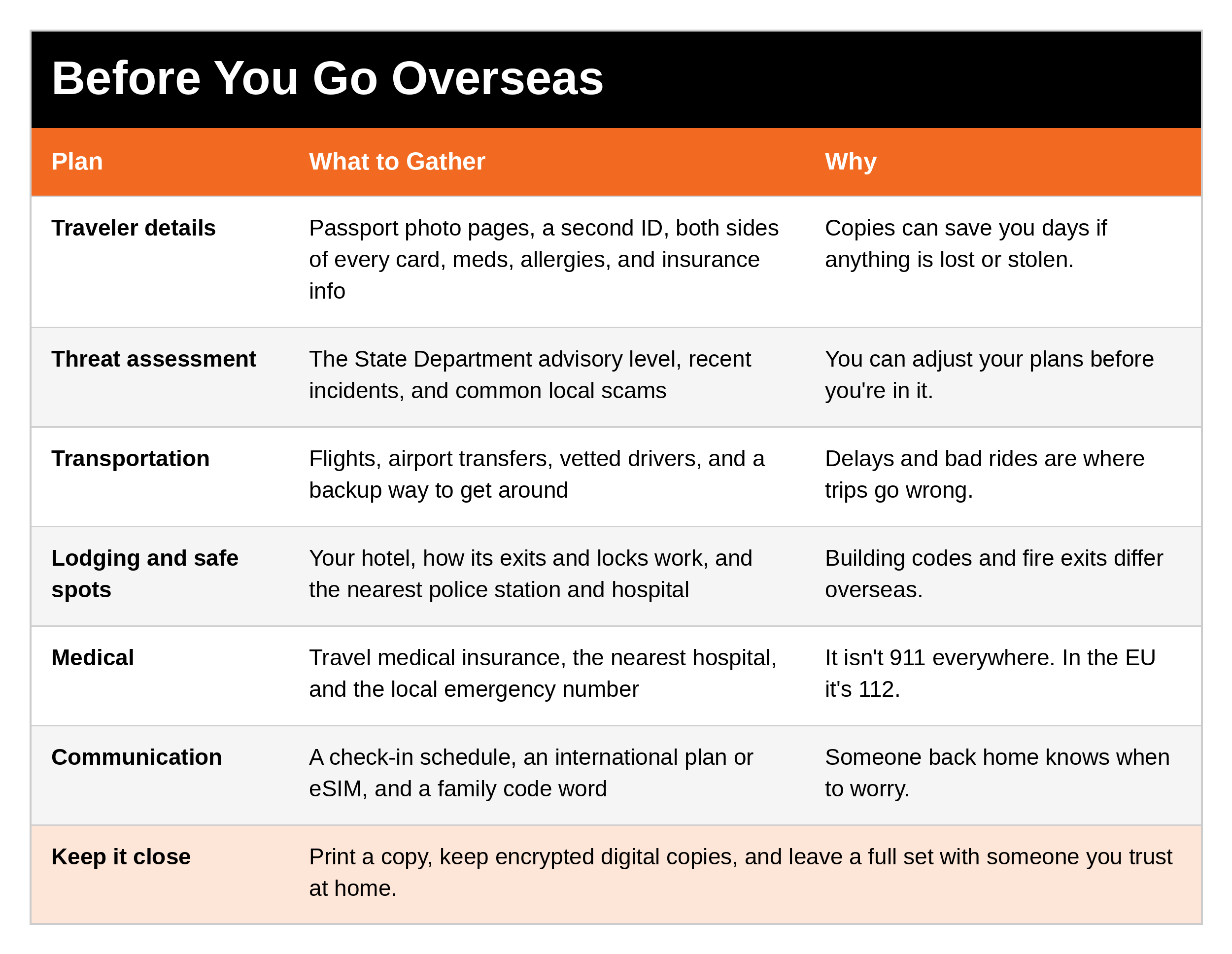
Check the State Department Travel Advisory at travel.state.gov. Every country gets a level from 1 to 4: Exercise Normal Precautions, Exercise Increased Caution, Reconsider Travel, or Do Not Travel. Some countries have different levels for different areas, so read the whole advisory.
Check your destination's environment. The Global Rescue Travel Intelligence Center gives you a current look at a destination's risks before you go.
Enroll in STEP, the State Department's free Smart Traveler Enrollment Program, so you get embassy alerts and the embassy can reach you, or your emergency contact back home, in an emergency. If you enrolled before September 2024, sign up again. The new system didn't carry old enrollments over. (Traveling Abroad Prepared, Part 1 walks you through it, step by step.)
Gather It Before You Leave
Here's what to gather before you go.
Planning a trip? My free Security-Focused Travel Planner puts your itinerary, lodging, contacts, medical information, and backup plans in one place. [Get it here: LINK] (Tip: it holds sensitive information, so keep it encrypted or printed and stored securely. Don't email it unencrypted.)
Copy everything. Make copies of each passport's photo page, a second ID, and both sides of every card you carry. Keep digital copies in a secure, encrypted place, printed copies hidden in your luggage, and a full set with someone you trust back home. If a passport or wallet goes missing, that one step can save you days.
Know the local emergency number. It isn't 911 everywhere. Across the European Union, it's 112. Look up the number for every country you'll visit, and put it in your phone.
Know how the building works. Building codes in many countries are very different from ours. Fire exits, window security, and how doors lock may not be what you expect. Take a minute to find the exits and think through how you'd get out in a fire.
Buy travel medical insurance before you go, and keep a printed copy of the policy with your documents.
Set your check-in plan. Agree on a check-in time with someone back home, and what they'll do if you miss it. (Traveling Abroad Prepared, Part 2 covers the embassy connection and your family check-in plan, and Emergency Communications, Part 8 covers staying connected overseas.)
What to Say
Safe and non-engaging
To a street vendor, a "guide," or a stranger with a story: "No, thank you," in the local language, and keep walking.
At check-in: "Could you write the room number down instead of saying it?"
Setting boundaries
Firm and polite: "No. We're fine." Don't stop to explain.
If someone grabs your arm or blocks your path to "help": "Please let go." Step away toward other people.
If they persist
Move into a shop, hotel lobby, or restaurant, and ask the staff for help.
Call the local emergency number, and contact your embassy if you need help as an American abroad. If you can't reach the embassy, the State Department's emergency lines are 1-888-407-4747 from the U.S. or Canada and +1-202-501-4444 from overseas.
SCAN It
S, See your environment: Notice who's paying attention to your family, and what changes on the street.
C, Create space: Step away from crowds that are turning, and from strangers who get too close.
A, Act deliberately: Know your route, your exits, your local emergency number, and your check-in time.
N, Never doubt your gut feelings: If a deal, a person, or a street feels wrong, walk away. You're allowed to be rude.
5 Quick Wins You Can Start Today
Check the Travel Advisory for your next destination at travel.state.gov.
Copy your passports and cards, and give a set to someone you trust.
Look up the emergency number for every country on your trip.
Pick neutral, broken-in shoes for the trip.
Set a check-in time with someone back home.
Ask Yourself
Would someone on the street know we're tourists in five seconds?
If a passport went missing on day two, how fast could we replace it?
Does someone back home know our plans and when to worry?
Remember
You don't have to stay home to stay safe. You just have to plan like someone's counting on you, because they are.
Blend in, stay aware, copy your documents, and keep someone back home in the loop. Then go enjoy the trip you've been dreaming about.
Get Started Today
Get the free Grey Man Pocket Guide. Simple habits for traveling without advertising that you're a tourist, the perfect companion to this post. DM the word GREYMAN on Instagram or Facebook and I'll send it to you. [Get it here: LINK]
Go Deeper
Situational Awareness and Safe Family Travel Strategies. This post gives you the highlights. The book gives you the full overseas chapter: the complete Security-Focused Travel Itinerary Guide, section by section, with why each piece matters; the shoe styles and brands that give Americans away (and what to wear instead); threat assessments, security infrastructure, and how to research a destination like a professional; plus hotels and Airbnbs, airports, and digital defense while you travel. [Get it here: https://store.bookbaby.com/book/situational-awareness-and-safe-family-travel-strategies]
Tools I recommend: The luggage locks, trackers, money belts, and travel safety gear I recommend are in my Travel Safety Amazon store. https://link.amazon/B023guhPk
Related reading:
Traveling Abroad Prepared, Part 1: Get On the Radar (STEP) [LINK]
Traveling Abroad Prepared, Part 2: Get Known, Stay Connected [LINK]
Safe Drinking Water, Part 5: Safe Drinking Water When You Travel Abroad [LINK]
Emergency Communications, Part 8: Staying Connected Overseas [LINK]
Safe Family Travel, Part 7: Choosing Safe Lodging [LINK when posted]
References
U.S. Department of State. Travel Advisories. https://travel.state.gov/
U.S. Department of State. Smart Traveler Enrollment Program (STEP). https://step.state.gov/
European Commission. 112, the European emergency number.
Global Rescue. Travel Intelligence Center. https://www.globalrescue.com/common/travel-intelligence-center/
Betz, L. Situational Awareness and Safe Family Travel Strategies (Lesson 4: Protective Strategies for Safe Traveling Overseas).
Betz, L. Navigating the Red Zone and Beyond (SCAN framework).
Disclaimer
This article is for general informational and educational purposes only. It is not a guarantee of safety and is not a substitute for professional security advice, legal advice, or official government travel guidance. Laws, customs, emergency numbers, and conditions vary by country and can change quickly, so always check current official sources before and during your trip. Prepared Not Paranoid and Larry Betz are not responsible for the content of third-party websites or resources linked here. Affiliate disclosure: I've linked to products from my Amazon store that I personally recommend. As an Amazon Associate, I earn from qualifying purchases, at no extra cost to you. Thank you for supporting my work.
If you're in danger, get to a safe place and call the local emergency number. U.S. citizens abroad who need emergency help can also call 1-888-407-4747 from the U.S. or Canada, or +1-202-501-4444 from overseas.
Awareness gives you time. Time gives you options.
The Prepared Protector is someone who's decided that loving someone means being ready for them, not just hoping things go fine.
Prepared Not Paranoid. Protecting the Most Vulnerable Among Us.