Red Cell Your Family: Part 7
Just in Case: Turn What You Found Into a Plan, and Be Ready to Recover
By Larry Betz | Prepared Not Paranoid https://www.preparednotparanoid.com
Every safety program I ran as a Safety Director came down to one document: the list of hazards we found, who was fixing each one, and by when. Without that list, an inspection was just a walk around the job site.
Assessment without action is just busywork.
Over the last six parts, you've red-celled your routines, your house, your digital life, your circle, and your family's training. You probably have a list of tells that's longer than you expected. That's normal. It means you took a hard look.
Now let's turn that list into a plan, and make sure your family can bounce back if something does happen.
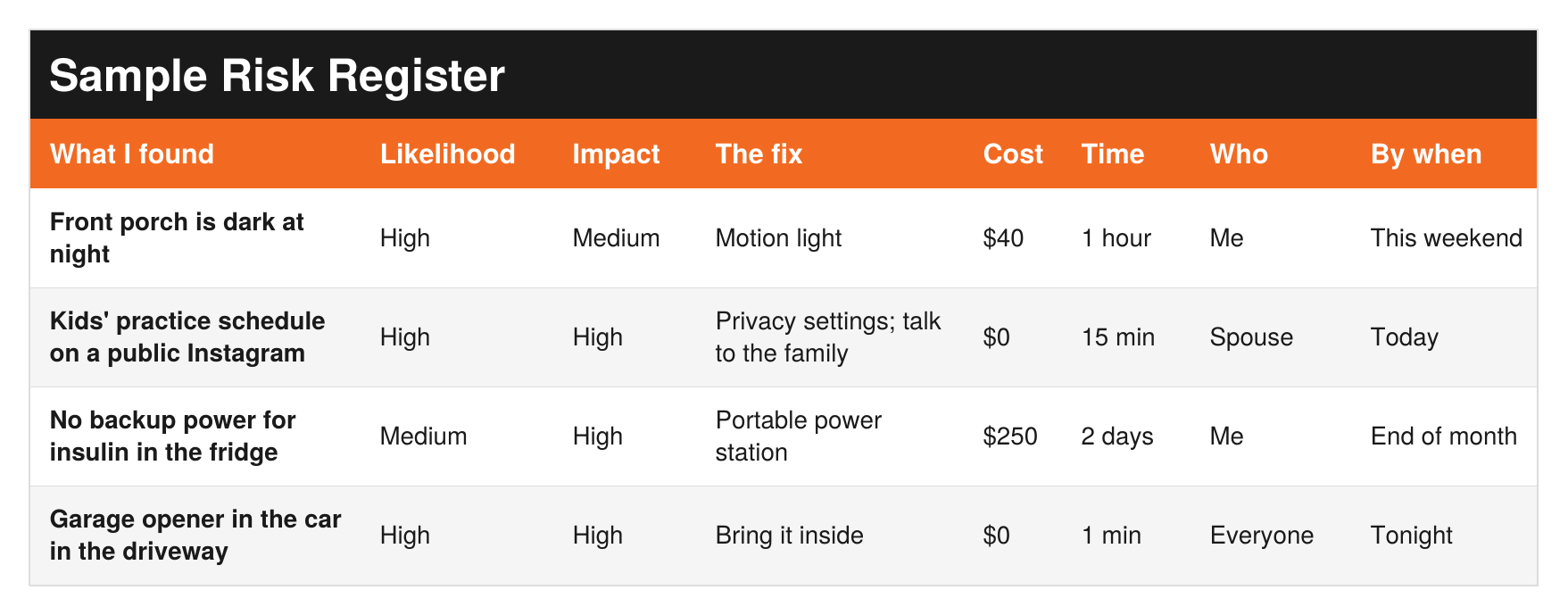
Step 1: Build Your Risk Register
A risk register is just a list of what you found and what you're doing about it. A notebook works. So does a spreadsheet.
Step 2: Fix the Right Things First
Start with the fixes that give you the most protection, fastest, for the least money:
Longer strike plate screws
Social media privacy settings
Motion lights and trimmed shrubs
The family code word
Bringing the garage opener inside
Then the medium projects (30 to 90 days):
Cameras that capture faces
Security film on vulnerable glass
Data broker removal
CPR and Stop the Bleed training
Then the long-term investments (3 to 12 months):
New exterior doors or windows
A monitored alarm system
Backup power for the whole house
My tip: pick three fixes a month and put them on the calendar. Steady progress beats a big weekend you never get to.
Step 3: Make It a Daily Habit
Post these where everyone sees them: on the fridge, inside a cabinet door, or by the garage.
Morning Departure
☐ Phone charged
☐ Doors and windows locked
☐ Nothing valuable in the car, garage opener out of sight
☐ A quick look around before you pull out
Evening "Secure the House"
☐ All doors and windows locked
☐ Alarm on
☐ Blinds and curtains closed
☐ Outside lights on
☐ Cars locked, keys put away
☐ Everyone home and accounted for
Before a Trip
☐ Mail and packages held or picked up by a neighbor
☐ Lights on timers
☐ A trusted neighbor told (not the internet)
☐ Valuables out of sight
☐ Security system on, and the app working on your phone
Step 4: Be Ready to Respond
Red-celling isn't only about keeping bad things out. It's also about being ready if something gets through.
Medical
As an EMT student, I learned how much happens in the minutes before help arrives. Your family is the first responder.
CPR, AED, and Stop the Bleed training for every adult, and older teens
A trauma kit with a tourniquet, not just bandages
Know your nearest ER and how long EMS takes to reach you. In rural areas, it can be a long time.
Physical Capability
I ran gyms for more than 20 years, and much of my work was with people coming back from injuries and with older adults. Here's what I know: in an emergency, your body is part of the plan.
Can you carry a child down the stairs? Help a parent out of a chair and to the car? Walk two miles out of a wildfire zone if the roads are blocked? You don't have to be an athlete. You do need enough strength, balance, and endurance to take care of the people who depend on you.
Step 5: Know When to Call the Professionals
Preparedness doesn't mean doing everything yourself.
Call the police if:
You think someone is stalking or harassing your family
You see the same suspicious person or vehicle near your home more than once
Someone sends threatening messages or tries to get into your home or your accounts
Document everything: dates, times, photos, screenshots, license plates, and descriptions. Keep a written incident log.
Get cybersecurity help if: your accounts are taken over, you see signs of identity theft, or your smart devices start acting strangely. Start with the company involved, and report identity theft at IdentityTheft.gov.
Hire a professional for: a full home security assessment, wired camera or alarm installation, structural upgrades, legal questions about surveillance or self-defense, and counseling for your family after a break-in or a frightening event, especially for kids.
Always check credentials, insurance, and references.
Step 6: The "Just in Case" File
Here's the part of red-celling most families skip.
Ask yourself: "If something happened to me tonight, could my family find everything they need?"
The insurance policy. The passwords. The doctor's names and the medication list. Who has power of attorney. Where the will is. Who picks up the kids. The account numbers. The spare key.
For most families, the honest answer is no. It's scattered across a desk drawer, an email inbox, and one person's memory.
Start With a Home Inventory
A home inventory is a record of what you own: a room-by-room list with photos or video, serial numbers, and receipts for big items. After a fire, flood, burglary, or evacuation, it helps you:
File an insurance claim faster
Prove what was stolen to the police
Remember what was lost when you're too stressed to think straight
The easy way: walk through every room with your phone recording video. Open closets and drawers. Narrate the expensive items. It takes about an hour.
Store a copy somewhere other than your house: secure cloud storage, a fireproof box, or with a trusted relative.
Then Build Your Family's Emergency File
Gather the essentials into one place:
IDs and passports (copies)
Insurance policies
Medical information for every family member: conditions, medications, allergies, doctors
Emergency contacts
Legal documents: wills, powers of attorney, guardianship plans for the kids
Financial accounts and who to call
Instructions for your digital accounts
The house basics: where the water shutoff is, the alarm company, the spare key
Then decide who's allowed to see what. Not everyone needs everything. A babysitter needs emergency contacts and allergies. Your adult child might need the insurance and the will. Only one or two people need the financial accounts.
That's exactly why I created the Prepared Not Paranoid Family Readiness Binder (coming soon). It organizes everything your family would need, from the immediate emergency summary to medical, home, financial, and legal records, into one place. Every page is color-coded so your family can agree ahead of time who's allowed to see what: green for emergency access, yellow for family, and red for restricted. It's the "just in case" file most families mean to build and never do.
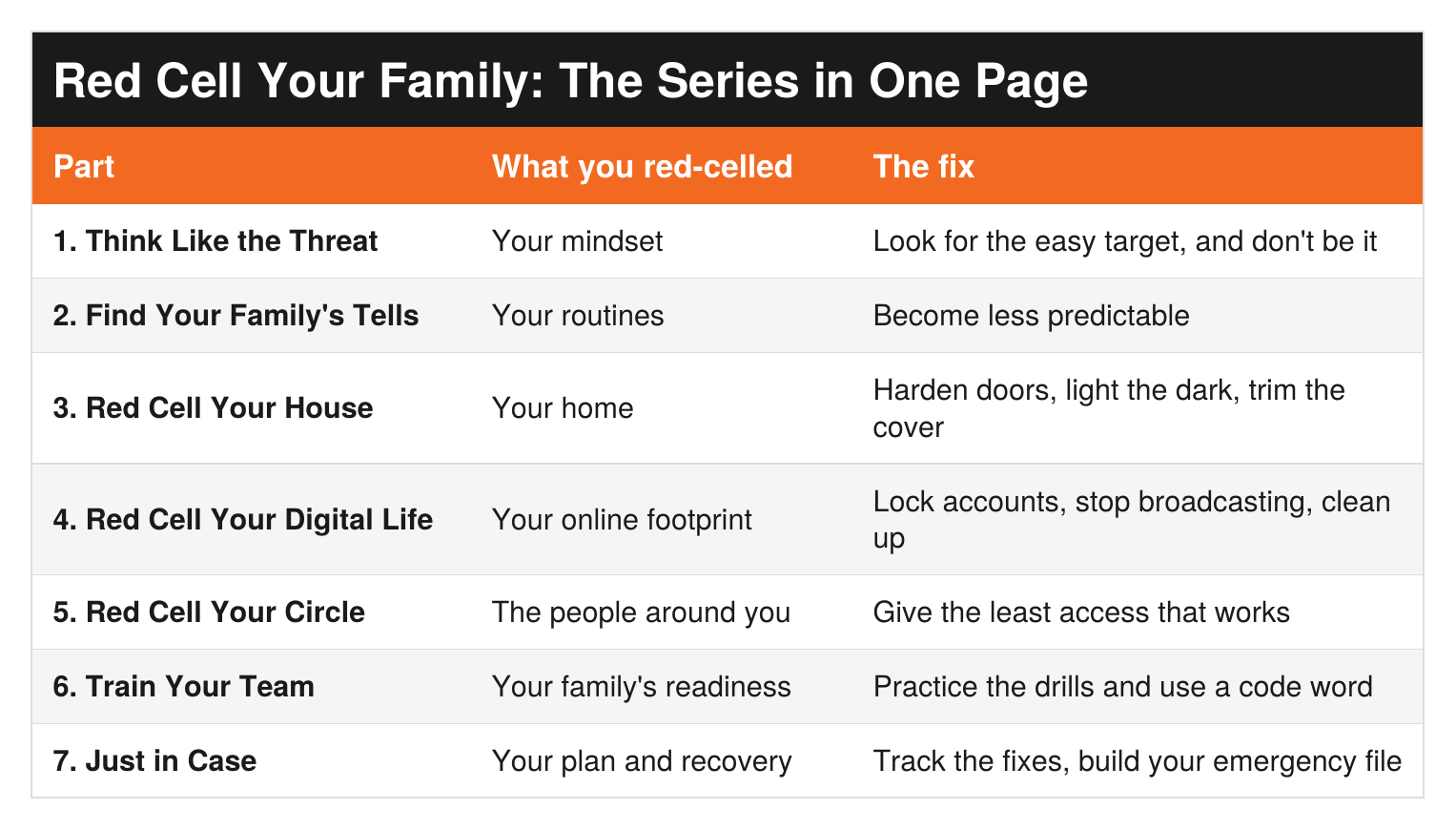
The Series in One Page
Ask Yourself
What are the three fixes I'll do this month?
If something happened to me tonight, could my family find what they need?
When will we red cell our family again? (Put it on the calendar. Once a year is a good start.)
Remember: Red-celling isn't about fear. It's about finding your weak spots before someone else does, fixing them, and giving your family the confidence that comes from being ready.
Take the Audit Again
Go back to the free Red Cell Family Audit and score yourself again. Part 6, "Just in Case," covers your documents, your medical information, and your home inventory. Compare your new score to your first one, and pick your next three fixes.
[CTA: Comment or DM "REDCELL" / or download it here: LINK]
Go Deeper
Everything in this series has a deeper guide behind it:
The Family Safety Toolkit: 20 ready-to-use checklists for the home, the kids, travel, seniors, and preparedness, including the Home Security Audit Checklist and Home Inventory Checklist. [Get the Toolkit here: LINK]
The Safest House on the Block: the complete guide to hardening your home. [LINK]
Cyber Safety and Hooked: protect your family online. [LINK]
Situational Awareness and Safe Family Travel Strategies: the awareness that makes all of it work. [LINK]
The Family Readiness Binder: your family's "just in case" file. Coming soon. [Join the list to be the first to know: LINK]
Tools I recommend: Visit my Amazon store for the products I recommend for keeping your family safe: the Children's Safety store [AMAZON CHILDREN'S SAFETY STORE LINK] and the Senior Safety store [AMAZON SENIOR SAFETY STORE LINK].
Related reading:
Emergency Preparedness Resource Center [LINK]
Summer Camp Safety, Part 3: When Something Goes Wrong [LINK]
Drones Over Your Home, Part 5: Drones and Preparedness [LINK]
References
Insurance Information Institute, Home Inventory: https://www.iii.org/article/how-create-home-inventory
Ready.gov, Make a Plan, and Ready.gov, Safeguard Critical Documents: https://www.ready.gov/plan and https://www.ready.gov/financial-preparedness
American College of Surgeons, Stop the Bleed: https://www.stopthebleed.org
Federal Trade Commission, IdentityTheft.gov: https://www.identitytheft.gov
Disclaimer
This article is for general informational and educational purposes only. It is not legal, financial, medical, or insurance advice, and it is not a substitute for professional guidance. For legal documents such as wills, powers of attorney, and guardianship plans, consult a qualified attorney.
If you are in immediate danger, call 911.
Awareness gives you time. Time gives you options
The prepared protector is someone who's decided that loving someone means being ready for them, not just hoping things go fine.
Prepared Not Paranoid. Protecting the Most Vulnerable Among Us.