Summer Awareness Skills for Kids
Teaching Children to Navigate the World With Confidence
By Larry Betz | Prepared Not Paranoid https://www.preparednotparanoid.com/
Preparedness for kids doesn't start with fear. It starts with awareness.
Summer puts our kids in some of the busiest places they'll ever be: crowded airports, hotels, amusement parks, beaches, water parks, buses, and trains. Most parents spend a lot of time on what the kids should pack. Far fewer spend any time teaching them how to stay aware while they're moving through the world.
I taught youth martial arts classes for years, and I helped coach my son's soccer team. Here's what I learned: kids don't learn safety from lectures. They learn it from games, repetition, and doing it with you.
Awareness taught early builds confidence, independence, communication, and problem-solving skills your child will carry into adulthood.
The goal is not to make kids fearful or paranoid. The goal is calmer, more observant, more capable kids. You get there through familiarity, repetition, and a few simple habits, turned into games and conversations your family can practice almost anywhere.
This series is built around five core skill pillars.
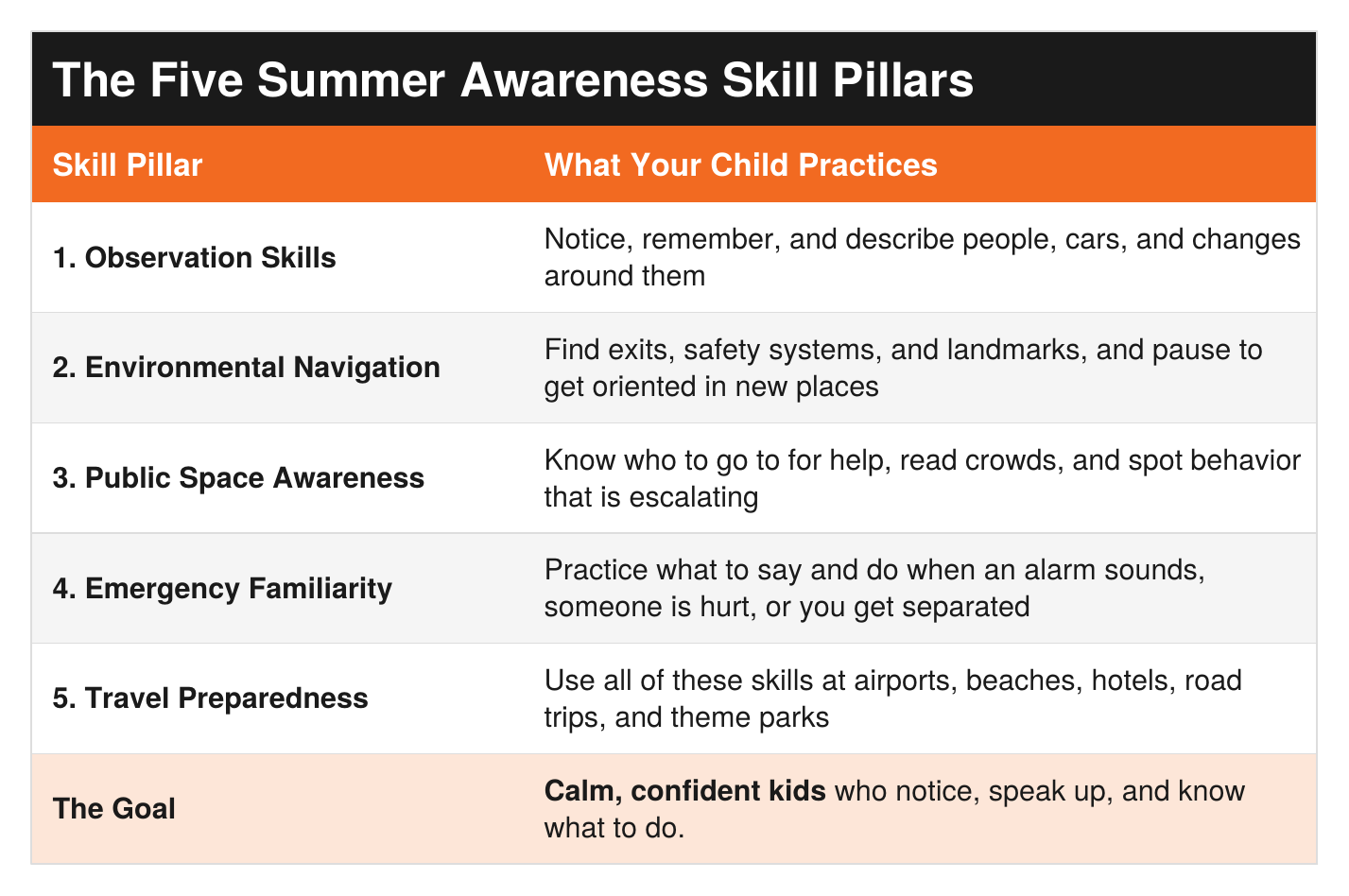
1. Observation Skills
Observation is the foundation of situational awareness. Kids who learn to notice details stay more connected to their surroundings, and they're better at spotting changes, problems, or important information when they're stressed.
These exercises teach kids to observe, remember, and describe what's around them.
Kim's Game: Builds memory, attention to detail, and the ability to notice small changes. [Learn how to teach Kim's Game here: LINK]
Remember 3 Things: Kids pick a person and remember three simple details: clothing, a name tag, glasses, a hat, or hair color.
Describe the Car: Kids practice noticing color, type, stickers, dents, direction of travel, or part of a license plate.
What Changed?: Move something in a familiar room and have them find it. This builds the habit of scanning.
Feed Your Eyes: Heads up, eyes moving. Kids practice looking up and watching movement instead of getting buried in a screen.
Try it on the road: At a rest stop, ask, "What color was the car parked next to us? What was the man at the counter wearing?"
2. Environmental Navigation
Most kids walk through buildings without ever noticing the exits, the landmarks, or how the place is laid out. When they learn to read a space, unfamiliar places feel a lot less overwhelming.
Find Two Ways Out: Spot the main exit and a second exit in restaurants, hotels, stores, theaters, and other public spaces.
Spot Safety Systems: Find the sprinklers, fire extinguishers, smoke detectors, and exit signs.
Hotel Safety: Look at the evacuation map on the back of the door, count the doors to the stairwell, check the locks, and agree on a family regroup spot.
Transition Zones: Parking lots, elevators, stairwells, entrances, and exits. These are the places where people get distracted, so this is where we pay the most attention.
The 10-Second Rule: Before walking into a new place, pause, look around, and get oriented.
The goal is for kids to understand how a place works before anything stressful happens.
3. Public Space Awareness
Crowds are loud, distracting, and overwhelming for kids. Teaching them who to go to, how crowds move, and what escalating behavior looks like helps them stay calm when things get busy.
Safe Adults: If they get separated, who do they go to? An employee, a security officer, customer service, or a mom with kids.
Who Works Here?: Practice spotting uniforms, name badges, security, and information desks.
Escalating Behavior: Notice yelling, aggression, erratic behavior, or a situation that starts to feel chaotic.
What If a Stranger Is Watching?: Trust that uncomfortable feeling, stay close to family, and tell a parent right away.
Water Park Safety: Meeting points, lifeguards, staff uniforms, a phone number on the wrist, and staying together in loud, crowded places.
Amusement Park Safety: Regroup planning, spotting employees, crowd awareness, and what to do if someone makes them uncomfortable.
Crowd Flow Awareness: Notice which way the crowd is moving, where it bottlenecks, and where it's easy to get separated.
This is not about teaching kids to fear strangers or crowds. It's about recognizing problems early, staying connected to trusted people, and responding calmly.
What to Say
"If you ever can't see me, stop right where you are. Look for someone who works here or a mom with kids. Tell them, 'I'm lost, can you help me find my parent?' and show them the number on your wristband. I will come to you."
4. Emergency Familiarity
Kids handle emergencies better when they've practiced simple steps ahead of time. We're not loading them up with worst-case scenarios. We're teaching them what to do, who to listen to, and how to speak up clearly.
Medical Emergency in a Crowd: How to ask for help, where the first aid station is, and how to give their name, a parent's name, a phone number, and where they are.
Fire Response Practice: What to do when an alarm sounds, why we listen to adults, and why we move calmly to the exit instead of freezing or hiding.
Regroup Planning: Pick a meeting spot ahead of time so kids know exactly where to go if you get separated.
Emergency Communication: Practice the words out loud:
"I need help."
"I'm separated from my family."
"My parent is hurt."
"Please call 911."
Hotel Exit Practice: Once you've found the exits and stairwells together, walk the route once so it's familiar.
When stress is high, kids fall back on what they've practiced. Simple planning and repetition build calm.
5. Travel Preparedness
Summer travel gives you a natural classroom. Airports, beaches, hotels, road trips, public transportation, and crowded tourist spots are all chances for your kids to practice observation, communication, and problem-solving in unfamiliar places.
Airport Awareness: Stay connected to family, identify airport staff, find the gate and the information desk, and stay alert in big crowds.
Public Transportation Awareness: Stay alert, know your stop and where the exits are, and stay connected to your trusted adult on buses, trains, subways, and shuttles.
Beach and Water Safety: Pick a landmark, find the lifeguard stand, learn the warning flags, drink water, wear sunscreen, and know the plan if you get separated.
Road Trip Awareness: Practice observation at gas stations, rest stops, restaurants, and new places along the way.
Amusement Park Awareness: Regroup plans, crowd awareness, spotting employees, and getting familiar with the park in a high-energy, distracting place.
Ask Yourself
Does my child know what to do if they can't see me?
Do they know who to go to for help in an airport, a park, or a hotel?
Have we practiced it, or have I only told them?
Remember
Travel preparedness isn't about fear or paranoia. It's about helping your kids use their awareness skills naturally, so they can explore the world with more confidence, independence, and familiarity.
Get Started Today
My free Child Safety bundle includes the Family Water Safety Checklist, the Summer Camp Safety Checklist for Parents, and more, ready to print before your next trip.
[CTA: Comment or DM "[KEYWORD]" / or download it here: LINK] COMING SOON
Go Deeper
Situational Awareness and Safe Family Travel Strategies teaches you and your kids how to read crowds, spot transition zones, and plan ahead at airports, hotels, theme parks, and everywhere in between. Many of the skills in this post come straight from the book. [Get the book here: LINK]
The Family Safety Toolkit includes 20 ready-to-use checklists for kids, travel, home, and emergencies, including Family Tech Rules and the Halloween Safety Checklist. [Get the Toolkit here: LINK]
Tools I recommend: Visit my Children's Safety store on Amazon for the ID wristbands, kid-friendly trackers, and travel safety gear I recommend. [AMAZON CHILDREN'S SAFETY STORE LINK]
Related reading:
Kim's Game: How to Teach It to Your Kids [LINK]
Parent Pro Tips: Staying Together in Crowded Places, on Vacation, and at Family Activities [https://www.preparednotparanoid.com/pnp-library/parent-pro-tips-for-crowded-places-ghb7w]
Family Water Safety series, Parts 1 to 3 [LINK]
Red Cell Your Family, Part 6: Train Your Team (the lost child plan and family code word) [LINK]
References
National Center for Missing & Exploited Children, Safety Tips: https://www.missingkids.org/education
United States Lifesaving Association, Rip Currents and Beach Warning Flags: https://www.usla.org/page/RIPCURRENTS
National Fire Protection Association, Escape Planning: https://www.nfpa.org/education-and-research/home-fire-safety/escape-planning
Betz, L. Situational Awareness and Safe Family Travel Strategies.
Disclaimer
These suggestions are intended to help you and your family build awareness, confidence, and safer decision-making habits. No safety plan, checklist, or training can guarantee 100% protection. There will always be people who try to exploit vulnerability, opportunity, trust, or positions of power. The goal is not to create fear, but to help guide families toward more informed, prepared, and practical safety decisions in everyday life.
If your child is missing, alert staff or security immediately and call 911.
Awareness gives you time. Time gives you options.
The prepared protector is someone who's decided that loving someone means being ready for them, not just hoping things go fine.
Prepared Not Paranoid. Protecting the Most Vulnerable Among Us.