Walking and Balance for Seniors
Six Simple Exercises and a Walking Plan to Stay Steady and Independent
By Larry Betz | Prepared Not Paranoid https://www.preparednotparanoid.com/
A loose rug. A step you didn't see. Getting up too fast from a chair in the middle of the night. For an older adult, one fall can change everything: a broken hip, a hospital stay, and a fear of falling again that keeps them sitting more and moving less.
For more than 20 years, a big part of my work in the gym was with the aging population and people coming back from injury. Today I also help take care of my own aging parents. Here's what I've learned: balance is a skill, and like any skill, it can be trained. It doesn't take a gym or fancy equipment. It takes a kitchen counter, a sturdy chair, a safe place to walk, and a few minutes a day.
Why Balance Matters
According to the CDC, about 1 in 4 adults 65 and older report a fall each year, and falls are the leading cause of injury for older adults. But the CDC is also clear on this: falling is not a normal part of aging. Many falls can be prevented.
Exercise is one of the most proven ways to do it. A major review of the research found that balance and functional exercise reduced the rate of falls in older adults by about 24%. The Otago Exercise Program, a simple home program of leg strength and balance exercises plus walking, cut falls in older women in its original trial.
The exercises below follow the same idea: build leg strength, train balance, and walk.
Start Here: Your Balance Check-In
Before you start, do a simple check-in and write down your results. Repeat it every 4 weeks so you can see your progress. Have someone stand next to you, and stand near a counter you can grab.
The 4-Stage Balance Test (from the CDC's STEADI program). Try to hold each position for 10 seconds without holding on:
Feet side by side
One foot slightly forward, with its instep touching the big toe of the other foot
One foot directly in front of the other, heel touching toe
Standing on one foot
If you can't hold Stage 3 for 10 seconds, your risk of falling is higher. That's not a reason to worry. It's a reason to start.
The 30-Second Chair Stand. Sit in a sturdy chair with your arms crossed. Count how many times you can stand all the way up and sit back down in 30 seconds. Write down your number and try to beat it next time.
Also write down how long you can walk comfortably without stopping, and how confident you feel on your feet, on a 1-to-10 scale.
Set Up for Safety
Use a sturdy kitchen counter or the back of a heavy chair that won't slide. Not a walker with wheels, a towel bar, or a rolling chair.
Wear supportive shoes with non-slip soles. No socks or slippers on smooth floors.
Clear the space of rugs, cords, and clutter.
Have someone nearby the first few times, until you feel steady.
Go slowly. Balance work is about control, not speed.
The 6 Balance Exercises
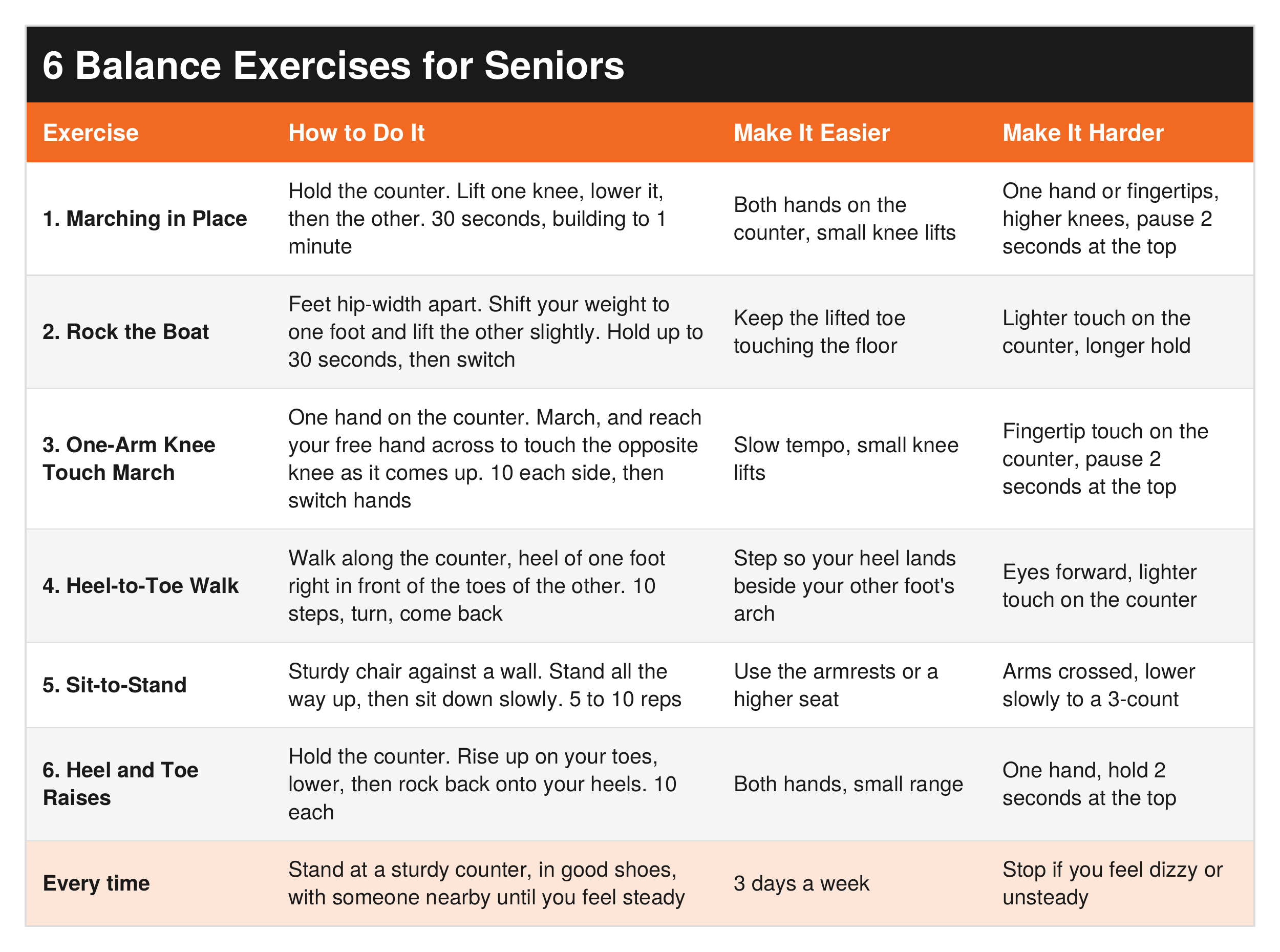
Do these 3 days a week. Start with both hands on the counter. As you get steadier, move to one hand, then just your fingertips. Only let go completely if you feel very steady and someone is with you.
1. Marching in Place
Hold the counter and stand tall. Lift one knee, lower it, then lift the other, like a slow march. Start with 30 seconds and build to 1 minute. Why it works: Every step you take, you spend a moment on one leg. Marching trains exactly that. Cue: "Stand tall, lift, and place." Watch it: [VIDEO LINK]
2. Rock the Boat
Stand with your feet hip-width apart, holding the counter. Slowly shift your weight onto one foot and lift the other foot slightly off the floor. Hold up to 30 seconds, then switch sides. Why it works: It teaches your body to shift weight under control, which is what keeps you steady when you turn or step to the side. Cue: "Shift slowly, stay tall." Watch it: [VIDEO LINK]
3. One-Arm Knee Touch March
Hold the counter with your right hand. March in place, and each time your right knee comes up, reach across your body with your left hand and touch it. Do 10, then turn around, hold the counter with your left hand, and touch your left knee with your right hand. Why it works: Reaching across your body while standing on one leg trains coordination and the core control you use when you reach for something. Cue: "Knee up, hand across." Watch it: [VIDEO LINK]
4. Heel-to-Toe Walk
Stand next to the counter and hold it lightly. Walk forward, placing the heel of one foot right in front of the toes of the other. Take 10 steps, turn carefully, and walk back. Why it works: A narrow walk challenges your balance the way a crowded sidewalk, a curb, or a tight hallway does. Cue: "Eyes forward, heel to toe." Watch it: [VIDEO LINK]
5. Sit-to-Stand
Place a sturdy chair against a wall. Sit near the front of the seat with your feet flat. Lean slightly forward and stand all the way up, then sit down slowly. Do 5 to 10 reps. Use the armrests at first if you need to. Why it works: Strong legs are your best defense against a fall, and getting up from a chair, a couch, or a toilet is something you do every day. Cue: "Nose over toes, then stand." Watch it: [VIDEO LINK]
6. Heel and Toe Raises
Hold the counter. Rise up onto your toes, then lower slowly. Then rock back onto your heels and lift your toes. Do 10 of each. Why it works: Your ankles make tiny corrections all day to keep you upright. Stronger ankles mean faster, better corrections. Cue: "Up slow, down slow." Watch it: [VIDEO LINK]
Your Walking Protocol
Walking is the perfect partner to balance work. It builds endurance, leg strength, and confidence, and it gets you out of the chair. Research shows the benefits for adults 60 and older level off at about 6,000 to 8,000 steps a day, so you don't need to chase 10,000.
The Rules
Start where you are. If 5 minutes is your limit, start with 5 minutes. That counts.
Add 2 to 3 minutes a week. Small steps, every week.
Take a recovery week every fourth week. Ease off so your body can catch up.
Two shorter walks count. Two 15-minute walks are just as good as one 30-minute walk.
Use the talk test. You should be able to talk, but not sing. That's about a 4 to 5 on a 0-to-10 effort scale.
Repeat a week if it felt hard, or if anything aches.
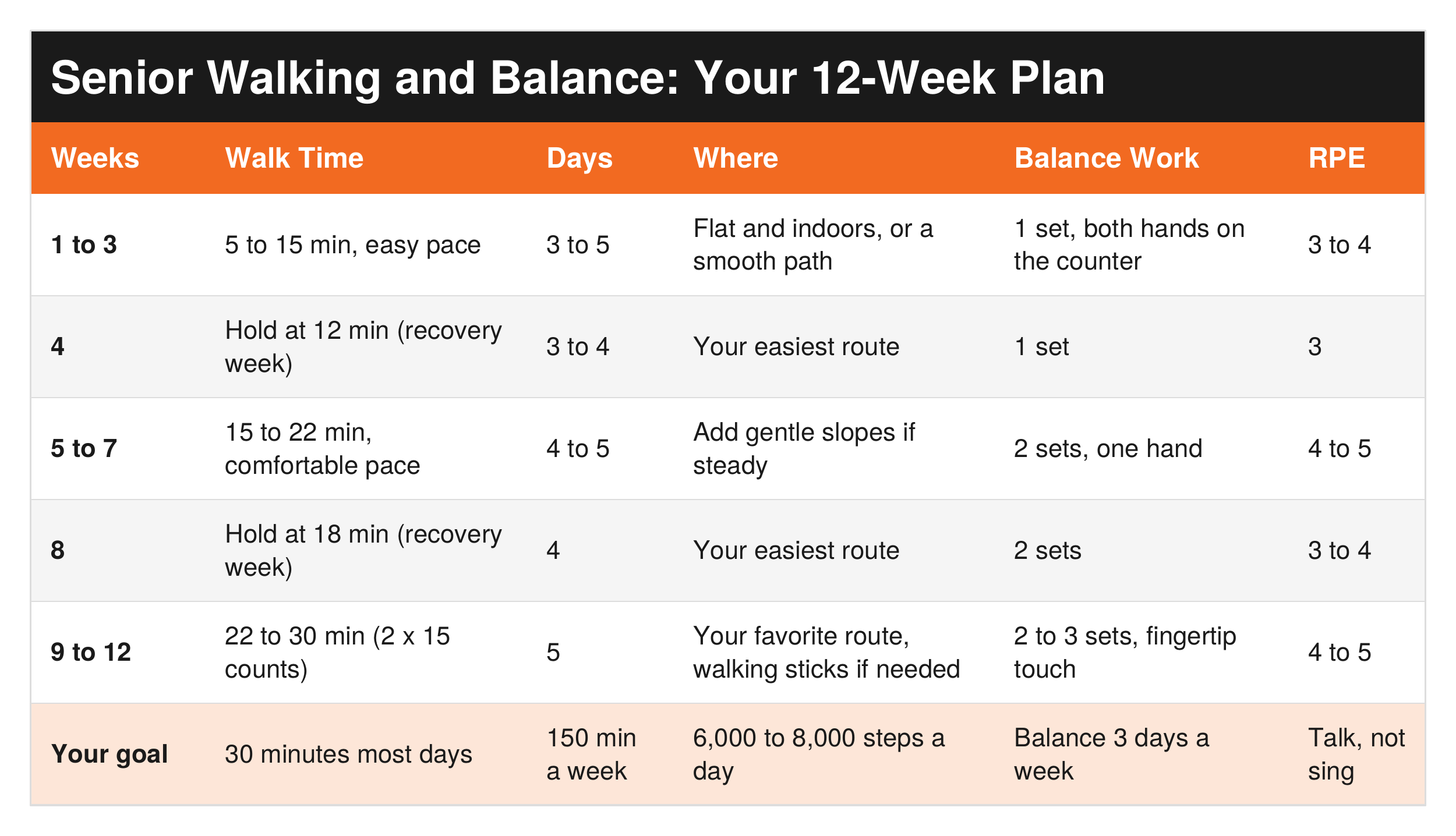
Your 12-Week Walking and Balance Plan
Here's how walking and balance work fit together over 12 weeks. Walk 3 to 5 days a week and do your balance exercises 3 days a week. Your goal is to build toward 30 minutes of walking most days, depending on your health and any injuries.
Walking Safety
Pick safe routes. Flat, well-lit, and smooth to start. Mall walking and indoor tracks are great in bad weather.
Consider walking sticks. They add stability and confidence. Because of my own injuries, I use Jetti walking sticks instead of traditional hiking poles. I've found them more stable, and the large rubber tips don't get stuck in wooden boardwalks.
Walk in daylight and wear bright clothing.
Carry your phone and ID, and a list of your medications and emergency contacts.
Bring water, especially in the heat.
Walk with a buddy when you can. It's safer, and it's more fun.
What to Say
Talking to a parent about falls can be tricky. Nobody wants to feel old or fragile. Lead with independence, not fear.
"I want you to keep doing everything you love for a long time. Can we try a few balance exercises together?"
"These take 10 minutes at the kitchen counter. I'll do them with you."
"Let's go for a walk after dinner. I could use it too."
"Your doctor would probably love to hear you're doing this. Want to ask at your next visit?"
Ask Yourself
Could I (or my parent) hold a heel-to-toe stand for 10 seconds today?
Has a fear of falling made me move less?
Is there a sturdy counter, a safe chair, and a safe place to walk at home?
Remember
Falling is not a normal part of aging, and balance can be trained at any age. A kitchen counter, a sturdy chair, and a daily walk are all it takes to start. Go slowly, build a little each week, and every step makes you steadier.
Go Deeper
Free download: Senior Safety Fall Prevention Checklist. Exercise is one half of fall prevention. The other half is the home. Walk through every room and fix the loose rugs, poor lighting, and missing grab bars that cause falls. [Get it here: LINK]
Free download: The 90-Day Aerobic Fitness Program. When you're ready for more, Section 2 has a full 12-week walking plan, a Start Here check-in, and a printable tracker. [Get it here: LINK TO 90-DAY PROGRAM]
Tools I recommend: You'll find the Jetti walking sticks, supportive walking shoes, pedometers, and home safety gear I recommend in my Senior Safety Amazon store. [SENIOR SAFETY AMAZON STORE LINK]
Related reading:
Senior Falls series, Part 2: Strong, Steady, Independent [LINK]
Aerobic Fitness, Part 1: Walking and Rucking [LINK]
Aerobic Fitness, Part 3: Speed, Agility, and Quickness [LINK]
References
Centers for Disease Control and Prevention. Older Adult Falls Data. https://www.cdc.gov/falls/data-research/index.html
Centers for Disease Control and Prevention. STEADI: Stopping Elderly Accidents, Deaths and Injuries (4-Stage Balance Test and 30-Second Chair Stand). https://www.cdc.gov/steadi/
Sherrington, C., et al. (2019). Exercise for preventing falls in older people living in the community. Cochrane Database of Systematic Reviews, 2019(1), CD012424. https://doi.org/10.1002/14651858.CD012424.pub2
Campbell, A. J., et al. (1997). Randomised controlled trial of a general practice programme of home based exercise to prevent falls in elderly women. BMJ, 315(7115), 1065-1069. https://doi.org/10.1136/bmj.315.7115.1065
Paluch, A. E., et al. (2022). Daily steps and all-cause mortality: A meta-analysis of 15 international cohorts. Lancet Public Health, 7(3), e219-e228. https://doi.org/10.1016/S2468-2667(21)00302-9
U.S. Department of Health and Human Services. (2018). Physical Activity Guidelines for Americans, 2nd edition. https://health.gov/our-work/nutrition-physical-activity/physical-activity-guidelines/current-guidelines
Disclaimer
This article is for general informational and educational purposes only. It is not medical advice and is not a substitute for guidance from your physician or physical therapist. Balance exercises and walking carry a risk of falls and injury. Talk to your doctor before starting any new exercise program, especially if you have a history of falls, dizziness, a heart condition, joint problems, or take medications that affect balance. Always exercise near a sturdy support, and have someone nearby until you feel steady. Stop any activity that causes pain, dizziness, or chest discomfort. Affiliate disclosure: I've linked to products from my Amazon store that I personally recommend. If you purchase through these links, I may earn a small commission at no extra cost to you. Thank you for supporting my work.
If someone falls and is badly hurt, hits their head, can't get up, or has chest pain or sudden dizziness, call 911.
Awareness gives you time. Time gives you options.
The prepared protector is someone who's decided that loving someone means being ready for them, not just hoping things go fine.
Prepared Not Paranoid. Protecting the Most Vulnerable Among Us.