Aerobic Fitness: An Introduction
Why Your Endurance Is Part of Your Preparedness Plan
By Larry Betz | Prepared Not Paranoid https://www.preparednotparanoid.com/
Picture this. A storm warning comes in, and you need to evacuate with your family and an elderly neighbor. The car is packed, but the road is blocked, and now you're on foot. You're carrying a bag, maybe a child, maybe helping your neighbor walk. How long can you keep going?
Fitness is rarely part of the conversation when people talk about preparedness. But in many emergencies, your physical condition could be the deciding factor in your ability to get yourself and others to safety.
Here's a truth I learned over 40 years in martial arts, the gym, and safety work: in a crisis, you won't rise to the occasion. You'll fall to the level of your training. Fitness is the foundation of that level.
"Fitness is non-negotiable and something you do every day, like brushing your teeth."
What Is Aerobic Fitness?
Aerobic fitness, also called cardiorespiratory fitness or endurance, is how well your heart, lungs, and blood vessels deliver oxygen to your working muscles. It's what lets you walk, climb stairs, carry a load, or keep moving for a long time without running out of gas.
It also matters for your long-term health. Large studies have found that higher cardiorespiratory fitness is linked to a lower risk of heart disease and early death. The American Heart Association has gone as far as recommending that doctors treat fitness as a vital sign.
Short Bursts vs. Long Efforts
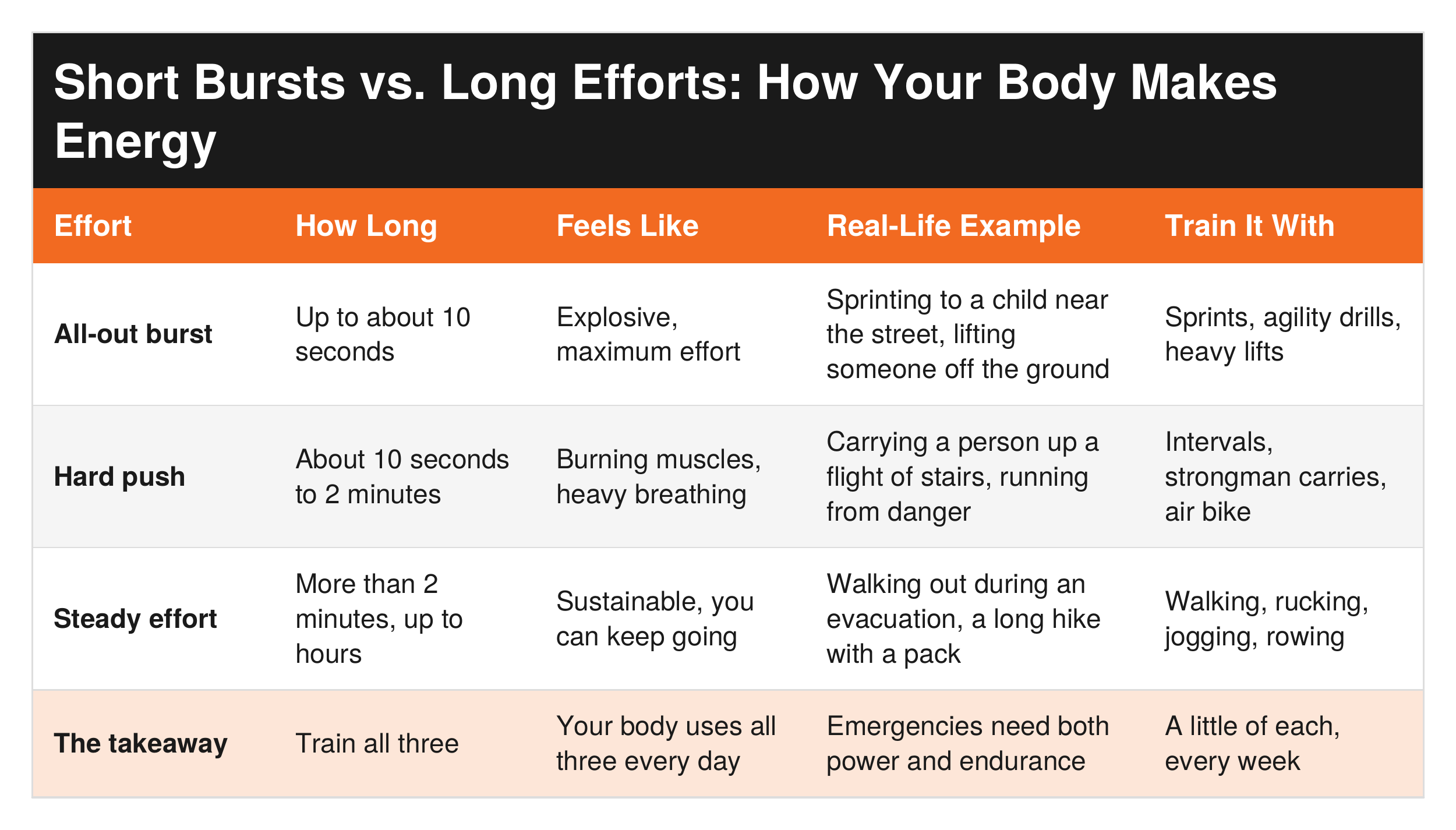
Your body makes energy in different ways depending on how hard and how long you're working. You don't need the lab terms. Here's the simple version:
All-out bursts (up to about 10 seconds) use energy stored right in your muscles.
Hard pushes (about 10 seconds to 2 minutes) burn through stored sugar fast, which is why your muscles start to burn.
Steady efforts (more than 2 minutes) use oxygen to keep you going for a long time.
Real life doesn't pick one. Sprinting to grab a child near the street is an all-out burst. Carrying someone up the stairs is a hard push. Walking out during an evacuation is a steady effort.
A good program trains all three systems, because in real life, all three systems work together.
How Much Do You Need?
The U.S. Physical Activity Guidelines recommend that adults get:
At least 150 minutes a week of moderate activity, like brisk walking, or 75 minutes of vigorous activity, like jogging or hard intervals. A mix of the two works too.
Strength training at least 2 days a week.
Some movement is better than none. If you're starting from zero, any amount helps.
The Talk Test: An Easy Way to Gauge Effort
You don't need a heart rate monitor to start.
Moderate: You can talk, but you can't sing.
Vigorous: You can only say a few words before you need a breath.
What This Series Covers
This series breaks aerobic training into five practical parts, from your first walk to choosing a cardio machine for your home.
Part 1: Walking and Rucking. The foundation. Low impact, no gym needed, and rucking adds the load you'd carry in a real emergency. [LINK]
Part 2: Running, From Jogging to Sprinting. How to build a running base safely, then add speed. [LINK]
Part 3: Speed, Agility, and Quickness. Footwork, balance, and reaction time, for athletes and for fall prevention. [LINK]
Part 4: Modified Strongman Training. Carries, drags, and lifts that build real-world strength and work capacity. [LINK]
Part 5: Cardio Machine Buyer's Guide. Rowers, SkiErgs, air bikes, stationary bikes, and treadmills, compared. [LINK]
Start Here: Which Part Fits You?
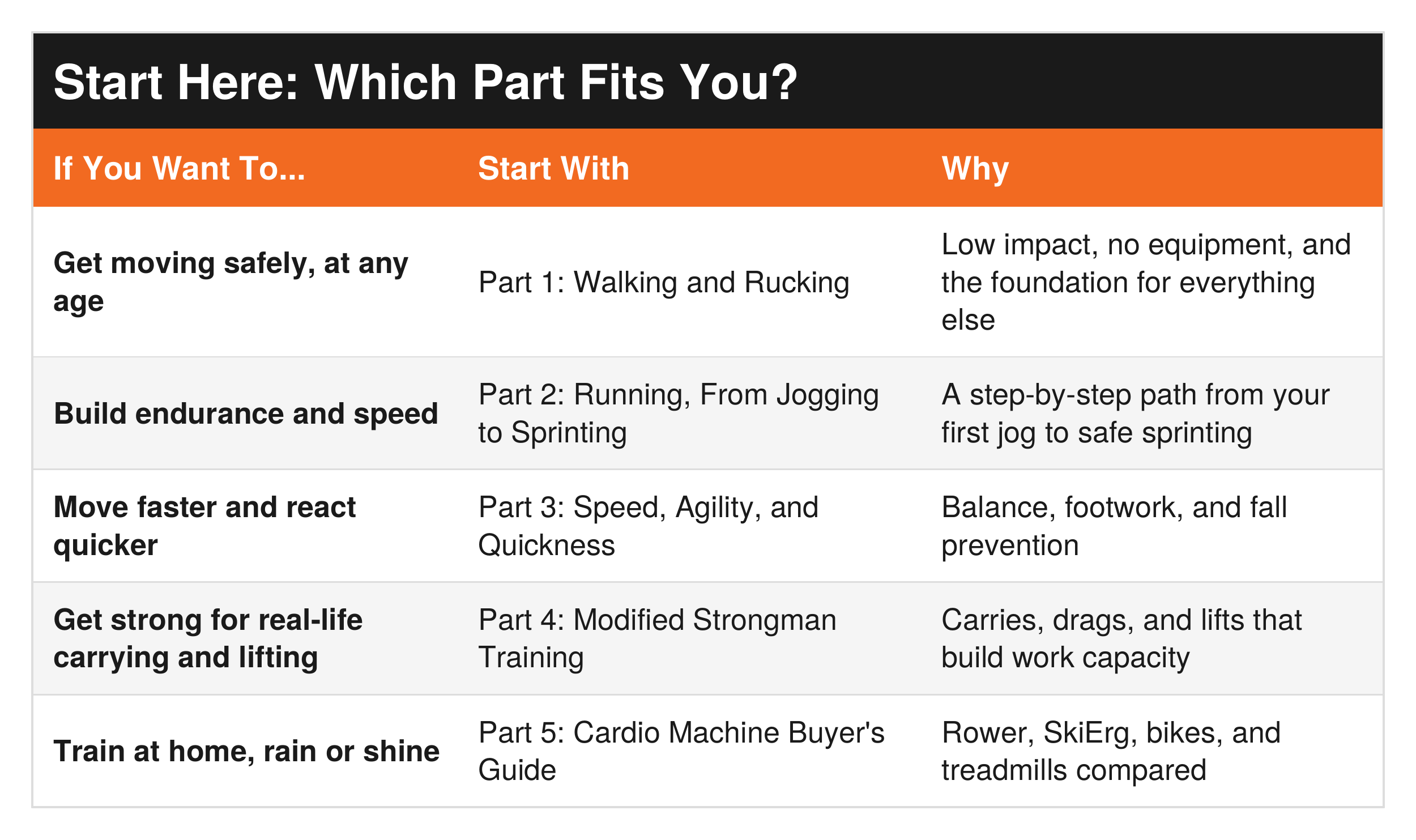
Not sure where to begin? Use this guide.
Before You Start
Talk to your doctor first, especially if you have a heart condition, high blood pressure, diabetes, joint problems, or you've been inactive for a while.
Know your training age. Training age is how long you've been training consistently, not how old you are. Someone new to exercise needs a gentler start than someone who's trained for years, no matter their age.
Warm up first. A good warm-up prepares your joints and muscles and lowers your risk of injury.
Start low and build slowly. Small, steady increases beat big jumps every time.
Stop if something hurts. Pain, chest discomfort, dizziness, or unusual shortness of breath means stop and get checked.
Ask Yourself
If I had to walk out of my neighborhood carrying a bag, how far could I go?
Could I help someone else get to safety, and keep going?
How many minutes of real activity did I get last week?
Remember
In an emergency, you fall to the level of your training. Aerobic fitness is the engine behind everything else you're prepared to do. Start where you are, build a little each week, and train for both short bursts and long efforts.
Go Deeper
Free download: My Dynamic Warm-Up Guide walks you through a 16-move, head-to-toe warm-up with a video demo for every move. Do it before every session. [Get it here: LINK TO WARM-UP GUIDE]
[PREMIUM PRODUCT CTA: confirm which product goes here]
Tools I recommend: You'll find the walking poles, rucks, weighted vests, and cardio gear I recommend in my Amazon store. [AMAZON STORE LINK]
Related reading:
Aerobic Fitness, Part 1: Walking and Rucking [LINK]
Mobility, Stability, Stretching, and Self Care, Part 1: The Foundation of Movement [LINK]
Recovery Strategies: Introduction [LINK]
References
U.S. Department of Health and Human Services. (2018). Physical Activity Guidelines for Americans, 2nd edition. https://health.gov/our-work/nutrition-physical-activity/physical-activity-guidelines/current-guidelines
Kodama, S., et al. (2009). Cardiorespiratory fitness as a quantitative predictor of all-cause mortality and cardiovascular events in healthy men and women: A meta-analysis. JAMA, 301(19), 2024-2035. https://doi.org/10.1001/jama.2009.681
Mandsager, K., et al. (2018). Association of cardiorespiratory fitness with long-term mortality among adults undergoing exercise treadmill testing. JAMA Network Open, 1(6), e183605. https://doi.org/10.1001/jamanetworkopen.2018.3605
Ross, R., et al. (2016). Importance of assessing cardiorespiratory fitness in clinical practice: A case for fitness as a clinical vital sign. A scientific statement from the American Heart Association. Circulation, 134(24), e653-e699. https://doi.org/10.1161/CIR.0000000000000461
Centers for Disease Control and Prevention. Measuring Physical Activity Intensity. https://www.cdc.gov/physical-activity-basics/measuring/index.html
Disclaimer
This article is for general informational and educational purposes only. It is not medical advice and is not a substitute for guidance from your physician. Physical exercise carries a risk of injury. Talk to your doctor before starting any new exercise program, especially if you have a medical condition or have been inactive. Stop any activity that causes pain, dizziness, or chest discomfort. Affiliate disclosure: I've linked to products from my Amazon store that I personally recommend. If you purchase through these links, I may earn a small commission at no extra cost to you. Thank you for supporting my work.
If you have chest pain, severe shortness of breath, or feel faint during exercise, stop and call 911.
Awareness gives you time. Time gives you options.
The prepared protector is someone who's decided that loving someone means being ready for them, not just hoping things go fine.
Prepared Not Paranoid. Protecting the Most Vulnerable Among Us.