Build Real Skill at Home, Safely, Without Firing a Shot
By Larry Betz | Prepared Not Paranoid https://www.preparednotparanoid.com/
Dry fire training is one of the best ways to get better with your firearm, and it doesn't cost a thing. You can practice your grip, trigger press, sight picture, draw, and reloads at home, any day of the week. But it comes with one serious responsibility: there can be no live ammunition anywhere near you. In this post, I'll show you the routine I follow every time, what to practice, and why the moment you finish is the most dangerous part of the whole session.
What Dry Fire Really Means
Dry fire is handling and practicing with your firearm when there is:
No live ammunition in the firearm
No live ammunition in any magazine you're using
No live ammunition in the room where you're training
If there is any way a live round could end up in the chamber, you are not dry firing.
Why Dry Fire Matters
Shooting is a perishable skill. Range time is great, but it costs time and money, and most people can't go every week. Dry fire fills the gap. Every clean, correct repetition at home builds the habits you'll rely on at the range, and if you ever need them, under stress. Most of what makes a good shooter, like a smooth trigger press, a clean draw, and fast reloads, can be built without firing a single round.
Every Session, Every Time
Dry fire is only safe if you follow the same routine every single time. No shortcuts.
Here's the routine.
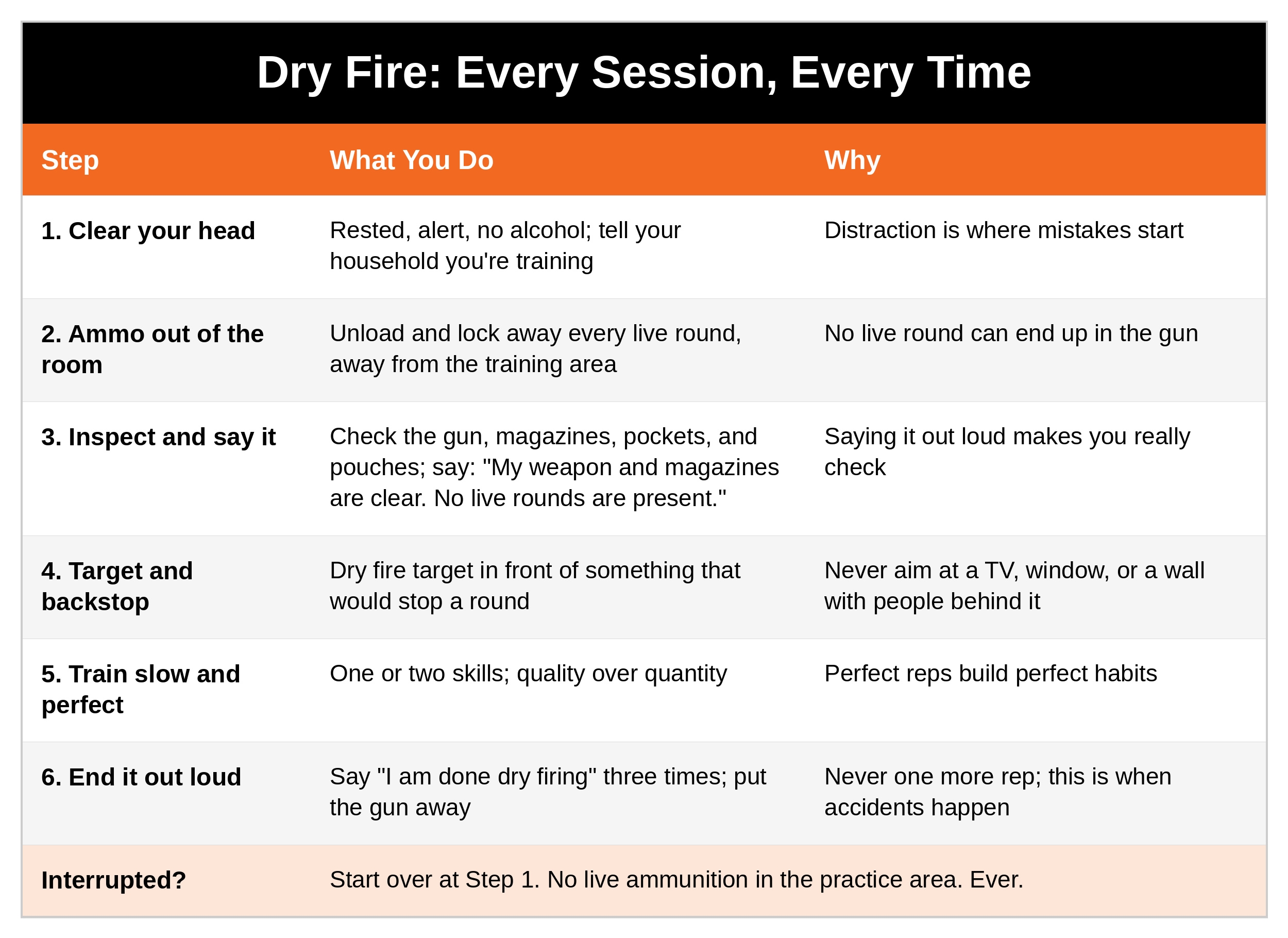
The Dry Fire Safety Rules
Eliminate all distractions. Only dry fire when you're well rested, alert, and free from alcohol, drugs, or anything else that affects your judgment. Your training should be deliberate and intentional.
Remove and lock away all ammunition, from your firearm and from the training area. Ideally, set up a permanent dry fire spot where live ammo is never allowed.
Visually and physically inspect your firearm, magazines, pockets, pouches, and magazine holders to confirm there are no live rounds. Then say out loud: "My weapon and magazines are clear. No live rounds are present."
Use a dedicated dry fire target placed in front of a backstop that could stop a round if something went wrong, like a bookcase full of books or an exterior wall with nothing behind it. Never aim at a TV, a window, or a wall with people on the other side.
If your concentration is interrupted at any point, start over at step 1 before you continue.
The Right Training Mindset
Focus on quality, not quantity. A hundred sloppy reps build a hundred bad habits. When you do a rep right, pause for a second and feel what "right" feels like. Dry fire is where you build perfect mechanics. Start slow, then build speed.
When your session is over, stop. Immediately. The switch from dry fire back to live fire is when many negligent discharges happen. Your brain has to clearly separate "dry fire mode" from "live fire mode." Treat that moment seriously.
At the end of every session, say out loud at least three times: "I am done dry firing." It may feel silly, but it's a powerful mental cue that training is over. You never go back for "just one more rep." That's how accidents happen.
What to Practice
Here are the basics I recommend. Pick one or two per session.
Trigger press. Line up your sights on the target and press the trigger smoothly straight back. Watch your front sight. If it dips or moves when the trigger breaks, slow down. On many striker-fired pistols, the trigger won't reset after a dry press, so you'll rack the slide to reset it. That's normal.
Sight picture and alignment. Practice bringing the gun up and finding a clean sight picture quickly. "Equal height, equal light." [LINK: Part 5, Range Day Basics: Terms and Commands]
The draw. From your holster, draw, get on target, and press, slowly at first. Once you're consistent, add a little speed. (Part 9 covers drawing from concealment.)
Reloads. Practice swapping magazines using empty magazines or bright-colored dummy rounds, never live ammo.
Malfunction clearing. With dummy rounds, practice clearing a failure to fire (tap the magazine, rack the slide, and get back on target). Ask your instructor to show you the right steps for your gun.
Helpful Dry Fire Tools
Dummy rounds or snap caps: Inert rounds for practicing reloads and malfunction clearing. Choose a bright, obvious color so they can never be mistaken for live ammo, and keep them separate from your real ammunition.
Dry fire targets: Small targets made for dry fire practice.
Laser training tools: Laser cartridges, training pistols, or sensor systems that show where your shot would have gone, which makes practice more useful and more fun.
Shooting a rimfire, like a .22? Many rimfire guns can be damaged by dry firing without a snap cap. Check your owner's manual first.
How Often and How Long
You don't need hours. Short sessions of about 10 to 15 minutes, a few times a week, will do more for you than one long session a month. Stop when your focus fades. Tired reps build tired habits.
Dry Fire in a Family Home
If you live with family, a little planning keeps everyone safe:
Tell your household before you start. That way no one walks in and breaks your focus, and if they do, you start over at step 1.
Choose a room kids can't wander into during your session.
When you're done, the gun goes back into safe storage, or back to its normal ready condition, with the same care you'd use any other time. [LINK: Part 11, Safe Storage at Home]
Keep SCAN Running
SCAN applies here too: S - See your environment (know what's behind your target and who's home), C - Create space (a dedicated area with no ammo), A - Act deliberately (slow, perfect reps), and N - Never doubt your gut feelings (if something feels off, stop and start over).
What to Say
Before you start, out loud: "My weapon and magazines are clear. No live rounds are present."
To your family: "I'm dry firing for the next 15 minutes. Please don't come in until I tell you I'm done."
When you finish, out loud, three times: "I am done dry firing. I am done dry firing. I am done dry firing."
Ask Yourself
Is every live round out of this room right now, including my pockets and mag pouches?
What's behind my dry fire target, and would it stop a round if I made a mistake?
Am I ready to stop, for real, when I say I'm done?
Remember
No live ammunition in the practice area or room. Ever. Follow the routine every time, practice slow and perfect, and when you say you're done, you're done.
Get Started Today
[FREE DOWNLOAD: TBD. Suggested: Dry Fire Session Card with the six-step routine and a practice log] [CTA: Comment or DM "KEYWORD" / or download it here: LINK]
Go Deeper
The Family Safety Toolkit. Safe practice at home is part of a safe home. The Toolkit gives you 20 checklists covering every area of family safety and preparedness, from your home and vehicle to travel and your go bag, all for $19.99. [Get it here: https://www.preparednotparanoid.com/family-safety-toolkit]
The Family Emergency Preparedness Manual is coming soon.
Tools I recommend: Dummy rounds, dry fire targets, and the training gear I recommend are in my Range Essentials Amazon store. https://link.amazon/B0hxQD89P
Related reading:
Firearms and Family Safety, Part 4: The Four Universal Safety Rules [LINK]
Firearms and Family Safety, Part 5: Range Day Basics: Terms and Commands [LINK]
Firearms and Family Safety, Part 9: Holsters, Clothing, and Drawing From Concealment [LINK]
Firearms and Family Safety, Part 11: Safe Storage at Home [LINK]
References
U.S. Concealed Carry Association (USCCA). Dry fire safety and practice resources.
National Rifle Association (NRA). Firearm safety fundamentals.
Firearm manufacturers' owner's manuals (dry fire guidance, especially for rimfire firearms).
Betz, Lawrence. Navigating the Red Zone and Beyond (the SCAN framework).
Disclaimer
These suggestions are intended to help you and your family build awareness, confidence, and safer decision-making habits. No safety plan, checklist, or tool can guarantee 100% protection. This article is for general informational purposes only and is not legal advice or a substitute for hands-on firearms training with a qualified instructor. Always follow your firearm manufacturer's instructions. Firearm and storage laws vary by state, so check your local laws and talk to a qualified attorney about your specific situation. Always store firearms securely and out of reach of children. Affiliate disclosure: I've linked to products from my Amazon store that I personally recommend. As an Amazon Associate, I earn from qualifying purchases, at no extra cost to you. Thank you for supporting my work.
If you are in immediate danger, get to safety and call 911.
Awareness gives you time. Time gives you options.
The prepared protector is someone who's decided that loving someone means being ready for them, not just hoping things go fine.
Prepared Not Paranoid. Protecting the Most Vulnerable Among Us.