What It Costs, How Much You Need, and Whether It's Right for Your Family
By Larry Betz | Prepared Not Paranoid https://www.preparednotparanoid.com/
A home battery switches on in a split second, runs without a sound, and never needs a drop of fuel. When the grid goes down, the lights just stay on. It's the closest thing to an outage that never happened. But it comes with a big price tag, and one battery won't run your whole house. Before you call an installer, here's what whole house battery backup really costs and how much of it you actually need.
In Parts 1 and 2, we looked at portable power stations: plug-in batteries you can carry or roll. A home battery is the permanent version. It's mounted on a wall or in the garage, wired into your electrical panel, and it takes over automatically when the grid fails.
What's in a Home Battery System
The cost isn't just the battery. A true home backup system usually includes:
High-capacity lithium battery banks
An inverter to turn the battery's DC power into the AC power your home uses (some batteries have one built in)
A gateway or transfer switch that disconnects from the grid in an outage and switches your home to battery
Charge controllers for safe solar charging
Monitoring equipment, usually an app on your phone
Solar panels to recharge the batteries during a long outage
Professional installation and permits
How Much Power Does Your Home Use?
The average U.S. home uses about 28 kilowatt-hours (kWh) a day. That's more than ten times the 2,410 watt-hour outage day we worked out in Part 2. The difference is the big stuff: central air, an electric dryer, an electric water heater, an electric range, and a well pump.
That's why the first question isn't which battery to buy. It's what do you want to keep running? Check your electric bill. It shows how many kWh your home uses each month. Divide by 30 for your daily number, and notice how much higher it is in summer or winter.
Essentials or the Whole House?
You don't have to back up everything. Most families start with the essentials and add more later.
Here's what each level looks like.
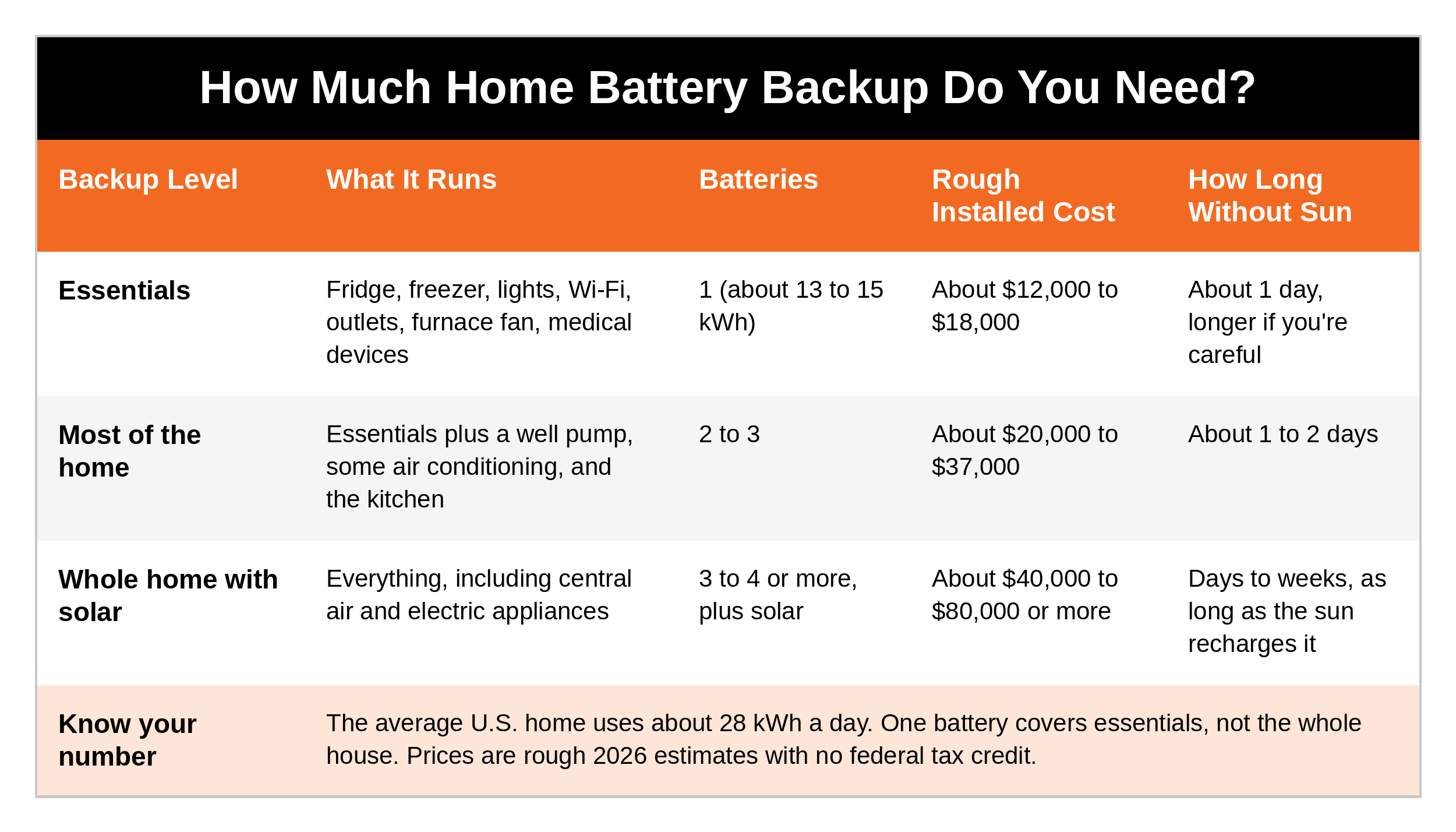
Essentials backup puts your most important circuits on a separate backup panel: the fridge and freezer, some lights, the Wi-Fi, a few outlets, the furnace fan, and any medical equipment. One battery can often carry that for a day, and longer if you're careful.
Whole-house backup runs everything, including the high-draw appliances like air conditioning, ovens, well pumps, and electric water heaters. That takes more than storage. It takes enough power to handle big startup surges, several batteries, and enough solar to recharge them during the day. It's also where costs can climb past $80,000, depending on your home's energy use, how many days you want to cover, and how complex the installation is.
Popular Home Batteries
There are a lot of good options, and an installer will help you match one to your home.
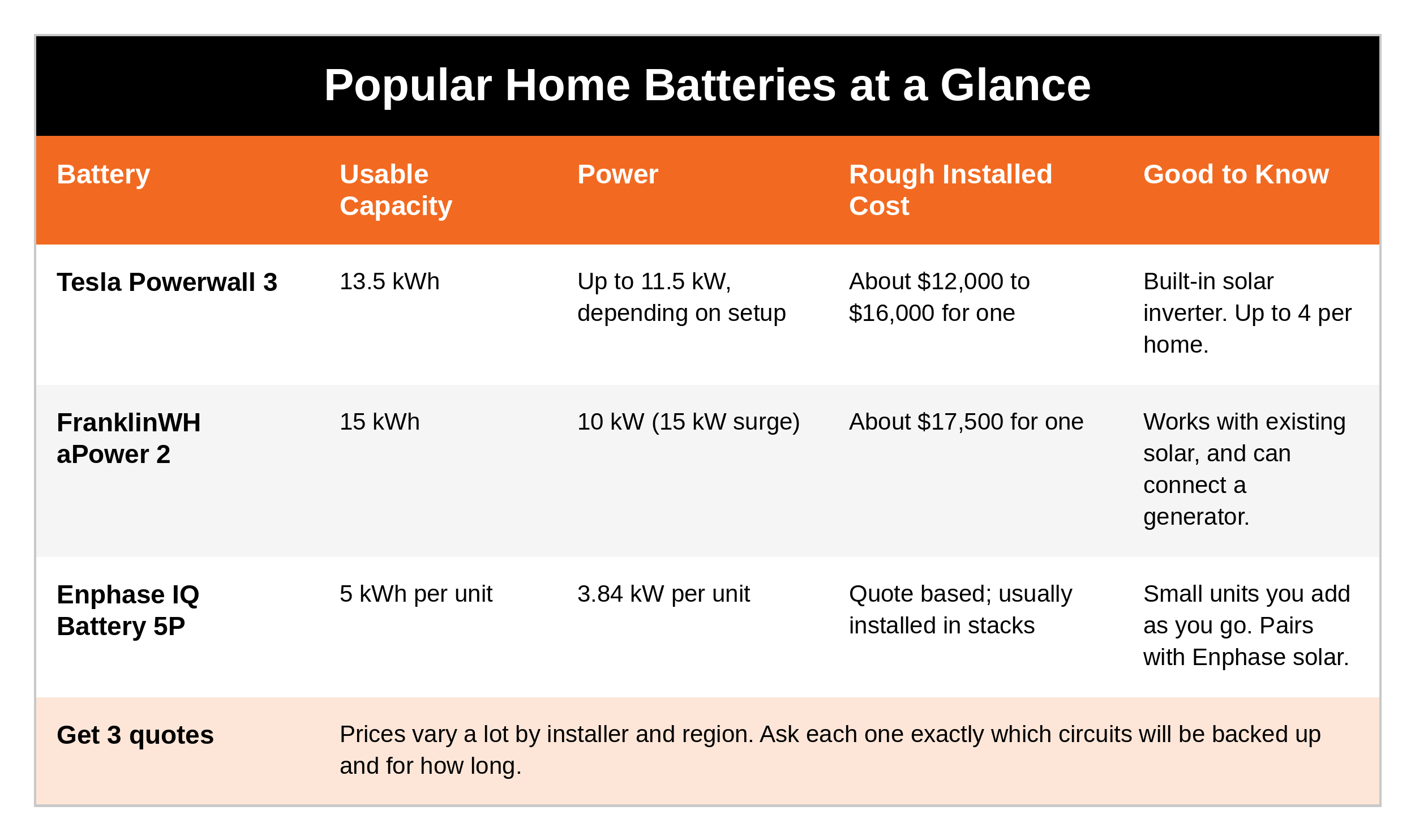
Here are three of the most common.
What It Costs in 2026
One battery, installed: roughly $12,000 to $18,000, depending on the brand and your home.
Two to three batteries: roughly $20,000 to $37,000.
Whole-home backup with new solar: often $40,000 to $80,000 or more.
The federal tax credit is gone. The 30 percent Residential Clean Energy Credit ended on December 31, 2025, so batteries installed in 2026 don't qualify. Some states and utilities still offer rebates or pay you to share your battery's power with the grid during peak times. Ask your installer and check your utility's website before you buy.
How a Home Battery Recharges
A battery is only as good as your plan to refill it.
There are three ways:
Solar. During a long outage, solar is the only way a home battery recharges without the grid or fuel. With the battery, your solar keeps working in a blackout. Part 4 explains why that matters.
The grid. When the power comes back, the battery recharges from the grid. That's fine for short outages, but it doesn't help in a long one.
A generator. Some systems can connect a generator to recharge the battery. Part 6 covers generators.
Without solar, a home battery is a one-time tank. Once it's empty, it stays empty until the grid comes back.
Who a Home Battery Makes Sense For
A home battery is a big investment.
It makes the most sense if:
Someone in your home depends on power for their health, like oxygen, a CPAP, or medicine that has to stay cold.
You lose power often, or for long stretches, from storms, heat, or wildfire shutoffs.
You already have solar, or you're planning it.
You can't safely run a generator, because of where you live or who would have to run it.
If none of those fit, a large power station (Part 2) with portable solar panels (Part 4), or a generator (Part 6), may give you most of the protection for a fraction of the cost.
Questions to Ask an Installer
Get at least three quotes, and ask each installer:
Which circuits will be backed up, exactly?
How long will the battery run those circuits with no sun?
Can it start my biggest motor, like the air conditioner or well pump?
Will my solar keep working and recharging the battery in an outage?
What's the warranty, and what does it cover?
Where will the battery go, and is that spot within its temperature range? (This matters in a hot garage, especially here in Arizona.)
What rebates or utility programs can I use?
Coming Up Next
In Part 6, we'll cover generators: portable, inverter, and standby, plus fuel storage and the carbon monoxide safety rules every family needs to know.
Ask Yourself
How many kWh does my home use in a day, and how much of that is essential?
Does anyone in my home depend on power for their health?
If we installed a home battery, how would it recharge in a week-long outage?
Remember
A home battery is the quietest, most automatic backup there is, but it's not magic and it's not cheap. Decide what you need to keep running before you decide what to buy. One battery covers the essentials, not the whole house. Plan how it will recharge. Get three quotes, and remember the federal tax credit ended in 2025.
Get Started Today
FREE GUIDE: Lights Out, The Prepared Not Paranoid Blackout Plan. What to do in the first 30 minutes, the first 24 hours, and beyond when the power goes out, plus what to power first, generator safety, and a blackout supply checklist. Whatever backup power you choose, this is your plan for using it. [CTA: Comment or DM "KEYWORD" / or download it here: LINK]
Go Deeper
The Family Safety Toolkit. This post helps you decide whether a home battery is right for your family. The Toolkit gives you 20 checklists covering every area of family safety and preparedness, from your go bag and your vehicle to first aid and home safety, all for $19.99. [Get it here: https://www.preparednotparanoid.com/family-safety-toolkit]
The Family Emergency Preparedness Manual is coming soon.
Tools I recommend: Home batteries are sold through installers, but the power stations, portable solar panels, and battery-backup carbon monoxide alarms I recommend are in my Backup Power Amazon store. https://link.amazon/B0aqcCOsk
Related reading:
Backup Power, Part 4: Recharging With Solar https://www.preparednotparanoid.com/pnp-library/alternative-power-lesson4
Backup Power, Part 6: Generators https://www.preparednotparanoid.com/pnp-library/alternative-power-lesson6
First Aid and Trauma, Part 5: Kits for Kids, Seniors and Caregivers https://www.preparednotparanoid.com/pnp-library/first-aid-kids-seniors-caregivers
References
U.S. Energy Information Administration. Average residential electricity consumption (Today in Energy).
Tesla. Powerwall 3 specifications.
FranklinWH. aPower 2 specifications. EnergySage, FranklinWH aPower review.
Enphase Energy. IQ Battery 5P specifications.
Internal Revenue Service. Residential Clean Energy Credit.
FEMA / Ready.gov. Power Outages.
Disclaimer
These suggestions are intended to help you and your family build awareness, confidence, and safer decision-making habits. No safety plan, checklist, or training can guarantee 100% protection. This article is for general informational purposes only. Prices are rough 2026 estimates and vary by location, installer, and home. I'm not a tax professional, so check with one about rebates and credits. Home battery systems must be installed by a licensed professional. Affiliate disclosure: I've linked to products from my Amazon store that I personally recommend. As an Amazon Associate, I earn from qualifying purchases, at no extra cost to you. Thank you for supporting my work.
If someone who depends on a medical device loses power and you can't restore it, call 911.
Awareness gives you time. Time gives you options.
The prepared protector is someone who's decided that loving someone means being ready for them, not just hoping things go fine.
Prepared Not Paranoid. Protecting the Most Vulnerable Among Us.