What to Do, Who Does It, and How to Protect the People Who Depend on You
By Larry Betz | Prepared Not Paranoid https://www.preparednotparanoid.com/
The most important piece of backup power isn't a battery or a generator. It's knowing what to do in the first 30 minutes. When the lights go out, most families scramble. Someone opens the fridge to look for a flashlight. Someone lights candles. Nobody's sure whether to call anyone, and the person who depends on an oxygen concentrator is already counting minutes. A plan turns that scramble into a routine. Here's what to do when the power goes out, step by step, and who in your family does each part.
Over the last six posts, we covered the gear: small power stations, sizing a system, keeping the fridge running, solar, home batteries, and generators. This post puts it all together.
Before the Outage: Five Things to Do Now
1. Know Who Depends on Power
Make a short list of everyone in your home who needs electricity for their health or safety: oxygen, a CPAP, a nebulizer, a power wheelchair, an insulin supply that has to stay cold, a baby's formula or breast milk, or a medical alert system.
For each one, write down:
How long their device or medicine is OK without power
What backup they have (a battery, a power station, a cooler)
Where they'd go if the outage lasts too long
That list is the heart of your plan. Everything else is built around it.
2. Register With Your Utility's Medical Program
Many utilities keep a list of customers who use life-support or medical equipment. It's usually free, and you'll need a form signed by your doctor. Members often get warnings before planned outages, and crews may see a tag on your meter.
Here's what most people don't know: registering doesn't mean your power comes back first. Utilities are clear that they can't promise priority restoration to any customer. Sign up anyway, and keep your own backup plan.
3. Sign Up for Alerts
Sign up for your utility's outage texts and emergency alerts from your city or county. In fire country, that's how you'll hear about Public Safety Power Shutoffs a day or two ahead. A battery or hand-crank weather radio is a good backup when cell service is spotty.
4. Set Up Your Backup Power
Use the series to decide what fits your home and budget, from a small power station to a standby generator. Then test it on a quiet weekend, so the first time you use it isn't in the dark.
5. Gather Your Blackout Supplies
Flashlights, headlamps, and LED lanterns (not candles) with extra batteries
A charged power bank for each person
Battery-powered or battery-backup carbon monoxide alarms
A cooler and frozen gel packs or water bottles
Fridge and freezer thermometers
Water and shelf-stable food for at least three days
Cash in small bills, since card readers and ATMs need power
A printed list of phone numbers, because you won't want to drain your phone looking them up
Know where your garage door's manual release cord is
Your Plan, Step by Step
Here's the plan, from the first minute to the morning the lights come back.

Power the Right Things First
When power is limited, use the same three tiers from the Introduction:
Critical: medical devices, the fridge and freezer, and phone charging
Important: some lights, fans or a safe way to stay warm, and the Wi-Fi or radio for news
Comfort: everything else
Stay Safe From Heat and Cold
An outage in an Arizona summer or a northern winter can be dangerous on its own, especially for older adults, babies, and anyone with a health condition.
In the heat: keep blinds closed, stay on the lowest floor, drink water, and use battery fans. If your home gets dangerously hot, go to a cooling center or somewhere with power. Don't wait until someone is sick.
In the cold: close off rooms you don't need, layer up, and gather in one room. Never use a grill, camp stove, or gas oven to heat your home. If it gets too cold, go to a warming center or a friend's house.
Who Does What
A plan works best when everyone has a job. Kids especially do better with something to do.
Here are the six jobs.
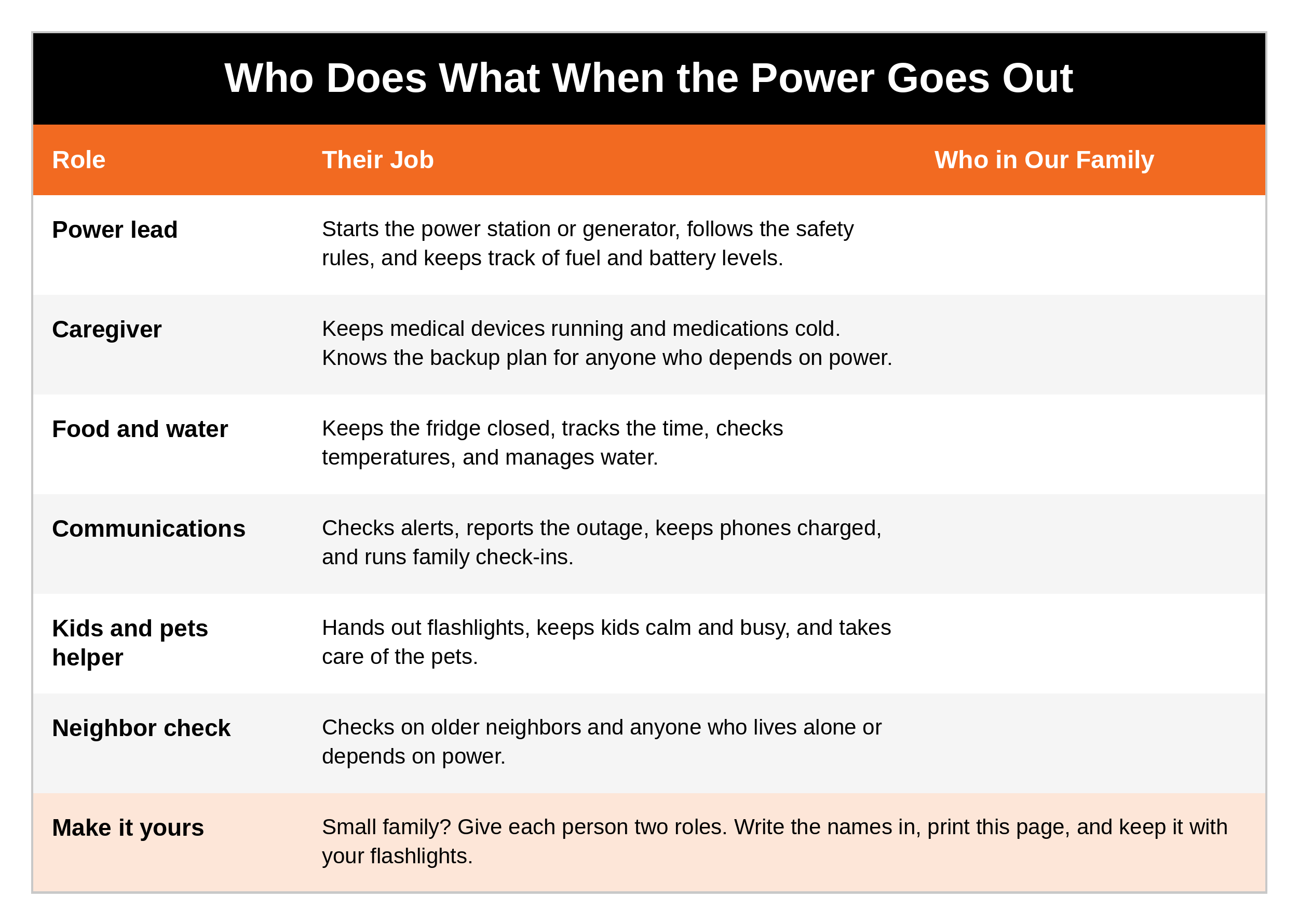
Write the names in, print the page, and keep it with your flashlights. If someone isn't home when the power goes out, the next person picks up their job.
If You Live in an Apartment or High-Rise
Water may stop on upper floors, because the pumps that push it up need power. Fill a few containers when a storm is coming.
Elevators stop. Plan for the stairs, and think about any neighbor who can't do them. If you're ever in an elevator when the power fails, stay calm, use the alarm or emergency phone, and wait for help. Never pry the doors or climb out.
Stairwells can be dark. Keep a headlamp by the door.
Generators usually aren't allowed. A power station is your best option, and it's safe indoors.
Check on older neighbors, especially anyone who lives alone.
When the Power Comes Back
Turn things back on a few at a time to avoid overloading circuits.
Check your food. Use your thermometers and the 4-hour, 48-hour, and 24-hour rules from Part 3. When in doubt, throw it out.
Recharge and refuel everything, so you're ready for the next one.
Restock batteries, water, and anything you used.
Talk it over as a family. What worked? What did we forget? Fix it while it's fresh.
Practice the Plan
Pick an evening, flip the main breaker (or just pretend), and live by the plan for a couple of hours. Run the power station, find the flashlights, and let everyone do their job. Kids usually love it. You'll find the gaps fast, and you'll fix them before they matter.
Bringing It All Together
Here's the whole series in a few lines:
Start small and learn your gear (Part 1).
Do the math for a real outage day (Part 2).
Protect the fridge, freezer, and medications, even when you're away (Part 3).
Recharge with the sun, and know whether your rooftop solar works in a blackout (Part 4).
Consider a home battery if your family can't afford to lose power (Part 5).
Run generators by the rules, every time (Part 6).
Make a plan and practice it (Part 7).
This is what being a prepared protector really means. It isn't about having the biggest generator on the block. It's about the person on oxygen who never had to worry, the kids who thought the blackout was an adventure, and the neighbor who got a knock on the door. It's about deciding ahead of time that the people who depend on you will be OK.
Coming Up Next
When the power goes out, your phone, your Wi-Fi, and sometimes the cell towers go with it. Next, we start the Emergency Communications series: how to stay in touch with your family, get trusted news, and call for help when the usual ways don't work.
Ask Yourself
Who in my home depends on power, and what's the plan for each of them?
Does everyone in my family know their job when the lights go out?
When was the last time we practiced?
Remember
Gear helps, but a plan is what keeps your family safe. Know who depends on power, and plan around them first. Power the critical things first. Give everyone a job. Never use a generator, grill, or camp stove indoors. Practice once, fix what you find, and you'll handle the real thing calmly.
Get Started Today
FREE GUIDE: Lights Out, The Prepared Not Paranoid Blackout Plan. Everything in this post, ready to print: what to do in the first 30 minutes, the first 24 hours, and beyond, what to power first, how long food stays safe, generator safety, a blackout supply checklist, and a page for your emergency contacts. Print it and keep it with your flashlights. [CTA: Comment or DM "KEYWORD" / or download it here: LINK]
Go Deeper
The Family Safety Toolkit. Your outage plan is one piece of being ready. The Toolkit gives you 20 checklists covering every area of family safety and preparedness, from your go bag and your vehicle to first aid and home safety, all for $19.99. [Get it here: https://www.preparednotparanoid.com/family-safety-toolkit]
The Family Emergency Preparedness Manual is coming soon.
Tools I recommend: The lanterns, headlamps, weather radios, power banks, battery-backup carbon monoxide alarms, and power stations I recommend are in my Backup Power Amazon store. https://link.amazon/B0aqcCOsk
Related reading:
Backup Power, Introduction: Staying Powered Up When It Goes Dark https://www.preparednotparanoid.com/pnp-library/alternative-power
Backup Power, Part 6: Generators https://www.preparednotparanoid.com/pnp-library/alternative-power-lesson6
First Aid and Trauma, Part 5: Kits for Kids, Seniors and Caregivers https://www.preparednotparanoid.com/pnp-library/first-aid-kids-seniors-caregivers
Emergency Communications https://www.preparednotparanoid.com/pnp-library/emergency-communications
References
FEMA / Ready.gov. Power Outages.
U.S. Department of Agriculture, Food Safety and Inspection Service. Keeping Food Safe During an Emergency.
U.S. Consumer Product Safety Commission. Portable Generator Safety.
Centers for Disease Control and Prevention. Carbon Monoxide Poisoning Prevention, and Extreme Heat.
MidAmerican Energy. Life Support Program. PNM. LifeWatch.
Disclaimer
These suggestions are intended to help you and your family build awareness, confidence, and safer decision-making habits. No safety plan, checklist, or training can guarantee 100% protection. This article is for general informational purposes only. If someone in your home depends on a medical device, talk to their doctor and equipment supplier about a backup plan. Always follow the manufacturer's instructions. Affiliate disclosure: I've linked to products from my Amazon store that I personally recommend. As an Amazon Associate, I earn from qualifying purchases, at no extra cost to you. Thank you for supporting my work.
If someone who depends on a medical device loses power and you can't restore it, or if a carbon monoxide alarm goes off or anyone feels sick, call 911.
Awareness gives you time. Time gives you options.
The prepared protector is someone who's decided that loving someone means being ready for them, not just hoping things go fine.
Prepared Not Paranoid. Protecting the Most Vulnerable Among Us.