What Stops Working, Your Options, and What to Power First
By Larry Betz | Prepared Not Paranoid https://www.preparednotparanoid.com/
In 2024, the average American home went about 11 hours without power, nearly twice the yearly average of the decade before. And that's just the average. Families in the path of the big hurricanes that year sat in the dark for days, some for weeks. We take for granted that everything will work when we wake up in the morning. Are you prepared for a long power outage? It's hard to picture until it happens. Here's where to start with backup power for your home.
I spent more than 20 years in the elevator industry in New York City, and I went through more than a few blackouts and brownouts, when the power drops and anything that runs on electricity stops working right. I've also been stuck in the subway during a power outage. None of it is fun. And most people don't realize how much they depend on power until it's gone.
What Stops Working When the Power Goes Out
It's more than the lights. Think about everything in your home and your town that depends on electricity:
Water. A well pump needs power. In tall buildings, so do the pumps that push water to the upper floors.
Food. Your refrigerator and freezer become coolers on a timer.
Medications. Insulin and many other medicines need to stay cold.
Medical devices. Oxygen concentrators, CPAP machines, nebulizers, and power wheelchairs all need power or charged batteries.
Heating and cooling. Most furnaces need electricity to run, even gas ones. Air conditioning stops completely.
Communications. Your Wi-Fi goes down, and cell towers only have limited backup power.
Security. Alarms and cameras run until their backup batteries die.
Your garage door. Know where the manual release cord is before you need it.
Your wallet. Gas pumps, ATMs, and card readers all need electricity.
Your town. Traffic lights go dark, and in big cities, subways and elevators stop.
A note on elevators: If you're ever in an elevator when the power fails, stay calm and stay put. Use the alarm button or emergency phone, and wait for help. Never try to pry the doors open or climb out on your own. Being stuck is uncomfortable. Climbing out is how people get hurt.
Keep cash on hand. If the power is out, gas stations may not be able to pump fuel unless they have backup power, and stores may not be able to take cards. Small bills are best.
Your Options at a Glance
There are four common ways to back up a home: portable power stations (big rechargeable batteries), whole-house battery systems, gas generators, and whole-house standby generators. Solar panels can recharge the batteries. Each one has a place. Here's how they compare.
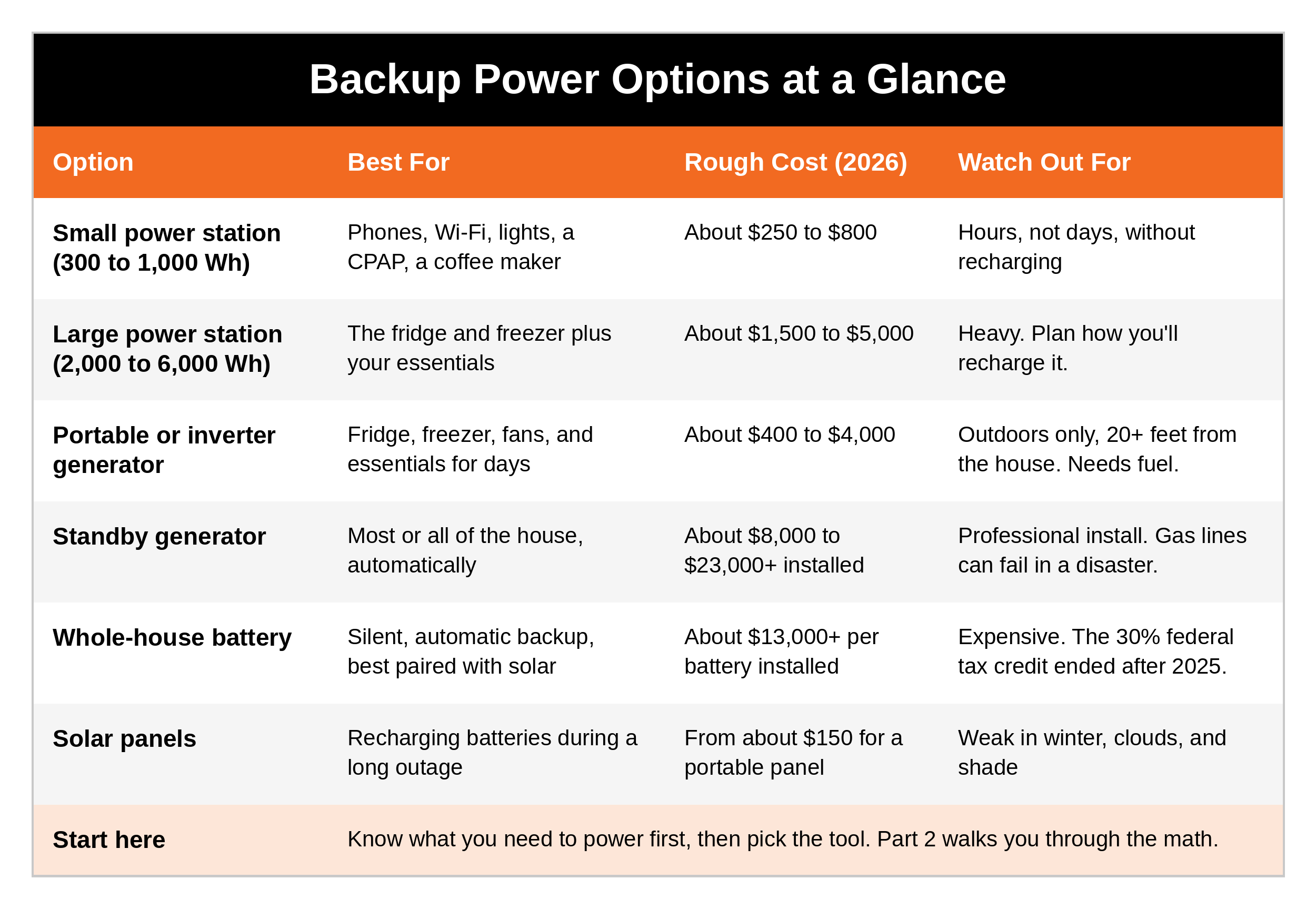
Two Questions to Ask Before You Buy Anything
1. What do you need to power, and for how long? A phone and a Wi-Fi router for one evening is a very different job than a refrigerator, a freezer, and a CPAP machine for three days. Part 2 of this series walks you through the math.
2. How will you recharge or refuel it? Every option eventually runs out. If you live somewhere with long, cloudy winters, solar might not be your best recharging option. If the nearest gas station is 30 minutes away, a gas generator might not be either. Pick the option that fits where you actually live.
What to Power First
When power is limited, and in an outage it always is, you have to choose. Here's the order I use.
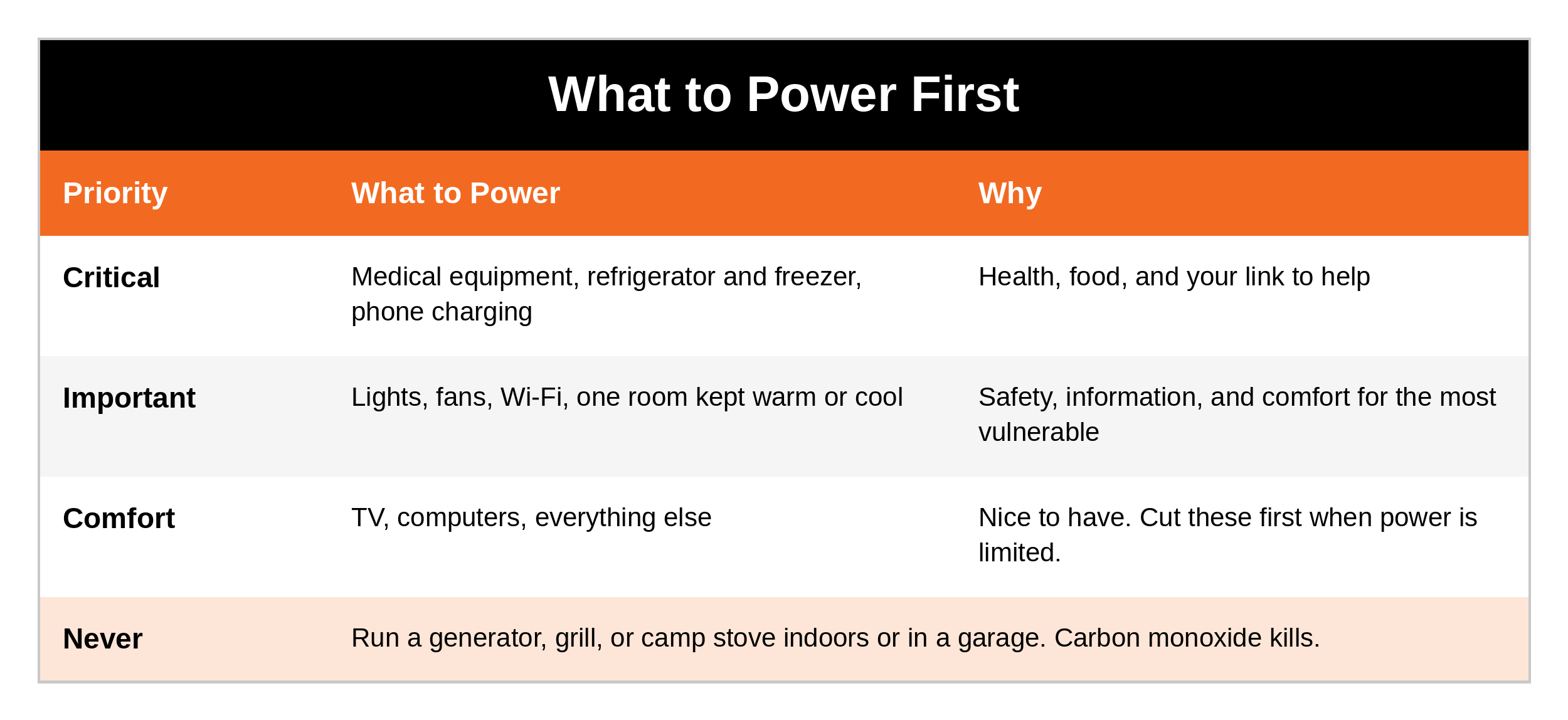
This is where being a prepared protector comes in. It isn't about running the whole house like nothing happened. It's about keeping the most important things running for the people who depend on you: the parent on oxygen, the child who needs their insulin cold, the family that needs to hear the weather alert.
What's Coming in This Series
Part 1: Start Small. Learn what a small power station can really do, before you spend big.
Part 2: Size Your System. The simple math for choosing the right size.
Part 3: Keep the Fridge and Freezer Running. Automatic backup, transfer switches, and food safety.
Part 4: Recharging With Solar. From portable panels to home solar.
Part 5: Whole-House Battery Backup. What it costs and what you get.
Part 6: Generators. Choosing, fueling, and running them safely, including carbon monoxide.
Part 7: Your Family's Power Outage Plan. Putting it all together.
Ask Yourself
If the power went out tonight for three days, what would we lose first?
Does anyone in my home depend on power for their health?
How would we keep food cold, phones charged, and the house safe?
Remember
Backup power isn't about running the whole house. It's about keeping the right things running. Know what you need to power, for how long, and how you'll recharge it. Medical needs, food, and communication come first. And never run a generator, grill, or camp stove indoors.
Get Started Today
FREE GUIDE: Lights Out, The Prepared Not Paranoid Blackout Plan. What to do in the first 30 minutes, the first 24 hours, and beyond when the power goes out, plus generator safety, a blackout supply checklist, and a page for your emergency contacts. Print it and keep it with your flashlight. [CTA: Comment or DM "KEYWORD" / or download it here: LINK]
Go Deeper
The Family Safety Toolkit. The blackout plan gets you through the outage. The Toolkit gives you 20 checklists covering every area of family safety and preparedness, from your go bag and your vehicle to first aid and home safety, all for $19.99. [Get it here: https://www.preparednotparanoid.com/family-safety-toolkit]
The Family Emergency Preparedness Manual is coming soon.
Tools I recommend: The power stations, solar panels, generators, battery-backup carbon monoxide alarms, and lighting I recommend are in my Backup Power Amazon store. https://link.amazon/B0aqcCOsk
Related reading:
Setting Up Your Mobile Command Center, Part 6: Fuel, Food and Surviving a Stranding https://www.preparednotparanoid.com/pnp-library/mobile-command-fuel-food-stranding
First Aid and Trauma, Part 5: Kits for Kids, Seniors and Caregivers https://www.preparednotparanoid.com/pnp-library/first-aid-kids-seniors-caregivers
Nutrition Basics, Part 16: Shop for Emergencies the Smart Way https://www.preparednotparanoid.com/pnp-library/nutrition-lesson-10
References
U.S. Energy Information Administration. "U.S. electricity customers experienced more hours without power in 2024" (December 2025).
FEMA / Ready.gov. Power Outages.
U.S. Consumer Product Safety Commission. Portable Generator Safety.
Centers for Disease Control and Prevention. Carbon Monoxide Poisoning Prevention.
Disclaimer
These suggestions are intended to help you and your family build awareness, confidence, and safer decision-making habits. No safety plan, checklist, or training can guarantee 100% protection. This article is for general informational purposes only. Prices are rough 2026 estimates and vary by location and installer. Always follow the manufacturer's instructions, and use a licensed electrician for any connection to your home's wiring. Affiliate disclosure: I've linked to products from my Amazon store that I personally recommend. As an Amazon Associate, I earn from qualifying purchases, at no extra cost to you. Thank you for supporting my work.
If a carbon monoxide alarm goes off or anyone feels dizzy, sick, or weak, get everyone outside to fresh air and call 911.
Awareness gives you time. Time gives you options.
The prepared protector is someone who's decided that loving someone means being ready for them, not just hoping things go fine.
Prepared Not Paranoid. Protecting the Most Vulnerable Among Us.