Matching the Tool to the Person, and the Plan to the Tool
By Larry Betz | Prepared Not Paranoid https://www.preparednotparanoid.com/
"What's the best self-defense tool?" It's one of the most common questions in self-defense, and the honest answer is simple: the best tool is the one you'll actually carry, know how to use, and have a plan for. There's no single best self-defense tool for everyone. A college student walking across campus at night, a runner on a canyon trail, and an aging parent living alone all need different things. In this final post of the series, we'll put every tool side by side, match the right ones to the people you protect, and bring it all back to the two things that matter most: awareness and a plan.
Awareness Comes First, Always
Before we compare a single tool, remember where this series started: not every problem is a gun problem, and most problems aren't a tool problem either. The most effective self-defense strategy is always to be aware of your surroundings and avoid dangerous situations when you can.
Here's the hard truth: in a true ambush, the chance of getting to any tool in time is slim. That's why the tools come after awareness, avoidance, and distance, not before. And the level of force you use must always match the level of danger you face.
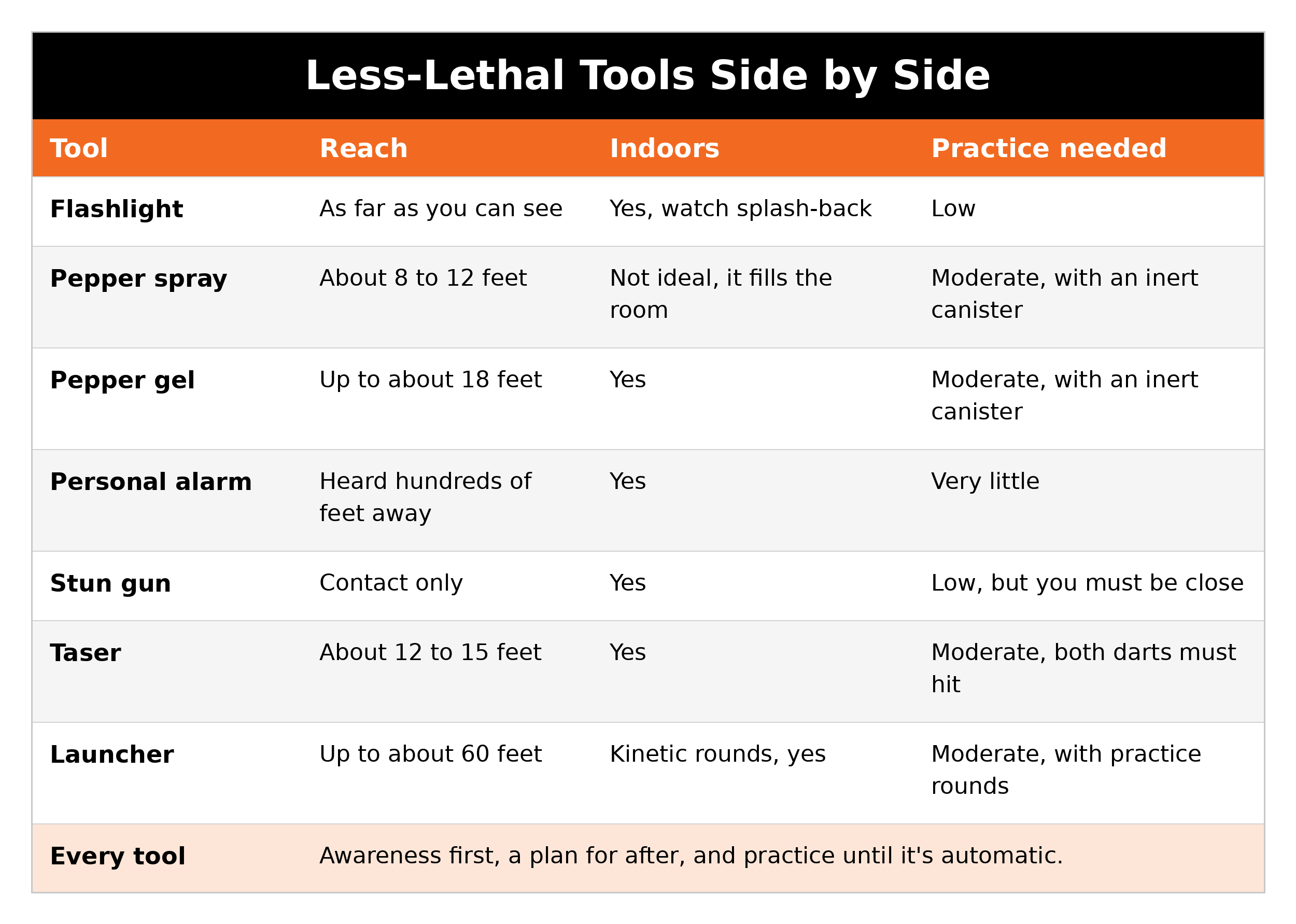
Every Tool Side by Side
Here's the whole series on one page.
Five Questions to Choose Your Tool
When you're deciding what to carry, ask yourself:
How much distance will I have? If you might need to stop someone before they reach you, choose a tool with reach: pepper gel, a Taser, or a launcher at home. A stun gun only works when they're already on you.
Where will I be? Indoors, choose gel over a spray mist, and kinetic launcher rounds over pepper. Outdoors in the wind, gel or a stream works better. On a plane or in another state, check the laws first (Part 8).
Will I actually carry it every day? A tool that's too big, too heavy, or too awkward ends up in a drawer. Pick something that fits your pockets, your purse, or your keys.
Can I access it? Carrying it isn't enough. Can you get it in your hand in two seconds, without looking, with either hand, while you're holding a child, groceries, or your keys? A tool at the bottom of a purse, in a zipped backpack, or locked in the glove box isn't there when you need it. At home, can you reach it from your bed in the dark, while keeping it out of reach of your kids?
Will I practice with it? If you won't practice, choose something simple, like a flashlight or an alarm. If you will, inert spray canisters and practice rounds make the other tools much more reliable.
Why Fewer Tools Can Make You Faster
Remember Hick's Law from the Intro: the more choices you have, the longer it takes to decide, and stress makes that delay worse. In my less-lethal presentations, I call it being an option facilitator. Our job is to give you good options, not a pile of gadgets.
So don't load up on every tool in this series. Choose one or two that fit your life, carry them every day, and practice until using them is automatic.
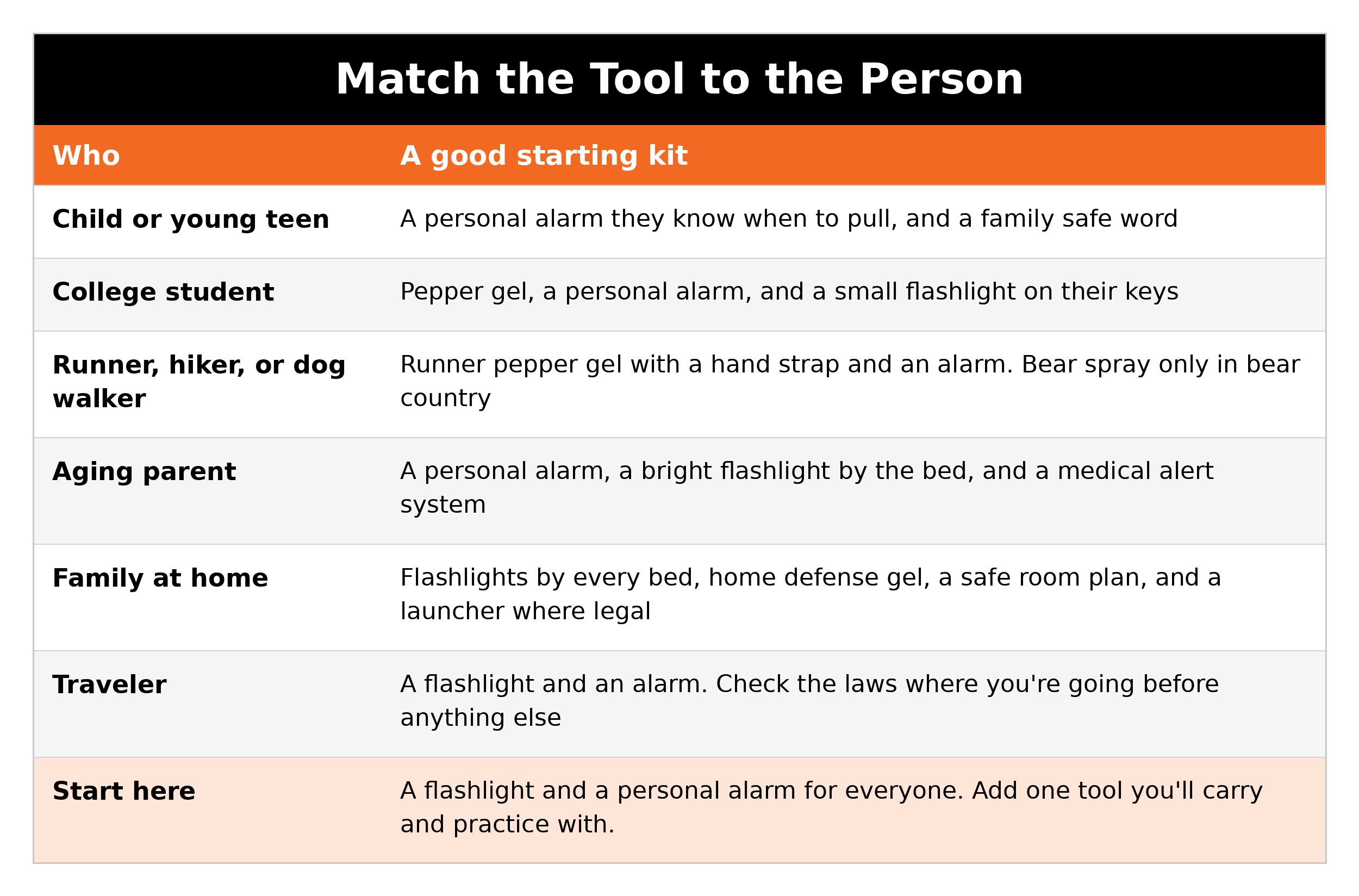
Match the Tool to the Person
A teenager, a college student, and an aging parent each need something different.
Here's where I'd start for the people you protect.
A few notes:
Kids: Pepper spray isn't for young children, and most states don't allow it for minors. A personal alarm they know how to use, plus a family safe word, is the right starting point.
College students: Check the school's policy on pepper spray before move-in day. Our College Safety Resource Center covers campus safety in depth.
Aging parents: A personal alarm makes noise, but it doesn't call anyone. Pair it with a medical alert system if they live alone. You'll find more in our Senior Safety Resource Center. [LINK]
Home defense: Your first tools are a locked door, a phone, and a safe room plan. A tool is for when that plan isn't enough.
Have a Plan
Every post in this series has come back to the same idea, and it's the most important one.
A Note From Larry
Remember, every one of these is a tool. You still need a plan. Situational awareness is always your number one go-to. If you ever need to use any tool, ask yourself: what is my plan after I use it? Where will I go? Who will I call? In most situations, running might be your best option. The tool buys you a few seconds. Your plan is what gets you home.
Your plan should answer three questions before you ever need it:
Before: What will I carry, where will I carry it, and how will I practice?
During: What will I say, and when will I use my tool?
After: Where will I go, who will I call, and what will I tell them?
Use SCAN Every Time
SCAN ties the whole series together:
S - See your environment. Head up, phone down. Notice people, exits, and anything that feels off.
C - Create space. Distance buys you time, and time gives you options.
A - Act deliberately. Make a decision and commit to it: leave, use your voice, or use your tool.
N - Never doubt your gut feelings. If something feels wrong, it probably is.
Rehearse It in Your Head
You don't need a training class to start practicing your plan. Run short "what if" scenarios during your day. Walking from your car to the grocery store, ask yourself: How would I react if someone approached me between two cars? What would I do if I were distracted loading groceries? A few seconds of thinking ahead means you aren't starting from zero when it counts.
The prepared protector doesn't just buy the tool. They choose it carefully, carry it, practice with it, and know exactly what they'll do before, during, and after.
What to Say
No matter which tool you carry, your voice comes first:
"Stop! Back up!"
"Leave me alone!"
To someone nearby: "You in the blue shirt, call 911!"
To 911: "I was attacked. I defended myself. I'm at [location]. I need police."
The Whole Series
Intro: Not Every Problem Is a Gun Problem [LINK]
Part 1: The Flashlight [LINK]
Part 2: How Pepper Spray Works and How to Choose One [LINK]
Part 3: Carrying and Using Pepper Spray [LINK]
Part 4: Personal Alarms and Air Horns [LINK]
Part 5: Stun Guns [LINK]
Part 6: Tasers [LINK]
Part 7: Pepper Ball Launchers [LINK]
Part 8: Laws and Travel [LINK]
If you're considering a firearm for home or personal defense, our firearms series picks up where this one leaves off. [LINK]
Ask Yourself
Does every person in my family have at least one tool that fits them, and do they know how to use it?
Do I carry my tool every day, and can I get it in my hand in two seconds without looking?
If I had to use it tonight, do I know where I'd go and who I'd call?
Remember
The best self-defense tool is the one you'll carry, practice with, and have a plan for. Awareness first, a tool that fits, and a plan for after. That's how you get home.
Get Started Today
Want every tool from this series in one place? The Less-Lethal Tool Comparison puts them side by side, matches each one to the people you protect, and walks you through building your plan with SCAN, so you can make the right choice for everyone in your family. [FREE DOWNLOAD: Less-Lethal Tool Comparison, coming soon] [CTA: Comment or DM "KEYWORD" / or download it here: LINK]
Go Deeper
The Family Safety Toolkit. This series helps you choose the right tools for your family. The Toolkit gives you 20 checklists covering every area of family safety and preparedness, from child and senior safety to home security, travel, and your go bag, all for $19.99. [Get it here: https://www.preparednotparanoid.com/family-safety-toolkit]
The Family Emergency Preparedness Manual is coming soon.
Tools I recommend: The pepper gels, alarms, stun guns, Tasers, and launchers from this series are in my Personal Safety Tools Amazon store https://link.amazon/B0cVLeoJM, and the flashlights I carry are in my Flashlights Amazon store https://link.amazon/B0giJW8RY.
Related reading:
Less Than Lethal Self-Defense Options, Intro: Not Every Problem Is a Gun Problem [LINK]
Less Than Lethal Self-Defense Options, Part 3: Carrying and Using Pepper Spray [LINK]
Less Than Lethal Self-Defense Options, Part 8: Laws and Travel [LINK]
References
Hick, W. E. "On the Rate of Gain of Information." Quarterly Journal of Experimental Psychology (1952).
Hyman, R. "Stimulus Information as a Determinant of Reaction Time." Journal of Experimental Psychology (1953).
Sources for each tool are listed in Parts 1 through 8 of this series.
Disclaimer
These suggestions are intended to help you and your family build awareness, confidence, and safer decision-making habits. No safety plan, checklist, or tool can guarantee 100% protection. This article is for general informational purposes only and is not legal advice or a substitute for professional training. Self-defense tool laws vary by state, city, and country, so check your local laws before you buy, carry, or travel. Use any self-defense tool only in true self-defense. Affiliate disclosure: I've linked to products from my Amazon store that I personally recommend. As an Amazon Associate, I earn from qualifying purchases, at no extra cost to you. Thank you for supporting my work.
If you are in immediate danger, get to safety and call 911.
Awareness gives you time. Time gives you options.
The prepared protector is someone who's decided that loving someone means being ready for them, not just hoping things go fine.
Prepared Not Paranoid. Protecting the Most Vulnerable Among Us.