What to Check Before You Buy, Carry, or Fly
By Larry Betz | Prepared Not Paranoid https://www.preparednotparanoid.com/
The pepper spray on your keychain might be perfectly legal at home and illegal the moment you cross a state line or walk into an airport. Self-defense tool laws are a patchwork. They change from state to state, sometimes from city to city, and they change over time. In this post, we'll walk through pepper spray laws and the rules for stun guns, Tasers, and launchers, the places you usually can't carry them, and how to travel with each one. This isn't legal advice. It's a guide to the questions you need to ask before you buy or carry.
Using a Tool Is Using Force
Before we get into what's legal to own, remember this: owning a tool and using it are two different legal questions. Pepper spray, stun guns, Tasers, and launchers are all legal only for self-defense. If you use one, the law will look at whether a reasonable person in your situation would have believed force was necessary, and whether the force you used matched the danger you faced.
A Note From Larry
A tool is a tool. You still need a plan, and that plan includes the law. Using pepper spray or a stun gun on someone is using force, and you'll be held to the same standard as any other use of force. Never use a tool to win an argument, scare someone off your property, or get even. Use it to stop a real threat, then get away and call 911. Situational awareness is always your number one go-to.
If you also carry a firearm, the same warning from the Intro applies: showing a gun when deadly force isn't justified can get you charged with a crime in many states. Your less-lethal tools give you options below that line. We'll cover use of force in much more detail in the firearms series. [LINK]
Pepper Spray Laws
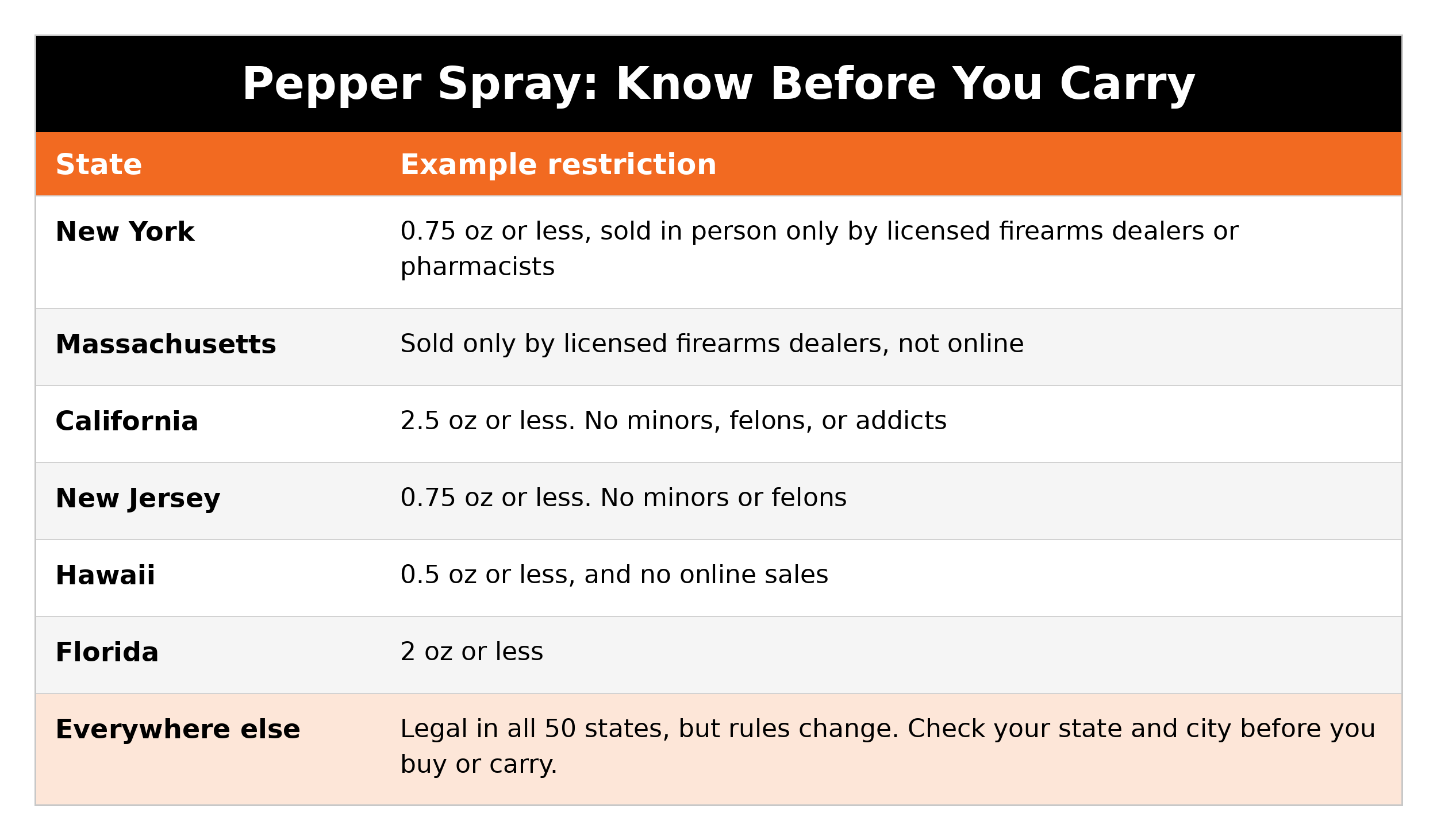
Pepper spray is legal in all 50 states for self-defense, but each state can set its own rules on size, strength, age, and where you can buy it. Here's what those rules usually cover:
Size and strength limits: Many states limit how big the canister can be, and a few limit how strong it can be.
Age limits: Most states require you to be at least 18 to buy or carry pepper spray, though some allow younger teens with a parent's permission.
Where you can buy it: A few states only allow sales through licensed firearms dealers or pharmacists, in person, with no online sales or shipping.
Formula limits: Some states don't allow certain formulas, like sprays that add tear gas.
Self-defense only: In nearly every state, pepper spray is legal only for self-defense. Using it offensively, or in a situation that isn't self-defense, can lead to criminal charges.
Here are some examples of how much the rules can vary.
Stun Gun and Taser Laws
Stun guns and Tasers are legal in most states, with specific rules. Depending on where you live, you may run into:
Age limits, often 18 or 21.
Permits or licenses, in some states, to buy or carry.
Purchase rules, like showing ID at the counter. In Arizona, for example, you need ID to buy a stun gun, and you can't buy one online.
City bans, like Chicago, where possession and carry are prohibited.
Restricted places, like schools, courthouses, and some public buildings.
Prohibited people, like felons.
Rules for stun guns and Tasers have changed a lot in recent years as courts have weighed in, so check your current state and city laws before you buy.
Pepper Ball Launcher Laws
Launchers like the Byrna and SABRE are not firearms under federal law, but states and cities treat them very differently:
Banned or currently illegal in some places, including New York State, North Carolina, and Washington, D.C. (pepper launchers), and not legal for sale in Massachusetts.
Live projectiles and tear gas are illegal in California, where kits come with inert rounds instead.
Regulated like firearms in some states, where felons and minors can't possess them.
Home defense only in some cities.
Restricted near schools and limited for concealed carry in some states.
Using chemical irritant projectiles for anything other than self-defense is a crime everywhere. Always check your state, county, and city laws before you buy, carry, or transport a launcher, including how you carry it in your vehicle.
Places You Usually Can't Carry
Even where a tool is legal, there are places where it usually isn't allowed:
Airports past the security checkpoint
Federal buildings, courthouses, and post offices
K-12 schools, and often school events
Many college campuses, depending on the school's policy (college students, check your student handbook)
Concert venues, stadiums, and theme parks with bag checks
Private businesses that post a "no weapons" sign or ask you to leave
When in doubt, leave it in the car (if it's legal and safe to store there, and remember the heat warning from Part 3), or leave it at home.
Flying With Less-Lethal Tools
This is where a lot of people get caught, usually by accident at the security checkpoint.
Here's the quick version.
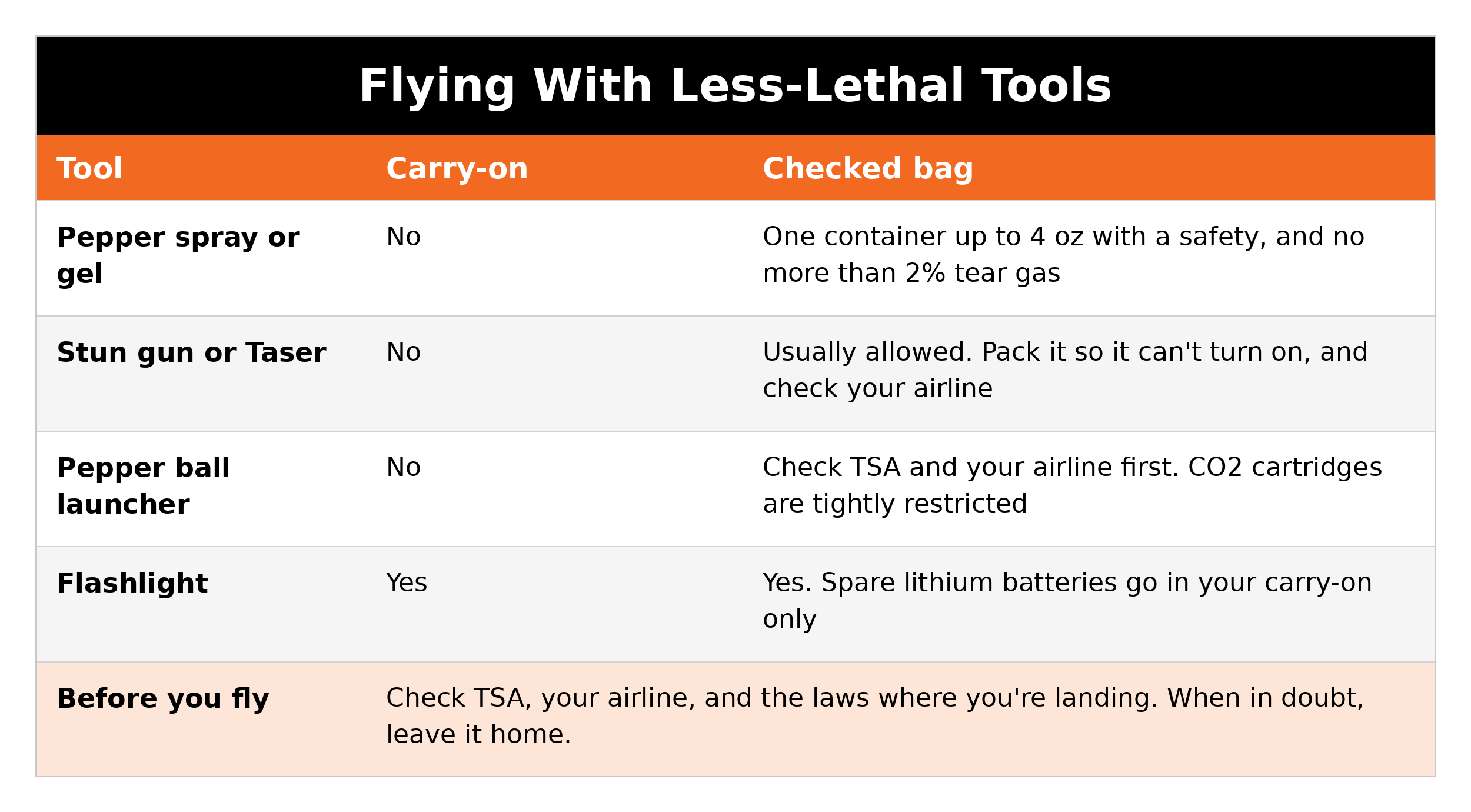
Pepper spray: Never in your carry-on. TSA allows one container up to 4 ounces in your checked bag, if it has a safety mechanism to prevent accidental discharge. Sprays with more than 2% tear gas aren't allowed at all. Your airline can have stricter rules, so check with them too.
Stun guns and Tasers: Never in your carry-on. They're generally allowed in checked bags, but pack them so they can't turn on, and check your airline's rules and battery rules before you go.
Pepper ball launchers: Never in your carry-on. Check with TSA and your airline before packing one in a checked bag. The CO2 cartridges are tightly restricted on flights, so it's often easier to leave the launcher at home or buy CO2 at your destination where legal.
Flashlights: Allowed in both carry-on and checked bags. Spare lithium batteries go in your carry-on only (see Part 1).
Your destination matters too. A tool that's legal to fly with may be illegal where you land. Check the laws at your destination before you pack.
The easiest plan for many families is simple: fly without it, and buy a small, legal pepper spray or gel when you arrive (where it's legal), then leave it behind or ship it home properly.
Traveling Abroad
If you're leaving the country, assume your self-defense tools are not welcome until you've confirmed otherwise. Many countries ban or tightly restrict pepper spray, stun guns, and launchers. In the United Kingdom, for example, pepper spray is a prohibited weapon, and in Canada, pepper spray made for use on people is prohibited. Carrying one by mistake can mean arrest, fines, or worse.
Before you travel, check the U.S. State Department's travel page for your destination and that country's own laws. For international trips, your best tools are often the ones you can always bring: your awareness, a good flashlight, a personal alarm, and a plan. Our Travel Safety Resource Center has more on staying safe abroad.
Use SCAN on the Law, Too
SCAN works for more than danger on the street:
See your environment: Know the laws where you are and where you're going.
Create space: Give yourself time to research before you travel, not at the checkpoint.
Act deliberately: Pack it right, or leave it home.
Never doubt your gut feelings: If you're not sure it's legal, don't carry it until you are.
Ask Yourself
Do I know my state's rules on the size and type of pepper spray I carry?
Is there a self-defense tool in my bag right now that would get stopped at airport security?
Does my college student know their school's policy on pepper spray?
Remember
Legal at home doesn't mean legal everywhere. Check your state and city laws before you buy or carry, never put a self-defense tool in your carry-on, and remember that using any tool is using force.
Get Started Today
[FREE DOWNLOAD: Less-Lethal Tool Comparison, coming soon] [CTA: Comment or DM "KEYWORD" / or download it here: LINK]
Go Deeper
Situational Awareness and Safe Family Travel Strategies. This post helps you travel with your self-defense tools the right way. The book goes much further, with practical strategies for keeping your family safe on the road, in airports, at hotels, and abroad. [Get it here: LINK]
The Family Emergency Preparedness Manual is coming soon.
Tools I recommend: The travel-friendly flashlights, personal alarms, and pepper gels I recommend are in my Personal Safety Tools Amazon store. https://link.amazon/B0cVLeoJM
Related reading:
Less Than Lethal Self-Defense Options, Part 3: Carrying and Using Pepper Spray [LINK]
Less Than Lethal Self-Defense Options, Part 7: Pepper Ball Launchers [LINK]
Less Than Lethal Self-Defense Options, Part 9: Choosing the Right Tool [LINK]
References
Transportation Security Administration. What Can I Bring? Self-Defense Sprays; Stun Guns/Shocking Devices.
Federal Aviation Administration. PackSafe printable chart; Small Compressed Gas Cylinders.
SABRE. Pepper Spray Laws by State.
SABRE. Stun Gun State Laws.
SABRE. Projectile Launcher State Laws.
U.S. Department of State. Country-specific travel information.
Disclaimer
These suggestions are intended to help you and your family build awareness, confidence, and safer decision-making habits. No safety plan, checklist, or tool can guarantee 100% protection. This article is for general informational purposes only and is not legal advice. Self-defense, weapon, and use-of-force laws vary by state, county, city, and country, and they change often. Check current laws where you live and where you're traveling, and talk to a qualified attorney about your specific situation. TSA and airline rules can change, and the TSA officer at the checkpoint makes the final decision. Affiliate disclosure: I've linked to products from my Amazon store that I personally recommend. As an Amazon Associate, I earn from qualifying purchases, at no extra cost to you. Thank you for supporting my work.
If you are in immediate danger, get to safety and call 911.
Awareness gives you time. Time gives you options.
The prepared protector is someone who's decided that loving someone means being ready for them, not just hoping things go fine.
Prepared Not Paranoid. Protecting the Most Vulnerable Among Us.