Why Kids Need the Words Before They Need Them
By Larry Betz | Prepared Not Paranoid https://www.preparednotparanoid.com/
Updated November 3, 2026
Body safety for kids starts long before anything goes wrong. A child who has the words, knows the rules, and knows who to tell is a child who can speak up. Here's where to start.
Imagine this. A six-year-old girl comes home from school every day, and every day her mom asks the same question.
"How was your day?"
"Fine."
There's a teacher's aide who's been extra kind to her. He sits with her during reading time. He tells her he's helping her. Over a few months, she starts wetting the bed again. She doesn't want her mom in the room when she changes. When her uncle goes to hug her, she flinches.
Her parents notice. They chalk it up to a phase. Kids go through phases.
She knew something was wrong. She didn't have the words to say it.
That's what this series is about. Not scaring kids. Giving them the words, the rules, and the trusted adults they need, before they ever need them.
Why "Don't Let Anyone Touch You" Isn't Enough
Most of us gave our kids some version of the same warning. Don't talk to strangers. Don't let anyone touch you.
The problem is that people who harm children rarely announce themselves. They don't say, "I'm going to do something wrong." They say:
"I'm helping you."
"It's a game."
"This is our special secret."
"You're so mature for your age."
Our kids do what we taught them to do. They listen to adults. They're polite. They follow directions. That's how we raised them, and a person with bad intentions counts on it.
Most Abuse Comes From Someone the Child Knows
According to the CDC, at least 1 in 4 girls and 1 in 20 boys in the United States experience child sexual abuse, and about 90% of the time, the abuser is someone the child or family knows and trusts.
I covered this in detail in The Creepy Coach series. "Creepy" isn't a look. It's a pattern: access, secrecy, boundary testing, isolation, and control. This series is the other half of that conversation. Creepy Coach teaches you what to watch for in adults. This series teaches your child what to do.
Body Safety for Kids, Step 1: My Body Deserves Respect
Kids can learn early that their bodies deserve care and respect. That includes the right to say no to ordinary affection like hugs, kisses, tickling, or sitting on someone's lap.
It also goes both ways. Kids learn to ask before they touch someone else, and to stop when someone says stop.
What to Say:
"Your body is important, and it deserves respect. You can say no to a hug, a kiss, or tickling. You can wave, give a high-five, or a fist bump instead. Other people get to say no too, so we ask first and we stop when they say stop."
Adults Have to Model It
This is where most families slip, and I understand why. Grandma wants a kiss. Uncle Joe wants a hug. Nobody wants to hurt anyone's feelings. With the holidays coming, those moments are about to happen a lot.
But if we force affection at family gatherings, we're teaching our kids that an adult's feelings matter more than their own comfort. That's the exact lesson an abuser is hoping they've learned.
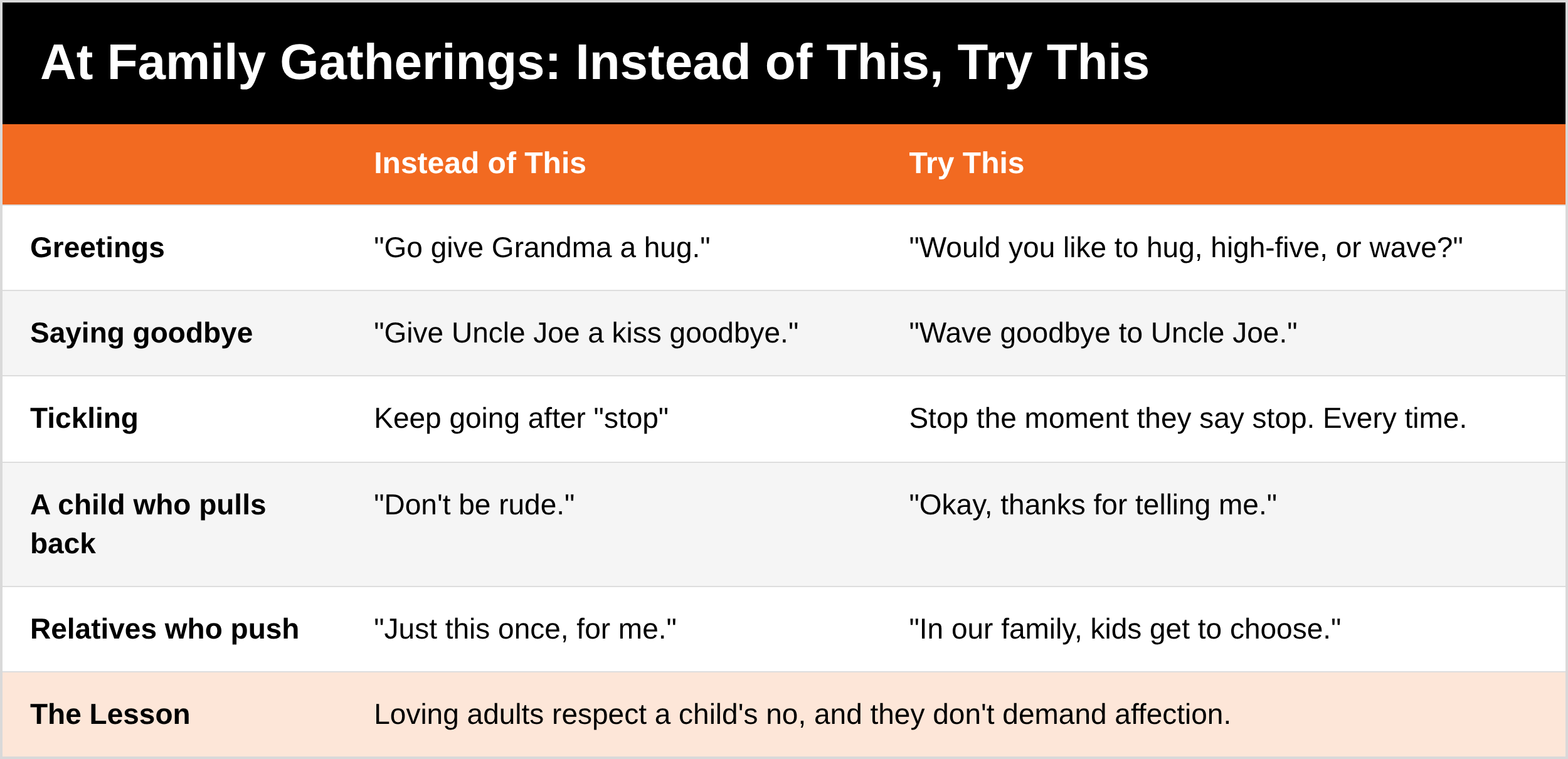
Ask first: "Would you like a hug?" instead of opening your arms and waiting.
Accept "no" warmly: "Okay, thanks for telling me."
Stop tickling or wrestling right away when your child says stop. Every time.
Don't guilt or tease a child for not wanting affection, and don't call them rude.
Remember: Grandma isn't doing anything wrong by asking for a kiss. The lesson is that loving adults respect a child's "no," and they don't demand affection.
Step 2: Clear Names and Private Parts
Teach your child the correct names for every part of their body, in the same calm voice you'd use for "elbow" or "knee." Depending on your child, that includes penis, testicles, vulva, vagina, buttocks, chest, and anus.
I know some parents squirm at this. Here's why it matters.
A child who can say exactly what happened is easier for adults to understand, and easier to believe. "He touched my cookie" can be missed. "He touched my vagina" can't. Kids who use correct names also send a message to anyone testing boundaries: this child talks to her parents.
The Prepared Protector Uses the Real Words
Nicknames feel softer, and that's exactly the problem. A child with "cute" words for their body sounds like a child who's never talked about it. A Prepared Protector says the real words calmly and early, at bath time and at the doctor's office, until they're just words. That calm voice tells your child two things: nothing about their body is too embarrassing to talk about, and you're the person to talk to.
What to Say:
"Every part of your body has a name. Your private parts are the parts covered by your swimsuit, and your mouth too. Private doesn't mean bad or embarrassing. It just means we have special rules about who can see or touch those parts, and why."
The Privacy Rule
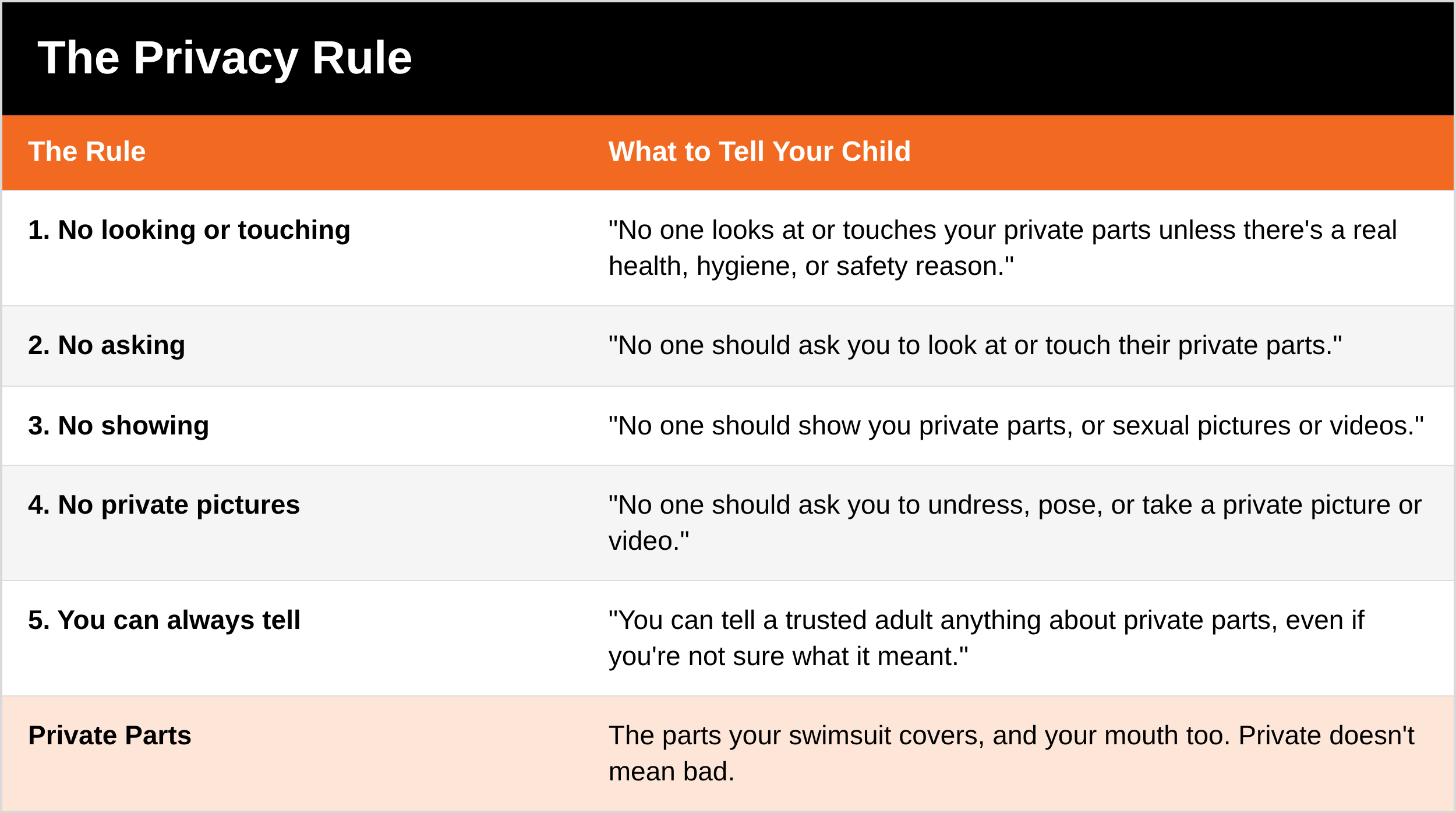
Teach these five rules, and come back to them often:
No one should look at or touch your private parts unless there's a real health, hygiene, or safety reason.
No one should ask you to look at or touch their private parts.
No one should show you private parts, or sexual pictures or videos.
No one should ask you to undress, pose, or take a private picture or video.
You can always tell a trusted adult about anything that has to do with private parts, even if you're not sure what it meant.
If your child uses a nickname, that's fine. Acknowledge it, and add the correct word without making a big deal of it.
Better Questions Than "How Was Your Day?"
"How was your day?" gets "fine" almost every time. Try questions that open a door instead:
"What was the best part of today? What was the hardest part?"
"Who did you sit with at lunch?"
"Did anyone make you feel uncomfortable or confused today?"
"Did anyone ask you to keep a secret?"
The good answers usually don't come at the dinner table. They come in the car, at bedtime, or over a snack. I go deeper on this in Summer Camp Safety, Part 4.
Signs That Aren't Always "Just a Phase"
Kids change for a lot of reasons, and most of them are normal. One sign on its own isn't proof of anything. But a pattern deserves calm attention.
Bedwetting after being dry for a long time
Not wanting to undress in front of a parent when they never minded before
Flinching, pulling away, or new fear around a certain person or place
Sexual words or behavior beyond their age
Nightmares, new clinginess, or sudden anger
Not wanting to go to a certain activity, house, or person they used to like
If you notice a pattern, don't interrogate. Stay close, stay calm, and keep the door open. In Part 4, I'll walk through exactly what to say and do if your child tells you something.
Ask Yourself
Does my child know the correct names for every part of their body?
Do I make my child hug or kiss relatives, even when they don't want to?
If something happened to my child, would they have the words to tell me?
5 Quick Wins You Can Start Today
Use one real word tonight. At bath time, name one body part correctly, in the same voice you'd use for "elbow."
Teach the swimsuit rule. "The parts your swimsuit covers, and your mouth, are private."
Try a better question. Swap "How was your day?" for "What was the hardest part of today?"
Give your child an out at gatherings. "You can wave or give a high-five instead of a hug."
Say the promise. "You can always tell me anything about your body, even if you're not sure what it meant."
Remember
Kids can't report what they can't name. Give them the words before they need them.
Coming Up in Part 2
The Rules Apply to Everyone. Relatives, coaches, teachers, doctors, and older kids. Why "good touch, bad touch" fails, and what to teach instead.
Get Started Today
Get the free Child Safety bundle. It includes When Trusted Adults Cross the Line, a quick-reference checklist of the warning signs in coaches, teachers, and other trusted adults, plus the Summer Camp Safety Checklist, Family Tech Rules, and more. DM the word [KEYWORD] on Instagram or Facebook and I'll send it to you. [Get it here: LINK]
Go Deeper
The Family Safety Toolkit. This post gives you the first two steps. The Toolkit gives you 20 complete safety checklists in one place, including a full Child Safety section for trusted adults, camp, water safety, online safety, and Halloween. That's 244 pages your family can actually use, for $19.99. [Get it here: LINK]
Coming soon: the Child Safety Manual. This series gives you the first steps. The manual will give you the full family guide: seven step-by-step body-safety conversations, the worksheets to go with them, and age-by-age scripts, so you're never searching for the right words.
Tools I recommend: The child safety gear and books I actually recommend are in my Children's Safety Amazon store. https://amzn.to/4hcldVo
The full series:
My Body, My Boundaries, Part 2: The Rules Apply to Everyone [LINK]
My Body, My Boundaries, Part 3: "If You Say Don't Tell, I Have to Tell" [LINK]
My Body, My Boundaries, Part 4: Sleepovers, Safe Words, and When Kids Harm Kids [LINK]
Related reading:
The Creepy Coach, Part 1: "Creepy" Is Not a Look. It's a Pattern. [LINK]
Summer Camp Safety, Part 4: Preparing Your Child and the Conversation After Camp [LINK]
Child Safety Resource Center [LINK]
References
Centers for Disease Control and Prevention. About Child Sexual Abuse. https://www.cdc.gov/child-abuse-neglect/about/about-child-sexual-abuse.html
American Academy of Pediatrics. 10 Tips for Parents to Teach Children About Body Safety and Boundaries. https://www.aap.org/en/news-room/news-releases/health--safety-tips/10-tips-for-parents-to-teach-children-about-body-safety-and-boundaries/
RAINN. Children and Sexual Violence. https://rainn.org/get-informed/issues/children-and-sexual-violence/
Betz, L. The Creepy Coach series, Prepared Not Paranoid.
Disclaimer
This article is for general informational and educational purposes only. It is designed to help families start important conversations. It is not a substitute for professional advice, training, or services, including medical, mental health, legal, or law enforcement guidance. No safety plan, checklist, or training can guarantee 100% protection. Laws and reporting requirements vary by state, so check your state and county for the exact rules where you live. Do not use this article to investigate or repeatedly question a child. If you suspect abuse, contact a professional right away. Affiliate disclosure: I've linked to products from my Amazon store that I personally recommend. As an Amazon Associate, I earn from qualifying purchases, at no extra cost to you. Thank you for supporting my work.
If you suspect a child is being abused, contact local law enforcement, your state's child protective services, or the Childhelp National Child Abuse Hotline at 1-800-422-4453 (call or text). If a child is in immediate danger, call 911.
Awareness gives you time. Time gives you options.
The Prepared Protector is someone who's decided that loving someone means being ready for them, not just hoping things go fine.
Prepared Not Paranoid. Protecting the Most Vulnerable Among Us.