How to Look Past the Brochure and Choose a Safe Camp
By Larry Betz | Prepared Not Paranoid https://www.preparednotparanoid.com/
Updated November 3, 2026
Choosing a safe summer camp takes more than a great website and a busy activity calendar. There's no national camp safety code, so the questions are up to you, and the best time to ask them is before the deposit is paid.
When parents start looking at summer camps, the conversation usually sounds the same. What activities do they offer? How many weeks? Can my child bring a phone? Will they make friends?
Those are fair questions. But there's a more important one that most families never ask out loud:
Who is going to be watching my child, and what systems are in place to keep my child safe?
Many camps open registration for next summer in the fall and winter, and the best spots fill fast. That's exactly why now is the time to ask these questions, before the deposit is paid and the decision is made.
Camp can be one of the best experiences of a child's life. It builds confidence, independence, and friendships that last for years. This series is not about scaring you away from camp. It's about helping you choose one with your eyes open.
There Is No National Camp Safety Code
This surprises most parents. In the United States, there is no single national standard for camp safety. Licensing, inspections, staff screening, and emergency planning rules are set state by state, and they vary widely.
When CBS News investigated camp safety in December 2018, it found that eight states had no licensing requirement for overnight camps, and 18 states did not require background checks for camp employees. Some states have tightened their rules since then. Many have not.
The type of program matters too. A day camp, an overnight camp, a church camp, a sports camp held on a college campus, and a specialty camp for kids with medical needs may all fall under different rules, or under almost no rules at all.
So the first question isn't "Is this camp safe?" It's "Who checks?"
Licensing vs. Accreditation: What's the Difference?
These two words get used like they mean the same thing. They don't.
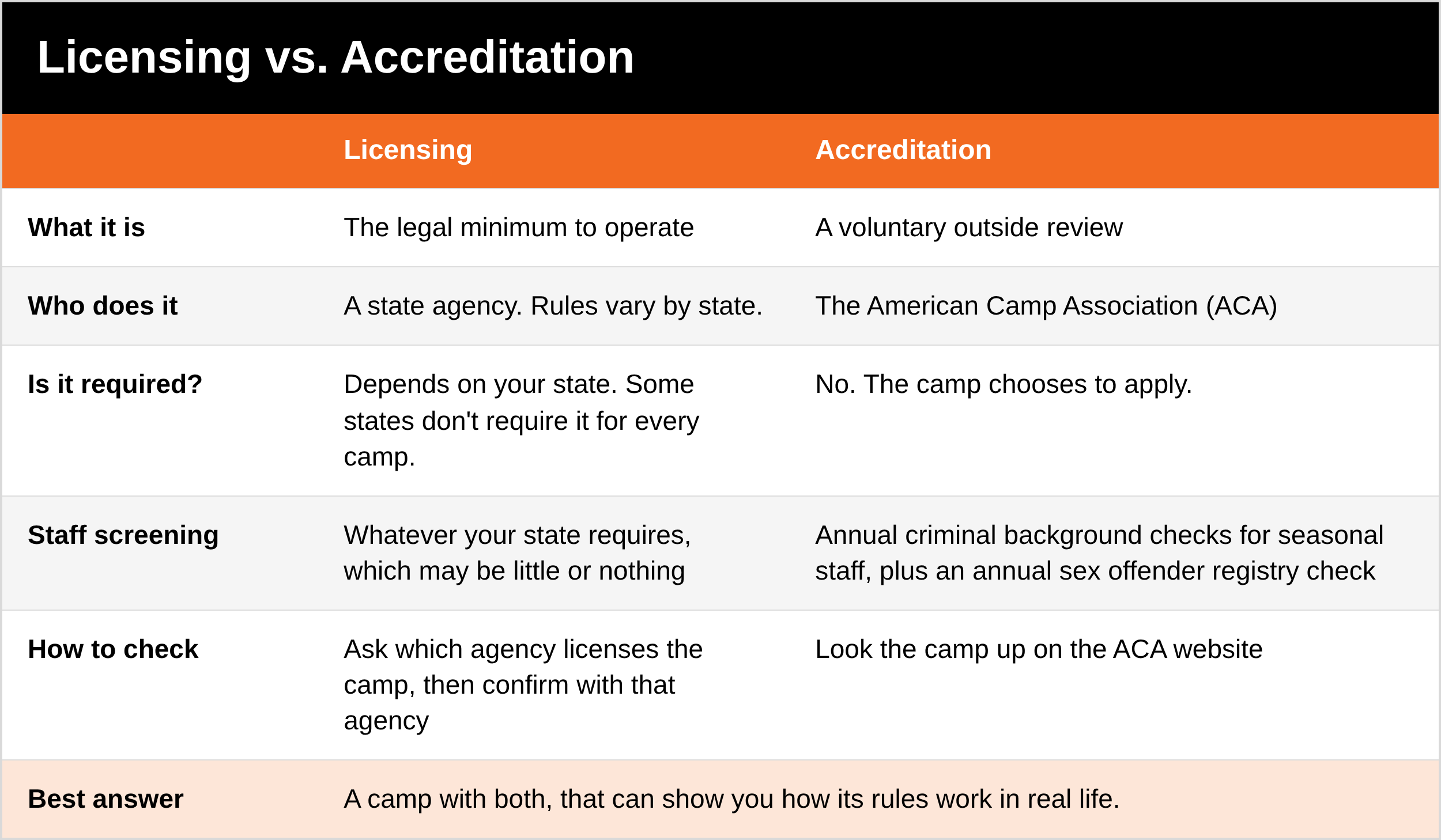
Licensing is the legal minimum. It's the state saying a camp met the basic requirements to operate. Ask which state agency licenses the camp, then verify with that agency that the license is current and in good standing.
Accreditation is voluntary. The American Camp Association (ACA) reviews camps against standards for health, safety, staff training, and risk management. For example, ACA standards require an annual criminal background check on all seasonal staff, interviews and reference checks when staff are hired, an annual check of the National Sex Offender Public Website, and a signed disclosure statement from staff every year.
Accreditation is a good sign. It means the camp invited an outside review. But it is not a guarantee that every staff member will follow every rule every day.
A strong camp has both, and it can show you how its rules work in real life.
Texas Shows How Camp Rules Really Change
If you want proof that camp safety rules often change only after something goes wrong, look at Texas.
On July 4, 2025, catastrophic flash flooding hit the Texas Hill Country. The Guadalupe River rose with almost no time to react. More than 130 people died, including 27 campers and counselors at Camp Mystic, an all-girls camp that had operated along the river for nearly a century.
Two months later, on September 5, 2025, Texas signed the Heaven's 27 Camp Safety Act into law, named for the girls and counselors who died. Among other things, the new rules:
Prohibit sleeping cabins in FEMA-designated floodplains, with limited exceptions
Require weather alert radios and a camp-wide warning system that works without internet
Require written emergency action plans for floods, storms, lost campers, and injuries, submitted to the state every year
Require annual staff emergency training and evacuation drills
Require camps to tell parents in writing if any part of the camp sits in a floodplain
Those changes came at a heavy price, and the rollout has not been simple. In May 2026, with summer about to start, only nine Texas camps had been approved under the new rules, and more than 300 were still waiting for licenses.
Here's the part every parent outside of Texas should hear. Families who lost daughters at Camp Mystic took their fight to other states. One of those mothers, Dr. Jill Marsh, put it simply: "It was a big surprise, both in Texas and here, to see how little is required and is just self-regulated."
It worked in her home state. In April 2026, Alabama signed the Sarah Marsh Heaven's 27 Camp Safety Act, named for her 8-year-old daughter. Missouri lawmakers have considered similar bills. Most states still haven't acted.
These families have been clear that they are not anti-camp. Neither am I. But if your state hasn't changed its rules, then the questions are up to you.
Asking about licensing, emergency plans, staff training, and reporting policies is not overreacting. It's doing your homework.
Why Child Protection Belongs in This Conversation
Floods and storms make headlines. Abuse usually doesn't, until years later.
That same 2018 CBS News investigation identified 578 people who reported being sexually abused at children's camps over a 55-year period, with 21 cases surfacing in 2018 alone. The number itself is dated. The lesson is not.
Camps put children away from home, outside their routines, and around adults and older kids they don't know well. Seasonal staff, overnight supervision, and one-on-one access all raise the stakes when screening and supervision are weak. We'll cover this fully in Part 2.
Look Beyond the Brochure to Find a Safe Summer Camp
A beautiful website, a busy activity calendar, and a well-known name do not prove a camp is safe. Before you pay a deposit, do a little digging.
Review what's in writing. Look for:
Named leadership, not just a logo and a phone number
A physical address and emergency contact information
Who provides health care, and when they're on site
Written child-protection rules
How parents are notified when something happens
A way to report a concern that doesn't go only through the camp director
Search online. Type the camp's name and the director's name along with words like complaint, lawsuit, inspection, violation, license, abuse, injury, flood, and closure. A clean search doesn't prove safety. An online accusation doesn't prove wrongdoing. But both can tell you which questions to ask.
Visit if you can. Walk the property and pay attention to:
Who can walk onto the grounds, and whether anyone notices
Whether staff are engaged with kids or looking at their phones
How bathrooms and changing areas are set up
How close the water is, and how access to it is controlled
Where kids sleep, and where staff sleep
How drop-off and pickup work
Whether leaders answer your questions calmly
That last one matters more than you'd think.
Red Flags in How Leadership Answers
A trustworthy camp understands why parents ask hard questions. Good directors welcome them because it shows you care.
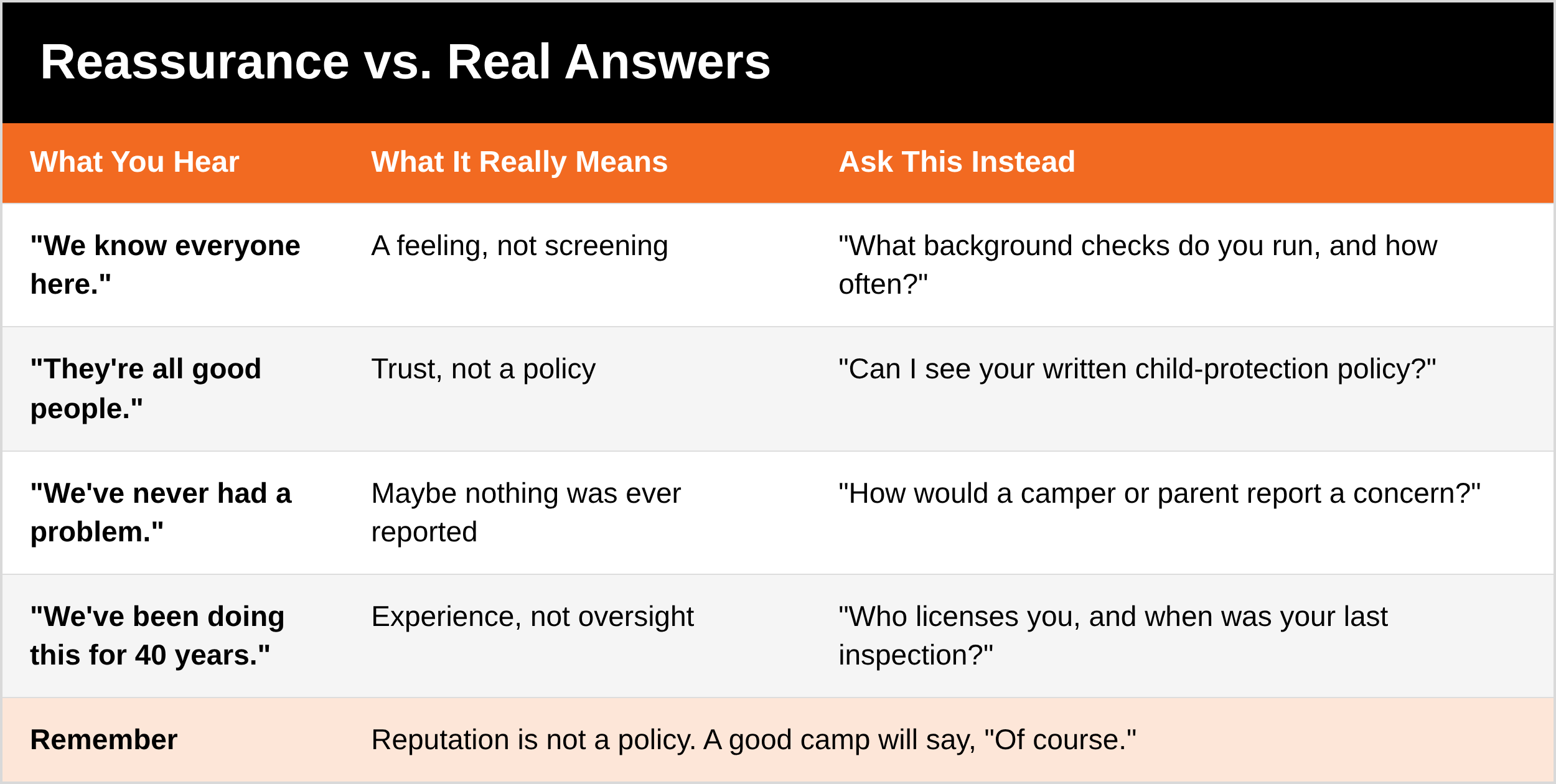
Be cautious when you hear answers like these:
"We know everyone here."
"They're all good people."
"We've never had a problem."
"We've been doing this for 40 years."
None of those answers describe a safeguard. They describe a feeling. Reputation is not a policy.
The Prepared Protector Asks for the Plan
When I was a Safety Director, "we've never had an accident" was never an answer. It usually meant nobody had written anything down. A real safety program is on paper, people are trained on it, and someone is responsible for it. A Prepared Protector asks a camp the same thing: show me the plan, and tell me who owns it.
Other red flags:
Leaders get defensive, brush you off, or make a joke of the question
They can't tell you who licenses or regulates the camp
They won't share written policies
They can't name the person responsible for safety or medical care
Ask Yourself
Did they answer my question, or did they just reassure me?
Could they show me the policy, or did they only describe it?
If something went wrong, would I trust these people to call me first?
What to Say
You don't need to be confrontational. You just need to be clear.
"We're excited about your program. Before we register, could you send me your written safety and child-protection policies?"
"Which state agency licenses your camp? I'd like to check your status."
"Is your camp accredited? When was your last review?"
"Who is in charge of safety on site, and how do I reach that person directly?"
A good camp will say, "Of course." Watch how they respond. Their reaction tells you as much as their answer.
Remember: Safety isn't something you assume about a camp. It's something you verify.
Trust Your Gut
If something about a camp doesn't sit right with you, don't talk yourself out of it because the website looked great or another family loves it. Your instincts are information. Awareness gives you time, and time gives you options. One of those options is choosing a different camp.
5 Quick Wins You Can Start Today
List the camps you're considering. Write down each one's name and its director's name.
Find out who licenses each camp. Then call or check that agency to confirm the license is current.
Check accreditation. Look each camp up on the American Camp Association website.
Run the search. Camp name and director name, plus "complaint," "lawsuit," and "violation."
Send one email. Ask each camp for its written safety and child-protection policies, and see who answers.
Remember
There's no national camp safety code, so you're the one who checks. Ask who licenses the camp, ask for the plan in writing, and pay attention to how they answer. A good camp will be glad you asked.
Coming Up in Part 2
In Part 2, we'll talk about the most important question of all: who has access to your child? We'll cover staff screening, the boundaries every camp should enforce, grooming warning signs, and what happens between campers when adults aren't looking.
Get Started Today
Get the free Summer Camp Safety Checklist for Parents. I put every question from this series into one printable checklist, so you can bring it to a tour, a phone call, or an open house and check things off as you go. DM the word [KEYWORD] on Instagram or Facebook and I'll send it to you. [Get it here: LINK]
Go Deeper
The Family Safety Toolkit. The Summer Camp Safety Checklist is one of 20 practical checklists in the Toolkit, covering water safety, trusted adults, family tech rules, home security, travel, and more. That's 244 pages, for $19.99. [Get it here: LINK]
Coming soon: the Child Safety Manual. The full family guide, with a Camp Comparison Scorecard to rate camps side by side, a guide to finding who licenses camps in your state, and follow-up scripts for when a camp's answers fall short.
Tools I recommend: The child safety gear and books I actually recommend are in my Children's Safety Amazon store. https://amzn.to/4hcldVo
The full series:
Summer Camp Safety, Part 2 [LINK]
Summer Camp Safety, Part 3 [LINK]
Summer Camp Safety, Part 4: Preparing Your Child and the Conversation After Camp [LINK]
Related reading:
The Creepy Coach, Part 1: "Creepy" Is Not a Look. It's a Pattern. [LINK]
The Creepy Coach, Part 4: Check, Don't Assume [LINK]
My Body, My Boundaries, Part 4: Sleepovers, Safe Words, and When Kids Harm Kids https://www.preparednotparanoid.com/pnp-library/sleepover-safety
Family Water Safety series [LINK]
Child Safety Resource Center [LINK]
References
CBS News. Hundreds of sexual abuse cases reported at children's camps across U.S. (December 10, 2018). https://www.cbsnews.com/news/hundreds-sexual-abuse-cases-childrens-camps-reported-across-us-cbs-this-morning/
American Camp Association. Accreditation FAQ: Does ACA accreditation require criminal background checks? https://www.acacamps.org/node/331
Office of the Texas Governor. Governor Abbott Signs Texas Summer Camp Safety Bills Into Law (September 5, 2025). https://gov.texas.gov/news/post/governor-abbott-signs-texas-summer-camp-safety-bills-into-law
Perry Weather. Heaven's 27 Camp Safety Act: New Texas Law HB1/SB1 Explained. https://perryweather.com/?p=19566
NPR via Texas Public Radio. After deadly floods last year, over 300 Texas summer camps await licenses to open (May 17, 2026). https://www.tpr.org/2026-05-17/after-deadly-floods-last-year-over-300-texas-summer-camps-await-licenses-to-open
PBS NewsHour (Associated Press). Camp Mystic parents seek stronger camp regulations in other states (February 12, 2026). https://www.pbs.org/newshour/politics/camp-mystic-parents-seek-stronger-camp-regulations-in-other-states
Office of the Alabama Governor. Governor Ivey Signs Sarah Marsh Heaven's 27 Camp Safety Act into Law (April 2026). https://governor.alabama.gov/newsroom/2026/04/governor-ivey-signs-sarah-marsh-heavens-27-camp-safety-act-into-law
Disclaimer
This article is for general informational and educational purposes only. It is designed to help families ask better questions and start important conversations. It is not a substitute for professional advice, training, or services, including legal, medical, mental health, licensing, or law enforcement guidance. No safety plan, checklist, or training can guarantee 100% protection. Camp laws and licensing requirements vary by state and change over time, so check the current rules in the state and county where your child's camp operates. Prepared Not Paranoid and Larry Betz are not responsible for the content of third-party websites or resources linked here and make no guarantee of their accuracy or completeness. Affiliate disclosure: I've linked to products from my Amazon store that I personally recommend. As an Amazon Associate, I earn from qualifying purchases, at no extra cost to you. Thank you for supporting my work.
If you suspect a child is being abused, contact local law enforcement, your state's child protective services, or the Childhelp National Child Abuse Hotline at 1-800-422-4453 (call or text) right away. If a child is in immediate danger, call 911.
Awareness gives you time. Time gives you options.
The Prepared Protector is someone who's decided that loving someone means being ready for them, not just hoping things go fine.
Prepared Not Paranoid. Protecting the Most Vulnerable Among Us.