Plan the Exit Before You Need It
By Larry Betz | Prepared Not Paranoid https://www.preparednotparanoid.com/
Updated November 3, 2026
Most parents think sleepover safety is about the parents. It usually isn't. Here's the risk most families miss, and the simple plan that lets your child get out of any situation without embarrassment.
I'm going to say something that some parents won't like.
I would never let my child sleep over at another family's house. Not even with a family I know and trust.
Some parents think that's over the top. So let me explain, because my reason probably isn't the one you're expecting.
It's Often Not the Parents You Need to Worry About
When most parents think about sleepover safety, they think about the adults. Do I know the mom and dad? Are they good people?
They probably are. But the parents aren't the only people in that house.
Picture it. Your child is sleeping over at a friend's house. The parents are great. But the friend has an older brother, and he has a friend sleeping over that same night. Nobody knows that this boy was abused himself when he was younger. Late at night, with the adults asleep, he abuses the youngest child in the house.
Nobody saw it coming. The parents did nothing wrong. Your child was still the one who paid for it.
That's the scenario I'm protecting against. You can vet the parents. You can't vet every older sibling, cousin, and friend who walks through that door on a Friday night.
The Research Backs This Up
This isn't a rare, made-up fear. A U.S. Department of Justice bulletin by researchers at the University of New Hampshire found that juveniles make up more than one-third (35.6%) of the people known to police for committing sex offenses against minors. The data is older, but it's still the most-cited research on this.
The same research found:
Offenses by youth rise sharply at age 12 and level off after age 14.
Juveniles are more likely than adults to offend in groups.
About 1 in 8 of these juvenile offenders is younger than 12.
Most kids will never harm anyone. But when parents only think about adults, they miss more than a third of the risk.
Why Sleepovers Raise the Risk
Sleepovers put together almost every condition a person with bad intentions is looking for:
Late nights when adults are asleep
Older kids and extra guests in the house
Changing clothes and sleeping in shared spaces
Phones and devices with no one watching
Dares and games that can push boundaries
A child away from home who may not want to "ruin the fun" by calling a parent
Remember: You can trust the parents and still say no to the sleepover. That's not rude. That's protective.
Sleepover Safety: Ask First
Every family makes its own decision. If yours says yes, ask these questions before you say it:
Who will be home the whole night? Will an adult be awake, or nearby?
Who else is sleeping over? Older siblings? Their friends? Cousins?
Where will the kids sleep? Who else will be in that room or area?
What are the device rules? Are phones collected at bedtime?
Will my child have a phone to reach me, any time, for any reason?
What's the plan if my child wants to come home at 11 p.m.?
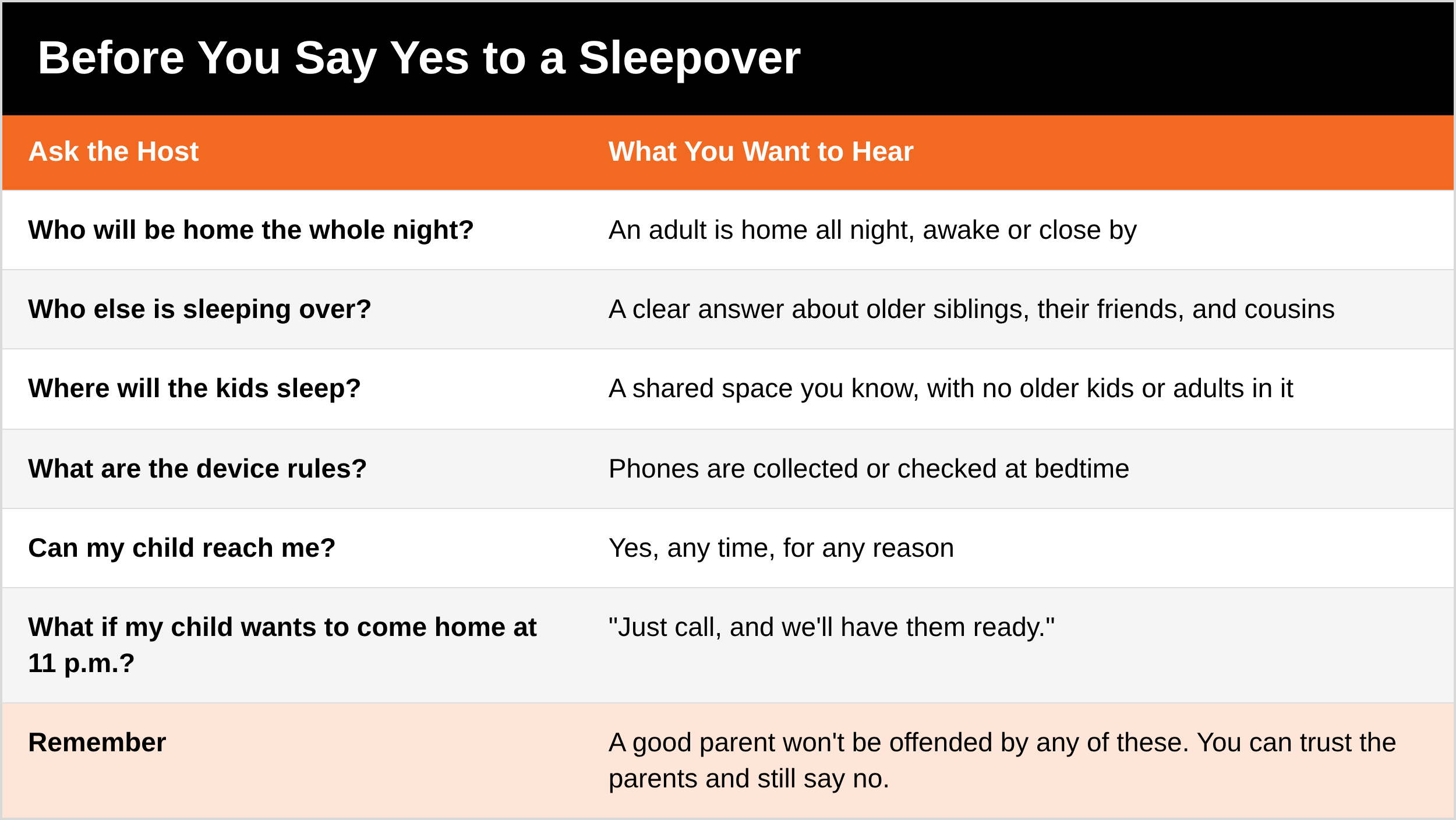
A good parent won't be offended by any of these. If someone is, that tells you something too.
The Alternative: The "Late-Over"
Here's the alternative I recommend, and kids love it. It's called a late-over.
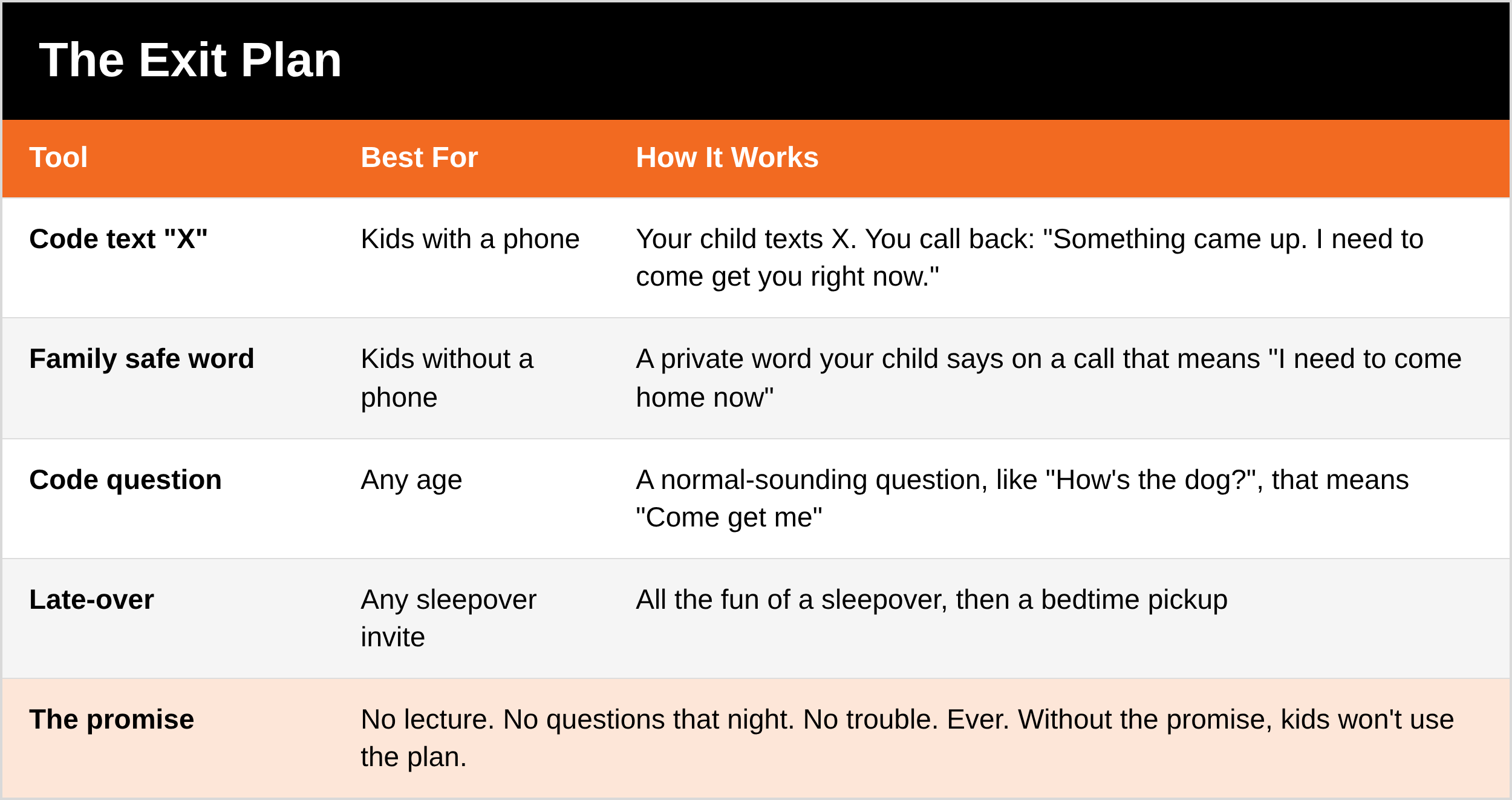
Your child gets all the fun of a sleepover: pizza, a movie, games, staying up later than usual, even pajamas. Then you pick them up at bedtime, and they sleep in their own bed.
They get the memories. You skip the overnight risk. Everybody wins.
The Family Safe Word and the Code Text
Every family needs a way for a child to say "Get me out of here" without saying it out loud.
A dad named Bert Fulks made this idea popular with what he calls the X-Plan. It's simple:
If your child is anywhere they feel uncomfortable, they text you the letter "X."
Within a few minutes, you call them back: "Something came up. I need to come get you right now."
Your child gets to leave without looking scared or embarrassed in front of their friends.
The part that makes it work is the promise: No lecture. No interrogation that night. Your child can tell you more later, when they're ready. If they're worried about getting questioned or getting in trouble, they won't use it.
The Prepared Protector Plans the Exit
On a job site, you don't figure out the exit after something goes wrong. You walk it before the shift starts. Kids need the same thing. A Prepared Protector sets up the code text and the safe word on a calm Tuesday night, practices them, and keeps the "no questions that night" promise every single time. That's how a child knows the way out is real.
For younger kids who don't have a phone, set up a family safe word. It's a word your child can say on a call to you, or to the adult in charge, that means "I need to come home now." Pick something private that would never come up by accident, and never post it online.
Some families use a code question instead, something that sounds completely normal to anyone listening, like "How's the dog?" Your child asks it on the phone, and you know it means "Come get me."
What to Say:
"If you're ever somewhere and something feels wrong, you text me X, or say our word on the phone. I'll come get you right away. I won't ask questions that night, and you won't be in trouble. Ever."
I go deeper on family code words and drills in Red Cell Your Family, Part 6: Train Your Team.
If Your Child Tells You Something
This is the moment that matters most. How you react in the first few minutes can decide whether your child keeps talking, or shuts down.
Stay as calm as you can. Breathe. Soften your voice.
Listen without interrupting. Thank them for telling you.
Say the three things they need to hear: "I believe you." "This is not your fault." "I'm going to help keep you safe."
Use open prompts like "Tell me more." Don't suggest answers or ask the same question over and over.
Don't promise to keep it secret. Explain that you may need help from people whose job is to protect kids.
Don't confront the person yourself. It can put your child in more danger and hurt an investigation.
Write down your child's exact words, with the date and time.
Get help: medical care if needed, a Children's Advocacy Center, and a report to law enforcement or child protective services.
Avoid These Responses
"Why didn't you say no or leave?"
"Why did you wait so long?"
"Are you sure?"
"This will tear the family apart."
Asking for details again and again, or asking them to show you what happened
A Short Script:
"Thank you for telling me. I believe you. You didn't cause this, and you're not in trouble. I'm going to get help from other safe grown-ups whose job is to protect kids. I'll tell you what happens next."
For a quick chart to save, see the "If Your Child Tells You" grid in The Creepy Coach, Part 3. I also cover this in Summer Camp Safety, Part 4.
The Series in Four Lines
Part 1: Give kids the words before they need them.
Part 2: The rules apply to everyone, including people we love.
Part 3: If someone says don't tell, that's when you tell.
Part 4: Plan the exit before you need it, and know what to say if they tell you.
Your Family Body-Safety Agreement
Read these together and put them where everyone can see them:
☐ We use the correct names for body parts.
☐ We ask before hugs and kisses, and we accept "no."
☐ We stop when someone says stop.
☐ Body-safety rules apply to everyone: family, friends, coaches, teachers, older kids, strangers, and people online.
☐ We don't keep unsafe secrets about touching, private parts, pictures, or threats.
☐ Kids can tell any trusted adult, and keep telling until someone helps.
☐ Kids will never be in trouble for asking for help.
☐ We have a family safe word and a code text, and we keep the "no questions that night" promise.
☐ We review this plan when school, activities, caregivers, or devices change.
Ask Yourself
Do I know everyone who will be in the house the next time my child sleeps over?
Does my child have a way to get out of a situation without embarrassment?
If my child told me something tonight, do I know exactly what I'd say?
5 Quick Wins You Can Start Today
Set up the X. Tell your child tonight: "If you ever text me X, I'll come get you. No questions that night."
Pick your safe word or code question. Something private that would never come up by accident.
Offer a late-over. Next time a sleepover invite comes up, offer pizza, a movie, and a bedtime pickup.
Save the six questions. Keep them in your phone so you're ready before you say yes.
Practice the short script. Say it out loud once, so the words are there if you ever need them.
Remember
You can trust the parents and still say no. Plan the exit before your child ever needs it, and keep the promise every time they use it. If your child tells you something, believe them, stay calm, and get help.
Get Started Today
Get the free Child Safety bundle. It includes When Trusted Adults Cross the Line, Family Tech Rules, and the Summer Camp Safety Checklist for Parents. DM the word [KEYWORD] on Instagram or Facebook and I'll send it to you. [Get it here: LINK]
Go Deeper
The Family Safety Toolkit. This series gives you the conversations. The Toolkit gives you 20 complete safety checklists in one place, with a full Child Safety section, so you're not starting from scratch every time your child heads out the door. That's 244 pages, for $19.99. [Get it here: LINK]
Coming soon: the Child Safety Manual. The full family guide, with a Sleepover and Late-Over Planner, safe-word practice drills by age, and a guide for parents when kids harm kids, including what to do if your child is the one who crossed the line.
Tools I recommend: The child safety gear and books I actually recommend are in my Children's Safety Amazon store. https://amzn.to/4hcldVo
The full series:
My Body, My Boundaries, Part 1: "Fine" Isn't Always Fine https://www.preparednotparanoid.com/pnp-library/body-safety-for-kids
My Body, My Boundaries, Part 2: The Rules Apply to Everyone https://www.preparednotparanoid.com/pnp-library/good-touch-bad-touch
My Body, My Boundaries, Part 3: "If You Say Don't Tell, I Have to Tell" https://www.preparednotparanoid.com/pnp-library/surprises-vs-secrets
Related reading:
The Creepy Coach, Part 3: What to Teach, What to Ask, and What to Do [LINK]
The Creepy Coach, Part 4: Check, Don't Assume [LINK]
Summer Camp Safety, Part 4: Preparing Your Child and the Conversation After Camp [LINK]
Red Cell Your Family, Part 6: Train Your Team [LINK]
Child Safety Resource Center [LINK]
References
Finkelhor, D., Ormrod, R., and Chaffin, M. (2009). Juveniles Who Commit Sex Offenses Against Minors. OJJDP Juvenile Justice Bulletin, U.S. Department of Justice. https://www.ojjdp.ojp.gov/library/publications/juveniles-who-commit-sex-offenses-against-minors
KSL. Dad's plan to save teens from uncomfortable social situations goes viral (the X-Plan). https://www.ksl.com/article/43351897
Childhelp. National Child Abuse Hotline. https://childhelp.org/hotline/
National Children's Alliance. Find a Children's Advocacy Center. https://www.nationalchildrensalliance.org/cac-coverage-maps/
Child Welfare Information Gateway. State Child Abuse Reporting Numbers. https://www.childwelfare.gov/
RAINN. National Sexual Assault Hotline, 1-800-656-HOPE (4673). https://rainn.org/resources/
Disclaimer
This article is for general informational and educational purposes only. It is designed to help families start important conversations. It is not a substitute for professional advice, training, or services, including medical, mental health, legal, or law enforcement guidance. No safety plan, checklist, or training can guarantee 100% protection. Laws and reporting requirements vary by state, so check your state and county for the exact rules where you live. Do not use this article to investigate or repeatedly question a child. If you suspect abuse, contact a professional right away. Affiliate disclosure: I've linked to products from my Amazon store that I personally recommend. As an Amazon Associate, I earn from qualifying purchases, at no extra cost to you. Thank you for supporting my work.
If you suspect a child is being abused, contact local law enforcement, your state's child protective services, or the Childhelp National Child Abuse Hotline at 1-800-422-4453 (call or text). If a child is in immediate danger, call 911.
Awareness gives you time. Time gives you options.
The Prepared Protector is someone who's decided that loving someone means being ready for them, not just hoping things go fine.
Prepared Not Paranoid. Protecting the Most Vulnerable Among Us.