What Arizona Requires, Why a Permit Still Matters, and the Places You Can't Go Armed
By Larry Betz | Prepared Not Paranoid https://www.preparednotparanoid.com/
In Arizona, you don't need a concealed carry permit to carry a concealed handgun if you're 21 or older and legally allowed to have a gun. So why would anyone get an Arizona concealed carry permit? Because a permit still opens doors that permitless carry doesn't, and because carrying legally takes more than knowing you can. You also need to know where you can't. In this post, I'll walk you through Arizona's permit, what it costs, why it's worth having, and the places where carrying is against the law, permit or not.
This post covers Arizona law, where I live and teach. If you live somewhere else, your state's rules may be very different, so check them before you carry.
Carrying in Arizona Without a Permit
Since 2010, Arizona has allowed adults 21 and older who aren't prohibited from having a firearm to carry concealed without a permit. If you're under 21, carrying concealed is generally against the law, with a few exceptions, like on your own property or your family's property.
Permitless doesn't mean rule-free. Every location restriction in this post still applies to you. And there's one rule every Arizona carrier needs to know: if a police officer asks you during a lawful stop whether you're carrying a concealed weapon, you must answer truthfully. Not answering accurately is a crime.
The Arizona Concealed Weapons Permit
Who Qualifies
Under Arizona law, to get a permit you must:
Be an Arizona resident or a U.S. citizen
Be 21 or older, or 19 or older with current military service or an honorable discharge
Not be a prohibited possessor under state or federal law, including no felony conviction or pending felony indictment unless your rights were restored, and no disqualifying mental health adjudication
Show firearm competence (see below)
The Training Requirement
You need proof of one of these:
A firearms safety or training course approved by AZ DPS or taught by an NRA-certified instructor
A hunter education course approved by Arizona Game and Fish (or another state's agency)
An NRA firearms safety course
A DPS-approved law enforcement or security firearms course
Current or former military service (with an honorable or general discharge)
A permit from another state that required training
How Long Is the Class?
Arizona doesn't set a minimum number of hours. Changes to the law in 2010 and 2011 removed any minimum class requirements, and DPS no longer approves individual courses or lesson plans. You'll see classes advertised as "8-hour CCW," but some courses today run as little as an hour online, and none are required to include live fire. As long as it's one of the options above, such as a class from an NRA-certified instructor, it meets the requirement.
Meeting the requirement and being ready are two different things. I put in over 300 hours of formal training, plus my own practice, before I started carrying a firearm for self-defense. A one-hour class checks the box. It doesn't make you ready. Look for a class with real range time, taught by an instructor who will watch you shoot and correct you. [LINK: Part 1, Before You Buy a Gun]
How to Apply
Apply online through AZ DPS or by mail.
Get fingerprinted. All new applicants need fingerprints, either electronically or on two fingerprint cards taken by a qualified technician.
Pay the fee. As of 2026, a new permit is $60.
Wait. Processing can take up to 60 days because of the background check.
Renewing Your Permit
Your permit is good for five years.
Renew no more than 90 days before it expires and no more than 60 days after. If you're 61 or more days late, you have to start over with a new application.
As of 2026, renewal is $43, and you don't need new fingerprints.
DPS sends a renewal reminder, but don't count on it. Put the date in your calendar.
Why Get a Permit If Arizona Doesn't Require One?
This is one of the most common questions I hear.
Here's why I recommend it:
Federal school zones. Federal law makes it a crime to carry a firearm within 1,000 feet of a school, with an exception for people licensed by the state the school is in. An Arizona permit covers you near Arizona schools. Permitless carry does not. In a city, you pass within 1,000 feet of a school all the time without knowing it.
Carrying in other states. Many states recognize the Arizona permit, so it can travel with you. Permitless carry ends at the state line. Before any trip, check which states honor your permit on the USCCA Concealed Carry Reciprocity Map: https://www.usconcealedcarry.com/resources/ccw_reciprocity_map/ Reciprocity changes, so check it every time, and remember that once you cross the line, you follow that state's laws, not Arizona's. (We cover travel in Part 12.) [LINK: Part 12, Traveling With a Firearm]
Buying a gun. At a licensed dealer, an Arizona permit can be used in place of the instant background check, which can make the purchase faster.
It proves you've had at least some training. That's a starting point, not a finish line.
Where You Can't Carry in Arizona
Even with a permit, there are places where carrying a firearm is against the law.
Here are the main ones.
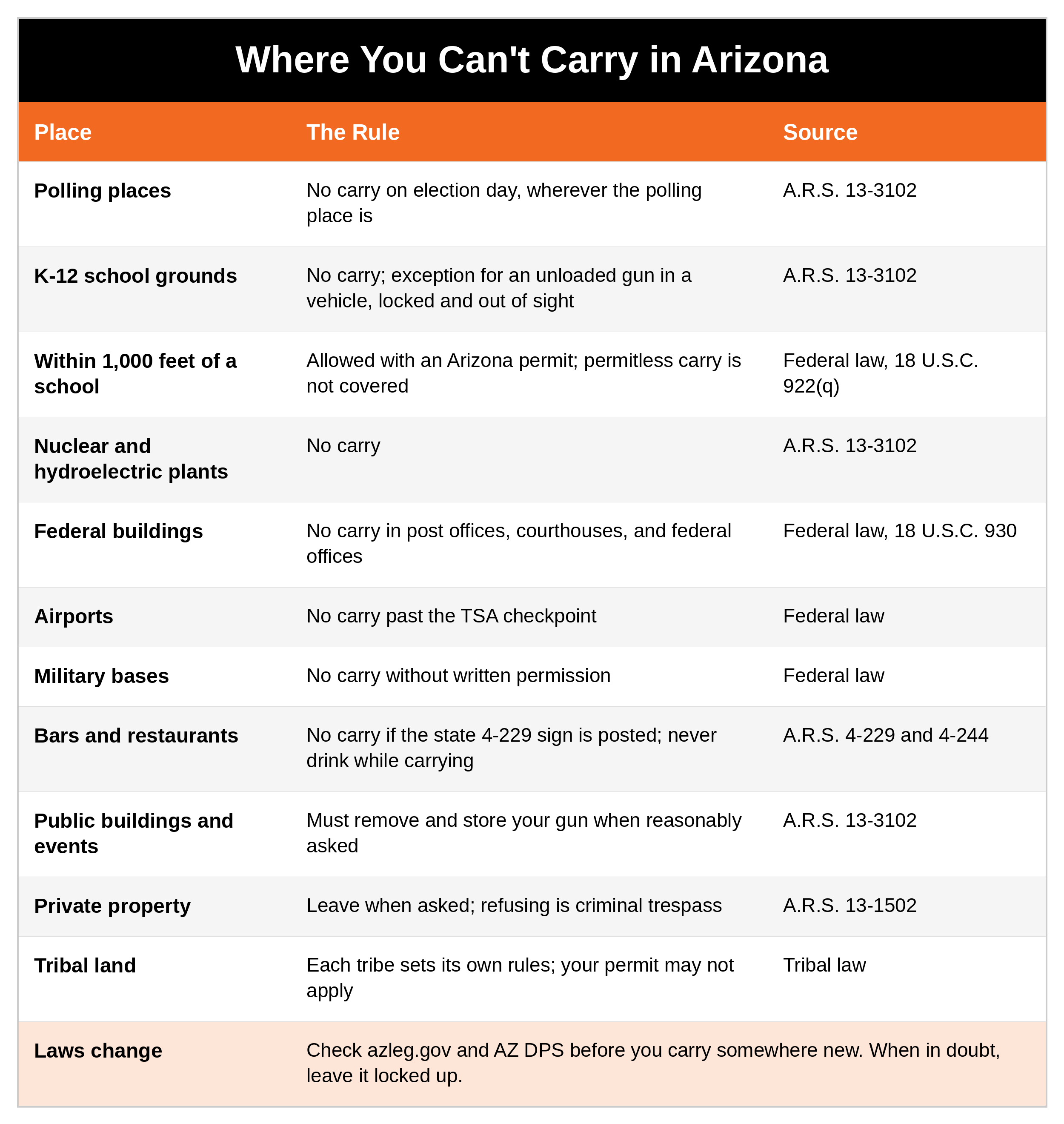
State Law
Polling places on election day. That includes schools, churches, and community centers being used as polling places.
K-12 school grounds. The one common exception: an unloaded firearm in a vehicle under an adult's control. If the adult leaves the vehicle, the gun must be out of sight and the vehicle locked.
Nuclear and hydroelectric generating stations.
Public establishments and public events, like a government building or a city event, when you're reasonably asked to remove your weapon and store it with them.
Bars and restaurants with the state sign. A business with a liquor license can ban guns only by posting the specific state sign (a red circle and slash over a firearm, with "No firearms allowed pursuant to A.R.S. section 4-229") right next to its liquor license. Without that sign, you can carry, but you can never drink alcohol there while you're carrying.
Private property when you're asked to leave. At most businesses, a "no guns" sign is the owner's wish, not a crime by itself. But if the owner, manager, or an officer asks you to leave and you don't, that's criminal trespass. Respect the sign anyway. It's their property.
College campuses. Arizona's public universities restrict firearms on campus by policy. Check the specific school's rules.
Federal Law
Federal buildings, including post offices, federal courthouses, IRS offices, and Social Security offices.
Secured areas of airports, meaning anything past the TSA checkpoint.
Military bases, unless you have written permission.
Within 1,000 feet of a school without an Arizona permit, as explained above.
Inside federal buildings in national parks, like visitor centers and ranger stations. You can generally carry in the park itself under Arizona law.
Tribal Land
Arizona has many tribal nations, and each sets its own firearm laws. Your Arizona permit doesn't automatically apply. Check with the tribe before you carry on tribal land, including at tribal casinos.
Laws change. Before you carry somewhere new, check the Arizona statutes and AZ DPS for the latest. [LINK: Part 8, Concealed Carry Positions]
Keep SCAN at the Center
Knowing the law is part of awareness. SCAN: S - See your environment (signs at the door, polling place notices, school zones), C - Create space (leave the gun locked in the car when you can't carry inside, and store it safely), A - Act deliberately (plan your day around where you can and can't carry), and N - Never doubt your gut feelings (if you're not sure it's legal, don't carry there).
What to Say
If police stop you and ask whether you're carrying: "Yes, officer. I have a firearm on my right hip and an Arizona concealed weapons permit. How would you like me to proceed?" Keep your hands visible and follow their instructions.
If you're asked to leave a business because you're carrying: "No problem. I'll leave." Then go.
At a public building that asks you to store your gun: "Where would you like me to secure it?"
Ask Yourself
Do I know the places I can't carry, with or without a permit?
Do I drive within 1,000 feet of a school, and do I have the permit that protects me there?
When does my permit expire, and is the renewal date on my calendar?
Remember
Carrying legally means knowing where you can't carry, not just where you can. In Arizona, a permit isn't required, but it protects you in ways permitless carry can't. Check the law before you go somewhere new, and when in doubt, leave it locked up.
Get Started Today
[FREE DOWNLOAD: TBD. Suggested: Arizona Carry Quick Reference Card] [CTA: Comment or DM "KEYWORD" / or download it here: LINK]
Go Deeper
The Family Safety Toolkit. Carrying legally is one part of protecting your family. The Toolkit gives you 20 checklists covering every area of family safety and preparedness, from your home and vehicle to travel and your go bag, all for $19.99. [Get it here: https://www.preparednotparanoid.com/family-safety-toolkit]
The Family Emergency Preparedness Manual is coming soon.
Tools I recommend: The holsters, belts, and range gear I recommend are in my Range Essentials Amazon store. https://link.amazon/B0hxQD89P
Related reading:
Firearms and Family Safety, Part 8: Concealed Carry Positions [LINK]
Firearms and Family Safety, Part 9: Holsters, Clothing, and Drawing From Concealment [LINK]
Firearms and Family Safety, Part 12: Traveling With a Firearm [LINK]
Firearms and Family Safety, Part 14: The Life-Altering Event: What Happens After [LINK]
References
Arizona Revised Statutes 13-3112, Concealed weapons permit. https://www.azleg.gov/ars/13/03112.htm
Arizona Revised Statutes 13-3102, Misconduct involving weapons. https://www.azleg.gov/ars/13/03102.htm
Arizona Revised Statutes 4-229, Licenses; handguns; posting of notice. https://www.azleg.gov/ars/4/00229.htm
Arizona Revised Statutes 4-244 (unlawful acts on liquor-licensed premises) and 13-1502 (criminal trespass).
Arizona Department of Public Safety, Concealed Weapons Permit Unit. Application and renewal fees and requirements (2026).
18 U.S.C. 922(q), Gun-Free School Zones Act, and 18 U.S.C. 930, firearms in federal facilities.
Arizona State Legislature, SB 1591 Fact Sheet (2025), current CCW fees.
U.S. Concealed Carry Association. Concealed Carry Reciprocity Map. https://www.usconcealedcarry.com/resources/ccw_reciprocity_map/
Bureau of Alcohol, Tobacco, Firearms and Explosives. Permanent Brady Permit Chart. https://www.atf.gov/rules-and-regulations/laws-alcohol-tobacco-firearms-and-explosives/gun-control-act/brady-law/permanent-brady-permit-chart
Betz, Lawrence. Navigating the Red Zone and Beyond (the SCAN framework).
Disclaimer
These suggestions are intended to help you and your family build awareness, confidence, and safer decision-making habits. No safety plan, checklist, or tool can guarantee 100% protection. This article is for general informational purposes only and is not legal advice. It covers Arizona law as of 2026, and laws change. Fees, requirements, and restricted locations can be updated at any time, and other states' laws are very different. Check the current Arizona statutes and AZ DPS, and talk to a qualified attorney about your specific situation. Always store firearms securely and out of reach of children. Affiliate disclosure: I've linked to products from my Amazon store that I personally recommend. As an Amazon Associate, I earn from qualifying purchases, at no extra cost to you. Thank you for supporting my work.
If you are in immediate danger, get to safety and call 911.
Awareness gives you time. Time gives you options.
The prepared protector is someone who's decided that loving someone means being ready for them, not just hoping things go fine.
Prepared Not Paranoid. Protecting the Most Vulnerable Among Us.