Why Owning a Gun Means Planning for the Day After, Not Just the Moment of Danger
By Larry Betz | Prepared Not Paranoid https://www.preparednotparanoid.com/
If you've bought a firearm to protect your family, what happens after a self-defense shooting is the most important thing you can understand. Most people think about the moment of danger. Very few think about the hours, months, and years that follow, even when the shooting is completely justified. Using deadly force is a life-altering event, legally, financially, and emotionally, for you and everyone you love.
I live in Arizona, so I'll use Arizona law as the example. The laws are different in every state, and how they're applied can vary by county. Always check your state and county for the exact laws where you live.
The Post That Horrified Me
A few years ago, something happened in my neighborhood that was posted on Nextdoor. A woman was watching TV in her bedroom with her son. Around 8 a.m., she went to the kitchen to make him breakfast, and a man was standing in her kitchen. She screamed, and he ran out.
You can imagine the replies:
"Should have shot him."
"Two to the chest, one to the head."
"That's why I have a gun."
It went on and on. I was horrified, not just by how little people knew about the use of force, but by how little they'd thought about what comes after.
So I started asking questions.
What was the man doing?
Is it possible he walked into the wrong Airbnb?
Would you want to live with having shot someone in your home over a mistake?
At what point was he a threat to her and her son?
When he was running out the door after she screamed?
Shooting someone who's running away isn't self-defense, and it could lead to a murder charge.
And honestly, when I get up in my pajamas to make my morning coffee, I don't have a gun strapped to me.
Too many people believe that if someone is in your home, you can shoot them. That's not how it works.
The Question the Law Will Ask:
Would a Reasonable Person Have Done the Same?
If, God forbid, on the worst day of your life, you have to use deadly force, your actions will be measured against what the law calls the "reasonable person" standard.
Investigators, prosecutors, and maybe a jury will want to know more than who the attacker was and who the victim was. They'll want to know:
What did you do to avoid the fight, or did you help start it?
Would a reasonable person, knowing what you knew, have believed the same thing you believed?
Would a reasonable person have reacted the same way you did?
It's not about what you felt in the moment. It's about whether your belief and your actions were objectively reasonable based on everything going on at the time.
Because of that test, using force has to carry real weight. Before it ever comes to that, it's fair to ask yourself: "Is this situation worth going to jail over? Is it worth dying over?" If the answer is yes, you have to be prepared to live with the results. If the answer is no, you need to remove yourself from the situation.
What Arizona Law Says (Your State May Be Different)
This is a brief overview, not legal advice. Check your state and county for the exact laws where you live. Here are the main Arizona statutes, summarized. The full text is linked in the References.
A.R.S. 13-404, Self-defense: You can use physical force when a reasonable person would believe it's immediately necessary to protect yourself from someone else's unlawful force. Words alone are never enough, and if you started the fight, you lose that protection unless you clearly try to withdraw.
A.R.S. 13-405, Deadly physical force: Deadly force is justified only when a reasonable person would believe it's immediately necessary to protect against deadly force. You have no duty to retreat if you're somewhere you have a right to be and aren't doing anything unlawful.
A.R.S. 13-418, Your home and occupied vehicle: You can use force, including deadly force, if you reasonably believe you or someone else is in imminent danger of death or serious physical injury and the person is unlawfully or forcefully entering, or has entered, your home or occupied vehicle. No duty to retreat.
A.R.S. 13-419, The presumption: You're presumed to have acted reasonably against someone unlawfully or forcefully entering your home or occupied vehicle, but there are exceptions, including when the person has a right to be there, like someone who lives there, or is a law enforcement officer doing their job.
A.R.S. 13-411, Preventing serious crimes: You can use force, including deadly force, when you reasonably believe it's immediately necessary to prevent certain serious crimes, such as burglary of a home, kidnapping, sexual assault, armed robbery, and aggravated assault.
Notice the words that keep showing up: reasonable, immediately necessary, imminent. Every case comes down to its own facts. Even when the law is on your side, you can do everything right and still go to jail.
For where you can and can't carry in Arizona, see Part 10. [LINK: Part 10, Concealed Carry Permits and Where You Can't Carry]
What Happens After, Step by Step
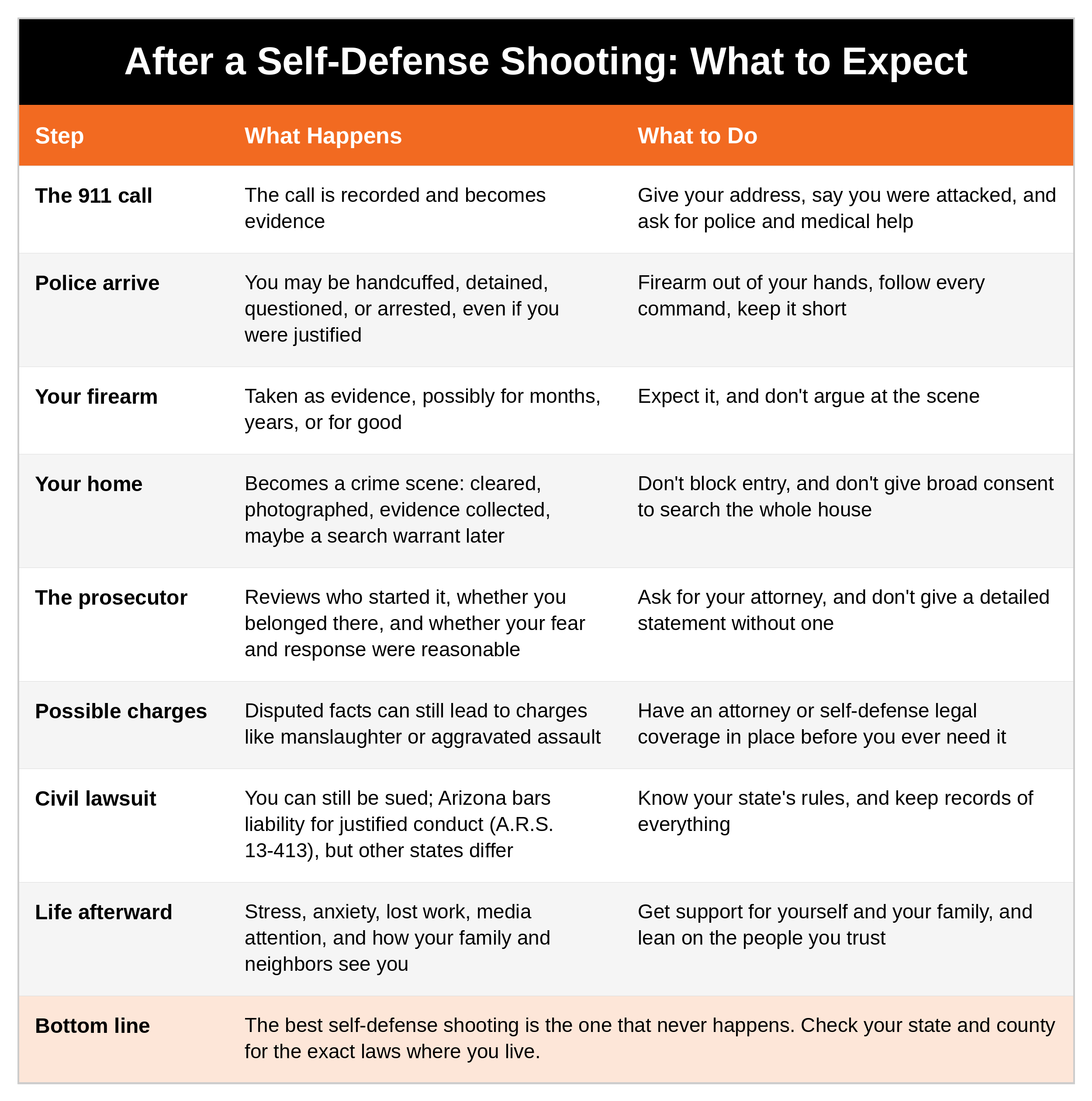
Even in a clear case of self-defense, here's what to expect, even if you did everything right.
The Police Investigate
Any time someone is shot, police will investigate. You may be handcuffed, detained, questioned, or arrested. That isn't necessarily a sign they think you're guilty. It's standard procedure when someone has been hurt or killed.
Your Firearm Will Almost Certainly Be Taken
The gun you used will almost always be taken as evidence. You may not get it back for months or years, or ever, depending on how the case goes. Other firearms in your home could be taken too.
Your Home Becomes a Crime Scene
When police respond to a shooting, they can enter to deal with the emergency and secure the scene. They'll clear the house, photograph everything, and collect evidence such as the firearm, shell casings, and blood. Anything illegal in plain view can be seized. Investigators may come back later with a search warrant for a more thorough search.
Don't try to block police from entering when you're the one who called 911. But you don't have to give broad permission to search the rest of the house beyond what's needed.
The Prosecutor Decides Whether to Charge You
In Arizona, that's the county attorney. Even if you say it was self-defense, the prosecutor's office will review the facts on its own and look at:
Whether you were the one who started it
Whether you had a right to be where you were
Whether your belief that you were in danger was reasonable
Whether your response matched the threat
This can take time. Depending on the case, you may be held, released on bail, or released while they decide.
You Could Be Charged Anyway
When there are no witnesses or the facts are disputed, you could still be charged with something like manslaughter, aggravated assault, or negligent homicide. A criminal defense can cost tens of thousands of dollars.
You Could Be Sued
In Arizona, A.R.S. 13-413 says you can't be held civilly liable for conduct that's justified under the state's self-defense laws. But that doesn't stop someone from filing a lawsuit, and you may still have to pay to defend yourself while the court decides whether you were justified. Many other states handle this differently, so check your state's laws. This is one reason many gun owners carry self-defense legal coverage, from companies like the USCCA and U.S. LawShield.
Self-Defense Insurance: Have It Before You Need It
Self-defense insurance, sometimes called firearm or carry insurance, helps pay for your legal defense after you use force to protect yourself or your family. A criminal defense, a civil lawsuit, or both can cost more than most families have saved, so this is coverage to set up long before you need it.
Plans are different, but many include:
A 24/7 number to call right after an incident
Help finding an attorney who handles self-defense cases
Criminal defense costs
Civil defense costs, and with some plans, help with damages
Help with bail
Before you choose a plan, ask:
Does it pay my attorney up front, or reimburse me only after the case is over?
Does it cover both criminal and civil cases?
Does it cover any tool I use to defend myself, like pepper spray, or only a firearm?
Does it cover me everywhere, at home, in my car, and when I travel to other states?
Is it available in my state, and what does it cover here? What these plans can offer varies by state, so check your state.
Companies that offer this coverage include the USCCA, U.S. LawShield, and CCW Safe. I'm a USCCA certified instructor, so you know where I'm coming from. Compare them, read the policy, and pick the one that fits your family. Then save the 24/7 number in your phone, write it down for your wallet, and make sure your spouse knows it too.
Life Afterward
The legal process is only part of it. People who've been through a self-defense shooting often deal with:
Anxiety, depression, and post-traumatic stress
Lost work or a lost job
Media and social media attention
Having to move
Think about it for your own family.
How will you and your family feel walking through your home after someone was killed there?
How will your neighbors and community see you?
If you have kids, how will they be treated at school?
What to Say, and What Not to Say
Talk with an attorney ahead of time about what's right for you and your state. This is what's commonly taught:
Call 911 right away. Tell them where you are, that you were attacked, and that you need police and medical help.
Keep it short. Say you'll cooperate fully, then ask for your attorney.
Don't give a detailed statement to investigators until you've spoken with your attorney. You're going to be in shock, and in that state it's easy to say something that's wrong.
Follow every police command. Make sure your firearm is holstered or set down and out of your hands before officers arrive. To them, the person holding the gun is the threat.
Avoid It If You Can
All of this is why the best self-defense shooting is the one that never happens. My goal as an instructor is to teach people how to never have to use their firearm.
At home, make your home a hard target. That's the point of the 4 D's: Deter, Detect, Delay, and Defend. Have a home security plan, and walk through different scenarios with your family often. [LINK: Intro, The 4 D's of Home Defense] For a complete guide to home security, pick up your copy of The Safest House on the Block. [LINK: The Safest House on the Block, add at link scrub]
In public, if you carry, you have to hold yourself to a higher standard. Your firearm isn't your ego. Walk away from arguments. Let the other person "win." Use your voice and body language to calm things down before they escalate.
Carrying a gun doesn't make you the hero of the story. It makes you the one most responsible for making sure the story never turns violent.
A Note From Larry:
Remember, a firearm is a tool. You still need a plan. Situational awareness is always your number one go-to. If you ever need to use this or any tool, what is your plan after you use it? Running might be your best option.
Keep SCAN at the Center
SCAN is how you stay out of the situations this post describes. S - See your environment (notice trouble early, at home and in public), C - Create space (distance and a locked door give you options), A - Act deliberately (no shots at shapes, sounds, or someone running away), and N - Never doubt your gut feelings (if something feels wrong, leave before it turns into a confrontation). The prepared protector plans for the moment of danger and for everything that comes after.
What to Say
To 911: "I was attacked at [address]. I need police and medical help."
To police: "Officer, I'll cooperate fully after I speak to my attorney."
To yourself, before you ever draw: "Is this worth going to jail over? Is it worth dying over?"
To your family: "If someone ever gets into our house, we get to the safe room, lock the door, and call 911. We don't go looking for them."
To your attorney, before anything ever happens: "What are the exact self-defense laws in my state and county, and what should I do after an incident?"
Ask Yourself
Do I actually know my state's self-defense laws, or just what I've heard online?
Does my family know the plan if someone breaks in?
Do I have an attorney's number, or self-defense legal coverage, ready before I need it?
Have I thought about what my life and my family's life would look like after using deadly force?
Remember
A self-defense shooting doesn't end when the threat stops. Know your state and county laws, have a plan for after, and do everything you can to make sure the day never comes.
Get Started Today
[FREE DOWNLOAD: TBD. Suggested: "After the Unthinkable" wallet card] [CTA: Comment or DM "KEYWORD" / or download it here: LINK]
Go Deeper
The Family Safety Toolkit. The best way to survive the aftermath is to never face it. The Toolkit gives you 20 checklists covering every area of family safety and preparedness, from your home and vehicle to travel and your go bag, all for $19.99. [Get it here: https://www.preparednotparanoid.com/family-safety-toolkit]
The Family Emergency Preparedness Manual is coming soon.
Tools I recommend: The range gear and accessories I recommend are in my Range Essentials Amazon store. https://link.amazon/B0hxQD89P
Related reading:
Firearms and Family Safety, Intro: The 4 D's of Home Defense [LINK]
Firearms and Family Safety, Part 4: The Four Universal Safety Rules [LINK]
Firearms and Family Safety, Part 10: Concealed Carry Permits and Where You Can't Carry [LINK]
Firearms and Family Safety, Part 13: Ballistics: Choosing Home Defense Ammo [LINK]
References
Arizona Revised Statutes 13-404, Justification; self-defense. https://www.azleg.gov/ars/13/00404.htm
Arizona Revised Statutes 13-405, Justification; use of deadly physical force. https://www.azleg.gov/ars/13/00405.htm
Arizona Revised Statutes 13-411, Justification; use of force in crime prevention. https://www.azleg.gov/ars/13/00411.htm
Arizona Revised Statutes 13-413, No civil liability for justified conduct. https://www.azleg.gov/ars/13/00413.htm
Arizona Revised Statutes 13-418, Justification; use of force in defense of residential structure or occupied vehicles. https://www.azleg.gov/ars/13/00418.htm
Arizona Revised Statutes 13-419, Presumptions; defense of a residential structure or occupied vehicle; exceptions. https://www.azleg.gov/ars/13/00419.htm
U.S. Concealed Carry Association. Arizona gun laws. https://www.usconcealedcarry.com/resources/ccw_reciprocity_map/az-gun-laws/
Betz, Lawrence. Navigating the Red Zone and Beyond (the SCAN framework).
Disclaimer
These suggestions are intended to help you and your family build awareness, confidence, and safer decision-making habits. No safety plan, checklist, or tool can guarantee 100% protection. This article is for general informational purposes only and is not legal advice. I'm not an attorney. Self-defense and use of force laws vary by state, and how they're applied can vary by county, and laws change. Always check your state and county for the exact laws where you live, and talk to a qualified attorney about your specific situation. Always store firearms securely and out of reach of children. Affiliate disclosure: I've linked to products from my Amazon store that I personally recommend. As an Amazon Associate, I earn from qualifying purchases, at no extra cost to you. Thank you for supporting my work.
If you are in immediate danger, get to safety and call 911.
Awareness gives you time. Time gives you options.
The Prepared Protector is someone who's decided that loving someone means being ready for them, not just hoping things go fine.
Prepared Not Paranoid. Protecting the Most Vulnerable Among Us.