What the Testing Really Shows, and How to Choose a Load for a Home With Your Family in It
By Larry Betz | Prepared Not Paranoid https://www.preparednotparanoid.com/
The home defense ammo you load matters as much as the gun you choose. The right round stops a threat. The wrong one may not, or it may go through the wall into the next room, where your kids are sleeping. In Part 3, I said we'd walk through the actual tests behind the claims you hear about ammunition. That's what this post is. Every finding here comes from a published test, and I'll tell you which one.
[LINK: Part 3, Shotgun or AR-15 for Home Defense]
What Makes a Good Defensive Round
When it comes to ammunition for self-defense, a few things matter most:
Penetration: The bullet has to go deep enough to reach vital organs, but not so deep that it keeps going.
Expansion: A hollow point that opens up makes a larger wound and slows down, which helps it stop inside the threat instead of passing through.
Caliber, bullet type, and velocity: These all affect how a bullet performs, but speed and energy alone don't guarantee anything.
Shot placement: The best bullet in the world won't help if it misses. Shot placement and training outweigh gear.
If terms like grain, FMJ, JHP, and frangible are new to you, start with Part 5. [LINK: Part 5, Range Day Basics: Terms and Commands]
The FBI Standard: 12 to 18 Inches
Most modern defensive ammunition is built around one standard, and it came out of tragedy.
On April 11, 1986, FBI agents in Miami got into a gunfight with two heavily armed suspects. Two agents were killed and five were wounded. One suspect kept fighting after being hit, partly because a bullet didn't penetrate deep enough to stop him. That gunfight led the FBI to rethink how it tested ammunition.
The testing that followed, done in 1989, shot rounds into 10% ballistic gelatin, which simulates human tissue, through eight different events:
Bare gelatin
Heavy clothing
Automotive sheet metal
Wallboard (drywall)
Plywood
Windshield glass
Light clothing and windshield glass at longer distance
A round that went less than 12 inches was a failure. Twelve inches was set to make sure a bullet could reach vital organs from different angles. Eighteen inches was the upper limit, because anything deeper was likely to exit the body and keep going.
That's where the 12 to 18 inch standard comes from. When an ammunition maker says a load "meets FBI protocol," this is what they mean.
Handgun Ammo
Avoid FMJ for Defense
Full metal jacket (FMJ) ammo is affordable and great for practice, but it isn't designed to expand. For self-defense, it tends to go too deep and keep going.
Choose a Quality Hollow Point
For home defense and carry, choose a quality jacketed hollow point (JHP) designed to meet the FBI standard. Two examples from Federal:
Federal HST, widely used by law enforcement.
Federal Hydra-Shok Deep, which Federal built specifically to meet the FBI's penetration standard.
Other major makers have loads designed for the same standard. Whatever you choose, run enough of it through your gun to know it feeds and functions reliably. A round that doesn't cycle in your gun isn't the right round for you.
Shotgun Ammo
In a 2020 test for NRA's Shooting Illustrated, writer Jeff Johnston fired common shotgun loads at 7 yards, through two sheets of half-inch sheetrock, into ballistic gelatin. Here's what he found:
7 1/2 birdshot: averaged only about half an inch of penetration. Not a defensive load.
#4 buckshot: about 8 to 9 inches, short of the FBI's 12-inch minimum.
00 buckshot: about 13 inches, inside the 12 to 18 inch range. Johnston called it the versatile default for most defensive shooters.
1-ounce slug: about 22 inches after going through the wall. More than you want inside a home.
He didn't test #1 buckshot, but Lucky Gunner's buckshot testing puts #1 at about 15 to 18 inches at typical velocities, compared with about 18 to 20 inches for 00, and calls #1 "really more ideal than #00 from a ballistics standpoint." The catch: it can be harder to find.
The takeaway: For home defense, 00 or #1 buckshot is the common recommendation. Avoid birdshot. It doesn't penetrate enough to reliably stop a threat.
Rifle Ammo (5.56 and .223)
This is where most of the myths live. [LINK: Part 3, Shotgun or AR-15 for Home Defense]
55-grain FMJ (like M193) can penetrate deeply if it doesn't fragment. It's practice ammo, not home defense ammo.
Defensive loads (soft points, hollow points, and open-tip match) are designed to fragment or expand quickly.
In a 2012 test for Athlon Outdoors, writer Paul Markel fired a 60-grain Hornady TAP .223 and a 147-grain 9mm hollow point through two layers of half-inch drywall and a quarter inch of plywood into ballistic media. The .223 fragmented completely at about 8 inches. The 9mm went about 15 inches. He concluded the 9mm was not less likely to over-penetrate than the .223.
But that's not the whole story. In the USCCA's wall test, which we'll look at next, 5.56 went through more drywall than any other round. The load you choose makes all the difference.
Every Round Goes Through Walls
Every family needs to understand: no common home defense round is "wall safe."
The USCCA's wall test (Ed Combs) fired rounds at 7 feet into a rack of 24 half-inch sheetrock panels, two panels per wall:
9mm and .45 ACP: at least six panels, about three interior walls
Shotguns and .22 LR: six to ten panels, including 20-gauge birdshot through six
10mm: more than ten panels
5.56: nineteen panels, the most of anything tested
The Box O' Truth, another well-known test, set up four interior walls of drywall. Every round tested, including .223 and buckshot, went through all four. Only birdshot and frangible rounds penetrated less, and neither is considered a reliable defensive load.
These tests used different setups, so the exact numbers don't line up. But the conclusion does: drywall stops very little. Whatever you load, you have to know what's behind every wall.
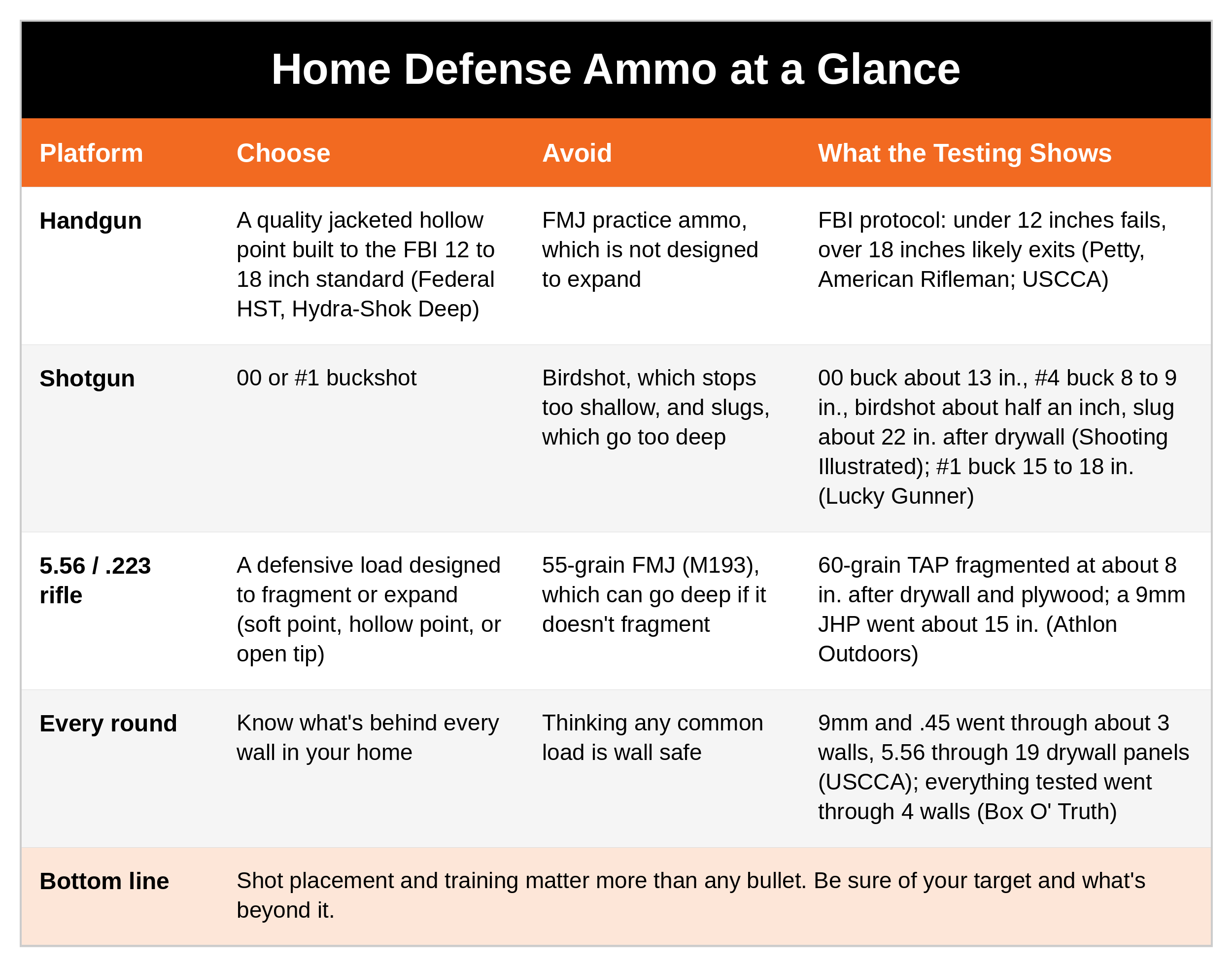
Home Defense Ammo at a Glance
Putting it all together.
Here's what the testing shows.
What This Means in Your Home
Choosing ammunition for home defense means balancing effective stopping power with the risk to everyone else in your home and your neighbors. Modern defensive loads give you good options, but no load replaces training, safe handling, and accountability for every round.
Know where your family sleeps and which walls they're behind.
Think about angles. Where would a shot from your safe room go if it missed?
Choose a defensive load, not practice ammo, for the gun you keep ready.
Train with it. Know where it hits and that it runs reliably in your gun. [LINK: Part 7, Dry Fire Training]
Remember Rule 4: be sure of your target and what's beyond it. [LINK: Part 4, The Four Universal Safety Rules]
Keep SCAN at the Center
The best ammunition is the round you never have to fire. SCAN: S - See your environment (know your home's layout and where everyone is), C - Create space (a safe room and a locked door keep the threat at a distance), A - Act deliberately (no shots at shapes or sounds), and N - Never doubt your gut feelings (if you're not sure what's beyond your target, don't shoot). The prepared protector chooses ammo with the whole family in mind.
What to Say
At the gun counter: "I'm looking for a home defense load for my [gun]. Is this designed to meet the FBI's 12 to 18 inch standard?"
To yourself, before you load your home defense gun: "Is this my defensive ammo, or my practice ammo?"
To your family: "If anything ever happens at night, get to the safe room and get low. Stay out of the hallway."
Ask Yourself
Is the gun I keep ready loaded with defensive ammo, not FMJ or birdshot?
Have I fired enough of that load to trust it in my gun?
Do I know which walls in my home have family members behind them?
Remember
Choose your ammunition as carefully as your firearm. Pick a load built to the 12 to 18 inch standard, know that every round can go through walls, and remember that shot placement and training matter more than any bullet.
Get Started Today
[FREE DOWNLOAD: TBD. Suggested: Home Defense Ammo Cheat Sheet, one page] [CTA: Comment or DM "KEYWORD" / or download it here: LINK]
Go Deeper
The Family Safety Toolkit. Choosing the right ammunition is one part of protecting your family at home. The Toolkit gives you 20 checklists covering every area of family safety and preparedness, from your home and vehicle to travel and your go bag, all for $19.99. [Get it here: https://www.preparednotparanoid.com/family-safety-toolkit]
The Family Emergency Preparedness Manual is coming soon.
Tools I recommend: The range gear and accessories I recommend are in my Range Essentials Amazon store. https://link.amazon/B0hxQD89P
Related reading:
Firearms and Family Safety, Part 3: Shotgun or AR-15 for Home Defense [LINK]
Firearms and Family Safety, Part 4: The Four Universal Safety Rules [LINK]
Firearms and Family Safety, Part 11: Safe Storage at Home [LINK]
Firearms and Family Safety, Part 14: The Life-Altering Event: What Happens After [LINK]
References
Petty, Charles E. "The FBI Ammo Tests." American Rifleman, June 1990 (republished online April 2015). https://www.americanrifleman.org/articles/2015/4/16/throwback-thursday-the-fbi-ammo-tests/
U.S. Concealed Carry Association. "FBI Ammo Testing." https://www.usconcealedcarry.com/blog/fbi-ammo-testing/
Combs, Ed. "Wall to Wall: Testing Penetration of Home Defense Ammo." U.S. Concealed Carry Association. https://www.usconcealedcarry.com/blog/wall-to-wall-testing-penetration-of-home-defense-ammo/
Johnston, Jeff. "Which Type of Shotgun Load is Best for Home Defense?" NRA Shooting Illustrated, December 2020. https://shootingillustrated.com/content/which-type-of-shotgun-load-is-best-for-home-defense
Lucky Gunner. "Stuff You Should Know About Buckshot, Part 1." https://www.luckygunner.com/lounge/stuff-you-should-know-about-buckshot-part-1/
Markel, Paul. "Home Defense Ammo: 9mm vs .223." Athlon Outdoors, October 2012. https://athlonoutdoors.com/article/9mm-vs-223-got-enough-gun/
The Firearm Blog. "The Box O' Truth Hurts: All Weapons Have Limits Inside the Home," June 2017. https://www.thefirearmblog.com/blog/2017/06/12/box-o-truth-hurts-weapons-limits-inside-home
Military.com. "Federal Unveils Pistol Ammo Built to Meet New FBI Standards," January 2018.
Betz, Lawrence. Navigating the Red Zone and Beyond (the SCAN framework).
Disclaimer
These suggestions are intended to help you and your family build awareness, confidence, and safer decision-making habits. No safety plan, checklist, or tool can guarantee 100% protection. This article is for general informational purposes only and is not legal advice or a substitute for professional firearms training. Test results vary with the exact load, the firearm, the distance, and the building materials, and the tests cited here used different methods. Always follow your firearm and ammunition manufacturers' guidance, check your local laws, and talk to a qualified attorney about your specific situation. Always store firearms securely and out of reach of children. Affiliate disclosure: I've linked to products from my Amazon store that I personally recommend. As an Amazon Associate, I earn from qualifying purchases, at no extra cost to you. Thank you for supporting my work.
If you are in immediate danger, get to safety and call 911.
Awareness gives you time. Time gives you options.
The Prepared Protector is someone who's decided that loving someone means being ready for them, not just hoping things go fine.
Prepared Not Paranoid. Protecting the Most Vulnerable Among Us.