Flying, Driving, and Keeping It Secure on the Road
By Larry Betz | Prepared Not Paranoid https://www.preparednotparanoid.com/
Traveling with a firearm is legal, but the rules change at the airport, at every state line, and at the hotel door. A firearm is your property, and with ownership comes the responsibility to handle, store, and transport it safely and legally wherever you go. In this post, I'll walk you through flying with a gun, driving through other states, and keeping it secure once you get there.
Start Before You Leave: Know the Laws
Firearm laws are different in every state, and some cities and counties add their own rules. Before any trip, check the laws:
Where you're starting
Every state you'll pass through or stop in
Where you're going
The USCCA keeps a state-by-state map of gun laws and permit reciprocity: https://www.usconcealedcarry.com/resources/ccw_reciprocity_map/ Your Arizona permit may be honored in some states and not others, and even in states that honor it, you follow their laws, not Arizona's. [LINK: Part 10, Concealed Carry Permits and Where You Can't Carry]
Flying With a Firearm, Step by Step
You can fly with a firearm, but only in checked baggage, and only if you follow TSA's rules exactly.
Here's the process.
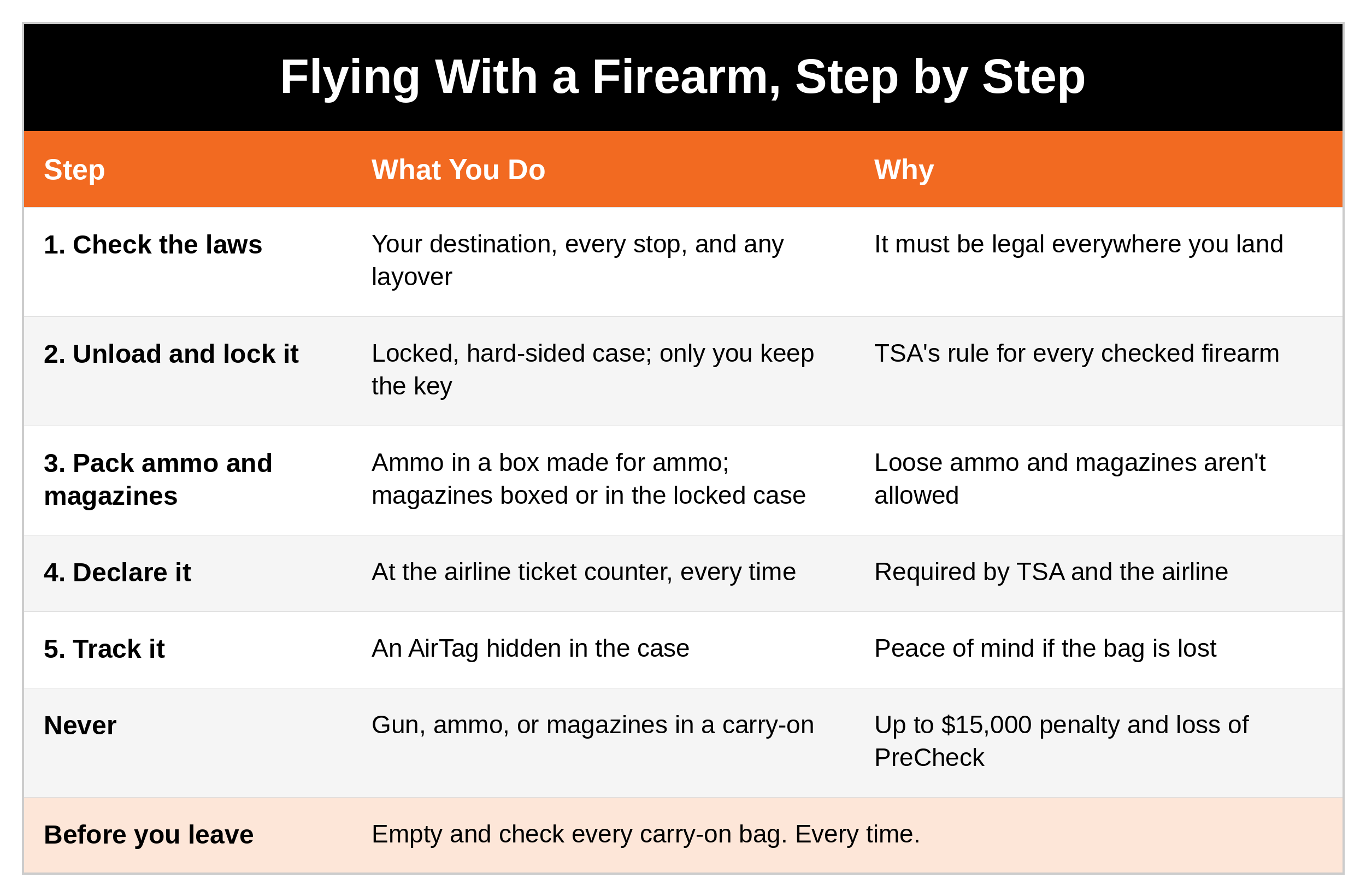
1. Unload It Completely
TSA considers a firearm loaded if there's a live round, or any part of one, in the chamber, the cylinder, or an inserted magazine. TSA also treats it as loaded if you can reach both the gun and the ammunition. Unload it, check it, and check it again. [LINK: Part 4, The Four Universal Safety Rules]
2. Lock It in a Hard-Sided Case
The firearm must be in a locked, hard-sided container that completely blocks access to it.
Easily opened cases aren't allowed, and the case your gun came in may not be secure enough.
You should be the only one with the key or combination. TSA may ask for it to inspect the case.
Any lock brand works, including TSA-recognized locks.
Two cases I like:
Pelican V800 Vault Case: high-impact polymer, customizable foam, crushproof and dustproof, with four lock points. It's heavier than some cases because it's built tough.
Condition 1 Tactical Rifle Case: push-button latches, an IP67 waterproof rating, steel pin hinges, wheels, and customizable foam. Also heavier and bulkier.
3. Pack Ammunition and Magazines Correctly
Ammunition goes in checked bags only, in a fiber (cardboard), wood, plastic, or metal box made for ammunition. The factory box works.
Ammunition can go in the same locked case as the firearm, as long as it's packed that way.
Magazines, loaded or empty, must be boxed or inside the locked case with the unloaded firearm.
Airlines set their own limits on how much ammunition you can bring, and some charge fees. Check with your airline before you pack.
4. Declare It at the Ticket Counter
Tell the airline you're checking a firearm at the ticket counter, every time. You'll usually fill out a declaration tag that goes inside the case. Don't walk up to the TSA checkpoint first.
5. Track Your Case With an AirTag
Consider hiding an AirTag (Apple's small Bluetooth tracker) inside your case. It uses Apple's Find My network to show you where your bag is, which gives you peace of mind if your luggage is lost or mishandled. Place it so it doesn't interfere with the firearm or anything else in the case.
6. Check the Law Where You Land
Your firearm has to be legal where you land, and in any state where you get stuck overnight on a layover. Some airports are in very strict states. Know the rules before you book.
Never in Your Carry-On
This is the mistake TSA catches at checkpoints every single day: someone forgets the gun in their backpack or purse. Firearms, ammunition, and magazines are never allowed in a carry-on. Bringing a gun to the checkpoint can mean a civil penalty of up to $15,000, possible criminal charges depending on local law, and if you have TSA PreCheck, you lose it.
Before you leave for the airport, empty and check every carry-on bag. Every time. If you carry off-body, this is where it bites people. [LINK: Part 8, Concealed Carry Positions]
Driving Through Other States
Federal law, under the Firearm Owners Protection Act (18 U.S.C. 926A), protects you when you drive through a state with stricter laws, as long as:
The firearm is legal where you start and where you end your trip
The firearm is unloaded
Neither the firearm nor the ammunition is readily accessible from the passenger compartment. Put them in the trunk.
If your vehicle has no trunk, they must be in a locked container that isn't the glove box or the console
A warning: travelers have been arrested in some restrictive states even when they followed this law, especially during stopovers. Plan your route so you don't stay overnight in a restrictive state with a firearm, keep your stops short, and carry a printed copy of the law and your permit.
Every state's transport rules are different. In some, a range bag is enough. In others, the gun must be unloaded, locked in a case, and kept separate from the ammunition. When in doubt, use the strictest standard: unloaded, locked, in the trunk, ammo separate.
Hotels and Rental Cars
Once you arrive, your firearm still needs to be secure. [LINK: Part 11, Safe Storage at Home]
Hotel rooms: Housekeeping, maintenance, and other people can get into your room. Don't leave a firearm loose in a drawer or bag. Use a lockable portable safe or lock box cabled to something solid, or keep it on you.
Rental cars: A rental car is no safer than your own car. Don't leave a firearm in it unattended unless it's in a locked box secured to the vehicle, out of sight.
Check the hotel's policy. Some hotels and resorts don't allow firearms on the property.
International Travel
Taking a firearm out of the country is a completely different world. Most countries tightly restrict or ban civilian firearms, and you'll need to work with U.S. Customs and Border Protection and the destination country before you go. If you're traveling abroad, plan months ahead, or leave it at home.
Keep SCAN at the Center
Travel is when people are tired, rushed, and distracted, and that's when mistakes happen. SCAN: S - See your environment (new laws, new places, unfamiliar hotels), C - Create space (give yourself extra time at the airport so you're not rushing), A - Act deliberately (follow the same packing checklist every trip), and N - Never doubt your gut feelings (if you're not sure it's legal where you're going, leave it at home). The prepared protector plans the trip before the trip.
What to Say
At the airline ticket counter: "I need to declare an unloaded firearm in my checked bag."
If TSA asks you to open the case: "Of course. Here's the key." Stay calm and follow their instructions.
If you're stopped while driving through another state: Keep your hands visible, stay calm, and say: "Officer, I'm traveling through to [destination]. I have an unloaded firearm locked in the trunk." Follow their instructions.
Ask Yourself
Have I checked the laws for every state I'll pass through, stop in, or land in?
Is every carry-on bag completely empty of firearms, ammunition, and magazines?
Where will my firearm be, and who can get to it, at the hotel?
Remember
Traveling with a firearm takes planning. Know the law everywhere you'll be, keep it unloaded and locked when you travel, declare it every time you fly, and check your carry-on before you leave the house.
Get Started Today
[FREE DOWNLOAD: TBD. Suggested: Traveling With a Firearm Checklist, flying and driving] [CTA: Comment or DM "KEYWORD" / or download it here: LINK]
Go Deeper
The Family Safety Toolkit. Traveling safely with a firearm is one part of protecting your family on the road. The Toolkit gives you 20 checklists covering every area of family safety and preparedness, from your home and vehicle to travel and your go bag, all for $19.99. [Get it here: https://www.preparednotparanoid.com/family-safety-toolkit]
Situational Awareness and Safe Family Travel Strategies. For everything else about keeping your family safe on the road, from hotels and rental cars to airports and new cities, my book covers it in detail. [Get it here: LINK]
The Family Emergency Preparedness Manual is coming soon.
Tools I recommend: The hard cases, lock boxes, and locks I recommend are in my Range Essentials Amazon store. https://link.amazon/B0hxQD89P
Related reading:
Firearms and Family Safety, Part 6: Range Gear Guide [LINK]
Firearms and Family Safety, Part 10: Concealed Carry Permits and Where You Can't Carry [LINK]
Firearms and Family Safety, Part 11: Safe Storage at Home [LINK]
Firearms and Family Safety, Part 13: Ballistics: Choosing Home Defense Ammo [LINK]
References
Transportation Security Administration. "Transporting Firearms and Ammunition." https://www.tsa.gov/travel/transporting-firearms-and-ammunition
Transportation Security Administration. Press release on checkpoint firearm penalties (January 2025). https://www.tsa.gov/news/press/releases/2025/01/27/tsa-intercepts-first-gun-2025-norfolk-international-airport
18 U.S.C. 926A, Interstate transportation of firearms. https://www.law.cornell.edu/uscode/text/18/926A
NRA Institute for Legislative Action. Guide to the Interstate Transportation of Firearms.
U.S. Concealed Carry Association. State gun laws and reciprocity map. https://www.usconcealedcarry.com/resources/ccw_reciprocity_map/
U.S. Customs and Border Protection. Traveling with firearms.
Betz, Lawrence. Navigating the Red Zone and Beyond (the SCAN framework).
Disclaimer
These suggestions are intended to help you and your family build awareness, confidence, and safer decision-making habits. No safety plan, checklist, or tool can guarantee 100% protection. This article is for general informational purposes only and is not legal advice. TSA, airline, state, and local rules change, and they vary widely, so check the current rules for every place you'll travel and talk to a qualified attorney about your specific situation. Always store firearms securely and out of reach of children. Affiliate disclosure: I've linked to products from my Amazon store that I personally recommend. As an Amazon Associate, I earn from qualifying purchases, at no extra cost to you. Thank you for supporting my work.
If you are in immediate danger, get to safety and call 911.
Awareness gives you time. Time gives you options.
The Prepared Protector is someone who's decided that loving someone means being ready for them, not just hoping things go fine.
Prepared Not Paranoid. Protecting the Most Vulnerable Among Us.