Keeping Your Firearms Away From Kids, Visitors, and Thieves
By Larry Betz | Prepared Not Paranoid https://www.preparednotparanoid.com/
Owning a firearm means you control who can touch it, every hour of every day. Safe gun storage is how you do that. A firearm in your home is a tool for protecting your family, but an unsecured one can become the danger: to a curious child, a struggling teenager, a visitor, or a burglar. In this post, I'll walk you through the storage options, how to choose, and how to protect your family at home and at other people's homes.
The Rule I Teach
Every firearm in your home should be in one of two places:
On you, in a holster
Locked up, in a safe, a lockbox, or with a lock
Never just hidden, and never left out. The top shelf of the closet, the nightstand drawer, and under the mattress aren't storage. Neither is the kitchen counter or the coffee table "for a minute." Kids find hidden things, and they find things left out. So do burglars.
Why Storage Matters
Kids Know More Than You Think
A 2006 study in the Archives of Pediatrics and Adolescent Medicine (Baxley and Miller) asked children ages 5 to 14 in gun-owning homes about the family's guns. About 3 in 4 knew where the guns were kept, and about 1 in 3 had handled one. Many of their parents were sure their child didn't know.
Kids are curious, and they're good at finding things. You can't count on a hiding spot.
Stolen Guns Fuel Crime
According to ATF's National Firearms Commerce and Trafficking Assessment, more than 1 million firearms were stolen from private citizens between 2017 and 2021. That's 96% of all guns reported stolen. Those guns end up on the street, and some are used in crimes against other families. A locked safe is one of the simplest ways to make sure your gun never becomes someone else's crime gun.
Quick Access vs. Long-Term Storage
Most families need two kinds of storage:
Quick-access storage for a home defense handgun, usually in the bedroom. You need to get to it fast in the dark, and no one else should be able to.
Long-term storage for every other firearm, in a larger safe, ideally with ammunition stored separately or locked inside.
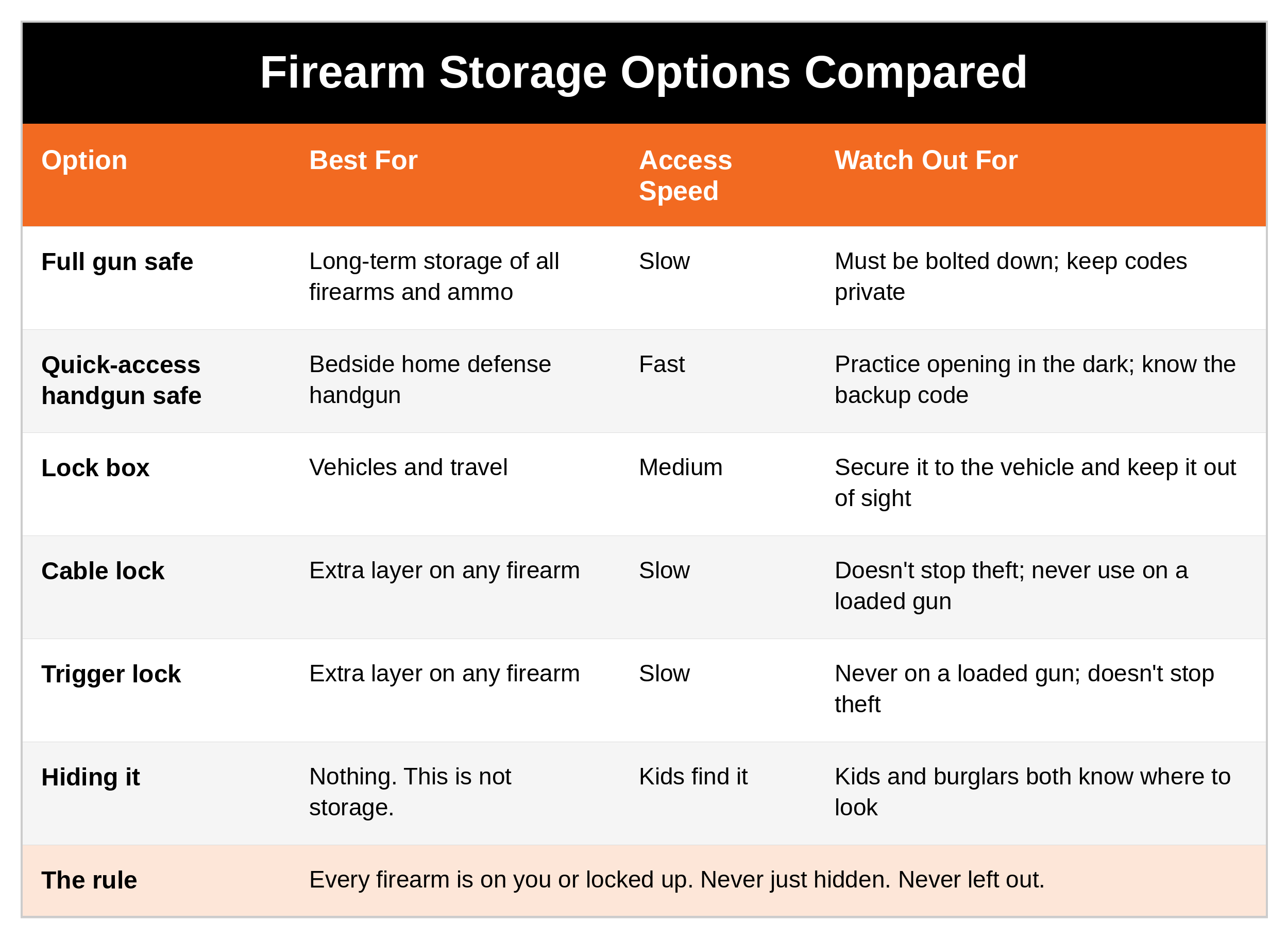
Storage Options Compared
Each option has a job.
Here's how they stack up.
Gun Safes
Gun safes are one of the most secure options. They come in many sizes and can hold multiple firearms, ammunition, and other valuables. Look for:
Steel thickness: thicker steel gives better protection.
Locking mechanism: combination, electronic keypad, or biometric.
Fire resistance: many safes protect the contents during a house fire.
Anchor points: bolt it to the floor or wall. A safe that isn't anchored can be carried out of the house.
Examples: Fortress and Steelwater make safes in a range of sizes with solid steel construction and customizable shelving.
Quick-Access (Biometric or Keypad) Handgun Safes
These small safes open with your fingerprint or a keypad, which makes them a good choice for a bedside home defense handgun.
Fast access in an emergency
Multiple user profiles, so another trusted adult in the home can open it too
Practice opening it in the dark, half asleep, under stress. Fingerprint readers can fail with wet, dirty, or shaking hands, so know your backup code or key.
Example: the BILLCONCH Smart Gun Safe.
Lock Boxes
Lock boxes are small, portable, and good for travel or for securing a handgun in a vehicle. They usually use a combination, key, or RFID lock.
Example: the Hornady RAPiD Vehicle Safe, designed for securing a firearm in a vehicle.
Trigger and Cable Locks
These are the most basic and affordable option. A cable lock runs through the action so the gun can't be loaded or fired. A trigger lock blocks the trigger.
Inexpensive, and they fit most firearms. Many new guns come with a free cable lock.
Never put a trigger lock on a loaded firearm.
They make a gun harder to fire, but they don't keep it from being stolen. They're a good extra layer, not a replacement for a safe.
Example: the Master Lock 94DSPT Trigger Lock.
Storage Starts With Who Lives in Your Home
The right setup depends on who's in your home and who visits.
Young Children
Every firearm locked up unless it's on you.
Teach the Eddie Eagle steps: Stop. Don't touch. Run away. Tell a grown-up. [LINK: Part 4, The Four Universal Safety Rules]
Keep keys and codes away from kids. Don't use birthdays or obvious codes.
Teenagers
Teens are curious, they talk to their friends, and some will try to figure out the code. Change your codes, keep keys on you, and talk honestly with them about why the guns are locked.
Visitors, Grandkids, and Parties
When anyone comes over, especially kids, every firearm is locked up. That includes the one in your nightstand. Guests don't know your house rules, and their kids don't either.
Grandparents' and Relatives' Homes
Many of the guns kids find are at a grandparent's or relative's house, where safe storage may not be on anyone's mind. If your kids spend time there, have the conversation. It's an act of love, not criticism.
If Someone in Your Home Is Struggling
If someone in your home is going through a crisis, such as depression, a loss, or thoughts of hurting themselves, consider storing your firearms outside the home for a while, with a trusted friend, family member, or a gun shop or range that offers storage. It's temporary, and it can save a life. If you or someone you love is in crisis, call or text 988, the Suicide and Crisis Lifeline.
Your Car Is Not a Safe
A gun left in a car is one of the easiest guns for a thief to steal. According to a 2024 analysis of FBI data reported by the Associated Press, gun thefts from cars have tripled over the past decade and now make up about half of reported gun thefts in the cities studied.
Never leave a gun loose in a glove box, console, or under the seat.
If you have to leave it in the car, use a lock box secured to the vehicle, out of sight.
Better yet, bring it in with you, or leave it locked up at home.
At home, bring it inside at night. Don't leave it in the car in the driveway.
When Your Child Visits Another Home
Your guns are locked up. But what about the house where your child is going for a playdate?
Ask before your child goes over. It's a simple question, and the right family won't be offended. Ask it the same way you'd ask about pets, allergies, or a pool.
Ask everyone. That way it's never personal.
If the answer is no guns, great.
If the answer is yes, ask how they're stored.
If the answer is unclear, or they get defensive, offer to host at your house instead.
What to Say Before a Playdate
"Before the kids get together, can I ask a safety question I ask everyone? Are there any guns in the house, and are they locked up?"
If they say yes: "Thanks for telling me. Are they locked in a safe, and is the ammunition locked up too?"
If you're not comfortable with the answer: "Thanks. How about we have them over at our place this time?"
Keep SCAN at the Center
Safe storage is awareness at home. SCAN: S - See your environment (who's in your home today, and who's visiting), C - Create space (a locked safe puts space between a child and a gun), A - Act deliberately (lock it up every time, not most of the time), and N - Never doubt your gut feelings (if a home doesn't feel safe for your child, say no). The prepared protector locks it up so it's there for the right person, and no one else.
What to Say
To your family: "Every gun in this house is either on me or locked up. If you ever see one that isn't, tell me right away."
To a visiting relative who carries: "We have kids in the house. Can I lock that up for you while you're here?"
To a grandparent: "The kids love coming over. Can we make sure the guns are locked up while they're here?"
Ask Yourself
If my child or grandchild went looking right now, could they find a gun in my home?
Is my home defense handgun in a quick-access safe I can open in the dark?
Have I asked about guns at every home my child visits?
Remember
A firearm is either on you or locked up. Never just hidden, and never left out. Choose storage that fits your home, lock it every time, and ask before your child visits someone else's home.
Get Started Today
[FREE DOWNLOAD: TBD. Suggested: Family Safe Storage Checklist with a "Before the Playdate" question card] [CTA: Comment or DM "KEYWORD" / or download it here: LINK]
Go Deeper
The Family Safety Toolkit. Safe storage is one part of a safe home. The Toolkit gives you 20 checklists covering every area of family safety and preparedness, from your home and vehicle to travel and your go bag, all for $19.99. [Get it here: https://www.preparednotparanoid.com/family-safety-toolkit]
The Family Emergency Preparedness Manual is coming soon.
Tools I recommend: The safes, lock boxes, and cable locks I recommend are in my Range Essentials Amazon store. https://link.amazon/B0hxQD89P
Related reading:
Firearms and Family Safety, Intro: Your Goal Is to Never Have to Use It [LINK]
Firearms and Family Safety, Part 4: The Four Universal Safety Rules [LINK]
Firearms and Family Safety, Part 7: Dry Fire Training [LINK]
Firearms and Family Safety, Part 12: Traveling With a Firearm [LINK]
References
Bureau of Alcohol, Tobacco, Firearms and Explosives. National Firearms Commerce and Trafficking Assessment (NFCTA), Volume II: Crime Guns Recovered 2017 to 2021. https://www.atf.gov/news/pr/justice-department-announces-publication-second-volume-national-firearms-commerce-and
Baxley, F., and Miller, M. "Parental Misperceptions About Children and Firearms." Archives of Pediatrics and Adolescent Medicine (2006).
Associated Press. Report on gun thefts from vehicles, based on an analysis of FBI data (May 2024).
National Rifle Association. Eddie Eagle GunSafe Program.
988 Suicide and Crisis Lifeline. https://988lifeline.org/
Betz, Lawrence. Navigating the Red Zone and Beyond (the SCAN framework).
Disclaimer
These suggestions are intended to help you and your family build awareness, confidence, and safer decision-making habits. No safety plan, checklist, or tool can guarantee 100% protection. This article is for general informational purposes only and is not legal advice or a substitute for professional firearms training. Some states have laws about storing firearms where children can access them, so check your state and county laws and talk to a qualified attorney about your specific situation. Always follow your safe or lock manufacturer's instructions. Affiliate disclosure: I've linked to products from my Amazon store that I personally recommend. As an Amazon Associate, I earn from qualifying purchases, at no extra cost to you. Thank you for supporting my work.
If you are in immediate danger, get to safety and call 911. If you or someone you love is in crisis, call or text 988.
Awareness gives you time. Time gives you options.
The Prepared Protector is someone who's decided that loving someone means being ready for them, not just hoping things go fine.
Prepared Not Paranoid. Protecting the Most Vulnerable Among Us.