The Foundation of Every Safe Gun Owner, and Every Safe Home
By Larry Betz | Prepared Not Paranoid https://www.preparednotparanoid.com/
Every firearm safety rule I teach comes back to four. If you follow these four firearm safety rules every time you handle a gun, at the range, at home, or anywhere else, it's nearly impossible for anyone to get hurt by accident. Break one, and you're relying on luck. Break two, and someone can get hurt. This is the foundation for everything else in this series.
Where the Four Rules Come From
These rules are widely credited to Col. Jeff Cooper, who popularized them, and some version of them is taught by the USCCA, the NRA, and nearly every firearms instructor in the country. The wording changes a little from teacher to teacher. The meaning never does.
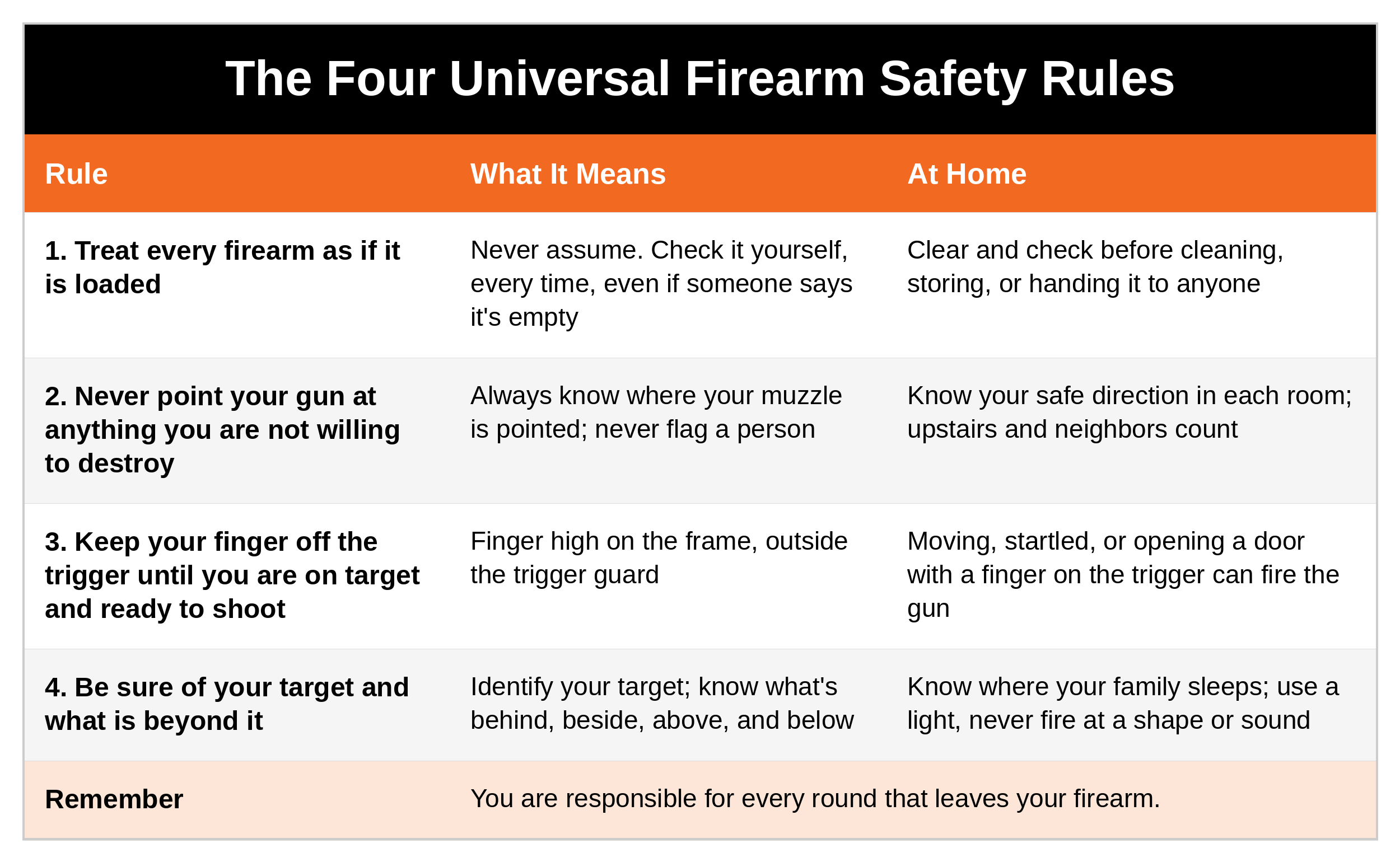
The Four Rules at a Glance
Memorize them. Teach them to everyone in your home.
Here they are in one place.
Rule 1: Treat Every Firearm as If It Is Loaded
Assume every firearm is loaded until you have personally confirmed it's unloaded and safe. Not someone else. You. If you're holding a firearm, you're responsible for confirming it's safe, even if someone just handed it to you and said, "It's empty."
How to Clear a Semi-Automatic Pistol
Keep the gun pointed in a safe direction the whole time.
Remove the source of feed (the magazine).
Lock the slide to the rear.
Visually inspect the chamber and magazine well from the top of the slide.
Visually inspect the feed ramp.
Look away briefly, then do a tactile check by putting your pinky into the chamber to confirm it's empty.
A chamber flag is a great visual aid. It shows you, and everyone around you, that the gun is clear.
How to Clear a Double-Action Revolver
Open the cylinder using the release latch, usually on the left side of the frame behind the cylinder.
Swing the cylinder all the way out.
Visually and physically check each chamber for live rounds or empty casings.
Tip the muzzle up and push the ejector rod to make sure every round is out.
How to Clear a Single-Action Revolver
Open the loading gate, usually on the right side of the frame.
Rotate the cylinder by hand, checking and unloading one chamber at a time with the ejector rod.
Make sure every chamber has been checked by sight and by touch.
With any revolver, don't assume it's unloaded just because it looks empty. Check every chamber.
Rule 2: Never Point Your Gun at Anything You Are Not Willing to Destroy
The muzzle is the front of the barrel, where the bullet comes out. You always need to know where it's pointed. That's called muzzle management.
Muzzle awareness: Keep your muzzle pointed in a safe direction at all times.
"Flagging": When your muzzle crosses or points at a person, or anything you aren't willing to destroy, that's called flagging. Avoid it every time, with no exceptions.
What Is a Safe Direction?
A safe direction is one where, if the gun went off unintentionally, it would cause the least risk to life or property. That changes with where you are:
In a two-story home, pointing up could put someone upstairs at risk.
In an apartment or a city, safe directions may be very limited.
On the stairs, think about where an unintended discharge would do the least harm.
Before you pick up a gun at home, ask yourself where your safe direction is in that room.
Rule 3: Keep Your Finger Off the Trigger Until You Are on Target and Ready to Shoot
Your trigger finger should rest high on the frame, outside the trigger guard, until:
Your sights are on the target, and
You've made the conscious decision to shoot.
That includes when you're moving with the gun or clearing a malfunction.
Why This Matters: The Sympathetic Muscle Response
Your hands can squeeze without you meaning to. It's called a sympathetic muscle response: an involuntary contraction when you're startled, lose your balance, trip, or use your other hand suddenly, like pushing open a door or deflecting an attack. If your finger is on the trigger when that happens, the gun fires.
Don't put your finger inside the trigger guard unless every legal and moral requirement for the use of deadly force has been met.
Rule 4: Be Sure of Your Target and What Is Beyond It
Always positively identify your target before you fire. You are responsible for every round that leaves your firearm.
Make sure there's a safe backstop to stop the bullet.
Know what's behind your target, and also what's to the left, right, above, and below. Bullets can go through things or miss altogether.
This applies everywhere: at the range, in a home defense situation, and in any real-world threat.
At home, that means knowing where your family sleeps and which walls they're behind. Common home defense rounds can go through interior walls. [LINK: Part 3, Shotgun or AR-15 for Home Defense] In the dark, it means a light, so you never fire at a shape or a sound. That shape could be your teenager coming home late.
A Note From Larry
Remember, a firearm is a tool. You still need a plan. Situational awareness is always your number one go-to. If you ever need to use this or any tool, what is your plan after you use it? Running might be your best option.
Rule 4 Is SCAN With a Gun in Your Hand
My short version of Rule 4 has always ended with "be situationally aware of your surroundings." That's SCAN:
S - See your environment. Know what's around and beyond your target.
C - Create space. Distance gives you time to identify what you're seeing.
A - Act deliberately. No rushed decisions with a gun in your hand.
N - Never doubt your gut feelings. If something isn't right, don't fire.
Teaching the Rules at Home
If there's a gun in your home, everyone in your home needs to know the rules, including people who will never shoot.
For young children, the NRA's Eddie Eagle GunSafe program teaches four simple steps if they ever find a gun:
Stop.
Don't touch.
Run away.
Tell a grown-up.
Practice it with them like a fire drill. And remember, kids visit homes where guns aren't stored safely. Teaching them these steps protects them everywhere, not just in your house. The best protection, of course, is a gun they can never get to. [LINK: Part 11, Safe Storage at Home]
What to Say
When someone hands you a gun: "Thanks. I'm going to check it myself."
When someone flags you at the range: "Hey, watch your muzzle, please."
When you hand someone a gun: "It's clear. Check it for yourself."
To your kids: "If you ever see a gun, anywhere, what do you do?" Have them say it back: "Stop. Don't touch. Run away. Tell a grown-up."
Ask Yourself
Do I check every gun myself, every time, even when I was just told it's empty?
Do I know my safe direction in each room of my home?
Does everyone in my house, including the kids, know what to do if they find a gun?
Remember
You are responsible for every round that leaves your firearm. Firearm safety isn't optional. It's the responsibility that comes with owning or handling any firearm, every time.
Get Started Today
[FREE DOWNLOAD: TBD. Suggested: Four Rules printable for your gun safe or range bag, with the kids' rules on the back] [CTA: Comment or DM "KEYWORD" / or download it here: LINK]
Go Deeper
The Family Safety Toolkit. Safe gun handling is one part of a safe home. The Toolkit gives you 20 checklists covering every area of family safety and preparedness, from your home and vehicle to travel and your go bag, all for $19.99. [Get it here: https://www.preparednotparanoid.com/family-safety-toolkit]
The Family Emergency Preparedness Manual is coming soon.
Tools I recommend: Chamber flags and the range gear I recommend are in my Range Essentials Amazon store. https://link.amazon/B0hxQD89P
Related reading:
Firearms and Family Safety, Part 3: Shotgun or AR-15 for Home Defense [LINK]
Firearms and Family Safety, Part 5: Range Day Basics: Terms and Commands [LINK]
Firearms and Family Safety, Part 11: Safe Storage at Home [LINK]
Firearms and Family Safety, Part 13: Ballistics: Choosing Home Defense Ammo [LINK]
References
Cooper, Jeff. The four rules of firearm safety, as popularized in his teaching and writing.
National Rifle Association. Eddie Eagle GunSafe Program.
U.S. Concealed Carry Association (USCCA). Firearm safety fundamentals.
Betz, Lawrence. Navigating the Red Zone and Beyond (the SCAN framework).
Disclaimer
These suggestions are intended to help you and your family build awareness, confidence, and safer decision-making habits. No safety plan, checklist, or tool can guarantee 100% protection. This article is for general informational purposes only and is not legal advice or a substitute for hands-on firearms training with a qualified instructor. Firearm, storage, and self-defense laws vary by state and situation, so check your local laws and talk to a qualified attorney about your specific situation. Always store firearms securely and out of reach of children. Affiliate disclosure: I've linked to products from my Amazon store that I personally recommend. As an Amazon Associate, I earn from qualifying purchases, at no extra cost to you. Thank you for supporting my work.
If you are in immediate danger, get to safety and call 911.
Awareness gives you time. Time gives you options.
The prepared protector is someone who's decided that loving someone means being ready for them, not just hoping things go fine.
Prepared Not Paranoid. Protecting the Most Vulnerable Among Us.