What Each One Does Well, What the Myths Get Wrong, and Why Training Matters Most
By Larry Betz | Prepared Not Paranoid https://www.preparednotparanoid.com/
Shotgun or AR-15 for home defense? It's one of the most common questions I hear. Both can be excellent choices, and both have real limits. In Part 2, we covered handguns. Now we'll look at the two most popular long guns for protecting your home, clear up some myths, and talk honestly about what happens when a round goes through a wall.
Why Consider a Long Gun at All?
A long gun gives you four points of contact: your shoulder, your cheek, the pistol grip, and your support hand. A handgun gives you two. Those extra contact points make a much more stable platform, which helps your accuracy and control under stress.
It's also easier to mount a light on a long gun, so you can see and identify what you're facing in the dark while keeping both hands on the gun. Many pistols take a weapon light too, but with a handgun, people often end up holding a flashlight in one hand and the gun in the other, which is hard to do well. That's one reason I recommend a handgun you can control with one hand.
The Shotgun
The shotgun is very versatile, and it's often called the thinking man's gun because it adapts to so many jobs. With slugs, you can reach out to 100 yards. With buckshot, you have loads suited for home defense. Slugs and buckshot are simply different types of ammunition for different purposes.
Pump-Action Shotguns
Pump-action shotguns are known for reliability and simplicity. You cycle the action by hand after every shot, which makes them a little slower than semi-automatics. Most hold about 4 to 8 rounds, and some models take more with extended or detachable magazines.
Semi-Automatic Shotguns
Semi-automatic shotguns use gas or inertia to cycle the action for you, so follow-up shots are faster. Most hold about 3 to 7 rounds, though some tactical models hold more.
The Shotgun's Limits
The biggest limitation is capacity. Most shotguns hold somewhere between 5 and 8 rounds. They can also be large, heavy, hard to move with in tight hallways, and the recoil is significant. That's why the shotgun takes a lot of practice before you're comfortable using it for home defense.
If you're considering a shotgun, take a lesson or a class with one before you buy it for self-protection.
A Quick Ammo Note
Published wall and gel testing generally shows that birdshot doesn't penetrate deep enough to be a reliable defensive load beyond very close range, that 00 buckshot can go through multiple walls, and that #1 buckshot often gives the best balance. In Part 13, we'll walk through the actual tests behind these findings. [LINK: Part 13, Ballistics: Choosing Home Defense Ammo]
The AR-15
When it comes to firearms and the media, there's a lot of misinformation. Let's clear some of it up.
What "AR" Really Means
Many people believe "AR" stands for "assault rifle." It doesn't. "AR" stands for ArmaLite Rifle, after the company that developed it. Eugene Stoner designed the AR-15 at ArmaLite in the late 1950s as a lightweight, smaller-caliber rifle based on the larger AR-10. In 1959, ArmaLite sold the design to Colt. The U.S. military adopted a select-fire version, the M16, during the Vietnam War, and Colt sold a semi-automatic version to civilians as the AR-15.
Why People Choose It for Home Defense
Responsible owners choose the AR-15 for home defense because it's:
Lightweight and easy to handle
Maneuverable in tight spaces, especially with a shorter barrel and adjustable stock
Accurate
Modular, so you can add a light and set it up to fit you
Easier on recoil than most shotguns
Like any firearm, it takes proper training and practice to use well.
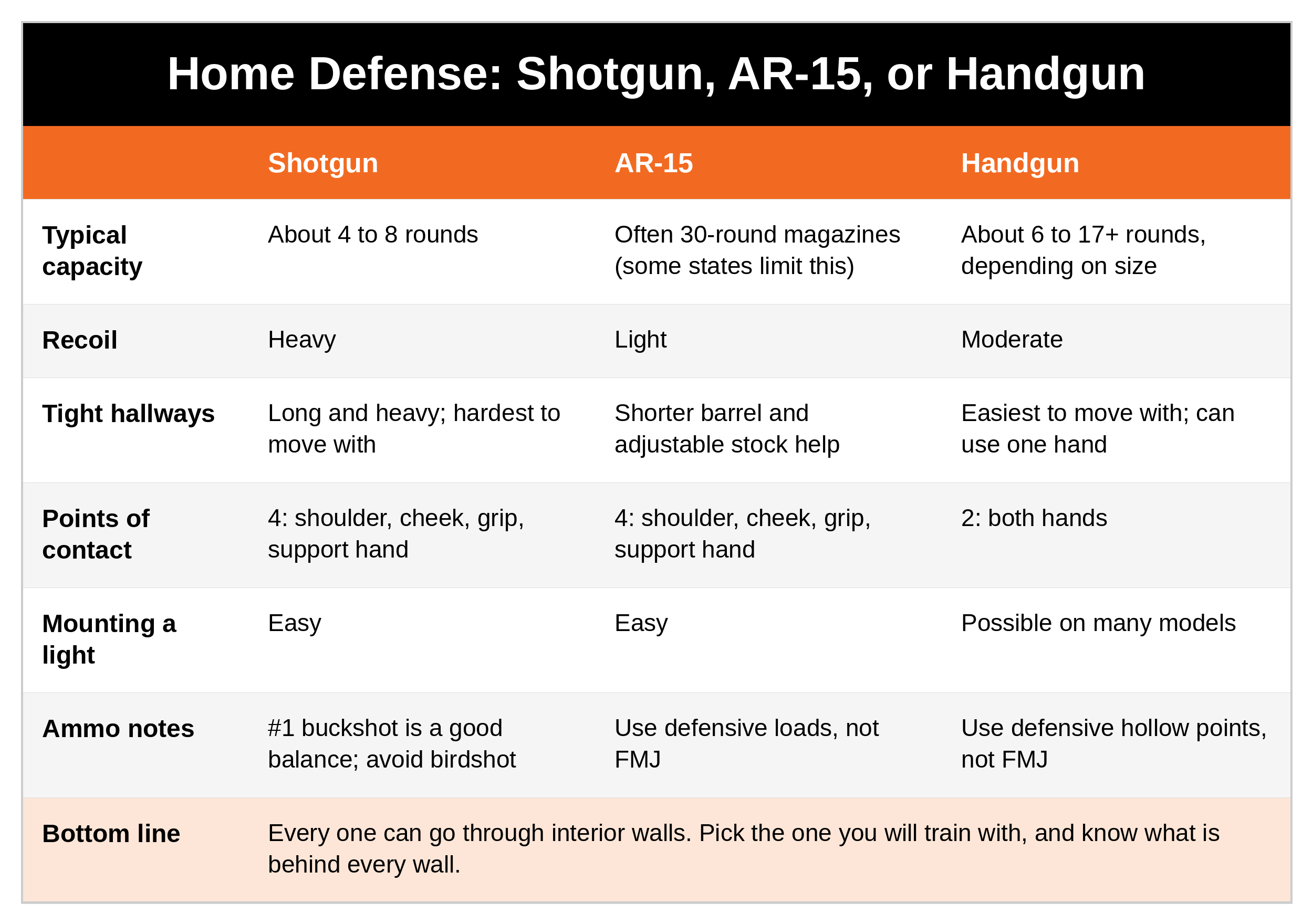
Shotgun, AR-15, or Handgun: How They Compare
There's no single right answer. Each one trades something for something else.
Here's how they stack up for home defense.
What About Going Through Walls?
You'll hear that an AR-15 round will go through several houses. That's an exaggeration. But here's the honest truth: every common home defense round, from a 9mm to buckshot to a 5.56, can go through interior walls. Drywall stops very little.
What makes the biggest difference is the load you choose, not just the gun:
Published testing generally shows that defensive 5.56 loads (soft points, hollow points, and open-tip match) often break apart and go through fewer walls than handgun full metal jacket or buckshot. 55-grain full metal jacket 5.56 is a different story and can go deep.
In a wall test by the USCCA, a 5.56 round went through more sheets of drywall than any handgun or shotgun load they tested.
Results change with the exact ammunition, the distance, and how the walls are built. That's why you need to know where your family is and what's behind every wall in your home. It's also why the fourth universal safety rule, be sure of your target and what's beyond it, matters so much at home. [LINK: Part 4, The Four Universal Safety Rules]
A Note From Larry
Remember, a firearm is a tool. You still need a plan. Situational awareness is always your number one go-to. If you ever need to use this or any tool, what is your plan after you use it? Running might be your best option.
Check Your State's Laws
Some states restrict AR-15 style rifles, certain features, or magazine capacity. Before you buy any long gun, check your state and local laws.
Keep SCAN at the Center
Whatever you choose, it's the last step in your home defense plan, not the first.
SCAN still comes first:
S - See your environment,
C - Create space,
A - Act deliberately,
N - Never doubt your gut feelings.
At home, that means locks, lights, an alarm, and a safe room, the 4 D's from the Intro. [LINK: Firearms and Family Safety, Intro] The prepared protector plans so the long gun stays in the safe.
What to Say
To an instructor: "I'm deciding between a shotgun and an AR-15 for home defense. Can I try both in a class before I buy?"
At the gun counter: "What defensive ammunition would you recommend for home defense, and why?"
To your family: "If anything ever happens at night, stay in your room with the door locked. Don't come looking for me. I'll call out to you when it's safe."
Ask Yourself
Can I handle this gun safely in my hallways and doorways?
Do I know which walls in my home have family members behind them?
Have I trained with the ammunition I plan to keep in it?
Remember
The best home defense gun is the one you've trained with and can control. Choose your ammunition as carefully as your firearm, know what's behind every wall, and keep your plan built around never having to use it.
Get Started Today
[FREE DOWNLOAD: TBD. Suggested: Home Defense Room Map, one page] [CTA: Comment or DM "KEYWORD" / or download it here: LINK]
Go Deeper
The Family Safety Toolkit. Choosing a home defense firearm is one piece of protecting your family. The Toolkit gives you 20 checklists covering every area of family safety and preparedness, from your home and vehicle to travel and your go bag, all for $19.99. [Get it here: https://www.preparednotparanoid.com/family-safety-toolkit]
The Family Emergency Preparedness Manual is coming soon.
Tools I recommend: The range gear and accessories I recommend are in my Range Essentials Amazon store. https://link.amazon/B0hxQD89P
Related reading:
Firearms and Family Safety, Part 2: Choosing a Handgun [LINK]
Firearms and Family Safety, Part 11: Safe Storage at Home [LINK]
Firearms and Family Safety, Part 13: Ballistics: Choosing Home Defense Ammo [LINK]
Firearms and Family Safety, Intro: Your Goal Is to Never Have to Use It [LINK]
References
Combs, Ed. "Wall to Wall: Testing Penetration of Home Defense Ammo." U.S. Concealed Carry Association. https://www.usconcealedcarry.com/blog/wall-to-wall-testing-penetration-of-home-defense-ammo/
Betz, Larry. Home defense wall and gel testing, Prepared Not Paranoid (details in Part 13).
ArmaLite and Colt company histories of the AR-15 and M16.
U.S. Concealed Carry Association (USCCA). Home defense firearm and ammunition resources.
Disclaimer
These suggestions are intended to help you and your family build awareness, confidence, and safer decision-making habits. No safety plan, checklist, or tool can guarantee 100% protection. This article is for general informational purposes only and is not legal advice or a substitute for professional firearms training. Firearm, magazine, and self-defense laws vary by state and situation, so check your local laws and talk to a qualified attorney about your specific situation. Ammunition performance varies by load, distance, and building materials. Always store firearms securely and out of reach of children. Affiliate disclosure: I've linked to products from my Amazon store that I personally recommend. As an Amazon Associate, I earn from qualifying purchases, at no extra cost to you. Thank you for supporting my work.
If you are in immediate danger, get to safety and call 911.
Awareness gives you time. Time gives you options.
The prepared protector is someone who's decided that loving someone means being ready for them, not just hoping things go fine.
Prepared Not Paranoid. Protecting the Most Vulnerable Among Us.