Sizes, Operating Systems, and Finding the One That Fits You
By Larry Betz | Prepared Not Paranoid https://www.preparednotparanoid.com/
Choosing a handgun starts with one question: can you control it? Not whether it looks good, not what someone else carries, but whether you can reach every control, handle the recoil, and shoot it accurately. In Part 1, we covered the questions to answer before you buy. Now we'll look at handgun sizes, how different handguns work, and how to pick one that fits your hands and your life.
Common Mistakes When Buying a Handgun
I see the same mistakes over and over.
People choose a handgun because:
It looks cool.
It was in a movie.
A neighbor recommended it. Remember, the people making these recommendations won't be there to help you if you ever need to defend yourself.
It's what SEALs and Special Forces use. Their needs, training, and hands aren't yours.
They think they need the most stopping power possible, without thinking about the size and recoil that come with it.
Please don't let any of these make the decision for you.
Fit Comes First
Choose a pistol you can easily handle, where you can reach all the controls, and that you can shoot accurately with both your strong hand and your support hand. That's the test. A handgun that fits you will make you safer and more accurate than one that doesn't, no matter what it costs or who recommends it.
Handgun Sizes
Understanding the different sizes will help you make an informed choice. Each one has advantages and trade-offs. Here's how the four sizes compare.
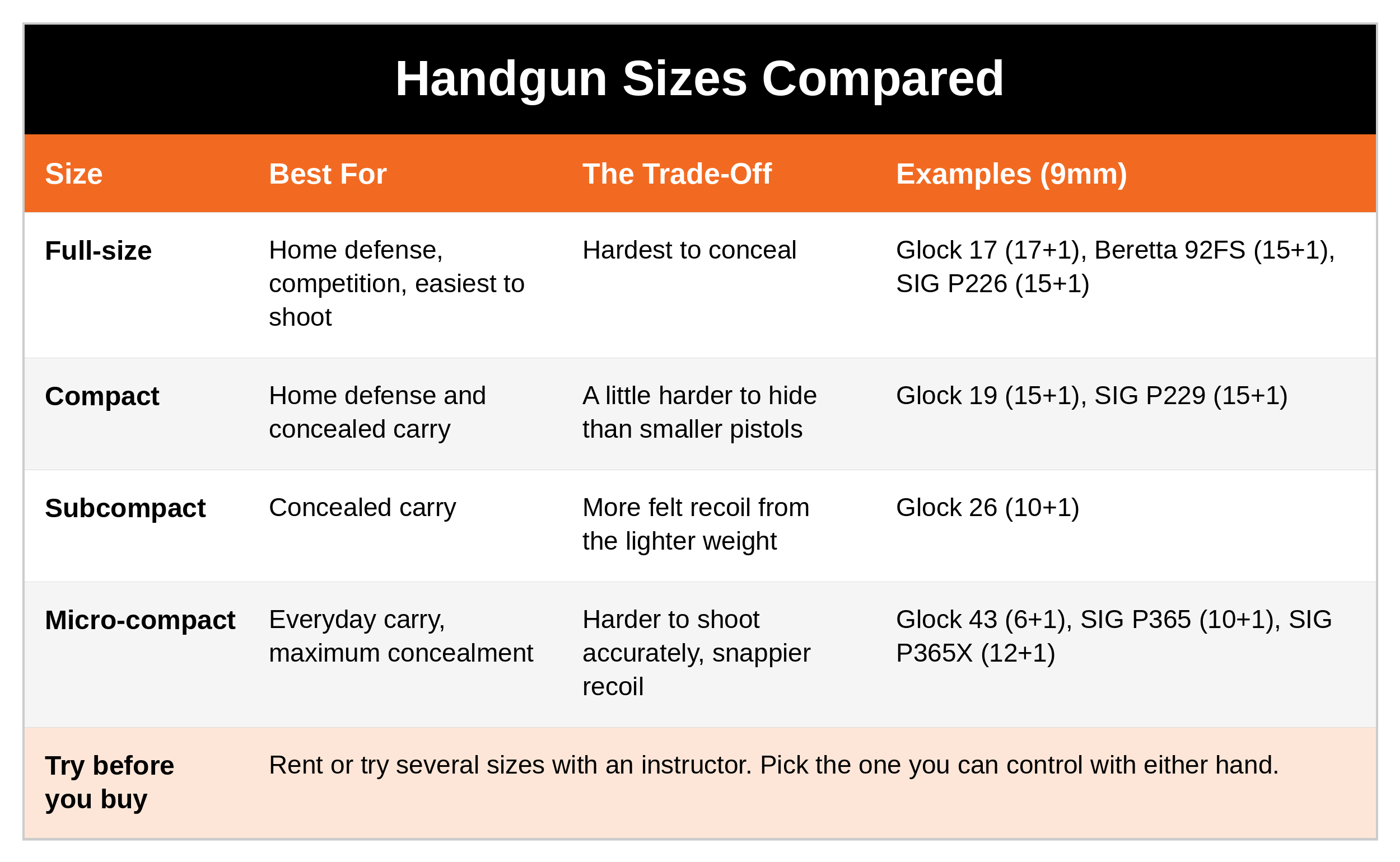
Makers define these sizes a little differently, so think of the barrel lengths below as rough ranges. All capacities listed are for 9mm.
Full-Size Pistols
Full-size pistols usually have barrels around 4.5 inches or longer, and a grip your whole hand fits on. They're larger, more comfortable to shoot, and easier to control under recoil, which makes them a great choice for home defense and competition.
Glock 17: 17+1
Beretta 92FS: 15+1
SIG Sauer P226: 15+1
SIG Sauer P320 (full size): 17+1, with 21-round magazines available
Compact Pistols
Compact pistols usually have barrels around 3.75 to 4.5 inches and are a bit smaller than full-size. They balance concealment and shootability, so they work for both home defense and concealed carry.
Glock 19: 15+1 with the standard magazine. It also takes the Glock 17's 17-round magazine, which sticks out a little below the grip.
SIG Sauer P229: 15+1
Subcompact Pistols
Subcompacts usually have barrels around 3 to 3.5 inches. They're smaller and lighter than compacts, which makes them easier to conceal, but the lighter weight means more felt recoil.
Glock 26: 10+1
Micro-Compact Pistols
Micro-compacts are the smallest, thinnest, and lightest. They're built for maximum concealment and are very easy to carry every day. The trade-off is that they can be harder to shoot accurately, with more snap in the recoil.
Glock 43: 6+1
SIG Sauer P365: 10+1, with 12 and 15-round magazines available
SIG Sauer P365X: 12+1
A Note on Magazines
Magazine capacity changes with caliber. If you want extended magazines, I recommend buying them directly from the manufacturer. Aftermarket magazines sometimes need modifications to work properly, and factory magazines give you the best fit and reliability. Also check your state's laws first: some states limit magazine capacity.
How Handguns Work: Common Operating Systems
The operating system is how the gun fires: what happens when you pull the trigger. It affects how the trigger feels and how much training it takes to shoot well.
Revolvers
Single-Action (SA): You cock the hammer by hand before every shot. The trigger only releases the hammer, so the pull is light and crisp. Think old Western movies: simple and reliable.
Double-Action (DA): You can cock the hammer by hand, or just pull the trigger, which both cocks and releases the hammer. The trigger pull is longer and heavier, but you can fire shots back to back without cocking each time.
Semi-Automatic Pistols
Single-Action (SA): The hammer has to be cocked for the first shot, by hand or by racking the slide. After that, the slide recocks the hammer every time you fire, and each trigger pull is light. The 1911 is the classic example.
Double-Action/Single-Action (DA/SA): The first shot is double-action, with a longer, heavier pull that cocks and releases the hammer. Every shot after that is single-action, with a lighter pull. The Beretta 92 and SIG P226 work this way. You'll need to practice the change between that first pull and the rest.
Double-Action Only (DAO): Every trigger pull cocks and releases the hammer, like a double-action revolver. The pull is heavier, but it's the same every time. Some older models, like certain versions of the SIG P250, work this way.
Striker-Fired Pistols
Striker-fired pistols don't have an external hammer. A spring-loaded striker hits the primer instead. The trigger pull is the same for every shot, usually lighter and shorter than a DAO. They're popular because they're simple and reliable. Glock is the best-known example, along with the Smith & Wesson M&P series and the SIG Sauer P320.
Caliber, Recoil, and Your Hands
Caliber is the diameter of the bullet a gun fires, measured in inches or millimeters. It affects power, recoil, and how the gun performs.
When you choose a caliber, be honest about your hand strength and whether you can control and manipulate the gun with one hand. As I work more with an aging population, I see people with diminished grip strength, wrist injuries, and arthritis in their hands. A gun you can't control isn't a gun you can depend on.
If racking the slide is hard for you, ask about pistols built with easier-to-rack slides, such as the Smith & Wesson M&P Shield EZ. And a larger, heavier gun often has less felt recoil than a tiny one, even in the same caliber.
That's why I can't stress this enough: schedule a session with an instructor from a reputable organization. Go through a detailed safety briefing and try several different handguns so you can see and feel the differences. If you've never fired a gun before, having an explosion go off in front of your face is startling, to say the least. If you're afraid to pull the trigger because of recoil or pain, that tool won't do you any good when you need it.
A Note From Larry
Remember, a firearm is a tool. You still need a plan. Situational awareness is always your number one go-to. If you ever need to use this or any tool, what is your plan after you use it? Running might be your best option.
Keep SCAN in Mind
The right handgun matters, but it's still the last step in your plan. SCAN comes first: S - See your environment, C - Create space, A - Act deliberately, N - Never doubt your gut feelings. The best handgun in the world won't help if you didn't see the problem coming. [LINK: Firearms and Family Safety, Intro]
What to Say
Use these at the range or the gun counter:
At the rental counter: "I'm a new shooter. Can I try a full-size and a compact in 9mm side by side?"
To your instructor: "I have trouble with my grip strength. Can we try a few pistols with easier slides?"
When a salesperson pushes: "Thanks, but I'm going to rent it and shoot it first before I decide."
Ask Yourself
Can I reach every control on this gun without shifting my grip?
Can I rack the slide, load the magazine, and shoot it accurately with either hand?
Am I choosing this gun because it fits me, or because of what someone else said?
Remember
The right handgun is the one you can control. Try several, choose the one that fits your hands and your life, and then train with it until it feels like part of you.
Get Started Today
[FREE DOWNLOAD: TBD. Suggested: Handgun Test Drive Scorecard, one page] [CTA: Comment or DM "KEYWORD" / or download it here: LINK]
Go Deeper
The Family Safety Toolkit. Choosing the right handgun is one part of keeping your family safe. The Toolkit gives you 20 checklists covering every area of family safety and preparedness, from your home and vehicle to travel and your go bag, all for $19.99. [Get it here: https://www.preparednotparanoid.com/family-safety-toolkit]
The Family Emergency Preparedness Manual is coming soon.
Tools I recommend: The range gear and accessories I recommend for new handgun owners are in my Range Essentials Amazon store. https://link.amazon/B0hxQD89P
Related reading:
Firearms and Family Safety, Part 1: Before You Buy a Gun [LINK]
Firearms and Family Safety, Part 3: Shotgun or AR-15 for Home Defense [LINK]
Firearms and Family Safety, Part 7: Dry Fire Training [LINK]
Firearms and Family Safety, Part 9: Holsters, Clothing, and Drawing From Concealment [LINK]
References
Glock, Inc. Product specifications: Glock 17, 19, 26, and 43.
SIG Sauer. Product specifications: P226, P229, P320, P365, and P365X.
Beretta. Product specifications: 92FS.
Smith & Wesson. Product specifications: M&P series and M&P Shield EZ.
U.S. Concealed Carry Association (USCCA). Handgun selection and training resources.
Disclaimer
These suggestions are intended to help you and your family build awareness, confidence, and safer decision-making habits. No safety plan, checklist, or tool can guarantee 100% protection. This article is for general informational purposes only and is not legal advice or a substitute for professional firearms training. Firearm, magazine, and self-defense laws vary by state and situation, so check your local laws and talk to a qualified attorney about your specific situation. Product specifications can change, so confirm capacity and features with the manufacturer before you buy. Always store firearms securely and out of reach of children. Affiliate disclosure: I've linked to products from my Amazon store that I personally recommend. As an Amazon Associate, I earn from qualifying purchases, at no extra cost to you. Thank you for supporting my work.
If you are in immediate danger, get to safety and call 911.
Awareness gives you time. Time gives you options.
The prepared protector is someone who's decided that loving someone means being ready for them, not just hoping things go fine.
Prepared Not Paranoid. Protecting the Most Vulnerable Among Us.