Seven Questions to Answer Before You Walk Into the Gun Store
By Larry Betz | Prepared Not Paranoid https://www.preparednotparanoid.com/
Before you buy a gun, you need to answer some hard questions. Choosing to own a firearm for recreation, home defense, or self-defense is a serious responsibility. It takes thoughtful planning and real training, and it affects everyone who lives in your home. In this post, I'll walk you through what I want every student to think about before they ever walk into a gun store.
Start With the Right Help
The first step isn't picking a gun. It's finding a reputable firearms instructor, such as one certified by the USCCA (U.S. Concealed Carry Association) or the NRA (National Rifle Association). A good instructor will give you a safety briefing, let you try different firearms, and help you build the skills to use one safely and effectively.
Beyond training, a responsible owner needs to understand:
Your state's laws on safe storage, safe transport, and the legal use of force
Ballistics: how your firearm and ammunition perform, and what they can go through in your home
Maintenance: how to clean and care for your firearm so it works when you need it
Accessibility: how you'll reach it quickly in an emergency while keeping it away from anyone who shouldn't have it
Mental readiness: whether you're prepared to own, and possibly use, a firearm
And don't skip less-lethal options and de-escalation. A firearm is one answer to one kind of problem. Most problems need something else. [LINK: Less Than Lethal Self-Defense Options, Intro]
Why I Don't Recommend Buying a Gun Just to Feel Safe
There's a saying in the firearms training world: "There is a judge attached to every round that leaves your gun." Every shot you fire is something you answer for.
As a firearms instructor, I know this might sound strange, but I don't recommend buying a gun just to feel safe. A firearm is a tool designed for a specific purpose, and owning one without the training to use it well can make you less safe, not more.
Here's my own path. I started my firearms training at the beginning of 2018, and it wasn't until the end of 2021 that I felt comfortable carrying a gun. That's almost four years and over 300 hours of formal training, including simulator training and use-of-force law. I remember coming home from my third low-light class and thinking about all the time I'd put in. I turned to my wife and said, "I finally feel comfortable carrying and using a gun for self-defense."
I'm not telling you that you need 300 hours before you can own a gun. I'm telling you that comfort and competence take time, and buying the gun is the beginning of the work, not the end of it.
Shooting Is a Perishable Skill
Shooting skills fade quickly when you don't use them. Even after you train, you have to keep practicing and keep challenging yourself. If you buy a gun, plan on regular range time and at-home dry fire practice (we cover that in Part 7) for as long as you own it.
A Note From Larry
Remember, a firearm is a tool. You still need a plan. Situational awareness is always your number one go-to. If you ever need to use this or any tool, what is your plan after you use it? Running might be your best option.
Seven Questions to Ask Before You Buy
If you're planning to buy a gun for self-defense, start here.
Here are the questions I want every student to answer first.
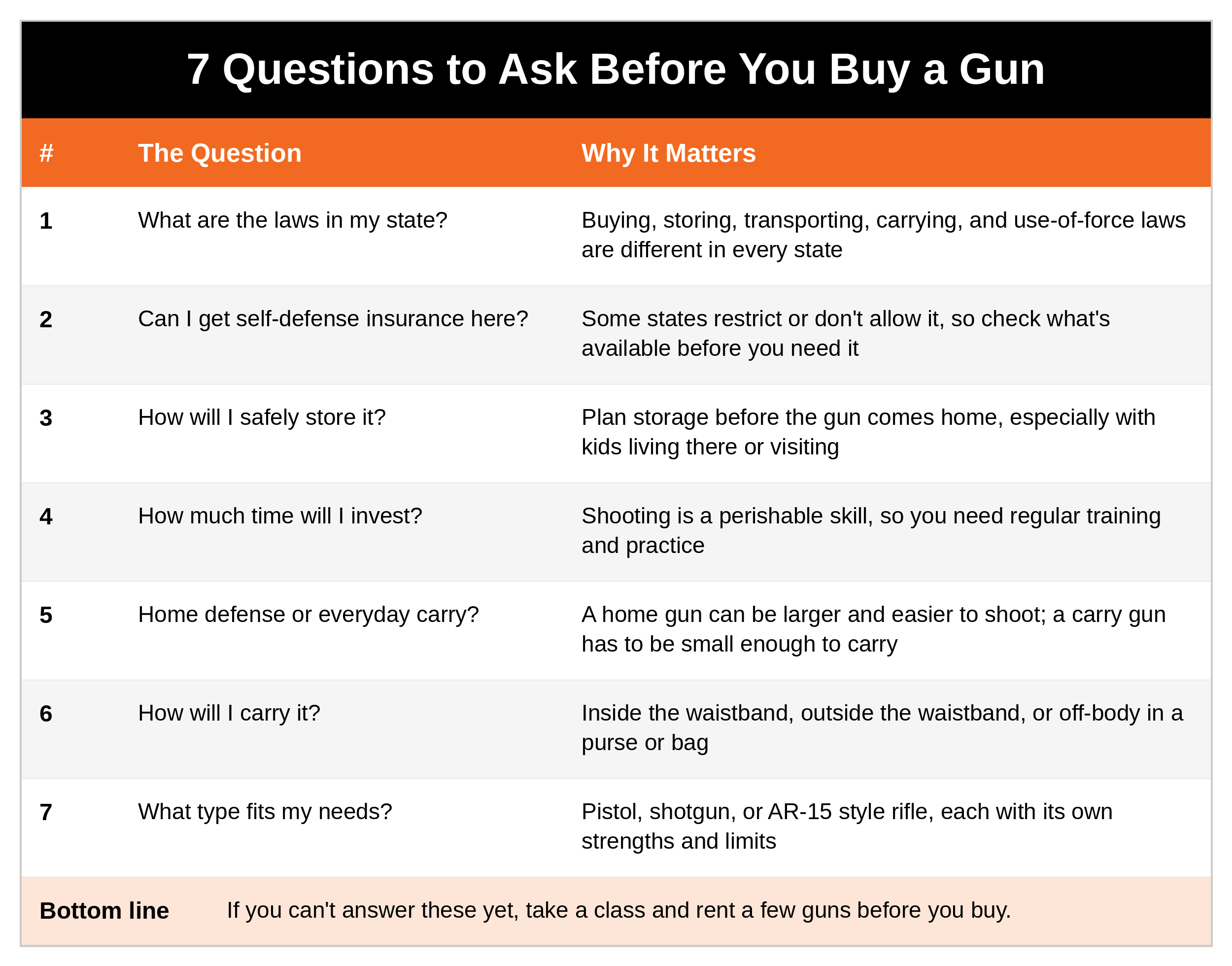
1. What are the laws in my state?
You need to understand your state's firearm laws to stay legal: buying, storing, transporting, carrying, and using force. [LINK: Part 10, Concealed Carry Permits and Where You Can't Carry]
2. Can I get self-defense insurance in my state?
Self-defense laws are different in every state, and some states restrict or don't allow self-defense insurance. Check with a USCCA representative to see what's available where you live. (We cover why this matters in Part 14.)
3. How will I safely store my gun?
Plan your storage before you buy, especially if you have children at home or kids who visit. [LINK: Part 11, Safe Storage at Home]
4. How much time am I willing to invest?
Getting proficient with your firearm, and staying proficient, takes regular practice and training. Be honest about how much time you'll really put in.
5. Is this for home defense or everyday carry?
The purpose shapes the choice. A home defense gun can be larger and easier to shoot. An everyday carry (EDC) gun needs to be small enough that you'll actually carry it.
6. How will I carry it?
If you plan to carry, decide how: inside the waistband (IWB), outside the waistband (OWB), or off-body carry, such as a purse or bag. (Part 8 covers carry positions.)
7. What type of firearm fits my needs?
Will it be a pistol, a shotgun, or an AR-15 style rifle? Parts 2 and 3 walk through each one.
There's No One Size Fits All
As we go through each type of firearm in this series, remember that no single gun is right for every situation. Your carry gun will likely be smaller than your home defense gun, and your home defense gun can be more robust than your everyday carry.
When you compare options, think about:
How accurate you are with it
How easy it is to become proficient with
How easy it is to maneuver
Size and weight
Whether it can be customized
Stopping power, recoil, and capacity
Each of these plays a role in finding the right firearm for your needs, your body, and your life.
Talk With Your Family First
A firearm in the home affects everyone who lives there. Your family's feelings about firearms, and their comfort with having one in the house, should be part of your decision.
Before you buy, talk through:
Who lives here and who visits? Kids, grandkids, aging parents, and guests all change your storage plan.
Is everyone comfortable with this? If someone isn't, listen. Their concerns are often about safety, and that's exactly what you're trying to protect.
Who will know where it's stored and how to access it? Decide this together.
What's the plan? A firearm fits into a bigger home safety plan, like the 4 D's from the Intro. [LINK: Firearms and Family Safety, Intro]
Keep SCAN at the Center
Buying a gun doesn't replace awareness. It only adds one more option at the very end of your plan. The SCAN framework I teach still comes first:
S - See your environment.
C - Create space.
A - Act deliberately.
N - Never doubt your gut feelings.
That last one applies to this decision too. If something about buying a gun doesn't feel right to you yet, trust that. Take a class first. Rent a few guns at the range. The gun store will still be there.
What to Say
Use these to start the right conversations:
To your family: "I'm thinking about getting a firearm for our home. Before I do anything, I want to hear how everyone feels about it."
To an instructor: "I've never owned a gun. Can I take a safety class and try a few different handguns before I buy?"
At the gun counter: "I'm not ready to buy today. Can you tell me which of these I can rent at the range first?"
Ask Yourself
Am I buying a gun to feel safe, or am I ready to train to be safe?
Does everyone in my home know about this decision, and are they on board?
Do I have a storage plan before the gun comes home?
Remember
Choosing to own a firearm isn't just a personal decision. It's a lifelong responsibility. It takes ongoing training, respect for the law, and a real commitment to safety. Stay informed, stay trained, and keep working to be the calm, confident protector your family may one day depend on.
Get Started Today
[FREE DOWNLOAD: TBD. Suggested: Before You Buy, Family Firearm Decision Worksheet, one page] [CTA: Comment or DM "KEYWORD" / or download it here: LINK]
Go Deeper
The Family Safety Toolkit. Buying a firearm is one piece of your family's safety plan. The Toolkit gives you 20 checklists covering every area of family safety and preparedness, from your home and vehicle to travel and your go bag, all for $19.99. [Get it here: https://www.preparednotparanoid.com/family-safety-toolkit]
The Family Emergency Preparedness Manual is coming soon.
Tools I recommend: The range gear and accessories I recommend for new shooters are in my Range Essentials Amazon store. https://link.amazon/B0hxQD89P
Related reading:
Firearms and Family Safety, Intro: Your Goal Is to Never Have to Use It [LINK]
Firearms and Family Safety, Part 2: Choosing a Handgun [LINK]
Firearms and Family Safety, Part 4: The Four Universal Safety Rules [LINK]
Firearms and Family Safety, Part 11: Safe Storage at Home [LINK]
References
U.S. Concealed Carry Association (USCCA). Firearms training, self-defense insurance, and state law resources.
National Rifle Association (NRA). Firearms safety and training courses.
Betz, Lawrence. Navigating the Red Zone and Beyond (the SCAN framework).
Disclaimer
These suggestions are intended to help you and your family build awareness, confidence, and safer decision-making habits. No safety plan, checklist, or tool can guarantee 100% protection. This article is for general informational purposes only and is not legal advice or a substitute for professional firearms training. Firearm, self-defense, and use-of-force laws vary by state and situation, so check your local laws and talk to a qualified attorney about your specific situation. Always store firearms securely and out of reach of children. Affiliate disclosure: I've linked to products from my Amazon store that I personally recommend. As an Amazon Associate, I earn from qualifying purchases, at no extra cost to you. Thank you for supporting my work.
If you are in immediate danger, get to safety and call 911.
Awareness gives you time. Time gives you options.
The prepared protector is someone who's decided that loving someone means being ready for them, not just hoping things go fine.
Prepared Not Paranoid. Protecting the Most Vulnerable Among Us.