How to Make Your Home a Hard Target So the Firearm Stays the Last Resort
By Larry Betz | Prepared Not Paranoid https://www.preparednotparanoid.com/
The best firearm for home defense is the one you never have to fire. That might sound strange coming from a firearms instructor, but it's the most important thing I teach. Owning a gun is a serious decision, and it's only one piece of protecting your family. In this series, we'll cover everything from buying your first handgun to safe storage, carrying, and what really happens after a defensive shooting. We start here, with the mindset that ties it all together.
My Goal as an Instructor
When someone comes to me wanting to learn to shoot for home defense, I tell them the same thing every time: my goal is to teach you to never have to use your firearm.
That isn't a contradiction. A firearm is a tool for the worst moment of your life. Everything else you do, your awareness, your locks, your lights, your plan, is about making sure that moment never comes. If home defense is your priority, make your home a hard target.
Your Home Should Be a Hard Target
Most criminals aren't looking for a fight. They're looking for an easy win: an unlocked door, a dark entryway, a house that looks like nobody's paying attention. Criminals don't want risk. Your job is to raise that risk before they ever touch your door.
A hard target is a home that says, from the street, "Not this one." When a bad guy sees cameras, lights, a reinforced door, and signs that someone's home, he moves on. That's a win, and nobody had to fire a shot.
The 4 D's of Home Defense
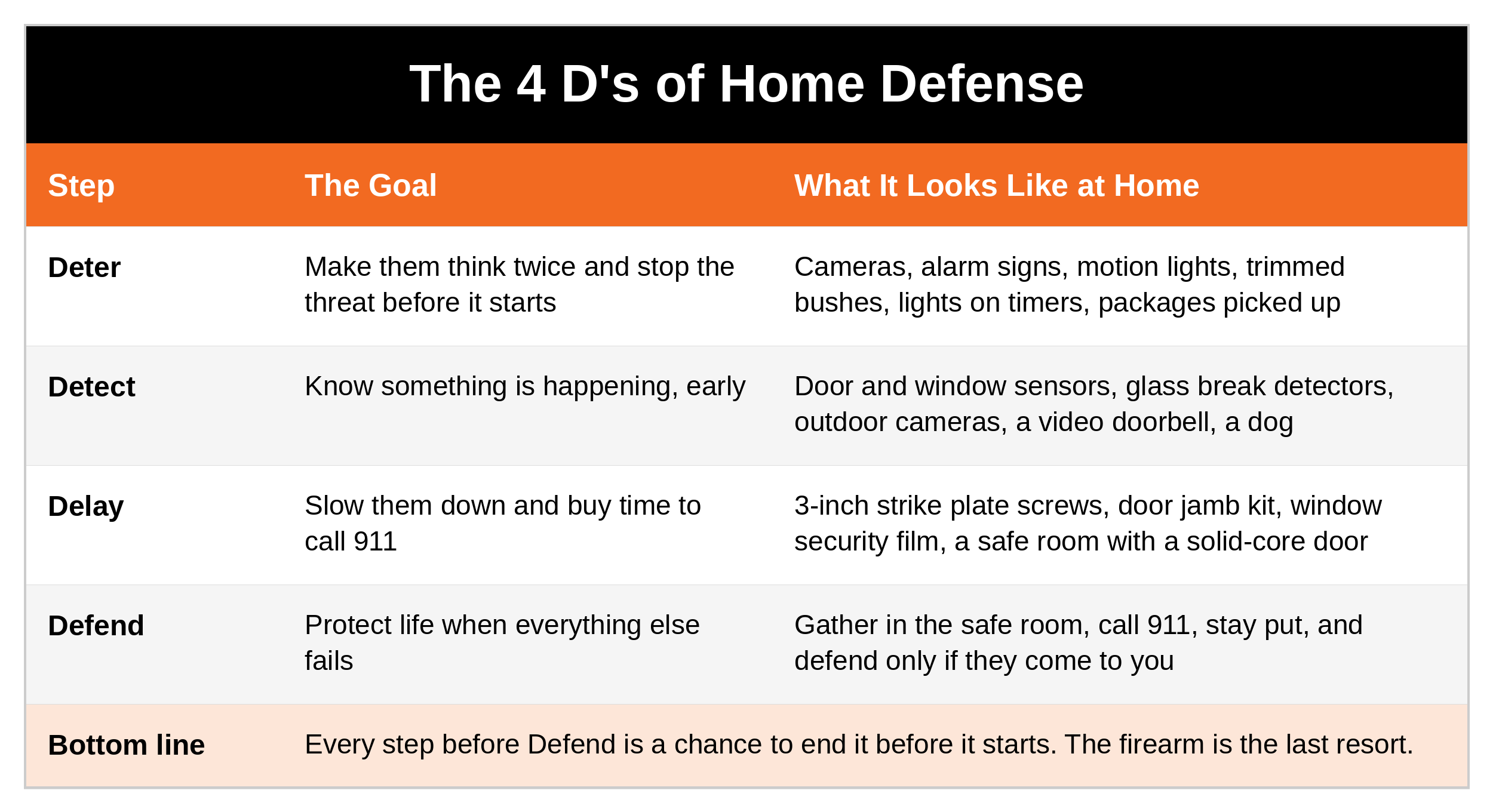
I teach home defense in four steps: Deter, Detect, Delay, Defend. Each one gives you more time, and time gives you options. Here's how the four steps work together.
1. Deter: Make Them Think Twice
The goal is to stop the threat before it starts.
Show visible security: cameras, alarm company signs, motion-activated lights, even a "Beware of Dog" sign.
Keep it visible: trim bushes near doors and windows, and get rid of dark entryways and blind spots.
Show signs of life: lights on timers, a car in the driveway, packages picked up the same day.
2. Detect: Know Something Is Happening, Early
The sooner you know, the more choices you have.
Door and window contact sensors
Glass break detectors
Motion-activated lights and outdoor cameras
A video doorbell
A dog. Even a small dog is an early warning system.
3. Delay: Slow Them Down
Every second you buy is a second to wake your family, call 911, and get to your safe room.
Reinforce your doors: use 3-inch screws in the strike plates so they reach the wall stud, and add a door jamb reinforcement kit.
Protect your windows with security film.
Use interior locks or door barricade devices on your safe room.
Pick a safe room with a solid-core door where your family gathers.
A 10-second delay might be the difference between dialing 911 or dialing 1911.
4. Defend: Protect Life When Everything Else Fails
If someone gets in and your family's life is in immediate danger, this is the last step.
Gather in your safe room with a charged phone, a flashlight, and your defensive tools.
Call 911 and stay put. Do not go looking for the intruder.
Prepare to defend only if they come to you.
When you control the space, you control the situation. Don't give that up by going hunting for the bad guy.
Take an Honest Look: Your Home Defense SWOT
The 4 D's tell you what a hard target looks like. A SWOT analysis tells you where your home stands right now. It's a simple planning tool: sit down at the kitchen table with your family and look honestly at four things.
S - Strengths. What's already working? Good locks, motion lights, a dog, a neighbor who keeps an eye on the house.
W - Weaknesses. Where are the gaps in your 4 D's? A dark side yard, a hollow-core door, no safe room, a garage door that stays open.
O - Opportunities. What can you improve easily? Longer strike plate screws, a video doorbell, a family drill, a training class.
T - Threats. What are the realistic risks where you live? Package theft, break-ins in your area, being home alone at night.
SCAN is what you do in the moment. SWOT is how you plan ahead, so the moment never comes. Start with your weaknesses and the easy opportunities, and you'll be a harder target by this weekend.
For a complete guide to home security, pick up your copy of The Safest House on the Block. [LINK: The Safest House on the Block. Add during the link scrub.]
Where the Firearm Fits
Look at where the firearm sits in the 4 D's: at the very end. It's your last resort, not your first response.
A solid 4 D's plan makes it much less likely you'll ever need deadly force. And if you do, you'll be in the strongest position possible, both for your safety and legally, because you stayed in a defensible spot, you called 911, and you clearly tried to avoid the confrontation.
A Note From Larry
Remember, a firearm is a tool. You still need a plan. Situational awareness is always your number one go-to. If you ever need to use this or any tool, what is your plan after you use it? Running might be your best option.
Use SCAN Every Day
In my books, I teach a simple framework called SCAN. It works at home, in the car, and anywhere you carry:
S - See your environment. Notice who's around, what's out of place, and where your exits are. At home, that means knowing what normal looks and sounds like.
C - Create space. Distance and barriers buy time. A locked door between you and a threat is space.
A - Act deliberately. Make a decision and commit to it: leave, lock in, call 911.
N - Never doubt your gut feelings. If something feels wrong, trust it. You don't need proof to lock the door or make the call.
Carrying a Firearm Means a Higher Standard
If you decide to carry a firearm in public, you're accepting a serious responsibility, legally, morally, and socially. Any mistake you make while armed can change your life.
Stay aware. Know your entrances, exits, and what's going on around you. Put the phone away.
Avoid and de-escalate. The gun is not your ego. It's your last resort. Walk away from the argument and let the other person "win."
Use your voice and body language to calm a situation before it grows.
Carrying a gun doesn't make you the hero of the story. It makes you the one most responsible for making sure the story never turns violent.
The Prepared protector carries with purpose, clarity, and restraint.
What's in This Series
Part 1: Before You Buy a Gun. The questions to ask yourself, talking with your family, and insurance.
Part 2: Choosing a Handgun. Sizes, operating systems, and calibers, including what works for aging hands.
Part 3: Shotgun or AR-15 for Home Defense. The pros and cons of each.
Part 4: The Four Universal Safety Rules. The foundation of everything else.
Part 5: Range Day Basics: Terms and Commands. What to expect your first time at the range.
Part 6: Range Gear Guide. Eye and ear protection, bags, cases, targets, and more.
Part 7: Dry Fire Training. How to practice safely at home.
Part 8: Concealed Carry Positions. Where on your body to carry and why.
Part 9: Holsters, Clothing, and Drawing From Concealment. Gear and drills.
Part 10: Concealed Carry Permits and Where You Can't Carry. Arizona's rules and restricted places.
Part 11: Safe Storage at Home. Keeping firearms secure, especially around kids.
Part 12: Traveling With a Firearm. Flying and driving legally.
Part 13: Ballistics: Choosing Home Defense Ammo. What goes through walls and what doesn't.
Part 14: The Life-Altering Event: What Happens After. The legal and personal reality after a defensive shooting.
What to Say
Your family should know these words before they ever need them:
To your family: "Everyone to the safe room. Lock the door. Stay down and stay quiet."
To the 911 dispatcher: "Someone has broken into my home at [your address]. My family and I are in the [room]. I am armed." Then stay on the line.
Through the door to the intruder: "I've called the police. I'm armed. Leave now."
Telling the dispatcher you're armed and where you are helps the responding officers know who's who when they arrive.
Ask Yourself
If someone broke in tonight at 2 a.m., does everyone in my house know where to go and what to do?
Which of the 4 D's is the weakest at my house right now?
Have I practiced my plan, or only thought about it?
Remember
Your goal is to never have to use your firearm. Make your home a hard target, have a plan your whole family knows, and keep the firearm where it belongs: the last resort.
Get Started Today
[FREE DOWNLOAD: TBD. Suggested: Make Your Home a Hard Target checklist, one page] [CTA: Comment or DM "KEYWORD" / or download it here: LINK]
Go Deeper
The Family Safety Toolkit. This series teaches you how to own and use a firearm responsibly. The Toolkit gives you 20 checklists covering every area of family safety and preparedness, from your home and vehicle to travel and your go bag, all for $19.99. [Get it here: https://www.preparednotparanoid.com/family-safety-toolkit]
The Family Emergency Preparedness Manual is coming soon.
Tools I recommend: The range gear and accessories I recommend are in my Range Essentials Amazon store. https://link.amazon/B0hxQD89P For flashlights, door barricades, and alarms from the 4 D's, see my Personal Safety Tools Amazon store. https://link.amazon/B0cVLeoJM
Related reading:
Firearms and Family Safety, Part 1: Before You Buy a Gun [LINK]
Firearms and Family Safety, Part 11: Safe Storage at Home [LINK]
Less Than Lethal Self-Defense Options, Intro: Not Every Problem Is a Gun Problem [LINK]
References
U.S. Concealed Carry Association. Home defense planning and responsible armed citizenship.
Betz, Lawrence. Navigating the Red Zone and Beyond (the SCAN framework).
Disclaimer
These suggestions are intended to help you and your family build awareness, confidence, and safer decision-making habits. No safety plan, checklist, or tool can guarantee 100% protection. This article is for general informational purposes only and is not legal advice or a substitute for professional firearms training. Firearm, self-defense, and use-of-force laws vary by state and situation, so check your local laws and talk to a qualified attorney about your specific situation. Always store firearms securely and out of reach of children. Affiliate disclosure: I've linked to products from my Amazon stores that I personally recommend. As an Amazon Associate, I earn from qualifying purchases, at no extra cost to you. Thank you for supporting my work.
If you are in immediate danger, get to safety and call 911.
Awareness gives you time. Time gives you options.
The prepared protector is someone who's decided that loving someone means being ready for them, not just hoping things go fine.
Prepared Not Paranoid. Protecting the Most Vulnerable Among Us.