No Spare, No Gas Can, No Problem, If You Plan Ahead
By Larry Betz | Prepared Not Paranoid https://www.preparednotparanoid.com/
You pop the trunk after a flat and find out there's no spare tire. Or you walk out on a cold morning, and the car won't unlock even though the main battery is full. Electric vehicles are great to drive, but they come with their own set of surprises, and most first-time owners don't find out until they're stuck. A well-planned EV emergency kit and a few new habits turn those surprises into minor inconveniences.
If your EV is your main way to get around, treat it like any other critical system in your life, something worth planning for. This post covers the tools, safety gear, and knowledge every EV driver should have.
Why EVs Need Special Planning
EVs offer a lot of advantages, from cleaner energy and instant torque to lower fuel costs and lower emissions. But owning one also comes with safety and maintenance challenges that aren't obvious to first-time drivers:
Range changes with the weather. Battery range can drop a lot in extreme heat or cold.
Towing cuts your range, even with a small trailer or a heavy load.
Tires and brakes can wear differently. EVs are heavy, and instant torque wears tires faster. Regenerative braking means the brakes get used less, which can lead to rust and sticking.
Flat tires are a bigger problem, because most EVs don't come with a spare.
A dead 12-volt battery can shut you down. Even with a full main battery, a dead 12V battery can leave the car locked and unresponsive.
Battery fires are rare, but very hard to put out, because lithium-ion batteries can keep reigniting.
High-voltage systems are dangerous to anyone who isn't trained to work on them.
Quiet at low speeds. Newer EVs are required to make a warning sound at low speeds so pedestrians can hear them, but older models may not. Watch for people in parking lots.
Winter and Travel Tips
Cold weather can change how your EV drives and how far it goes.
Expect less range in the cold. Range can drop 20 to 40 percent or more in freezing weather, because of battery chemistry and the energy it takes to heat the cabin.
Precondition while you're plugged in. Warm up the battery and cabin before you leave, while the car is still charging. It saves range and improves efficiency.
Use heated seats, a heated steering wheel, or a heated blanket instead of the main cabin heater on long trips. They use far less energy.
Check tire pressure often. Cold air makes pressure drop faster, which hurts traction, safety, and range.
Plan charging stops more carefully in winter. A cold battery can charge more slowly.
Keep an emergency kit with warm gear, snacks, and a backup charging plan, especially on rural or snowy routes.
If you're stranded in the cold, an EV can be a good shelter. It can run the heat without making carbon monoxide, often for many hours on a good charge. Use seat heaters and a blanket to stretch the battery, and keep the cabin heat low.
In the heat, cooling also uses battery. On a long desert drive, plan your charging stops with extra margin.
Before an Evacuation or Storm
Charge to full when a storm, wildfire, or evacuation is coming. Power outages can take public chargers down, and the ones that work will have long lines.
Know at least two backup charging locations along your evacuation route.
Don't drive through floodwater. It's dangerous in any car.
If your EV has been in saltwater flooding, like after a hurricane, keep it away from your house and garage, and have it inspected. Saltwater can damage the battery and cause a fire days or even weeks later.
Maintenance Reminders
EVs generally need less maintenance than gas cars, but they still have their own needs:
Tires: Wear is faster because of the added weight and instant torque. Rotate your tires every 5,000 to 7,500 miles to extend their life and keep the car handling well.
Brakes: Because regenerative braking does most of the work, brake calipers can rust or seize from lack of use. Have them inspected and serviced at least once a year, especially in wet or salted areas.
Cabin air filter: Replace it every 12,000 to 15,000 miles, or more often in dusty or smoky areas.
Coolant: EVs use coolant to manage battery and motor temperature. It still needs inspection and eventual replacement, so follow your manufacturer's schedule.
Software updates: Updates often include safety, performance, and range improvements. Check regularly for over-the-air updates or service notices.
EV-Specific Equipment and Safety Essentials
EVs need a few specialized tools and emergency items. This gear keeps you safe, moving, and prepared, especially in remote areas or bad weather.
1. Portable Tire Inflator and Sealant Kit
Most EVs don't have a spare tire, to save weight and make room for the battery. Instead, carry:
A compact 12V air compressor
A bottle of tire sealant for minor punctures. Make sure it's safe for your tire pressure sensors (TPMS).
An emergency tire repair kit made for EVs, like the one from EVANNEX, covers both. Tire damage is more common on EVs because of their weight and torque. Sealant is only a temporary fix, so get to a tire shop as soon as you can.
2. Portable 12V Jump Starter
Even with a fully charged main battery, a dead 12-volt battery can leave your EV locked and unresponsive. Locks, power-on, and charging can all depend on it. A compact jump starter, like one from NOCO, can get you going again. Follow your owner's manual for exactly where and how to connect it, since every EV is different. And never use your EV to jump-start another car unless your manual says you can.
Know your manual door release. If the 12V battery dies, power doors and windows may not work. Most EVs have a manual release. Find it in your owner's manual now, before you need it.
3. Portable Level 1 Charging Cable
Most EVs come with, or can use, a Level 1 charging cable that plugs into a regular 120-volt household outlet. It's slow, adding only about 3 to 5 miles of range per hour, but it's invaluable when you're stuck far from public charging.
Keep it in your car, coiled neatly and checked for damage.
Avoid extension cords unless they're rated for high amperage and outdoor use.
4. Charging Adapters for Travel
Having the right adapters opens up more places to charge, including RV parks, campgrounds, and other outlets.
NACS and CCS or J1772 adapters. Most automakers are switching to NACS, the Tesla-style charging port, and many non-Tesla EVs can now use Tesla Superchargers with the right adapter. Check which adapter your car needs.
TT-30P to NEMA 14-50 for RV hookups
NEMA 14-50 to NEMA 5-15 for household outlets
Always verify adapter ratings (amps and volts) to avoid overloading, and use only equipment that's right for your vehicle and charging system.
5. 12V Battery Monitoring Tools
Some EVs don't warn you before the 12V battery fails. A Bluetooth OBD-II reader, paired with a monitoring app, lets you track your 12V battery's voltage over time, so you can replace it before it strands you.
6. EV Range Planning Tools
Trip planning matters more in an EV, because of charger availability, terrain, and weather.
PlugShare for real-time charger status and reviews
A Better Route Planner (ABRP) for planning trips based on your car's actual energy use
ChargePoint, Electrify America, and the Tesla app for station access
Save offline maps for remote areas, and always keep at least a 20% battery buffer on long trips.
7. High-Visibility Warning Gear
Reflective triangles or LED flares
A high-visibility vest
These are critical if you're stopped on the roadside at night for charging or repairs. Part 4 covers your signaling gear.
8. EV Fire Safety: The Dangers and What to Do
EV battery fires are rare. The data so far suggests they happen less often than gas car fires. But when an EV battery does catch fire, it behaves very differently, and it's important to know why.
Why an EV battery fire is so dangerous:
Thermal runaway. When a lithium-ion battery cell is damaged or overheats, it can heat the cells around it in a chain reaction. Once that starts, the battery feeds its own fire.
It burns extremely hot and spreads fast. The fire can grow in seconds, and battery packs can vent jets of flame.
Toxic smoke. Burning batteries release dangerous gases, including hydrogen fluoride. The smoke itself can seriously hurt you.
It's very hard to put out. No handheld fire extinguisher can put out a burning EV battery. Firefighters may need thousands of gallons of water, and sometimes they have to let it burn out under control.
It can reignite. A battery that looks like it's out can catch fire again hours, days, or even weeks later.
It can start after the event. A battery damaged in a crash, by road debris hitting the underside, or by flooding (especially saltwater) may not catch fire right away.
Warning signs of a battery problem:
Smoke coming from under the car
Hissing, popping, or crackling sounds from the battery area
A strong, sweet, or chemical smell
A battery warning or high-temperature alert on the dash
What to do if your EV is smoking or on fire:
Pull over somewhere safe, away from buildings, other cars, gas pumps, and dry grass or brush.
Put it in park and turn it off.
Get everyone out immediately, including kids from car seats and pets. Leave your belongings. Don't go back for anything.
Move at least 100 feet away, and stay upwind so you're not breathing the smoke.
Call 911 and tell the dispatcher it's an electric vehicle. That tells firefighters to bring more water and the right equipment.
Don't try to fight a battery fire, and don't open the hood or trunk.
Warn others to stay back, and keep traffic away if you can do it safely.
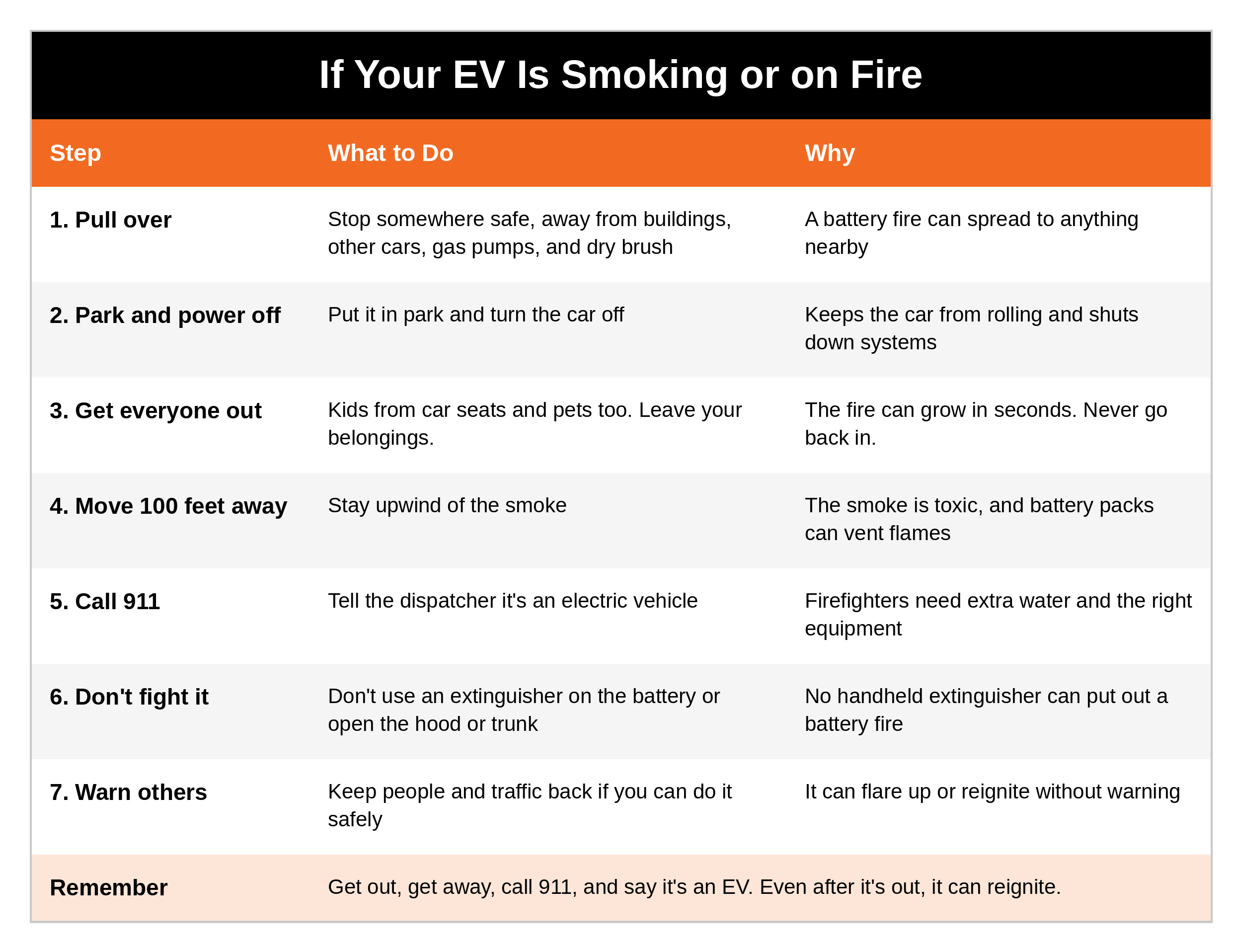
If it happens while charging: Don't touch the car or the charger. Get everyone away, and call 911. If the charger is at your home and you can safely reach the circuit breaker away from the fire, shut it off.
A regular vehicle fire extinguisher still belongs in your car. It's for small fires in the cabin, like a burning seat or a melting charger cord, not the battery.
How to lower the risk:
Check for recalls. Enter your VIN at nhtsa.gov/recalls, and get recall repairs done right away. Some EV recalls are for battery fire risk.
Use certified charging equipment, keep cords in good shape, and don't charge with a cheap extension cord.
After a crash, deep pothole, or road debris strike to the underside, have the battery inspected, even if everything seems fine.
After any flooding, have it inspected before you drive it or park it in the garage. After saltwater flooding, park it outside, away from your house.
At home, put a smoke alarm in the garage, keep the path out of the garage clear, and follow your manufacturer's charging recommendations.
9. Thermal Blanket and Heated Gear (Winter Kit)
Stay warm if you're stranded in cold weather, without draining your battery on cabin heat.
Compact 12V or USB heated blankets use very little energy.
10. Stay Away From High Voltage
After a crash or flood, stay away from any damaged high-voltage parts, usually marked with bright orange cables. Even insulated gloves don't make it safe for someone who isn't trained. Let firefighters and trained technicians handle it.
Your EV Emergency Kit
Here's the whole kit on one page.
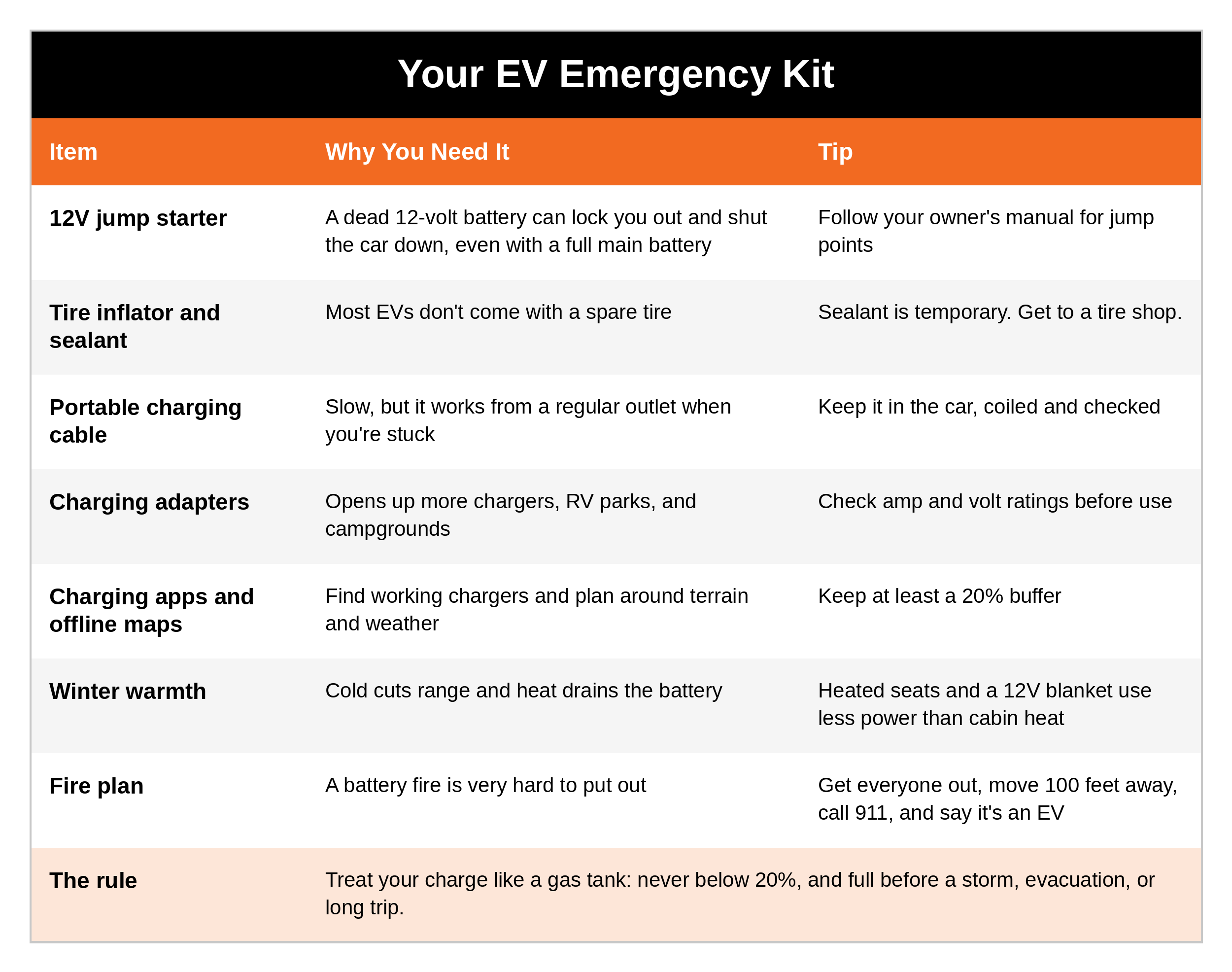
Final tip: Keep everything organized in a compact trunk bag or underfloor storage area. Every three months, check that it all still works: charge the jump starter, test the tire inflator, and update your apps.
Ask Yourself
If I got a flat today, would I know my EV doesn't have a spare, and do I have a plan?
Do I know how to open my doors if the 12V battery dies?
If a wildfire or storm were coming tonight, would my battery be full?
Remember
Treat your charge like a gas tank. Never let it drop below 20%, charge to full before a storm or evacuation, carry a jump starter and tire kit, and know your manual door release. Your EV can be a great Mobile Command Center if you plan for how it's different.
Get Started Today
Grab the free Preparedness checklist bundle: the Go Bag Checklist, the Mobile Command Center Checklist (with an EV-specific equipment page), and the First Aid and Trauma Checklist. While you're there, download your free copy of The Prepared Protector's Guide to Driving in Environmental Hazards. [CTA: Comment or DM "KEYWORD" / or download it here: https://www.preparednotparanoid.com/preparedness]
Go Deeper
The Family Safety Toolkit. This post covers the EV gear and habits that keep you moving. The Toolkit gives you the complete Mobile Command Center Checklist, including the EV-Specific Equipment page, plus 19 more checklists covering every area of family safety, all for $19.99. [Get it here: https://www.preparednotparanoid.com/family-safety-toolkit]
The Family Emergency Preparedness Manual is coming soon.
Tools I recommend: The jump starters, tire repair kits, charging gear, and emergency supplies I recommend are in my Amazon store. https://link.amazon/B0ebnfoA3
Related reading:
Setting Up Your Mobile Command Center, Introduction: Your Vehicle Is Part of the Plan https://www.preparednotparanoid.com/pnp-library/mobile-command-intro
Setting Up Your Mobile Command Center, Part 6: Fuel, Food and Surviving a Stranding https://www.preparednotparanoid.com/pnp-library/mobile-command-fuel-food-stranding
Setting Up Your Mobile Command Center, Part 2: When Something Fails While You're Driving https://www.preparednotparanoid.com/pnp-library/mobile-command-when-something-fails
References
AAA. Cold-weather electric vehicle range testing.
National Highway Traffic Safety Administration. Minimum Sound Requirements for Hybrid and Electric Vehicles.
National Fire Protection Association. Electric vehicle safety and emergency response.
SAE International. J3400 (NACS) charging connector standard.
National Highway Traffic Safety Administration. Vehicle recall lookup (nhtsa.gov/recalls).
U.S. Fire Administration. Electric vehicle fire safety.
Disclaimer
These suggestions are intended to help you and your family build awareness, confidence, and safer decision-making habits. No safety plan, checklist, or training can guarantee 100% protection. Every electric vehicle is different, so always follow your owner's manual and manufacturer guidance for charging, jump-starting, and emergencies. Affiliate disclosure: I've linked to products from my Amazon store that I personally recommend. As an Amazon Associate, I earn from qualifying purchases, at no extra cost to you. Thank you for supporting my work.
If your EV is smoking or on fire, get everyone out, move away, and call 911.
Awareness gives you time. Time gives you options.
The prepared protector is someone who's decided that loving someone means being ready for them, not just hoping things go fine.
Prepared Not Paranoid. Protecting the Most Vulnerable Among Us.