When Help Is Hours Away
By Larry Betz | Prepared Not Paranoid https://www.preparednotparanoid.com/
A snowstorm closes the highway. A wildfire blocks the only road out. A crash shuts down the interstate for hours, and you're sitting in a line of cars that isn't moving. If you've ever been stranded in your car, you know how fast "we'll be home soon" turns into "how long is this going to last?" The families who handle it well aren't lucky. They have fuel, water, food, and a plan for staying safe until help arrives.
Spare Fuel and Safe Fuel Storage
Having spare fuel can be a crucial necessity in an emergency. If the power is out, gas stations can't pump fuel, and you could be left stranded without a backup supply. How you store spare fuel will depend on your vehicle's design and available space.
When you store fuel, use containers designed specifically for fuel to prevent leaks and keep everyone safe.
Rotopax containers are a reliable option. They're tough and come with several mounting options to fit different vehicles.
Your fuel kit:
Approved fuel can (2 to 5 gallons) or mounted fuel pack
Fuel stabilizer
Siphon pump
No-spill spout or funnel
Fuel gloves and a shop towel
A label for the fuel type (gas or diesel)
An optional laminated fuel card with the date you filled it, the fuel type, and any stabilizer you added
Store it safely:
Never store fuel inside the passenger cabin. Use an outside mount, a truck bed, a hitch carrier, or a ventilated cargo area.
Keep containers upright and secured, so they can't tip or slide.
Leave expansion space. Don't fill a container to the top. Fuel expands as it warms.
Keep containers sealed and away from direct sunlight and heat.
Watch the heat. In an Arizona summer, a fuel can in a closed car or in direct sun can build up pressure and fumes. If you live somewhere this hot, consider keeping spare fuel at home in a shaded, ventilated spot during the hottest months, and loading it when you travel or when a storm or fire is coming.
Fill cans on the ground, never in a truck bed or trunk. That prevents a static spark.
Check your local laws for carrying and storing fuel.
Rotate it. Untreated gasoline starts to break down in about 3 to 6 months. A fuel stabilizer can extend that, so follow the label. Mark your rotation date on the can or your fuel card, pour old fuel into your tank, and refill. In cold weather, check your containers and fuel for condensation or damage.
Regularly check the condition of your spare fuel and containers to make sure they're in good shape and ready to use when you need them.
24-Hour Sustainment and Hygiene
If you plan to drive in winter, in the desert, or anywhere a road closure could trap you, be ready to take care of everyone in the car for at least 24 hours.
Water
Bottled water: At least 1 gallon per person, more in the heat.
Electrolyte packets to help your body hold onto water.
Rotate your water. Heat breaks down plastic bottles faster, and freezing can crack them. Replace your car water every few months, and leave a little room in the bottles if they might freeze.
Food
High-calorie rations, MREs, or energy bars. Emergency ration bars are made to handle a hot or cold car better than most snacks.
Child-specific snacks or comfort items for the little ones.
Utensils, a can opener, and napkins.
Store food in a cooler or insulated bag to protect it from temperature swings.
Hygiene
Toiletries: wipes, a toothbrush, floss, and mouthwash
Toilet paper
A portable toilet or travel urinal bags. Nobody wants to think about this until they're stuck for six hours on a closed interstate with kids in the back.
First Aid and Medications
Keep your first aid kit, trauma kit, and a few days of personal medications in the car. Part 3 covers these in detail.
Carbon Monoxide Safety During a Stranding
If you're stuck in the cold and running the engine for heat, carbon monoxide is the hidden danger. It has no smell or color, and it can build up inside a car, especially if the tailpipe is blocked by snow.
Clear the tailpipe of snow before you run the engine, and check it again often.
Crack a window for fresh air while the engine runs. Downwind is best.
Run the engine about 10 minutes per hour for heat (National Weather Service guidance), then turn it off.
Know the warning signs: headache, dizziness, nausea, unusual tiredness, and confusion. If anyone has them, turn off the engine, get fresh air, and call 911.
Optional heat sources, with caution:
Portable heaters: Only use a heater rated for indoor use, with a low-oxygen shutoff. Crack a window, and never sleep with it running.
12V heated blanket: A good way to stay warm without the engine running. Watch your battery power, and use it in short bursts.
Stay With Your Vehicle
In most strandings, your vehicle is the safest place to be. It's your shelter from the cold, wind, and sun, and it's much easier for rescuers to spot than a person walking. People have died walking away from a stranded car in a snowstorm or the desert heat.
Leave your vehicle only if:
It's on fire, or filling with smoke
Rising water is threatening it
You're stopped in a dangerous spot in traffic and can safely get to a better place
Help or shelter is clearly visible, close, and safe to reach
While you wait:
Signal for help. Tie a bright cloth to your antenna or door, use your flashers, and turn on the dome light at night while the engine runs. Part 4 covers your signaling gear.
Conserve energy and stay put. Save your phone battery for calls and updates, not entertainment.
Keep everyone moving a little, with arm and leg movements, to stay warm.
Keep morale up. A notebook and marker, books, cards, and small games make a long wait much easier, especially for kids. The notebook is also useful for writing down times, your location, and what's happening.
A prepared protector plans the stranding before it happens. You're not just packing for yourself. You're packing for the toddler who will get hungry, the parent who needs their medication on time, and the dog who needs water too. When the highway closes, they're counting on what you put in the car.
Your 24-Hour Stranding Kit
Here's what to pack, all in one place.
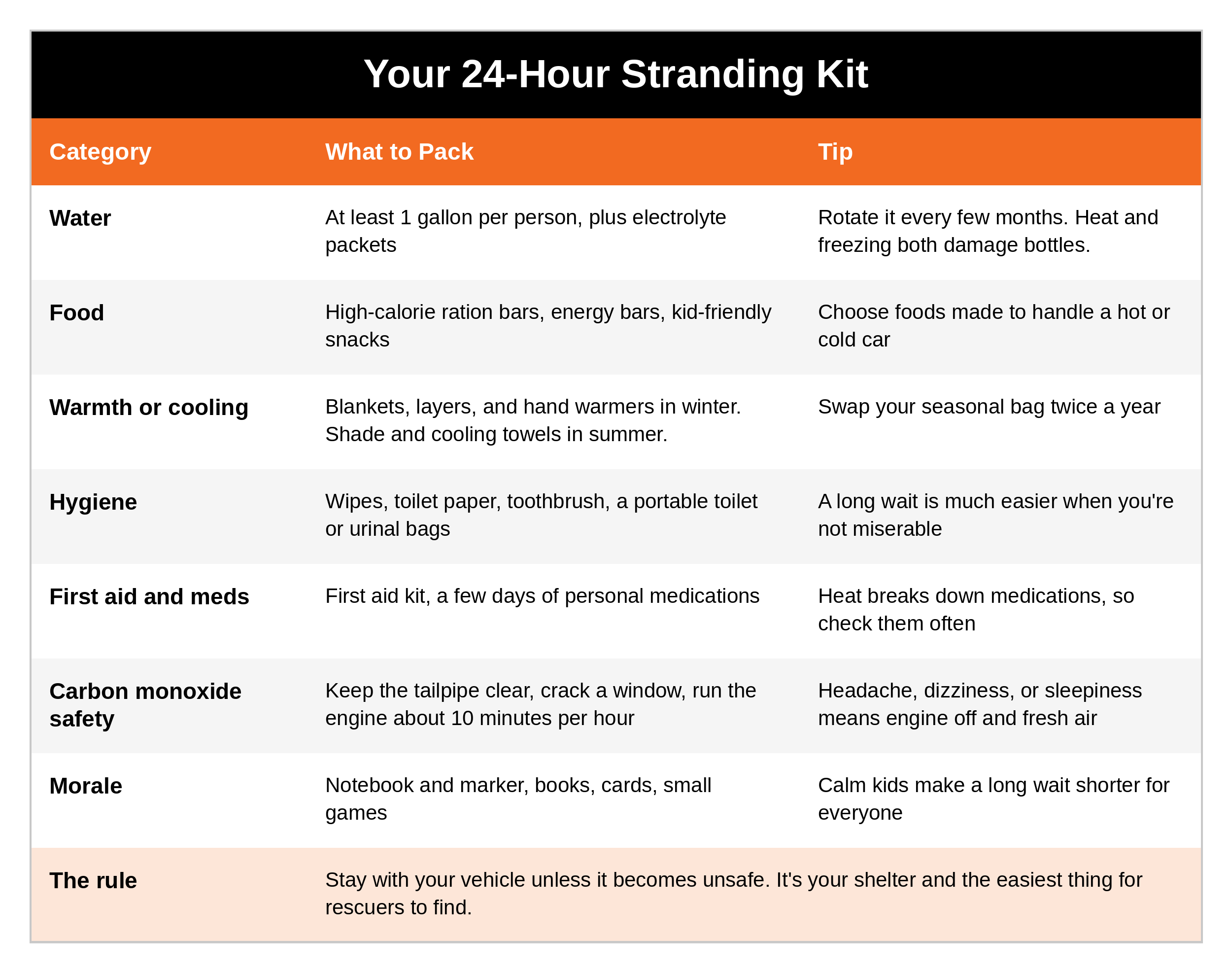
Pack it once, put a rotation date on your calendar, and swap your seasonal gear twice a year. That's the whole system.
Ask Yourself
If we were stuck on a closed highway tonight, could everyone in my car get through 24 hours?
Do I know the signs of carbon monoxide poisoning, and is my tailpipe clear?
If I carry spare fuel, is it stored safely and is it still fresh?
Remember
Stay with the car, stay warm or cool, and stay safe from carbon monoxide. Store fuel safely and rotate it, pack 24 hours of water, food, and hygiene for everyone in the car, and keep morale up until help arrives.
Get Started Today
Grab the free Preparedness checklist bundle: the Go Bag Checklist, the Mobile Command Center Checklist, and the First Aid and Trauma Checklist. While you're there, download your free copy of The Prepared Protector's Guide to Driving in Environmental Hazards, with step-by-step stranding advice for snowstorms, extreme heat, and more. [CTA: Comment or DM "KEYWORD" / or download it here: https://www.preparednotparanoid.com/preparedness]
Go Deeper
The Family Safety Toolkit. This post covers fuel, food, water, and surviving a stranding. The Toolkit gives you the complete Mobile Command Center Checklist, including the full fuel, sustainment, and CO safety lists, plus 19 more checklists covering every area of family safety, all for $19.99. [Get it here: https://www.preparednotparanoid.com/family-safety-toolkit]
The Family Emergency Preparedness Manual is coming soon.
Tools I recommend: The fuel containers, emergency rations, water, and stranding supplies I recommend are in my Amazon store.
Mobile Command Center: https://link.amazon/B0ebnfoA3
First Aid: https://link.amazon/B01SD3sHS
Related reading:
Setting Up Your Mobile Command Center, Part 5: Navigation and Communications on the Road https://www.preparednotparanoid.com/pnp-library/mobile-command-navigation-communications
Setting Up Your Mobile Command Center, Part 3: Essential Safety Equipment https://www.preparednotparanoid.com/pnp-library/mobile-command-lesson-2
Go Bag and Emergency Bug-Out Bag, Part 5: Bags for Kids, Seniors and Pets https://www.preparednotparanoid.com/pnp-library/go-bag-kids-seniors-pets
References
National Weather Service. Winter Weather Safety: if you're stranded in your vehicle.
Centers for Disease Control and Prevention. Carbon Monoxide Poisoning: symptoms and prevention.
Ready.gov. Car Safety (emergency car kit).
Ready.gov. Water.
U.S. Consumer Product Safety Commission. Portable fuel containers and static safety.
Disclaimer
These suggestions are intended to help you and your family build awareness, confidence, and safer decision-making habits. No safety plan, checklist, or training can guarantee 100% protection. Fuel storage laws vary by state and city, so check your local rules. Always follow the manufacturer's instructions for fuel containers, stabilizers, and heaters. Affiliate disclosure: I've linked to products from my Amazon store that I personally recommend. As an Amazon Associate, I earn from qualifying purchases, at no extra cost to you. Thank you for supporting my work.
If you're stranded and in danger, or anyone shows signs of carbon monoxide poisoning, call 911.
Awareness gives you time. Time gives you options.
The prepared protector is someone who's decided that loving someone means being ready for them, not just hoping things go fine.
Prepared Not Paranoid. Protecting the Most Vulnerable Among Us.