What to Do When Your Phone Has No Signal
By Larry Betz | Prepared Not Paranoid https://www.preparednotparanoid.com/
For most of us, the phone is everything: the map, the radio, the flashlight, and the way we call for help. Then you drive into a canyon, a storm takes out the cell towers, or a wildfire overloads the network, and that phone goes quiet right when you need it most. Planning your emergency communication for your car ahead of time means you can still find your way, get alerts, and reach help when the network goes down.
Navigation: Know Where You're Going Without Your Phone
If cell service is lost or your phone dies, you still need to know where you are and how to get where you're going.
Paper maps: Keep a current road map of your state and the areas you travel most. Paper doesn't need a signal or a battery. Paper maps
GPS device: A dedicated GPS unit works off satellites, not cell towers, so it keeps working when your phone can't get a signal.
Offline maps on your phone or tablet: Google Maps and Apple Maps both let you download maps of an area ahead of time. Download your home region and any route you're traveling before you leave.
Primary route notes: Write down your main route, with highway numbers and key exits.
Alternate route notes: Write down at least one backup route in case roads close. Keep both notes with your paper maps.
Before any trip, check your route for weather, closures, and events. Call 511 or use your state's 511 website or app. In Arizona, that's AZ511. Part 2 of the free hazards guide covers the full pre-trip check.
Communications: Layers, Not One Lifeline
The answer isn't one perfect device. It's layers, so if one fails, you still have another.
Your Phone
Turn on Wireless Emergency Alerts in your phone's settings, so you get warnings for flash floods, dust storms, and other emergencies on the road.
Keep it charged. Keep a car charger and a power bank in the vehicle.
Know if your phone has satellite SOS. Many newer phones can text emergency services by satellite when there's no cell signal. Check your phone's settings and your carrier, and try the demo mode if your phone has one, so you know how it works before you need it.
Satellite Communicators
A satellite communicator, like the Garmin inReach, gives you two-way satellite messaging, GPS tracking, and an SOS button when you're off the grid and out of cell range. It works almost anywhere you can see the sky, and your family can follow your location. It requires a subscription. Garmin inReach
Signal and Internet Boosters
weBoost cell signal booster: A weBoost system improves cell reception in low-service areas by amplifying weak signals. It's a great option for rural areas, off-grid locations, or emergencies when the network is strained. It needs at least a weak signal to work with. weBoost
Starlink satellite internet: Starlink provides satellite internet, making it a strong backup when you're traveling through areas with no traditional cell service. It needs a subscription and a power source.
Rapid Radios: These are push-to-talk devices that use cellular or Wi-Fi networks to give you instant voice communication with nationwide coverage. Because they rely on cell or Wi-Fi networks, they won't work where there's no service. Rapid Radios
Emergency Radio
A battery-powered NOAA weather radio keeps you informed when cell networks are down. Look for one with a hand crank or battery power, NOAA weather alerts, and, if possible, a solar panel and a USB port to charge your phone.
Two-Way Radios: The Basics
When there's no cell service at all, radios let you talk directly to other people.
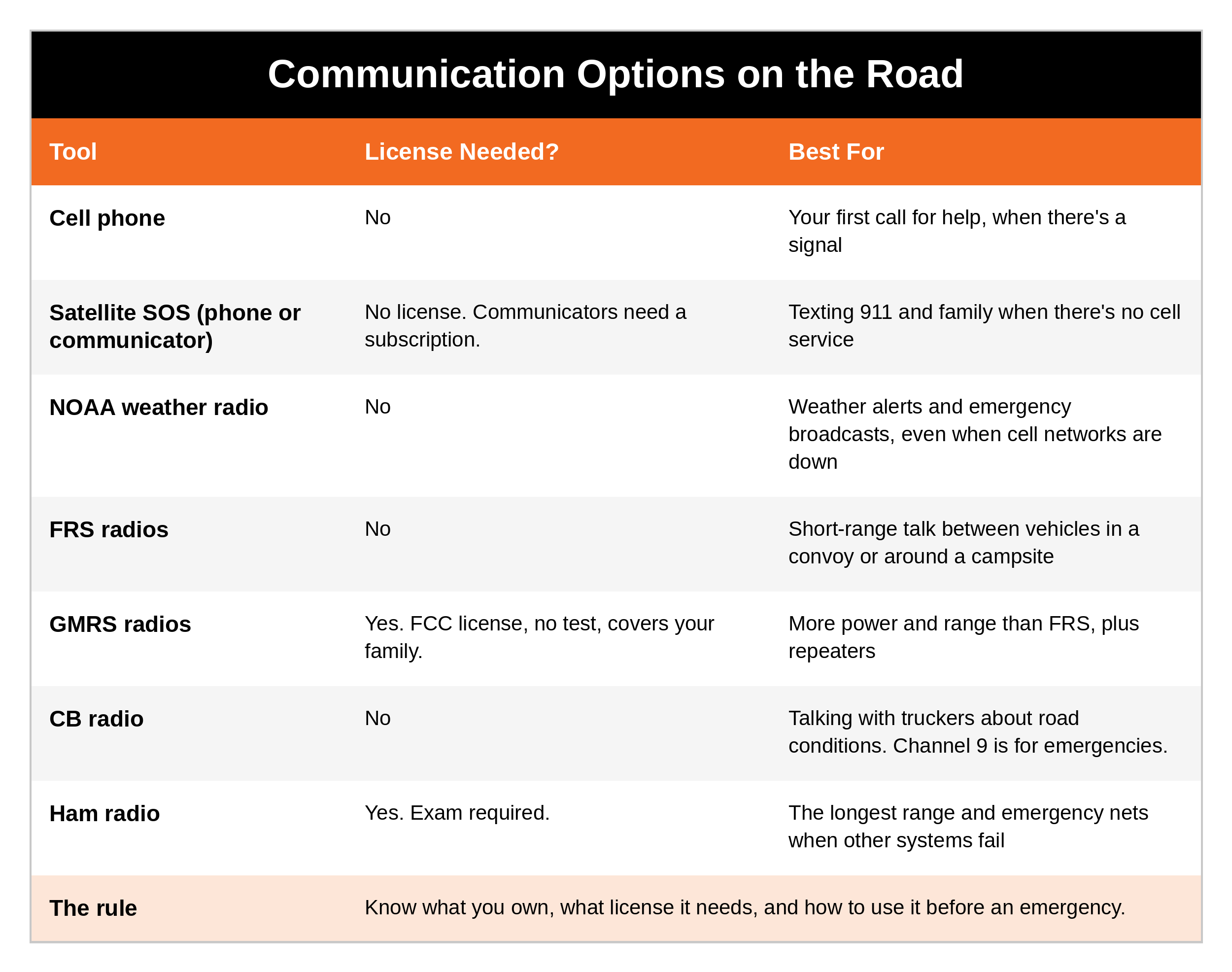
FRS radios: The simple walkie-talkies you can buy anywhere. No license is needed. They're great for talking between vehicles in a convoy or around a campsite, but their range is short.
GMRS radios: More power and more range than FRS, and they can use repeaters to reach even farther. GMRS requires an FCC license, but there's no test. It costs $35, lasts 10 years, and covers your immediate family.
CB radio: No license needed. CB is still widely used by truckers, which makes it useful for road conditions and accident reports on the highway. Channel 9 is reserved for emergencies, and channel 19 is where truckers talk.
Ham (amateur) radio: The longest range and the most options, including emergency nets that keep running when other systems fail. A ham license requires passing an exam. The entry-level license is called Technician.
Add-ons for your vehicle:
Magnetic mount antenna for better range from inside the car
12V adapter to power your radio from the vehicle
Handheld backup radio in case you have to leave the car
Printed list of local repeaters for GMRS or ham
Printed communications cheat sheet with your channels, call signs, and family contacts
Know what equipment you own, what licenses are required, and how to use it before an emergency. A radio you've never turned on won't help you on the side of the road. The Emergency Communications series covers licensing, ham radio, and practice in detail.
Your Communication Options
Each tool does a different job. Here's how they compare.
Your Family's Car Communication Plan
Gear only works if everyone knows the plan. Talk about these with your family:
Who's your out-of-area contact? After a disaster, it's often easier to reach someone in another state than across town. Everyone in the family calls or texts that one person.
Text first. Texts often go through when calls won't, and they use less battery.
Where do you meet if you get separated, or if one car can't reach the other?
Which channel do you use if you have radios? Write it on the cheat sheet.
Tell someone your route and your arrival time before every trip, and check in when you get there.
Ask Yourself
If my phone had no signal right now, how would I find my way home?
Does my phone have satellite SOS, and do I know how to use it?
If my family got separated on the road, does everyone know who to contact and where to meet?
Remember
Layers, not one lifeline. Paper maps and offline maps get you there, your phone and a satellite option get help, and a weather radio keeps you informed. Know what you own, what license it needs, and how to use it before an emergency.
Get Started Today
Grab the free Preparedness checklist bundle: the Go Bag Checklist, the Mobile Command Center Checklist, and the First Aid and Trauma Checklist. While you're there, download your free copy of The Prepared Protector's Guide to Driving in Environmental Hazards, including the full pre-trip checklist. [CTA: Comment or DM "KEYWORD" / or download it here: https://www.preparednotparanoid.com/preparedness]
Go Deeper
The Family Safety Toolkit. This post covers how to navigate and communicate when your phone can't. The Toolkit gives you the complete Mobile Command Center Checklist, including every navigation and communications item, plus 19 more checklists covering every area of family safety, all for $19.99. [Get it here: https://www.preparednotparanoid.com/family-safety-toolkit]
The Family Emergency Preparedness Manual is coming soon.
Tools I recommend: The maps, radios, satellite communicators, and signal boosters I recommend are in my Amazon store.
Mobile Command Center: https://link.amazon/B0ebnfoA3
Backup Communications: https://link.amazon/B09z0lfEb
Related reading:
Setting Up Your Mobile Command Center, Part 4: Lighting, Signaling and Escape Tools https://www.preparednotparanoid.com/pnp-library/mobile-command-lighting-signaling-escape
Setting Up Your Mobile Command Center, Part 6: Fuel, Food and Surviving a Stranding (coming next)
Emergency Communications series [LINK]
References
Federal Communications Commission. General Mobile Radio Service (GMRS).
Federal Communications Commission. Amateur Radio Service.
Federal Communications Commission. Citizens Band (CB) Radio Service.
National Weather Service. NOAA Weather Radio.
Federal Communications Commission. Wireless Emergency Alerts.
Ready.gov. Make a Plan: family communication plan.
Disclaimer
These suggestions are intended to help you and your family build awareness, confidence, and safer decision-making habits. No safety plan, checklist, or training can guarantee 100% protection. Radio licensing rules and fees are set by the FCC and can change, so check fcc.gov before you buy or transmit. Coverage for satellite and cell services varies by location and carrier. Affiliate disclosure: I've linked to products from my Amazon store that I personally recommend. As an Amazon Associate, I earn from qualifying purchases, at no extra cost to you. Thank you for supporting my work.
In an emergency, call 911. If you can't call, text 911 where available, or use your phone's satellite SOS.
Awareness gives you time. Time gives you options.
The prepared protector is someone who's decided that loving someone means being ready for them, not just hoping things go fine.
Prepared Not Paranoid. Protecting the Most Vulnerable Among Us.