Plus the Power, Tire, and Recovery Gear That Gets You Moving Again
By Larry Betz | Prepared Not Paranoid https://www.preparednotparanoid.com/
It's dark, it's raining, and your car is on the shoulder with a flat tire while traffic flies past a few feet away. The other drivers can't see you, you can't see the lug nuts, and your phone flashlight is down to 10 percent. This is where the right car emergency escape tools, lights, and signaling gear make the difference between a frustrating night and a dangerous one. This post covers how to be seen, how to get out, and how to get moving again.
Emergency Lighting
Having the right lighting can make a major difference in safety during a roadside emergency.
Work light: A reliable, rechargeable work light is essential for nighttime repairs. Work light The Milwaukee M18 work lights are excellent choices because they're durable, bright, and run on the same batteries as other essential gear, including an air compressor and impact gun. They also have USB ports to charge devices like phones and radios.
Headlamp: Keeping both hands free is crucial for vehicle repairs in low light. Headlamp
Flashlight: A reliable flashlight is non-negotiable. Keep one within reach of the driver's seat. For an in-depth breakdown of flashlights, click here.
Chemlights (glow sticks): These long-lasting, battery-free lights provide up to 12 hours of light, making them ideal for signaling, marking locations, or a power outage. Chemlights
Signaling
When you're stopped on the side of the road, or stranded and waiting for help, you need other drivers and rescuers to see you.
Rechargeable LED disc road flares: Place them about 100 feet behind your vehicle to give oncoming traffic early warning, and farther back on a highway or around a curve. Avoid traditional road flares, which can start a fire, especially in dry areas like the desert Southwest. LED road flares
VS-17 panel marker: This highly visible fabric panel, usually bright orange or pink, is used by the military and emergency services to signal for help. It can mark your vehicle, serve as a makeshift stretcher, or work as a quick shelter. VS-17 panel
Air horn: A compact, high-decibel signaling device that's loud enough to get attention in an emergency, and can help deter a potential threat. Air horn
Whistle: A lightweight backup to the air horn. Three short blasts is the universal call for help, and a whistle carries much farther than your voice.
Signal mirror: Small, light, and visible for miles on a sunny day.
High-visibility flag or banner: Tie it to your antenna, door, or window so rescuers can spot your car, especially in snow.
Keep it together and keep it close:
Store your signaling items together in one pouch you can grab fast.
Keep at least one signaling item reachable from the driver's seat.
Check batteries and charge levels regularly.
A note on high-risk signaling tools: Some signaling tools, like flare guns and traditional burning flares, carry legal, fire, or safety concerns. If you use them, follow all laws and the manufacturer's guidance.
Vehicle Escape Tools
If you're ever trapped in a vehicle after a crash or in floodwater, seconds matter.
Glass breaker and seatbelt cutter: Secure these within easy reach, like on a visor, center console, or door pocket, never in the glove box or the trunk. They come in different mounting options, so choose what works best for your setup. Glass breaker and seatbelt cutter | More mounting options
Escape hammer: A larger option that can also be used as a defensive tool if needed. Escape hammer
Know your glass. In AAA's testing, escape tools broke tempered side windows, but none of them broke laminated glass, and many newer cars have laminated side windows. Check the label in the bottom corner of each window. A spring-loaded tool is easier to use than a hammer, especially underwater. The free hazards guide walks you through exactly what to do.
Battery and Power Solutions
A dead battery can leave you stranded, so it's crucial to have the right gear.
Jumper cables: Make sure they're long enough to reach difficult spots. Jumper cables
Jump starter booster pack: If no one is around to help, a portable jump starter can get your vehicle running. Choose one with enough power for your engine size. Jump starter booster pack | Portable jump starter
Power bank or charging block: A small but powerful battery pack keeps your phone and other essential devices charged. Power bank
Small solar generator with recharging panels: A compact solar generator gives you a reliable, renewable power source when you're away from home or the grid is down. Paired with foldable solar panels, these systems can recharge phones, radios, GPS units, flashlights, and even laptops, helping you stay connected, informed, and operational during emergencies. Unlike gas generators, solar options are silent, safe to use inside a vehicle, and need no fuel. Small solar generator
Keep your power ready:
Charge your jump starter and power banks regularly. Put a reminder on your calendar.
Watch the heat. Lithium batteries don't like hot cars. Keep them out of direct sun, and check your manufacturer's temperature limits. In an Arizona summer, the trunk or a shaded spot under a seat is better than the dashboard.
Make sure your solar charging setup works with your devices before you rely on it in an emergency.
If you're stranded for a long time, save battery power by limiting what you use.
Tire Repair and Inflation
Most vehicles come with a jack, a lug wrench, and a spare tire, which may be full-size or a compact temporary spare (a "donut"). Both are designed to help you reach a safe place, but the standard equipment can be hard to use, especially on the side of a busy highway.
If you bought a used vehicle, make sure the jack, spare tire, and lug wrench are actually there and working. Many vehicles have them removed by a previous owner.
Portable air compressor: An excellent addition to keep in your vehicle. It lets you inflate a low tire and get to a safe location before it goes completely flat. The Milwaukee tire inflator is a great choice because it runs on the same M18 battery system as the work lights and impact gun, making it an efficient multi-use tool.
Tire plug kit: A quick, temporary fix for small punctures, so you can drive to a repair shop instead of waiting for roadside assistance. Plugs are for punctures in the tread only. Never plug a sidewall.
Floor jack: If you have the space, a floor jack is a lifesaver when changing a tire. Compared with the small factory scissor jack, it's more stable, easier to use, and faster, making tire changes safer. Floor jack Never get under a vehicle held up only by a jack. Use jack stands if you need to work underneath.
Wheel chocks (tire blocks): Use them whenever you jack up a vehicle to keep it from rolling, especially on uneven ground. Wheel chocks
Impact gun with impact sockets: If space allows, an impact gun makes lug nut removal quick and easy, cutting the effort and time of a tire change, especially in bad weather or heavy traffic. Impact gun
4-way heavy-duty lug wrench: Multiple socket sizes in a single cross-shaped tool, with better leverage from multiple angles. It's durable, reliable, and ideal for loosening stubborn lug nuts when the factory tire iron falls short. 4-way lug wrench
Extendable lug wrench: If you're tight on space or need extra torque, an extendable lug wrench has a telescoping handle that extends for more leverage, making it much easier to break loose stubborn lug nuts. It usually comes with multiple socket sizes and folds down to fit in your roadside kit. Extendable lug wrench
If a tire goes flat: Drive slowly, with your flashers on, only as far as you need to reach a safe spot off the road. Driving on a flat can destroy the tire and damage the rim quickly. If you have run-flat tires, they're usually rated for about 50 miles at up to 50 mph, but check your owner's manual. If you notice a tire losing pressure, inflate it as soon as you can to prevent more damage.
Additional Tools
If space allows, these tools can be invaluable in an emergency.
Shovel: A compact, foldable shovel is useful for digging out of mud or snow. Shovel
Ice scraper: Depending on where you live and the time of year, you may need one.
Crowbar or pry tool: For forced entry or breaking through debris in an emergency. Crowbar
Hand tools: A basic tool kit with screwdrivers, pliers, wrenches, and a multi-tool covers a variety of roadside repairs. Hand tools
Camping axe or hatchet: Helpful for cutting branches, breaking ice, or self-defense if needed. Hatchet
Compact fire extinguisher: To quickly put out a small fire before it spreads. Mount it so it can't roll around, and keep it within reach. Fire extinguisher
Duct tape, paracord, and wire ties: These versatile items can be used for quick repairs, securing gear, or even improvising medical solutions. Duct tape, paracord, and wire ties
Bungee cords: Stretchable cords with hooks on each end, ideal for quickly securing loose items, tarps, or gear in your vehicle or on a roof rack.
Ratchet straps: Heavy-duty tie-downs with a ratcheting mechanism that tightens and locks the strap in place. They're perfect for heavy or bulky loads, and they hold far better than bungee cords, especially on a roof rack, trailer, or truck bed. Ratchet straps
Tow strap: A strong, flat nylon or polyester strap designed to recover or tow a disabled vehicle. It usually has reinforced loops or hooks on each end and is essential for pulling a stuck vehicle out of mud, snow, or off-road terrain. Tow strap
Traction and Surface Recovery
If you drive in snow, ice, mud, or sand, add these:
De-icing spray for frozen locks and windshields
Traction aids, like cat litter or sand, to put under your tires
Traction boards to drive out of snow, mud, or sand
Tire chains, if they're right for your vehicle and region. Practice putting them on at home, not on the side of the road.
Secure everything. In a sudden stop or a crash, a loose fire extinguisher, jack, or toolbox becomes a flying object. Use straps, bins, or a cargo net to hold your gear in place.
Be Seen. Get Out. Get Moving.
That's a lot of gear, and you don't need it all on day one. Here's the whole kit and where it lives.
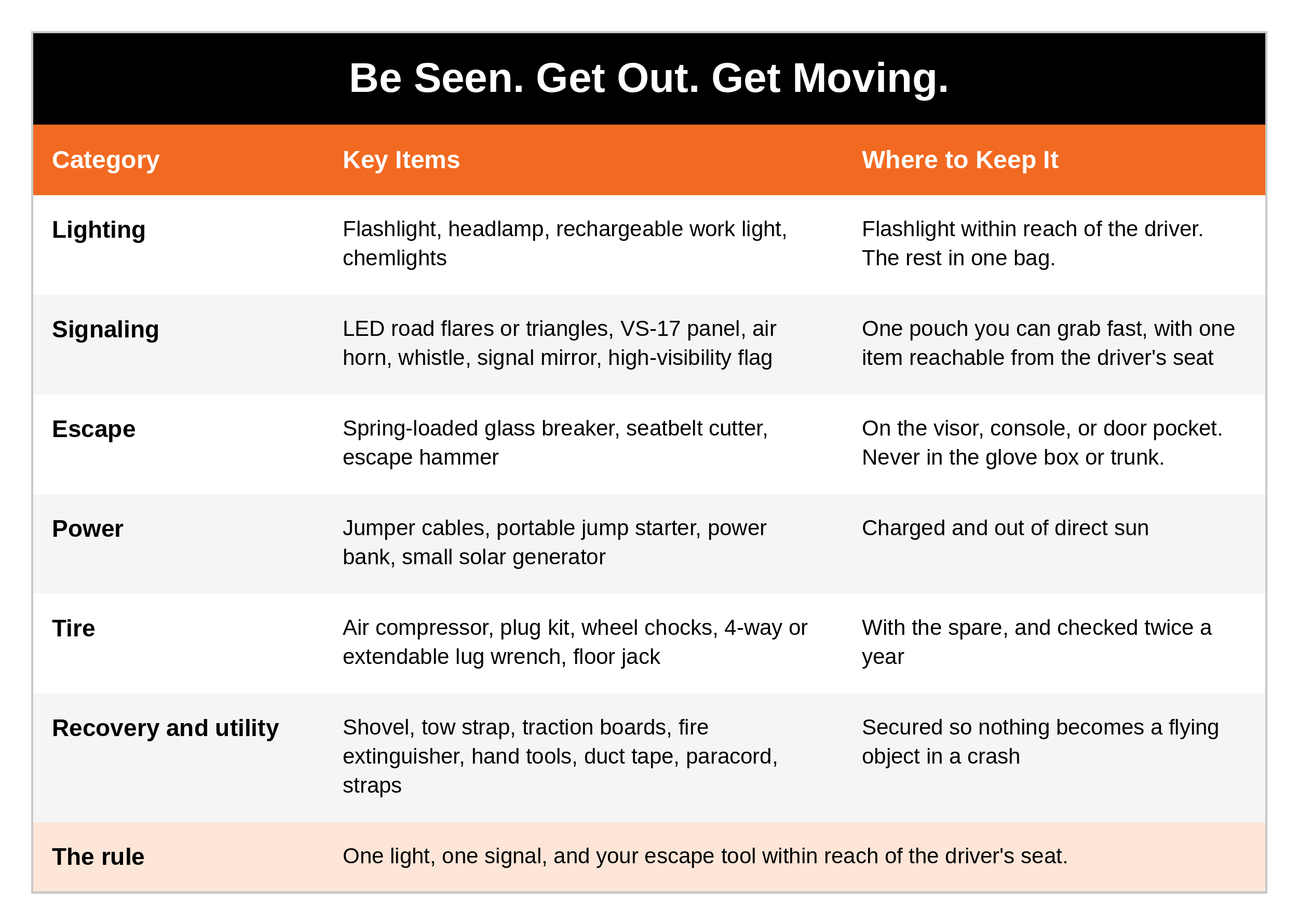
Start with the three things in the bottom row: a light, a signal, and an escape tool within reach of the driver's seat. Then add a jump starter and an air compressor, and build from there as your space and budget allow.
Ask Yourself
If I broke down on the highway tonight, how would other drivers see me?
Can I reach my glass breaker from the driver's seat right now, and do I know which of my windows it can break?
When did I last charge my jump starter?
Remember
Be seen, get out, get moving. Keep a light, a signal, and an escape tool within reach of the driver's seat, keep your power charged, and make sure you can change a tire before you ever have to do it on the shoulder.
Get Started Today
Grab the free Preparedness checklist bundle: the Go Bag Checklist, the Mobile Command Center Checklist, and the First Aid and Trauma Checklist. While you're there, download your free copy of The Prepared Protector's Guide to Driving in Environmental Hazards, including which window to break and which to stay away from. [CTA: Comment or DM "KEYWORD" / or download it here: https://www.preparednotparanoid.com/preparedness]
Go Deeper
The Family Safety Toolkit. This post covers the lights, signals, escape tools, and recovery gear for your vehicle. The Toolkit gives you the complete Mobile Command Center Checklist, with every item from this series in one place, plus 19 more checklists covering every area of family safety, all for $19.99. [Get it here: https://www.preparednotparanoid.com/family-safety-toolkit]
The Family Emergency Preparedness Manual is coming soon.
Tools I recommend: All of the lighting, signaling, escape, power, and tire gear I recommend is in my Amazon store. https://link.amazon/B0ebnfoA3
Related reading:
Setting Up Your Mobile Command Center, Part 3: Essential Safety Equipment https://www.preparednotparanoid.com/pnp-library/mobile-command-lesson-2
Setting Up Your Mobile Command Center, Part 2: When Something Fails While You're Driving https://www.preparednotparanoid.com/pnp-library/mobile-command-when-something-fails
Flashlights (my flashlight guide) https://www.preparednotparanoid.com/flashlights
References
AAA. Vehicle Escape Tool Testing (2019).
Ready.gov. Car Safety (emergency car kit).
Tire Industry Association and manufacturer guidance. Run-flat tire ratings and tire repair (plug) guidelines.
National Highway Traffic Safety Administration. Tires and roadside safety.
Disclaimer
These suggestions are intended to help you and your family build awareness, confidence, and safer decision-making habits. No safety plan, checklist, or training can guarantee 100% protection. Always follow the manufacturer's instructions for every tool and your vehicle's owner's manual, and follow all local laws on signaling devices. Affiliate disclosure: I've linked to products from my Amazon store that I personally recommend. As an Amazon Associate, I earn from qualifying purchases, at no extra cost to you. Thank you for supporting my work.
If you're stopped in a dangerous spot or trapped in your vehicle, call 911.
Awareness gives you time. Time gives you options.
The prepared protector is someone who's decided that loving someone means being ready for them, not just hoping things go fine.
Prepared Not Paranoid. Protecting the Most Vulnerable Among Us.