The First Few Seconds Decide How It Ends
By Larry Betz | Prepared Not Paranoid https://www.preparednotparanoid.com/
A loud bang and the car jerks to one side. The brake pedal sinks to the floor. The engine dies in the middle of traffic. These moments are rare, but when they happen, they happen fast, and most drivers have never thought about what to do. Knowing what to do if your car fails while driving turns a panic into a plan, and the first few seconds are what decide how it ends.
We’ve all seen it. A family stuck in the middle of the highway with a flat tire, cars flying past, and no one slowing down or giving them room to get to safety. You can see the fear on their faces. It’s a terrible situation to be in, and it often starts with one panicked moment: hitting the brakes and stopping right where the tire failed. Knowing what to do in those first few seconds can keep your family out of that lane and on the shoulder, where they belong.
In Part 1, we covered the maintenance that keeps your vehicle from breaking down. According to AAA, more than half of all roadside breakdowns could be prevented with basic maintenance. This post is for the times something fails anyway.
The One Rule for Every Failure
Steer first. Slow down second. Stop somewhere safe third.
Your first job is to keep the car pointed where you want it to go. Panic moves, like slamming the brakes or jerking the wheel, cause more crashes than the failure itself. Once you have control, slow down smoothly. Then get the car somewhere safe, away from moving traffic, and turn on your flashers.
If This Fails, Do This
Here are the 10 most common mechanical failures drivers face. Here's the whole list on one page.
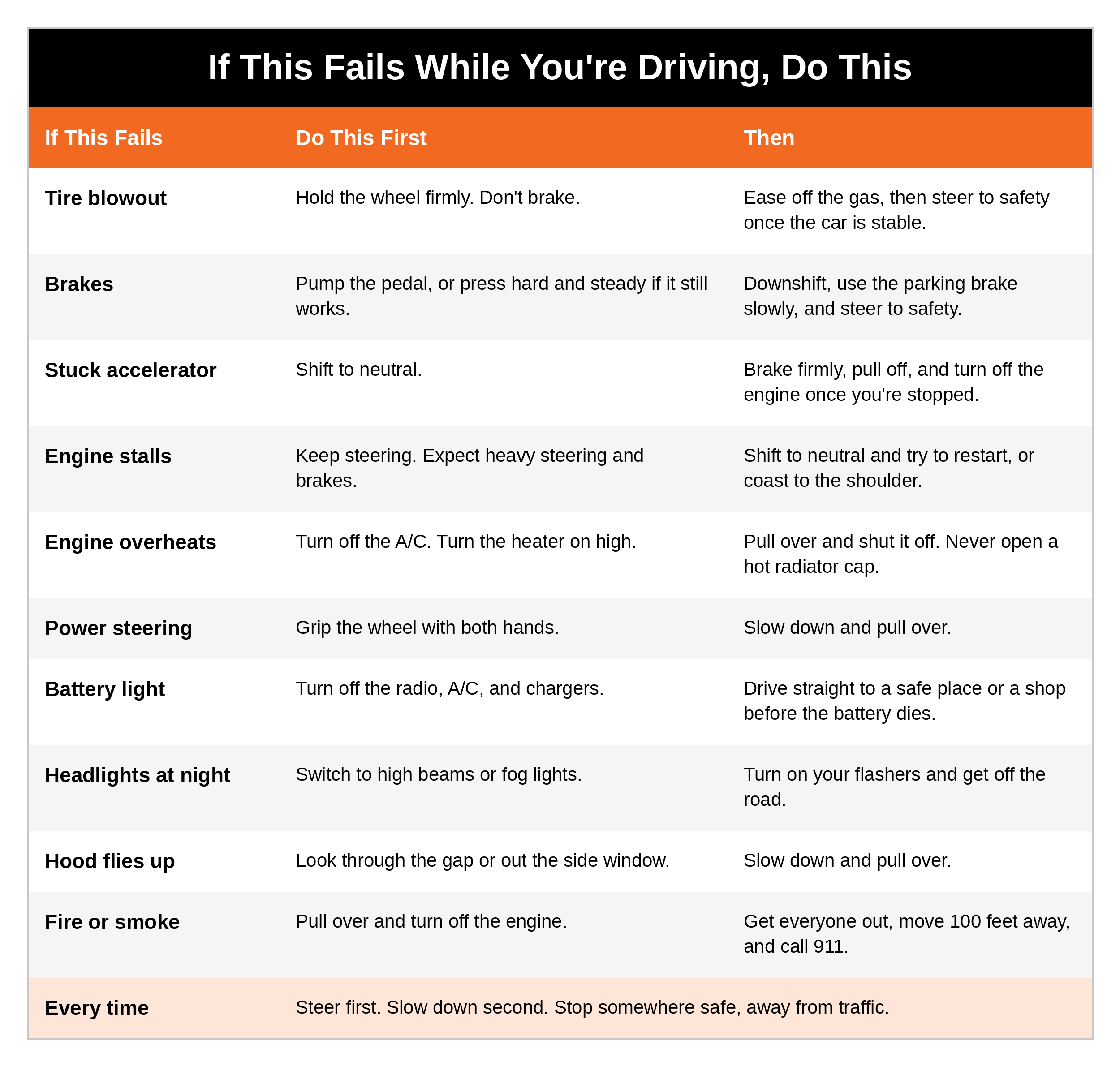
Want the full step-by-step version? Part 4 of my free guide, The Prepared Protector's Guide to Driving in Environmental Hazards, covers every failure in this post in detail, plus 15 environmental hazards like flash floods, hail, dust storms, and wildfires. Keep it in your glove box or on your phone. [Download it free here: LINK]
1. Tire Blowout
The car will pull hard toward the blown tire, and your instinct will be to slam on the brakes. Don't.
Hold the wheel firmly with both hands and correct smoothly.
Don't brake hard. Ease off the gas and let the car slow down on its own.
Once it's stable, turn on your flashers and steer to the shoulder, an exit, or a parking lot. Don't stop in a travel lane.
2. Brake Failure
Take your foot off the gas.
Try the brakes again. If the pedal works at all, press hard and steady. If it goes to the floor, pump it fast to build pressure.
Downshift to a lower gear to let the engine slow you down.
Use the parking brake slowly so the wheels don't lock. With an electronic parking brake, pull and hold the switch.
As a last resort, steer into something that will slow you gently, like brush or an open field.
3. Stuck Accelerator
Often it's a floor mat jammed under the pedal. Your brakes are stronger than your engine.
Shift to neutral. The engine will rev loudly. That's okay.
Brake firmly and steadily, and steer off the road.
Turn off the engine once you're stopped.
Know your push-button start today. On many cars, you hold the button for about 3 seconds, or press it several times quickly, to shut off the engine while moving. It varies by car, so look it up in your owner's manual. You'll lose power steering and power brakes when the engine shuts off.
4. Engine Stalls While Driving
The car will still steer and stop, but it will take much more strength, because the power steering and power brakes go with the engine.
Keep a firm grip and keep steering. Push harder on the wheel and the brake.
Turn on your flashers, shift to neutral, and try to restart.
If it won't restart, use your momentum to coast to the shoulder.
5. Engine Overheating
Turn off the A/C and turn the heater on high. It pulls heat away from the engine.
Pull over and turn off the engine.
Wait at least 30 minutes before opening the hood, and never remove a hot radiator cap.
6. Loss of Power Steering
The car still steers. It just takes a lot more effort.
Grip the wheel with both hands, slow down gradually, and pull over.
Have it checked before you drive again.
7. Battery Light Comes On (Alternator Failure)
The car is running on battery power alone, and the clock is ticking.
Turn off everything you don't need: radio, A/C, seat heaters, and chargers.
Don't shut the engine off until you're somewhere safe. It may not restart.
Drive straight to a safe place or a shop. At night, expect your headlights to dim.
8. Headlights Fail at Night
Try your high beams, fog lights, or parking lights.
Turn on your flashers, slow down, and get off the road as soon as you safely can.
9. Hood Flies Up
Don't slam the brakes. The car behind you may not be able to stop.
Look through the gap under the hood or out your side window.
Turn on your flashers and steer to the shoulder.
10. Fire or Smoke
Pull over away from traffic, buildings, and dry brush, and turn off the engine.
Get everyone out, including kids from car seats and pets. Leave your belongings.
Move at least 100 feet away and call 911.
Don't open the hood. The rush of air can make the fire flare up.
Practice Before You Need It
You won't have time to read a list when it happens. Take five minutes now:
Look up how to shut off your engine while moving in your owner's manual.
Find your parking brake and know how it works, whether it's a lever, a pedal, or a button.
Find your flasher button without looking.
Check your floor mats. Make sure they're secured, and never stack one on top of another.
Talk to your family. Everyone stays buckled and calm, the driver focuses on driving, and one passenger is in charge of calling for help.
A prepared protector rehearses the emergency before it happens, so the first few seconds are a plan, not a panic. If you have a new or teen driver in the family, walk through this list with them. It's one of the most important conversations you can have before they drive alone.
Ask Yourself
Do I know how to shut off my engine while moving, or would I be guessing?
If my brakes failed on the way home today, what would I do first?
Has my teen driver ever heard any of this?
Remember
Steer first. Slow down second. Stop somewhere safe third. Most failures are survivable if you stay calm and keep control. Maintenance prevents most of them, and practice gets you through the rest.
Get Started Today
Grab the free Preparedness checklist bundle: the Go Bag Checklist, the Mobile Command Center Checklist, and the First Aid and Trauma Checklist. While you're there, download your free copy of The Prepared Protector's Guide to Driving in Environmental Hazards, with the full version of every failure in this post. [CTA: Comment or DM "KEYWORD" / or download it here: https://www.preparednotparanoid.com/preparedness]
Go Deeper
The Family Safety Toolkit. This post shows you what to do in the first few seconds when something fails. The Toolkit gives you the complete Mobile Command Center Checklist, so your vehicle has the tools, lights, signaling gear, and fire extinguisher you'll need if it does, plus 19 more checklists covering every area of family safety, all for $19.99. [Get it here: https://www.preparednotparanoid.com/family-safety-toolkit]
The Family Emergency Preparedness Manual is coming soon.
Tools I recommend: The vehicle fire extinguishers, emergency flashers, jump starters, and roadside safety gear I recommend are in my Amazon store. https://link.amazon/B0ebnfoA3
Related reading:
Setting Up Your Mobile Command Center, Part 1: Vehicle Maintenance https://www.preparednotparanoid.com/pnp-library/mobile-command-lesson-1
Setting Up Your Mobile Command Center, Part 3: Essential Safety Equipment https://www.preparednotparanoid.com/pnp-library/mobile-command-lesson-2
Setting Up Your Mobile Command Center, Introduction: Your Vehicle Is Part of the Plan https://www.preparednotparanoid.com/pnp-library/mobile-command-intro
References
National Highway Traffic Safety Administration. Tire safety and blowout guidance; keyless ignition shutoff.
Oregon Driver and Motor Vehicle Services. Parent Guide to Teen Driving: Vehicle Malfunctions.
Montana Office of Public Instruction. Driver Education: Emergencies.
AAA. Roadside breakdowns preventable with proper maintenance.
Disclaimer
These suggestions are intended to help you and your family build awareness, confidence, and safer decision-making habits. No safety plan, checklist, or training can guarantee 100% protection. This article is not a substitute for professional driver training, your vehicle's owner's manual, or a qualified mechanic. Vehicle systems vary, so learn how your own vehicle works before you need it. Affiliate disclosure: I've linked to products from my Amazon store that I personally recommend. As an Amazon Associate, I earn from qualifying purchases, at no extra cost to you. Thank you for supporting my work.
If your vehicle is on fire, you're stopped in a dangerous spot, or anyone is hurt, get to safety and call 911.
Awareness gives you time. Time gives you options.
The prepared protector is someone who's decided that loving someone means being ready for them, not just hoping things go fine.
Prepared Not Paranoid. Protecting the Most Vulnerable Among Us.