Building Kits for the People Who Depend on You, and Keeping Them Ready
By Larry Betz | Prepared Not Paranoid https://www.preparednotparanoid.com/
Most first aid kits are built for an average adult. Your family isn't average. You might have a toddler who can't take adult medicine, a parent on blood thinners whose skin tears if you look at it wrong, a child with a peanut allergy, or a dog who's first in line for every adventure. The kits we built in Parts 1 through 3 are the foundation. This post makes them fit the people you're actually protecting.
That's what being a prepared protector looks like. It isn't buying the biggest kit. It's knowing who depends on you and building around them.
Kits for Kids
Children aren't small adults. Their medicine, their doses, and even their bandages are different.
Add these to your family kit, or build a small kit just for the kids:
Children's pain reliever and fever reducer (children's acetaminophen or ibuprofen) in liquid or chewable form, with the dosing syringe or cup that came with it
Children's antihistamine for allergies, hives, and bug bites
Fun bandages. A kid who loves the bandage stops crying sooner. That's real first aid.
Digital thermometer
Tweezers and a tick remover for splinters and ticks
Oral rehydration like Pedialyte, for vomiting or diarrhea
Instant cold pack for bumps and bruises
For babies and toddlers, add: infant fever reducer with its own syringe, saline drops and a nasal bulb, and diaper cream. Call your pediatrician before giving any medicine to a baby.
Dose by weight, not by guess. Children's doses go by weight and age. Follow the label's dosing chart, and keep a card in the kit with each child's current weight. Update it as they grow. If you're not sure, call your pediatrician or pharmacist.
If your child has a severe allergy, their epinephrine auto-injector goes wherever they go: school, sports, sleepovers, grandma's house. Make sure every adult in charge knows where it is and how to use it.
Teens can carry their own small kit for sports, school, and the car. Teach them how to use it, where your family kits are, and how to call 911 and give your address. Many Stop the Bleed and first aid classes welcome teens. I covered training in Part 4.
What about tourniquets? Tourniquets work on most children's arms and legs. On a very small child, a tourniquet may not tighten enough, and firm, direct pressure with gauze is often the answer. A hands-on class is the best place to learn the difference.
Kits for Seniors
As we age, a scrape becomes a skin tear, a bump becomes a serious bruise, and a missed medication becomes its own emergency.
Add these for an older family member:
A complete medication list: every prescription, over-the-counter medicine, and supplement, with doses, allergies, and doctors' names
A 7-day backup supply of daily medications, in their original labeled containers
Gentle supplies for fragile skin: paper tape or silicone tape, non-stick pads, and roll gauze instead of strong adhesive bandages
Spare reading glasses and hearing aid batteries
Glucose tablets or gel if they have diabetes (covered in Part 3)
A blood pressure cuff and a pulse oximeter, if their doctor recommends them
If someone is on blood thinners: bleeding takes longer to stop, so carry extra gauze and pressure bandages, and hold pressure longer. And here's the one to remember: any hit to the head needs to be checked by a doctor, even if they seem fine. Bleeding inside the head can show up hours later.
Keep their information where EMS will find it. A copy of the medication list in their wallet, one in the kit, and one on the refrigerator. Many communities offer free "Vial of Life" forms for exactly this.
Falls are the biggest injury risk for older adults. If you haven't read my Staying Steady senior falls series, it walks through fall-proofing a home room by room.
Kits for Caregivers
If you care for someone with a disability, a chronic illness, or limited mobility, your kit has two jobs: caring for them, and covering for you if something happens to you.
For the person you care for:
Their everyday care supplies: gloves, wipes, barrier cream, and any specialized items they rely on
A care binder: diagnoses, medications, allergies, doctors, insurance, and copies of any advance directive or healthcare power of attorney
A plan for powered medical equipment. Oxygen concentrators, CPAP machines, and other equipment stop when the power does. Ask your utility about a medical priority list, and keep a backup power plan. Our upcoming Backup Power series covers this in detail.
For you:
Carry a caregiver card in your wallet that says who depends on you and who to call. If you're the one who gets hurt, someone needs to know there's a person at home waiting for you.
Name a backup caregiver, and make sure they know where the binder and kits are.
Don't Forget the Pets
Pets get hurt too, and an injured animal in pain may bite, even someone they love.
Gauze, vet wrap, and saline
A tick remover
A soft muzzle sized for your pet
Vet records and your vet's number, plus the nearest 24-hour emergency vet
ASPCA Animal Poison Control: (888) 426-4435 (a fee may apply)
Never give a pet human medication unless your vet tells you to. Many common medicines are toxic to dogs and cats. I covered pet go bags in Go Bag and Emergency Bug-Out Bag, Part 5.
Kit Add-Ons at a Glance
Every person you protect needs something a little different. Here's the whole list on one page.
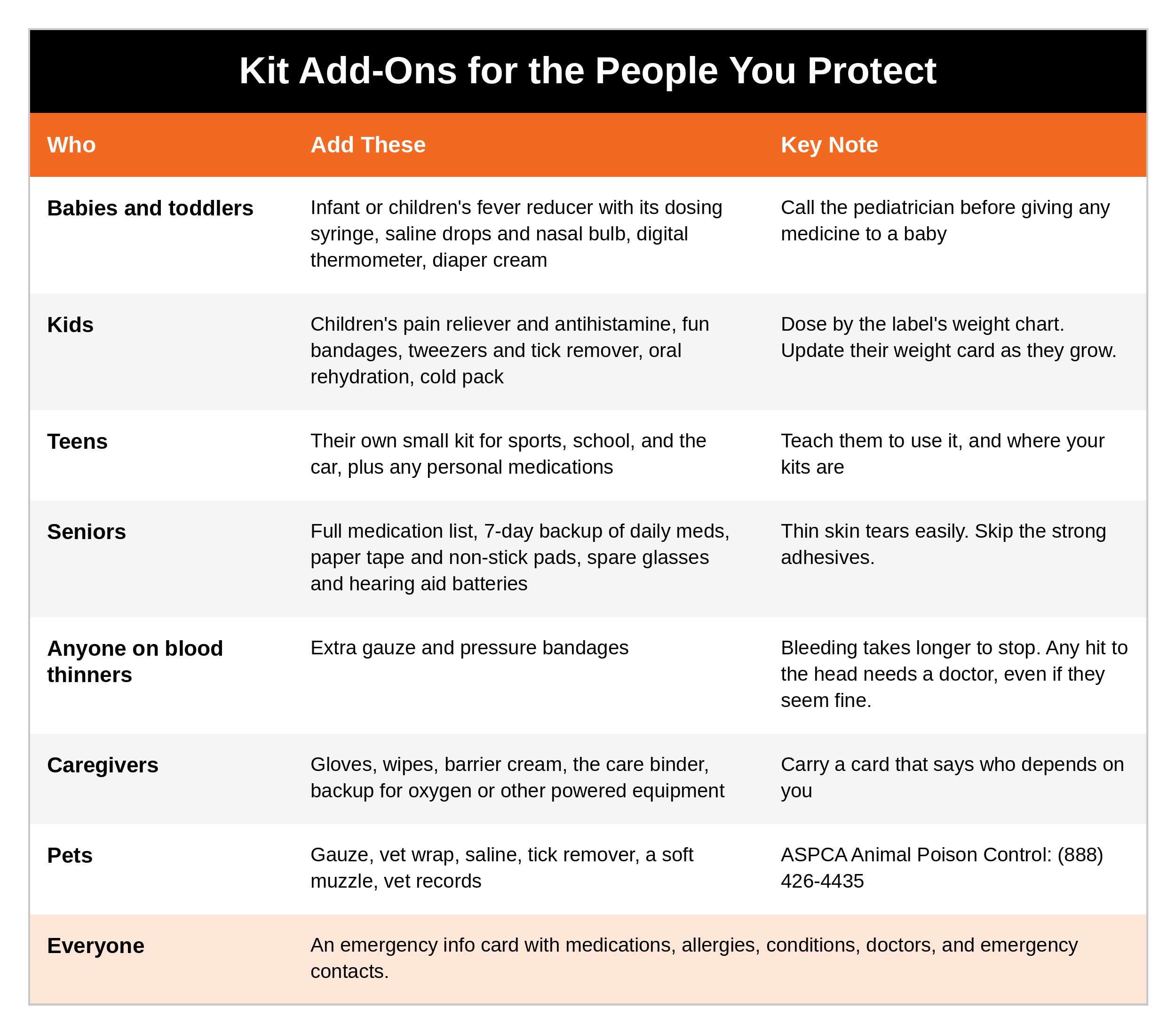
Everyone gets an emergency info card: medications, allergies, conditions, doctors, and emergency contacts. In an emergency, it speaks for the person who can't.
Keeping Every Kit Ready
A kit you built two years ago and never opened is a kit you can't count on. Medications expire. Adhesives stop sticking. Batteries die. Kids grow. Prescriptions change.
The fix is a simple routine. Here's the schedule.
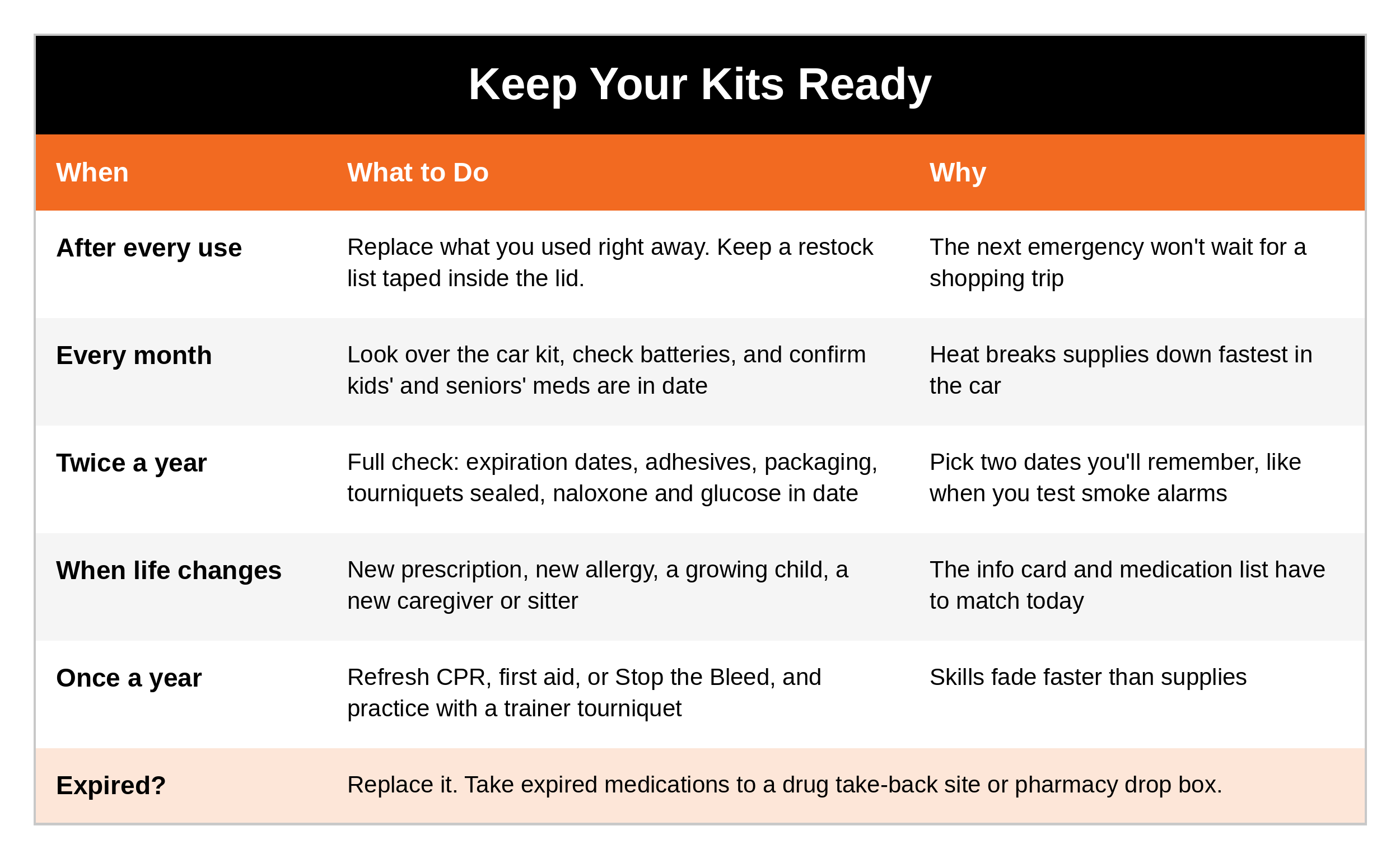
A few tips that make it stick:
Tape a restock list inside every kit lid. When you use something, write it down.
Check car kits more often, especially in hot climates. Heat breaks down medications, adhesives, and batteries faster than anything.
Pick two dates you'll remember for the full check, like when you test your smoke alarms.
Turn expired gauze into training gear. Expired dressings are perfect for practicing wound packing.
Dispose of expired medications safely. The DEA holds National Prescription Drug Take Back Days every April and October, and many pharmacies have drop boxes all year.
Write it down. Any time you give care in an emergency, write down what happened, what you gave, and what time. Hand that note to EMS. It helps them, and it helps you remember.
The Series in One Page
Over this series, we built a complete plan
Introduction: the difference between first aid and trauma care, and why you need both
Part 1: a first aid kit for the everyday stuff
Part 2: a trauma kit for life-threatening bleeding
Part 3: the medications every kit should have
Part 4: the training that makes it all work
Part 5: kits for the people who depend on you, and keeping them ready
The prepared protector is someone who's decided that loving someone means being ready for them, not just hoping things go fine. You don't have to do it all this weekend. Pick one thing. Check one kit. Sign up for one class. Then do the next one.
Coming Up Next
Next, we start a new series: Backup Power. When the lights go out, what keeps your phones charged, your food cold, and your family's medical equipment running?
Ask Yourself
Does my kit actually fit the people in my family, including the kids, the seniors, and the pets?
If I were hurt and couldn't speak, would someone know about the person who depends on me?
When did I last open every kit and check what's inside?
Remember
Build for the people you protect, not the average adult. Children's medicine dosed by weight, gentle supplies for fragile skin, a doctor visit after any head bump on blood thinners, a care binder, and an info card for everyone. Then keep every kit ready with a simple routine.
Get Started Today
Grab the free Preparedness checklist bundle: the First Aid and Trauma Checklist, the Go Bag Checklist, and the Mobile Command Center Checklist. The First Aid and Trauma Checklist includes a kit sustainment section so you can track your checks. [CTA: Comment or DM "KEYWORD" / or download it here: https://www.preparednotparanoid.com/preparedness]
Go Deeper
The Family Safety Toolkit. This post covers kits for the people who depend on you and how to keep them ready. The Toolkit gives you the complete First Aid and Trauma Checklist, from medications and wound care to trauma gear, training, and restocking, plus 19 more checklists covering every area of family safety, including child and senior safety, all for $19.99. [Get it here: https://www.preparednotparanoid.com/family-safety-toolkit]
The Family Emergency Preparedness Manual is coming soon.
Tools I recommend: The first aid kits, children's supplies, and senior care items I recommend are in my Amazon stores:
First Aid store: https://link.amazon/B01SD3sHS
Children's Safety store: [LINK]
Senior Safety store: [LINK]
Related reading:
First Aid and Trauma, Part 1: First Aid Kit Essentials https://www.preparednotparanoid.com/pnp-library/first-aid-ghmj4
First Aid and Trauma, Part 3: Medications Every Kit Should Have https://www.preparednotparanoid.com/pnp-library/first-aid-medications
First Aid and Trauma, Part 4: Training Before Gear https://www.preparednotparanoid.com/pnp-library/first-aid-training
Go Bag and Emergency Bug-Out Bag, Part 5: Bags for Kids, Seniors and Pets https://www.preparednotparanoid.com/pnp-library/go-bag-kids-seniors-pets
References
American Academy of Pediatrics (HealthyChildren.org). Medication safety and dosing for children.
Centers for Disease Control and Prevention. Older adult fall prevention (STEADI).
American College of Emergency Physicians. Head injuries in older adults on blood thinners.
ASPCA Animal Poison Control Center.
U.S. Drug Enforcement Administration. National Prescription Drug Take Back Day.
American College of Surgeons. Stop the Bleed.
Disclaimer
These suggestions are intended to help you and your family build awareness, confidence, and safer decision-making habits. No safety plan, checklist, or training can guarantee 100% protection. This article is for general informational and educational purposes only. It is not medical or veterinary advice and is not a substitute for the advice of your doctor, pharmacist, pediatrician, or veterinarian, the medication label, or hands-on first aid training. Affiliate disclosure: I've linked to products from my Amazon stores that I personally recommend. As an Amazon Associate, I earn from qualifying purchases, at no extra cost to you. Thank you for supporting my work.
For any medical emergency, call 911. For a pet emergency, call your vet or the nearest emergency animal hospital.
Awareness gives you time. Time gives you options.
The prepared protector is someone who's decided that loving someone means being ready for them, not just hoping things go fine.
Prepared Not Paranoid. Protecting the Most Vulnerable Among Us.