The Most Important Thing in Your Kit Isn't in Your Kit
By Larry Betz | Prepared Not Paranoid https://www.preparednotparanoid.com/
More than 350,000 people in the U.S. go into cardiac arrest outside a hospital every year. About 73% of them are at home. If it happens in your house, the person standing there isn't a paramedic. It's you. Right now, only about 4 in 10 people get CPR from a bystander before help arrives, and CPR right away can double or triple someone's chance of surviving. That's why this post matters more than the three before it. First aid training is what turns a kit into a plan.
In Parts 1 through 3, we built the kits: everyday first aid, trauma gear, and medications. Now let's make sure you can use them.
Why Training Comes Before Gear
A tourniquet still sealed in its package, in the hands of someone who's never opened one, isn't going to save anyone. Under stress, your hands shake, your thinking narrows, and fine motor skills go out the window. There's an old saying: under stress, you don't rise to the occasion. You fall to the level of your training.
Training gives you three things gear can't:
Recognition. Knowing when something is an emergency, and what kind.
Confidence. Moving instead of freezing.
Muscle memory. Hands that know what to do while your brain catches up.
You don't need to become a paramedic. A few hours of the right training puts you ahead of most people.
Your Training Plan
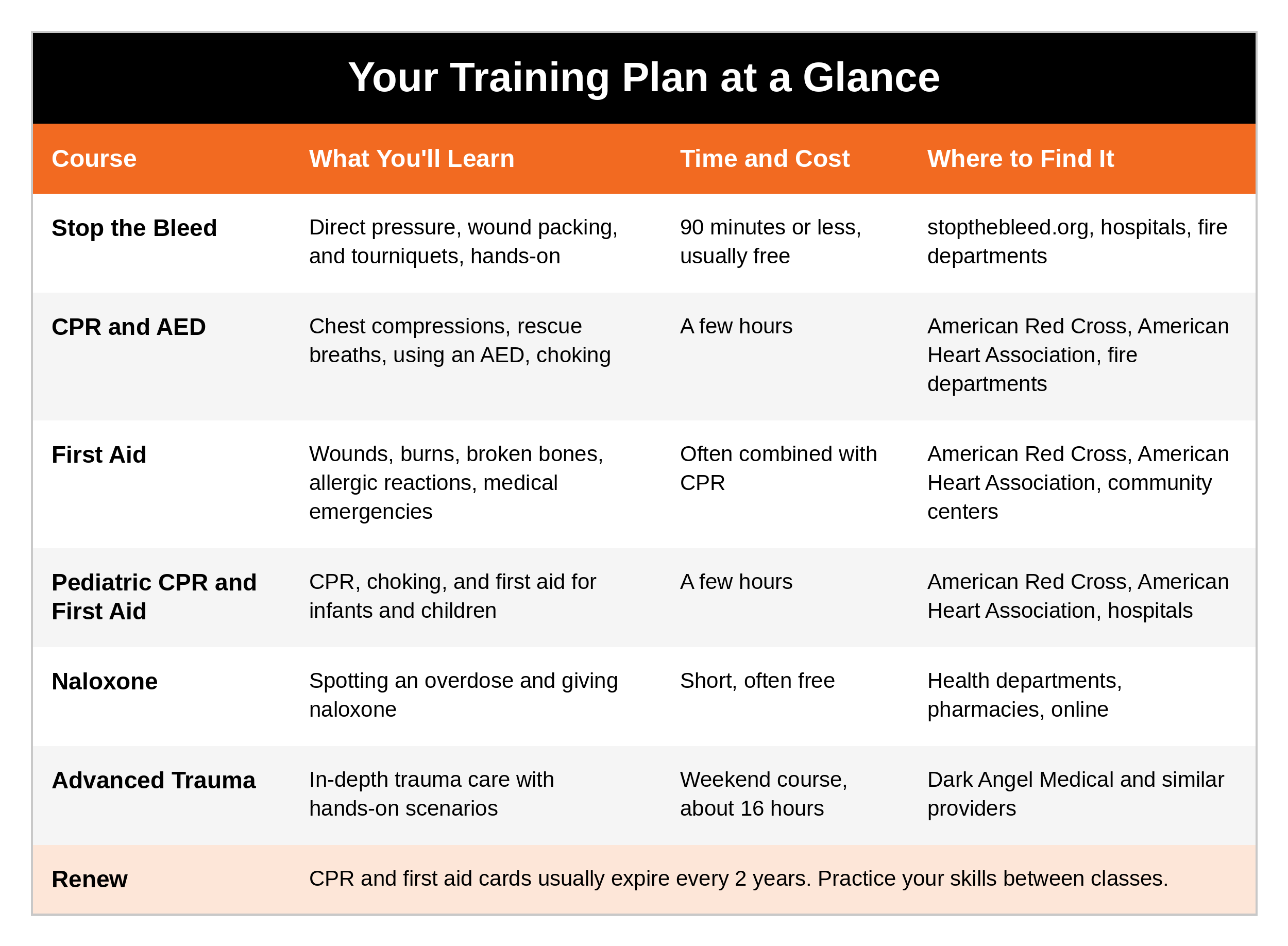
You don't have to do it all at once. Start with Stop the Bleed and CPR, then build from there. Here's the whole plan on one page.
Stop the Bleed
If you only take one class this year, make it this one. Stop the Bleed was created by the American College of Surgeons to teach everyday people how to control life-threatening bleeding. You'll get your hands on a tourniquet, pack a wound on a training model, and practice direct pressure.
Most classes run 90 minutes or less, and most are free.
The lecture part is available online, but the hands-on skills must be done in person to finish the course.
Find a class at stopthebleed.org by searching your zip code. If nothing's nearby, ask your local hospital or fire department to host one.
CPR and AED
CPR keeps blood moving to the brain until help arrives. An AED can restart the heart. You need both.
Hands-only CPR, the basics:
Call 911, or have someone else call and find an AED.
Push hard and fast in the center of the chest, about 100 to 120 times a minute. That's the beat of "Stayin' Alive."
Don't stop until help arrives or an AED is ready.
AEDs are built for regular people. You open it, and it talks you through every step. It checks the heart rhythm and only delivers a shock if one is needed. Start noticing where the AEDs are at your work, your gym, your church, and your kids' school.
A CPR class teaches you the full version, including rescue breaths and how to handle choking. Many local fire departments offer monthly classes, and the American Red Cross and American Heart Association hold them all over the country.
Choking
Choking can happen at any dinner table, to anyone. A CPR or first aid class teaches you what to do for adults, children, and infants. Depending on who trains you, you'll learn back blows, abdominal thrusts, or both. Infants need a different technique than adults, which is one more reason to take a class rather than guess.
If you carry an anti-choking device like a LifeVac, the hands-on skills still come first. The device is a backup, not a replacement.
First Aid and Pediatric Training
A basic first aid class covers the everyday stuff from Part 1, plus broken bones, allergic reactions, heat illness, and recognizing a medical emergency like a stroke or diabetic low. It's often combined with CPR in one session.
If you have kids or grandkids, or you care for someone else's, take a pediatric CPR and first aid class. Children aren't small adults. Their CPR, choking response, and medication doses are different.
Naloxone Training
In Part 3, we covered naloxone, the medication that reverses an opioid overdose. Training on how to use it is short, often free, and offered through many local health departments, pharmacies, and online. It teaches you how to recognize an overdose and give naloxone with confidence.
Going Further
If you want to go deeper, I highly recommend a Dark Angel Medical weekend course. It's about 16 hours of comprehensive trauma training with hands-on scenarios that put you under realistic pressure.
Practice Between Classes
A class gives you the skill. Practice keeps it. Skills fade faster than most people think, so build in a little practice every month:
Get a trainer tourniquet. Practice with a training version so your real tourniquets stay sealed and ready. Put it on each arm and each leg, then time yourself.
Practice one-handed. Apply a tourniquet to your own arm using only one hand. If you're the one who's hurt, that's how it'll go.
Open your kits. Name every item and what it's for. Do it with the lights off, or in the car.
Run a family drill. Who calls 911? Who grabs the kit? Does everyone know your address and where every kit is kept?
Renew your cards. CPR and first aid certifications usually last 2 years. I recommend a refresher every year to keep your skills sharp.
What About the Law?
Every state has some form of Good Samaritan law that protects people who help in an emergency in good faith. The details vary by state, so look up yours. The bigger risk is almost always doing nothing.
Final Thoughts
Medical preparedness saves lives, but gear is only part of it. Training, maintenance, and calm decision-making matter just as much. The kits we built in this series will sit there waiting. The training is what makes you ready to use them. Sign up for one class this month. Your family is the reason.
Coming Up Next
In Part 5, we'll build kits for the people who need us most: kids, seniors, and the people we care for, plus how to keep every kit stocked and ready year after year.
Ask Yourself
If someone in my home collapsed right now, would I know how to start CPR?
When was my last CPR, first aid, or Stop the Bleed class?
Have I ever actually put a tourniquet on, even a trainer, on myself with one hand?
Remember
Gear without training is just a heavy bag. Start with Stop the Bleed and CPR, add first aid, pediatric, and naloxone training, and practice every month. You don't rise to the occasion. You fall to the level of your training.
Get Started Today
Grab the free Preparedness checklist bundle: the First Aid and Trauma Checklist, the Go Bag Checklist, and the Mobile Command Center Checklist. The First Aid and Trauma Checklist includes a training section so you can track what you've done and what's next. [CTA: Comment or DM "KEYWORD" / or download it here: https://www.preparednotparanoid.com/preparedness]
Go Deeper
The Family Safety Toolkit. This post covers the training that makes your kits work. The Toolkit gives you the complete First Aid and Trauma Checklist, from medications and wound care to trauma gear, training, and restocking, plus 19 more checklists covering every area of family safety, all for $19.99. [Get it here: https://www.preparednotparanoid.com/family-safety-toolkit]
The Family Emergency Preparedness Manual is coming soon.
Tools I recommend: The trainer tourniquets, first aid kits, and trauma gear I recommend are in my Amazon store. https://link.amazon/B01SD3sHS
Related reading:
First Aid and Trauma, Introduction: First Aid vs Trauma Care https://www.preparednotparanoid.com/pnp-library/first-aid
First Aid and Trauma, Part 2: Trauma Kit Essentials https://www.preparednotparanoid.com/pnp-library/first-aid-hlmlm
First Aid and Trauma, Part 3: Medications Every Kit Should Have https://www.preparednotparanoid.com/pnp-library/first-aid-medications
Mobile Command Center, Part 3: Essential Safety Equipment https://www.preparednotparanoid.com/pnp-library/mobile-command-lesson-2
References
American Heart Association. CPR Facts and Stats.
American Heart Association. Hands-Only CPR.
American College of Surgeons. Stop the Bleed: Frequently Asked Questions.
American Red Cross. CPR, AED, and first aid training.
Substance Abuse and Mental Health Services Administration (SAMHSA). Naloxone.
Disclaimer
These suggestions are intended to help you and your family build awareness, confidence, and safer decision-making habits. No safety plan, checklist, or training can guarantee 100% protection. This article is for general informational and educational purposes only. It is not medical advice and is not a substitute for hands-on training from a certified instructor or care from a medical professional. Good Samaritan laws vary by state; this is not legal advice. Affiliate disclosure: I've linked to products from my Amazon store that I personally recommend. As an Amazon Associate, I earn from qualifying purchases, at no extra cost to you. Thank you for supporting my work.
If someone collapses, isn't breathing, or is bleeding severely, call 911.
Awareness gives you time. Time gives you options.
The prepared protector is someone who's decided that loving someone means being ready for them, not just hoping things go fine.
Prepared Not Paranoid. Protecting the Most Vulnerable Among Us.