The Right Medications, Ready When You Need Them
By Larry Betz | Prepared Not Paranoid https://www.preparednotparanoid.com/
A pounding headache in the middle of a road trip. A child with a fever at 2 a.m. A bad stomach in a city where you don't speak the language. Most of the time you reach into a first aid kit, it's not for a bandage. It's for a medication. And when it really matters, a diabetic low or an overdose, the right medication in your kit can keep someone alive until help arrives. Here are the first aid kit medications I recommend, and what to do when it's an emergency.
In Part 1, we built the everyday first aid kit. In Part 2, we covered trauma gear for life-threatening bleeding. This post covers the medications that go with both.
Why I Use Unit Dose Packs
Loose pills in a baggie or an unlabeled bottle are a problem. In an emergency, you need to know exactly what you're giving, how strong it is, and whether it's expired.
That's why I stock my kits with unit dose packs. Each pill is sealed in its own small foil packet, labeled with the name, the strength, and the expiration date. They stay clean and dry, they take up almost no room, and they're easy to restock. They're also easy to travel with, because every packet is clearly labeled.
The Everyday Medications
Rescue Essentials offers a Medications Unit Dose Pack with six common over-the-counter medications:
Ibuprofen 200 mg (like Advil or Motrin): an NSAID for pain, inflammation, and fever. It's my go-to for headaches, muscle or joint pain, and minor injuries.
Acetaminophen 325 mg (like Tylenol): a pain reliever and fever reducer for headaches, muscle aches, and colds.
Aspirin 325 mg (like Bayer): an NSAID for pain, inflammation, and fever. It also thins the blood, which is why it can help during a heart attack.
Loperamide 2 mg (like Imodium): an anti-diarrheal, especially useful when you travel.
Diphenhydramine 25 mg (like Benadryl): an antihistamine for allergies, itching, hives, and hay fever.
Calcium carbonate 420 mg (like Tums): an antacid for heartburn, acid indigestion, and an upset stomach.
Add these to round it out:
Baby aspirin 81 mg (low-dose aspirin): some people take it on a doctor's advice for heart health. If someone in your family does, keep some in the kit.
Bismuth subsalicylate (like Pepto-Bismol): for an upset stomach, nausea, and diarrhea.
Meclizine 25 mg (like Bonine or Dramamine Less Drowsy): for motion sickness on boats, planes, and winding roads.
Electrolytes (like LMNT, Pedialyte, or DripDrop): for dehydration from heat, illness, or long travel days.
One I leave out: Many cold medicines contain a decongestant called phenylephrine. An FDA advisory panel found that phenylephrine taken by mouth doesn't work as a decongestant, and the FDA has proposed removing it. If you need a decongestant, ask the pharmacist about one that works.
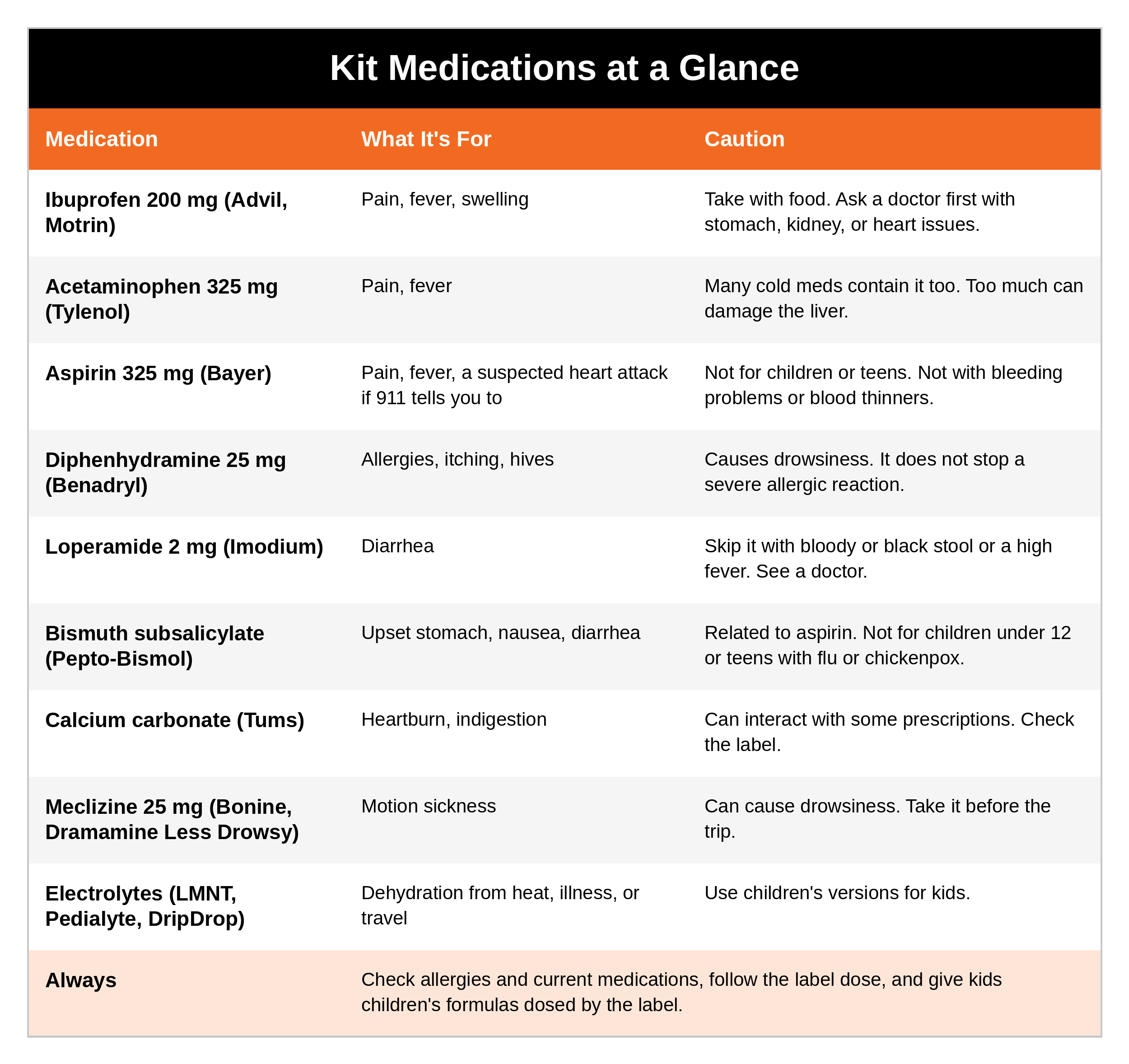
Your Kit Medications at a Glance
Every medication has a job, and every one has a caution. Here's the whole list on one page.
Medication Safety Notes
Before you give anyone anything, run through these:
Check allergies before giving any medication.
Know their current medications, health conditions, and possible interactions.
Check the dose carefully, especially for children.
Use only medications that are right for the person, the situation, and their age.
Don't give aspirin to children or teens, especially with flu-like symptoms or chickenpox. It's linked to Reye's syndrome, a rare but serious illness. Pepto-Bismol contains a similar ingredient, so the same rule applies.
Never give food, drink, or pills to someone who is unconscious or can't swallow safely.
A word on acetaminophen: It's in hundreds of products, including many cold and flu medicines. It's easy to double up without realizing it, and too much can damage the liver. Read the labels.
Medications for Kids
Adult medications don't belong in a child's mouth. If you have kids or grandkids, carry their medications separately:
Children's acetaminophen and ibuprofen in liquid or chewable form
Children's antihistamine
The dosing syringe or cup that comes with the medicine
Children's doses go by weight and age. Follow the label's dosing chart, and call your pediatrician or pharmacist if you're not sure. We'll cover kits for kids in more detail in Part 5.
Diabetic Emergency Support
Low blood sugar can come on fast, and it can make someone shaky, sweaty, confused, or irritable. If someone in your family has diabetes, or you're around people who do, these belong in your kit:
Glucose tablets (like Dex4): fast sugar for low blood sugar
Glucose gel (like Glutose): easier to take if someone's shaky
Fast-acting sugar packets: honey packets, sugar packets, or glucose chews as a backup
Diabetic emergency note card: the person's condition, medications, and emergency contacts
The 15-15 rule: If someone with low blood sugar can swallow, give them 15 grams of fast sugar (usually 3 to 4 glucose tablets). Wait 15 minutes, then recheck. If they're still low, repeat. If they can't swallow or won't wake up, call 911 and give nothing by mouth. If they have prescribed glucagon, use it as their doctor directed.
Opioid Overdose Support
An opioid overdose can happen to anyone: a teenager who takes a pill from a friend that turns out to be laced with fentanyl, a grandparent who mixes up their pain medications, a stranger in a parking lot. Naloxone (like Narcan) reverses an opioid overdose, and it's now sold over the counter. You don't need a prescription.
Naloxone nasal spray: emergency overdose reversal
Check the expiration date: Narcan has a 3-year shelf life
Keep the instructions with the kit: so anyone can use it under stress
Signs of an overdose: won't wake up, slow or no breathing, blue or gray lips, and tiny pupils.
What to do: Call 911. Spray one dose into one nostril. If they don't respond in 2 to 3 minutes, give a second dose in the other nostril. Stay with them, because naloxone can wear off before the opioid does.
Naloxone won't hurt someone who isn't having an overdose, so if you're not sure, give it.
Severe Allergic Reactions
Benadryl is great for itching and hives. It won't stop a severe allergic reaction (anaphylaxis), which can close the throat in minutes. The treatment is epinephrine, from an auto-injector like an EpiPen.
If someone in your family has a severe allergy, their epinephrine should go everywhere they go, and everyone around them should know where it is and how to use it.
What to Do: Medical Emergencies
Medications buy time. Knowing when and how to use them is what saves the life. Here's what to do for each one.
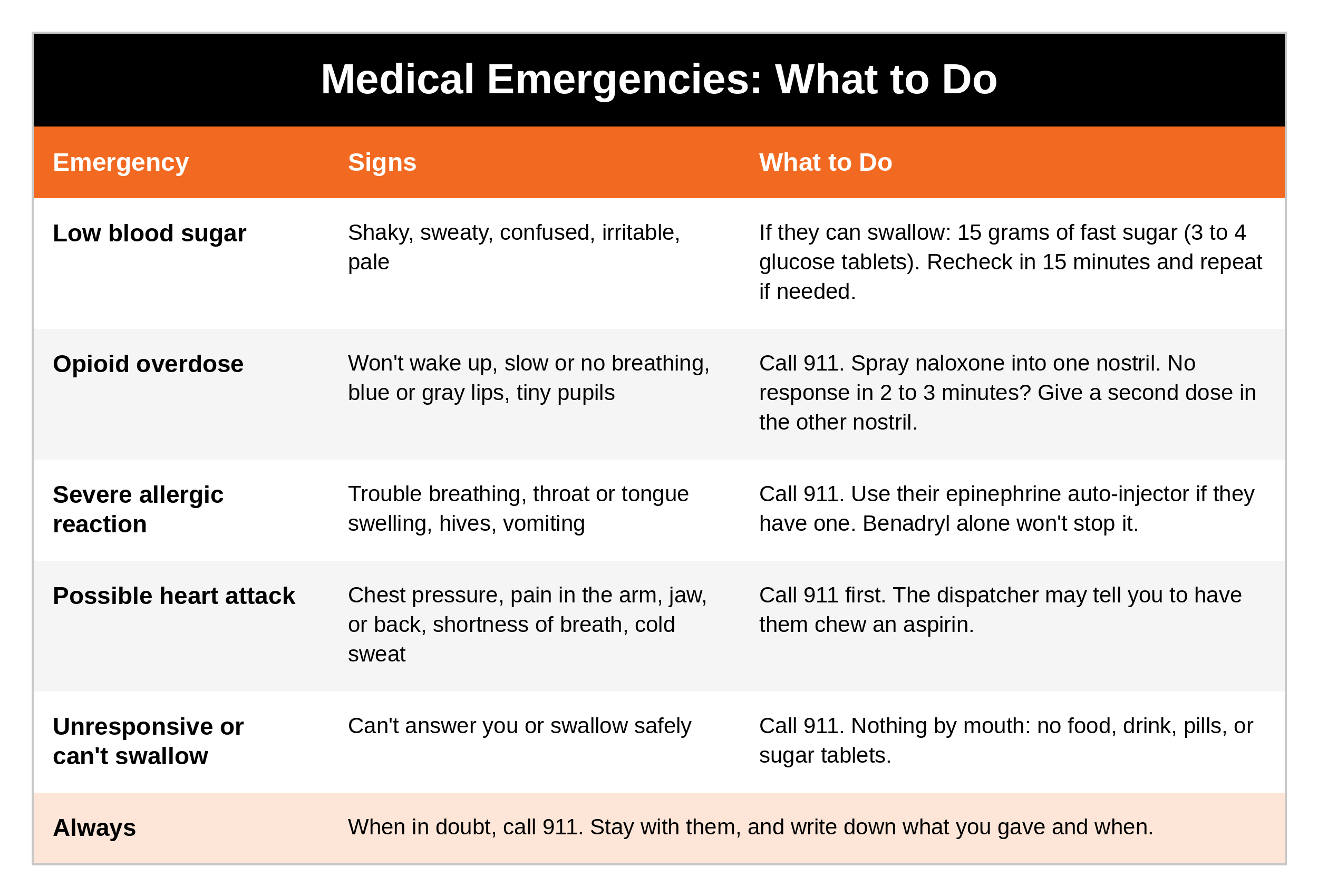
A note on heart attacks: Call 911 first. Don't drive the person yourself if an ambulance can come. The dispatcher may tell you to have them chew an aspirin. Don't give it if they're allergic or have been told not to take it.
Prescriptions and the Backup List
Over-the-counter meds are only half of it. If someone in your family takes daily prescriptions, a missed dose during an emergency can turn into an emergency of its own.
Keep a few days' supply of daily prescriptions in your go bag and travel bag, in their original labeled containers.
Carry a backup prescription list with each medication's name, dose, and prescribing doctor, plus allergies.
Keep a copy on your phone and a paper copy in your kit.
I covered packing medications and documents in Go Bag and Emergency Bug-Out Bag, Part 4.
Storage and Heat
Heat breaks medications down. A car in the summer can get far hotter than any medication is meant to handle.
Store medications at room temperature when you can. Narcan, for example, is meant to be stored at room temperature and kept out of extreme heat and cold.
Rotate car kit medications more often, especially in hot climates.
Check expiration dates twice a year, when you check the rest of your kit. Check naloxone and glucose supplies every time.
Replace anything you use right away.
Write it down. Any time you give a medication in an emergency, write down what you gave, how much, and what time. Hand that note to EMS. Part 1 covers the notebook and pen that belong in every kit.
Coming Up Next
In Part 4, we'll cover the most important piece of any kit: the training to use it. Stop the Bleed, CPR and AED, first aid, naloxone, and how to practice so you're ready.
Ask Yourself
Are the medications in my kit labeled, in date, and right for everyone in my family, including the kids?
Does anyone in my family need glucose, epinephrine, or a daily prescription I'd be lost without?
Would I know what to do if someone in front of me stopped breathing from an overdose?
Remember
Labeled, in date, and right for the person. Stock unit dose packs, keep children's medications separate, and add glucose and naloxone. Benadryl doesn't stop anaphylaxis, aspirin isn't for kids, and when in doubt, call 911.
Get Started Today
Grab the free Preparedness checklist bundle: the First Aid and Trauma Checklist, the Go Bag Checklist, and the Mobile Command Center Checklist. Print them, check them off, and keep them with your kits. [CTA: Comment or DM "KEYWORD" / or download it here: https://www.preparednotparanoid.com/preparedness]
Go Deeper
The Family Safety Toolkit. This post covers the medications that belong in a family kit. The Toolkit gives you the complete First Aid and Trauma Checklist, from medications and wound care to trauma gear, training, and restocking, plus 19 more checklists covering every area of family safety, all for $19.99. [Get it here: https://www.preparednotparanoid.com/family-safety-toolkit]
The Family Emergency Preparedness Manual is coming soon.
Tools I recommend: The unit dose medications, glucose supplies, naloxone, and first aid gear I recommend are in my Amazon store. https://link.amazon/B01SD3sHS
Related reading:
First Aid and Trauma, Part 1: First Aid Kit Essentials https://www.preparednotparanoid.com/pnp-library/first-aid-ghmj4
First Aid and Trauma, Part 2: Trauma Kit Essentials https://www.preparednotparanoid.com/pnp-library/first-aid-hlmlm
Go Bag and Emergency Bug-Out Bag, Part 4: Documents, Cash and Medications https://www.preparednotparanoid.com/pnp-library/go-bag-documents-cash-medications
References
U.S. Food and Drug Administration. Naloxone for over-the-counter use; Narcan shelf life extension.
U.S. Food and Drug Administration. Proposal to remove oral phenylephrine as an OTC decongestant.
Centers for Disease Control and Prevention. Treatment of low blood sugar (the 15-15 rule).
American Heart Association. Warning signs of a heart attack; aspirin and heart attack.
National Institutes of Health. Reye's syndrome.
American Academy of Allergy, Asthma and Immunology. Anaphylaxis and epinephrine.
Disclaimer
These suggestions are intended to help you and your family build awareness, confidence, and safer decision-making habits. No safety plan, checklist, or training can guarantee 100% protection. This article is for general informational and educational purposes only. It is not medical advice and is not a substitute for the advice of your doctor or pharmacist, the medication label, or hands-on first aid training. Always follow the label and ask a medical professional before giving any medication, especially to children. Affiliate disclosure: I've linked to products from my Amazon store that I personally recommend. As an Amazon Associate, I earn from qualifying purchases, at no extra cost to you. Thank you for supporting my work.
For an overdose, a severe allergic reaction, chest pain, or any medical emergency, call 911.
Awareness gives you time. Time gives you options.
The prepared protector is someone who's decided that loving someone means being ready for them, not just hoping things go fine.
Prepared Not Paranoid. Protecting the Most Vulnerable Among Us.