Aerobic Fitness: Part 1
Walking and Rucking: The Foundation of Real-World Fitness
By Larry Betz | Prepared Not Paranoid https://www.preparednotparanoid.com/
If you had to leave your home on foot today, carrying a bag and maybe helping someone else, how far could you go?
That question is why walking comes first in this series. It's the most natural movement we have, and it's the foundation for everything else: jogging, agility, strength, and carrying a load. Rucking, walking with weight on your back, takes that foundation and turns it into real-world readiness.
This post is the full companion guide to Sections 2 and 3 of my free 90-Day Aerobic Fitness Program. Read it here for the "why" and the "how," then use the program to track every walk and ruck. [Get the free 90-Day Program: LINK]
Why Walking Comes First
Walking is one of the most accessible forms of low-impact aerobic exercise there is, which makes it a great choice for every fitness level.
It's gentle on your joints. Lower impact means lower risk of injury, while you still get real cardiovascular benefits.
It needs almost no equipment. Good shoes and a safe route, and you're set.
You can do it anywhere. Around the block, at the park, at the mall, or on a trail.
It's easy to build into your life. A steady weekly progression that becomes a habit is far better than one hard session a week.
How Many Steps Do You Really Need?
Based on my experience working with clients, walking about 10,000 steps a day is very effective for weight reduction. But research shows the biggest health benefits start well before that. A large analysis of 15 studies found the benefits level off at about:
Adults under 60: 8,000 to 10,000 steps a day
Adults 60 and older: 6,000 to 8,000 steps a day
Don't start at 10,000 on day one. Find your baseline first, then build from there.
Getting Started: Gear That Helps
Good walking shoes. Proper support and cushioning prevent foot and leg discomfort. This is the one thing worth spending on.
Compression socks can help circulation and reduce leg fatigue.
Knee sleeves can add stability and comfort to your joints.
A simple pedometer. Phone apps work, but many people don't carry their phone all day. A small clip-on pedometer you can forget about tracks every step.
Walking Sticks: Stability, Confidence, and a Full-Body Workout
Once you're comfortable with your walking routine, walking sticks can take it up a level. They add stability on uneven ground, work your arms and shoulders, and turn your walk into more of a full-body session. Research on Nordic walking has found benefits for heart health, fitness, and quality of life.
Walking sticks also add confidence. If balance problems or a fear of falling have kept you from starting, sticks can give you the support you need to get going. Because of my own injuries, I use Jetti walking sticks instead of traditional collapsible hiking poles. I've found them more stable, and the large rubber tips don't get stuck in wooden boardwalks.
Start Here: Your Walking Check-In
Before your first walk, test yourself and write down your numbers. Then repeat the same check-in on Day 30, Day 60, and Day 90. It's how you'll see your progress in black and white.
How long can you walk comfortably without stopping?
What's your 1-mile walk time?
What are your average daily steps over one week?
What's your RPE at the end of a 20-minute walk?
RPE is your Rate of Perceived Exertion: how hard the walk feels to you on a 0-to-10 scale. Most of your walking should be at RPE 4 to 6. A quick check is the talk test: if you can talk but not sing, you're in the right zone.
Your 12-Week Walking Plan
Walk 3 days a week, plus a longer walk on Saturday. Add about 3 to 5 minutes a week, and every fourth week, ease off with a recovery week so your body can catch up. Your goal is to build toward up to 60 minutes, depending on your age, health, and injuries. For some people, 30 to 45 minutes is the right goal, and that's a great result.
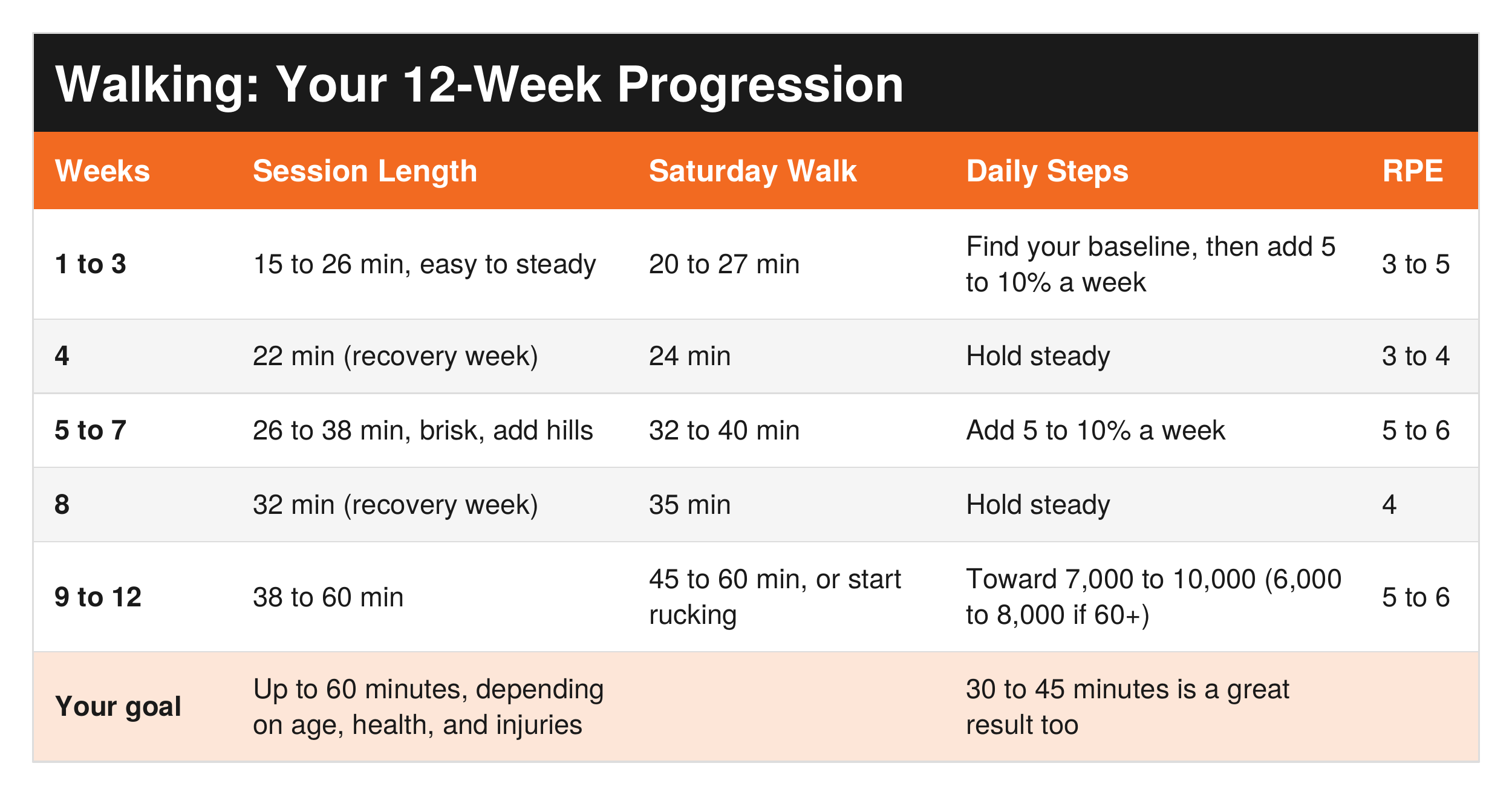
The full week-by-week plan, plus a printable walking tracker, is in Section 2 of the 90-Day Program.
Listen to Your Body
Go for a walk and pay close attention to how you feel. Note your time, your steps, and your RPE. On your next walk, adjust: add a little time if it felt easy, or hold steady if it felt hard. If a week felt too hard, repeat it. There's no prize for rushing.
Want to Make Your Walk More Challenging?
Add a weighted vest, a backpack, or even resistance leggings from Skinnify. That additional resistance makes your daily walk more challenging without adding more time. Start light, and change only one thing at a time. [SKINNIFY LINK]
Rucking: Walking With a Purpose
Once your body has adapted to walking, it's time to consider adding an external load. Rucking means walking with a weighted backpack, or "rucksack." A weighted vest works too. It's the closest training there is to a real emergency: carrying a go bag, supplies, or a child over distance.
The Benefits of Adding Weight
More work in the same time. The added load raises your heart rate and calorie burn.
Strength. It builds your legs, back, and core.
Bone health. Weight-bearing exercise helps support bone density, which matters more as we age. A small long-term study found postmenopausal women who exercised with weighted vests maintained hip bone density while a control group lost it. (Weighted vests aren't magic, though. A recent trial found they didn't prevent bone loss during weight loss, and strength training built more strength. Use rucking alongside strength work, not instead of it.)
Balance and coordination. Your body has to work harder to stay stable with a load.
Mental toughness. Carrying weight breaks the routine and gives you a real sense of accomplishment.
Are You Ready to Ruck?
You should be able to walk 30 minutes briskly at RPE 5 without pain. If you're not sure about your physical ability to ruck, or you feel pain, check with your doctor or a trusted healthcare professional first.
Start Here: Your Rucking Check-In
What weight can you carry comfortably for 20 minutes?
What's your 1-mile ruck time? (Use the same weight at each check-in.)
What's your longest comfortable ruck?
How do your feet, back, and shoulders feel afterward, on a 1-to-10 scale?
Repeat it on Day 30, Day 60, and Day 90.
Your 12-Week Rucking Plan
Ruck 1 to 2 times a week, usually on Saturday. Start light, with 5 to 10 pounds. Build your time first, then add weight. Work toward up to 60 minutes, depending on your age, health, and injuries.
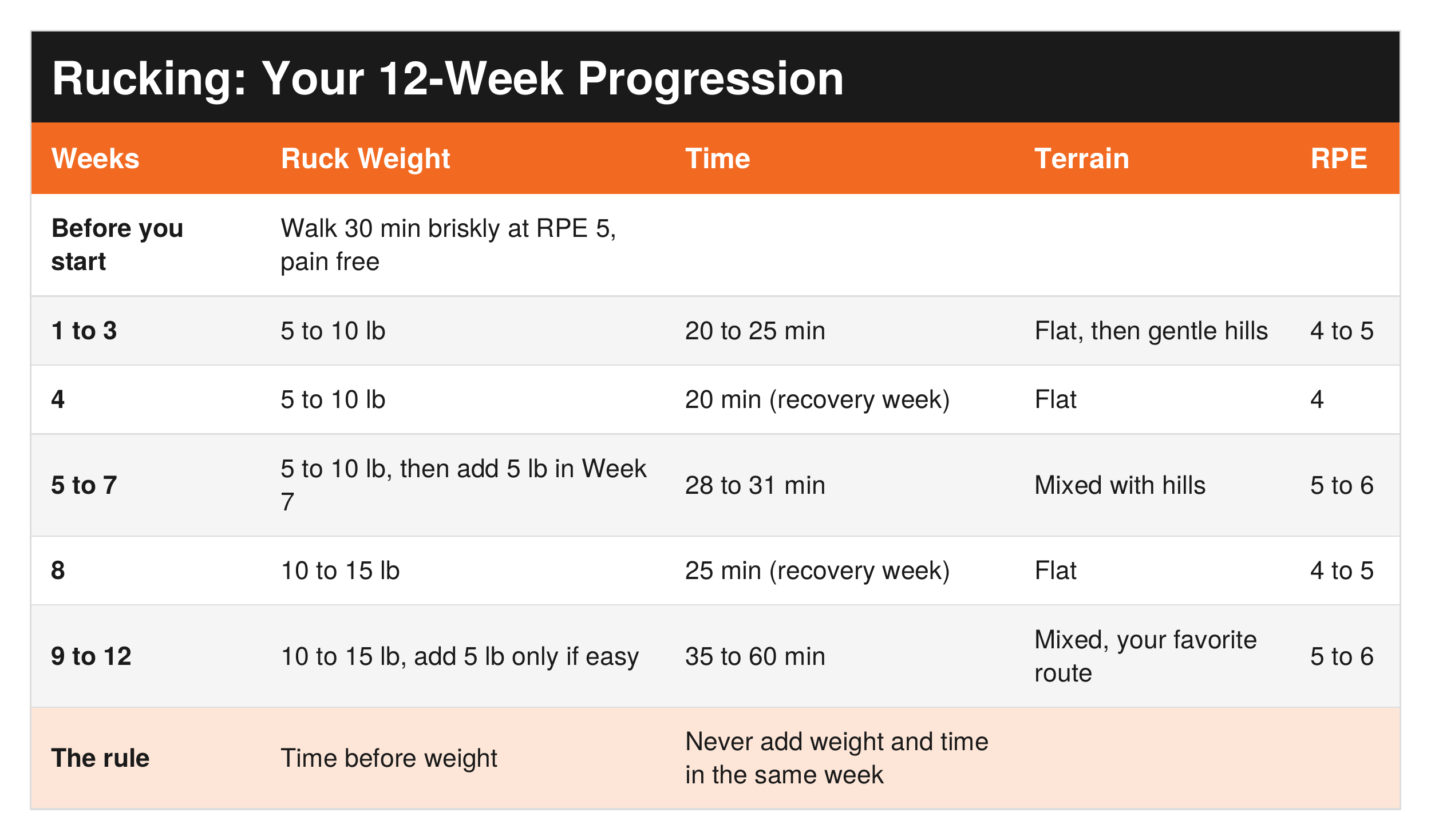
The full plan and a printable rucking tracker are in Section 3 of the 90-Day Program.
Rucking Tips
Time before weight. Never add weight and time in the same week.
Pack it high and tight. Keep the weight close to your back so it doesn't swing. Books, water jugs, or a ruck plate all work.
Stand tall. Don't lean forward or let your shoulders round.
Footwear matters. Hiking boots give you extra ankle support with a load. Add a shock-absorbing insole to reduce impact on your joints.
Watch for hot spots. Sore feet, shoulders, or lower back mean hold your weight steady until it feels easy.
Safety First
Talk to your doctor first, especially if you have a heart condition, high blood pressure, diabetes, joint problems, past injuries, or you've been inactive.
Warm up before every session.
Stop and get checked if you feel chest pain or pressure, dizziness, unusual shortness of breath, or sharp joint pain.
Respect old injuries. If something bothers a past injury, scale back. Progress is never worth a setback.
Stay visible and hydrated. Bright clothing or a light in low light, and water on longer walks.
Ask Yourself
If I had to walk out of my neighborhood with a bag, how far could I go today?
Do I know my daily steps, or am I guessing?
Is it time to add walking sticks, a vest, or a ruck?
Remember
Walking is the foundation, and rucking turns it into readiness. Start where you are, add a few minutes a week, build time before weight, and write it all down. Every walk makes you more prepared for the day you need it.
Go Deeper
Free download: The 90-Day Aerobic Fitness Program. Sections 2 and 3 have the full 12-week walking and rucking plans, a Start Here check-in for each, and printable trackers. [Get it here: LINK TO 90-DAY PROGRAM]
Free download: Dynamic Warm-Up Guide. The 16-move warm-up I recommend before every session. [Get it here: LINK TO WARM-UP GUIDE]
Coming Soon: The Prepared Not Paranoid Fitness and Nutrition Guide. A complete guide to training, eating and recovering so you’re ready when it matters. Join the email list to be the first to know when it’s here. [LINK TO EMAIL SIGNUP]
Tools I recommend: You'll find the walking shoes, Jetti walking sticks, pedometers, rucks, weighted vests, and hiking boots I recommend in my Amazon store. [AMAZON STORE LINK]
Related reading:
Aerobic Fitness: An Introduction [LINK]
Aerobic Fitness, Part 2: Running, From Jogging to Sprinting [LINK]
Senior Falls series, Part 2: Strong, Steady, Independent [LINK]
Recovery Strategies: Introduction [LINK]
References
U.S. Department of Health and Human Services. (2018). Physical Activity Guidelines for Americans, 2nd edition. https://health.gov/our-work/nutrition-physical-activity/physical-activity-guidelines/current-guidelines
Paluch, A. E., et al. (2022). Daily steps and all-cause mortality: A meta-analysis of 15 international cohorts. Lancet Public Health, 7(3), e219-e228. https://doi.org/10.1016/S2468-2667(21)00302-9
Tschentscher, M., Niederseer, D., & Niebauer, J. (2013). Health benefits of Nordic walking: A systematic review. American Journal of Preventive Medicine, 44(1), 76-84. https://doi.org/10.1016/j.amepre.2012.09.043
Knapik, J. J., Reynolds, K. L., & Harman, E. (2004). Soldier load carriage: Historical, physiological, biomechanical, and medical aspects. Military Medicine, 169(1), 45-56. https://doi.org/10.7205/MILMED.169.1.45
Snow, C. M., et al. (2000). Long-term exercise using weighted vests prevents hip bone loss in postmenopausal women. Journals of Gerontology Series A, 55(9), M489-M491. https://doi.org/10.1093/gerona/55.9.M489
Beavers, K. M., et al. (2025). Weighted vest use or resistance exercise to offset weight loss-associated bone loss in older adults: A randomized clinical trial. JAMA Network Open, 8(6), e2516772. https://doi.org/10.1001/jamanetworkopen.2025.16772
Centers for Disease Control and Prevention. Measuring Physical Activity Intensity. https://www.cdc.gov/physical-activity-basics/measuring/index.html
Disclaimer
This article is for general informational and educational purposes only. It is not medical advice and is not a substitute for guidance from your physician. Physical exercise carries a risk of injury. Talk to your doctor before starting any new exercise program, especially if you have a medical condition, past injuries, or have been inactive. Stop any activity that causes pain, dizziness, or chest discomfort. Affiliate disclosure: I've linked to products from my Amazon store that I personally recommend. If you purchase through these links, I may earn a small commission at no extra cost to you. Thank you for supporting my work.
If you have chest pain, severe shortness of breath, or feel faint while exercising, stop and call 911.
Awareness gives you time. Time gives you options.
The prepared protector is someone who's decided that loving someone means being ready for them, not just hoping things go fine.
Prepared Not Paranoid. Protecting the Most Vulnerable Among Us.