The Bag Supports the Plan. It Isn't the Plan.
By Larry Betz | Prepared Not Paranoid https://www.preparednotparanoid.com/
If you had 10 minutes to leave your house right now, what would you grab? Most people have never thought about it. Then the day comes, the phone alert goes off, and they're running from room to room trying to remember where the passports are and whether anyone packed Mom's medications. That's where the go bag vs bug-out bag question starts to matter. Knowing which bag does which job, and having it packed before you need it, turns a panicked 10 minutes into a calm one.
Just last year, my wife and I had a very close call. A wildfire was burning close enough to see from our home, and we had to stage everything and be ready to go. The timing couldn't have been worse. My wife had just had ACL surgery. That's not something you plan for. Suddenly the question wasn't only what to pack, but how to safely move her and everything else we needed. Fortunately, we live in a very close community, and our neighbors were standing by ready to help. It was a real reminder that no matter how well you prepare, you can't plan for every problem. What you can do is build a plan flexible enough to handle the one you didn't see coming. Go Bag vs Bug-Out Bag: What's the Difference?
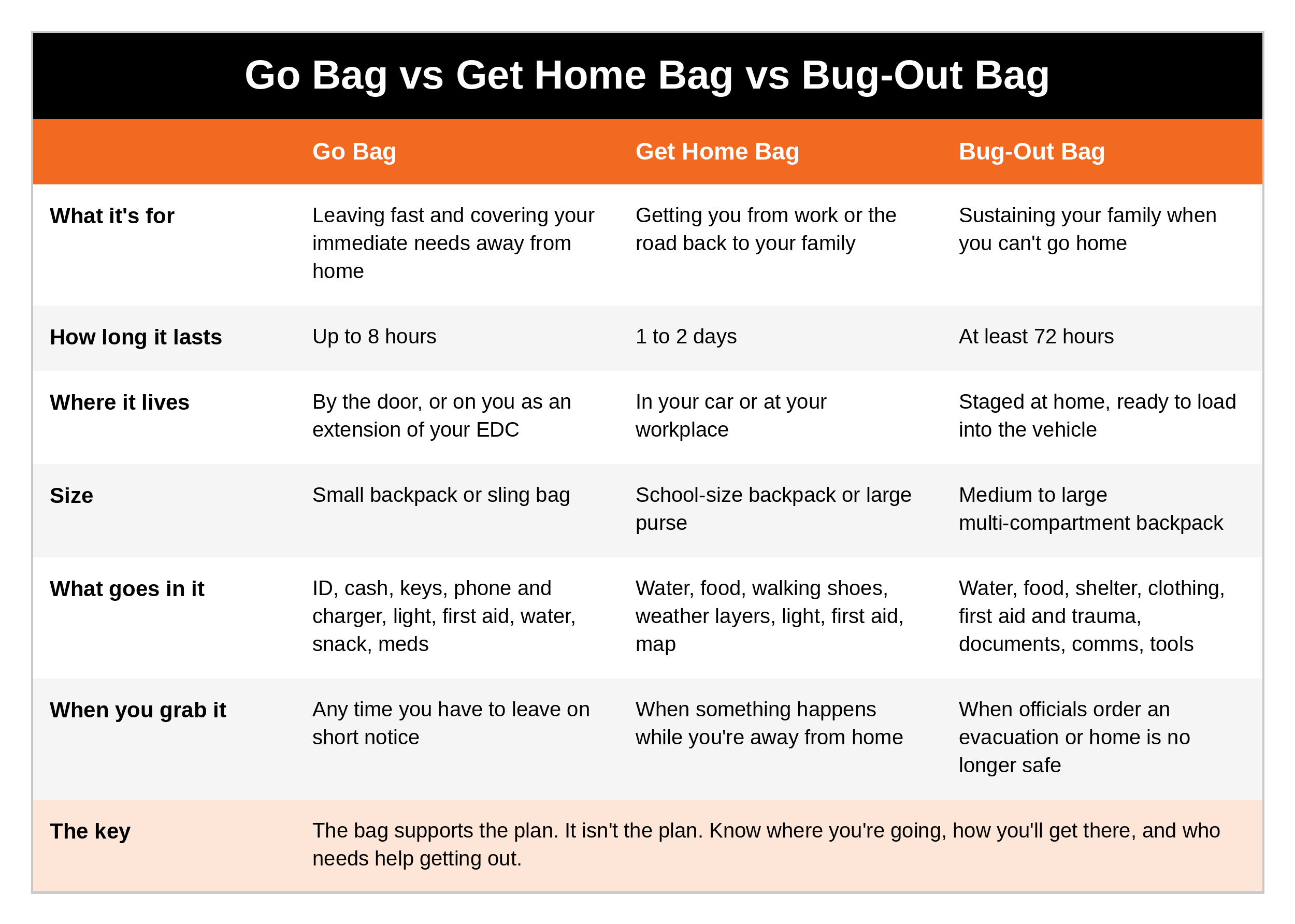
Although the terms "Go Bag" and "Emergency Bug-Out Bag" are often used interchangeably, they serve different purposes in emergency preparedness. Here's how I separate the two.
A Go Bag is built for quick access. It holds the essential supplies to carry you for up to 8 hours while you're away from home. Think of it as an extension of your Everyday Carry (EDC), set up to cover your immediate needs when you have to leave in a hurry.
An Emergency Bug-Out Bag is built to sustain you and your loved ones for at least 72 hours. It carries more complete supplies for situations where going back home may not be an option anytime soon.
There's a third bag worth knowing about, too. A Get Home Bag lives in your car or at your workplace, and it has one job: getting you from wherever you are back to your family, even if that means a day or two on foot or stuck in traffic.
You don't need three fully loaded packs sitting around the house. For most families that isn't realistic, financially or otherwise. The smarter approach is to make the bags work together. Your EDC feeds your Go Bag, your Get Home Bag gets you home, and at home a larger bag is staged and waiting, so you can combine supplies and head out with a full Bug-Out Bag.
Start With Where You Live
When I first wrote this on January 20, 2025, California was facing devastating wildfires, and many residents were on evacuation standby. It was a timely reminder of why we prepare for both short-term and extended emergencies.
You can't prepare for every scenario, and emergencies look different depending on where you live. California is more likely to face wildfires. Florida deals with hurricanes almost every year. Understanding the risks specific to your region, the time of year, and your environment will help you tailor your plan and make sure your Go Bag and Bug-Out Bag hold the right tools and resources.
If you're not sure what your area's biggest risks are, FEMA's National Risk Index lets you look up your county and see which hazards are most likely where you live. It's free, and it takes about five minutes.
Stay or Go: The Bag Is Only Half the Plan
A bag is not a plan. It supports a plan.
Ready.gov puts it simply: depending on the situation, your first decision is whether to stay where you are or leave, and you should plan for both. That matches how I've always looked at it. Bugging in (staying home) is often the best choice, unless your home is no longer safe. Your home has your food, your water, your beds, your tools, and your medications. You don't walk away from all that lightly.
But when officials tell you to evacuate, you go, and you go immediately. That's when the bag earns its place, because the decision has already been made for you and the only question left is how fast and how calm you can be out the door.
So before you buy a single item, settle these three things with your family:
Where are we going? A friend or family member's home out of the area, a hotel, or a public shelter. Pick one, plus a backup.
How are we getting there? Your main route and at least one alternate, in case roads are closed. Keep your gas tank at least half full at all times.
Who needs help getting out? Kids, aging parents, a family member with a disability, and your pets. That last question is the one that matters most. A prepared protector packs the bag for the slowest person in the family, not the fastest. I learned that firsthand the week of my wife's surgery. If your dad can't carry a 30-pound pack, or your toddler can't walk a mile, your plan has to account for that now, not in the driveway with smoke on the horizon.
What This Series Covers
This series takes you from "I should probably do something about this" to a packed bag and a practiced plan:
Part 1: Go Bag Necessities. The core items that handle most situations when you're away from home.
Part 2: Preparing to Leave Your Home. Evacuation triggers, the 10-minute list, and how to use the warning time you do get.
Part 3: Comprehensive Emergency Supply List. Everything for the 72-hour Bug-Out Bag, organized by category.
Part 4: Documents, Cash and Medications. The things you can't replace if you leave them behind.
Part 5: Bags for Kids, Seniors and Pets. Planning for the people (and animals) who can't carry their own.
Part 6: What You Can Actually Carry, and Practicing the Plan. Weight limits, a family drill, and choosing your destination.
Ask Yourself
If we had to leave in 10 minutes, does everyone in my house know what to grab and where to meet?
Which person in my family would struggle the most in an evacuation, and what does my plan do for them?
Do I know the two most likely emergencies where I live, and is my bag built for those? Remember
The bag buys you time. The plan tells you what to do with it. Preparedness isn't just about having supplies. It's about having a plan and knowing how to use everything in your kit.
Get Started Today
Grab the free Preparedness checklist bundle: the Go Bag Checklist, the Mobile Command Center Checklist, and the First Aid and Trauma Checklist. Print them, check them off, and keep them with your gear. [CTA: Comment or DM "KEYWORD" / or download it here: https://www.preparednotparanoid.com/preparedness]
Go Deeper
The Family Safety Toolkit. This post shows you the difference between a Go Bag, a Get Home Bag, and a Bug-Out Bag, and the three questions to settle before you pack. The Toolkit goes further, with the complete Go Bag Checklist, the Mobile Command Center Checklist, the First Aid and Trauma Checklist, and 17 more checklists covering every area of family safety, all for $19.99. [Get it here: https://www.preparednotparanoid.com/family-safety-toolkit]
The Family Emergency Preparedness Manual is coming soon.
Tools I recommend: The everyday carry gear, first aid kits, flashlights, and backup communications I recommend are in my Amazon store.
Everyday Carry: https://link.amazon/B08cbUYC1
First Aid: https://link.amazon/B01SD3sHS
Flashlights: https://link.amazon/B0giJW8RY
Backup Communications: https://link.amazon/B09z0lfEb
Related reading:
Go Bag and Emergency Bug-Out Bag, Part 1: Go Bag Necessities https://www.preparednotparanoid.com/pnp-library/go-bag-lesson-1
Go Bag and Emergency Bug-Out Bag, Part 2: Preparing to Leave Your Home https://www.preparednotparanoid.com/pnp-library/go-bag-lesson-2
Setting Up Your Mobile Command Center: Introduction https://www.preparednotparanoid.com/pnp-library/mobile-command-intro
References
Ready.gov. Build A Kit.
Ready.gov. Evacuation.
Federal Emergency Management Agency. National Risk Index.
Disclaimer
This article is for general informational and educational purposes only. It is not a substitute for professional emergency planning or training. Always follow evacuation orders and instructions from your local officials. Affiliate disclosure: I've linked to products from my Amazon store that I personally recommend. As an Amazon Associate, I earn from qualifying purchases, at no extra cost to you. Thank you for supporting my work.
If you are in immediate danger, or officials order an evacuation, call 911 or follow their instructions right away.
Awareness gives you time. Time gives you options.
The prepared protector is someone who's decided that loving someone means being ready for them, not just hoping things go fine.
Prepared Not Paranoid. Protecting the Most Vulnerable Among Us.