What to Carry for the First 8 Hours Away From Home
By Larry Betz | Prepared Not Paranoid https://www.preparednotparanoid.com/
Most emergencies don't start at home. They start when you're at work, in the car, at the store, or sitting in the school pickup line. The roads close, the power goes out, or your phone hits 5% with no charger in sight. That's what a Go Bag is for. In the Introduction, we covered the difference between the bags. This post is the introduction to Go Bag checklist itself: what to carry, why each item matters, and how to keep the bag ready so it's there when you need it.
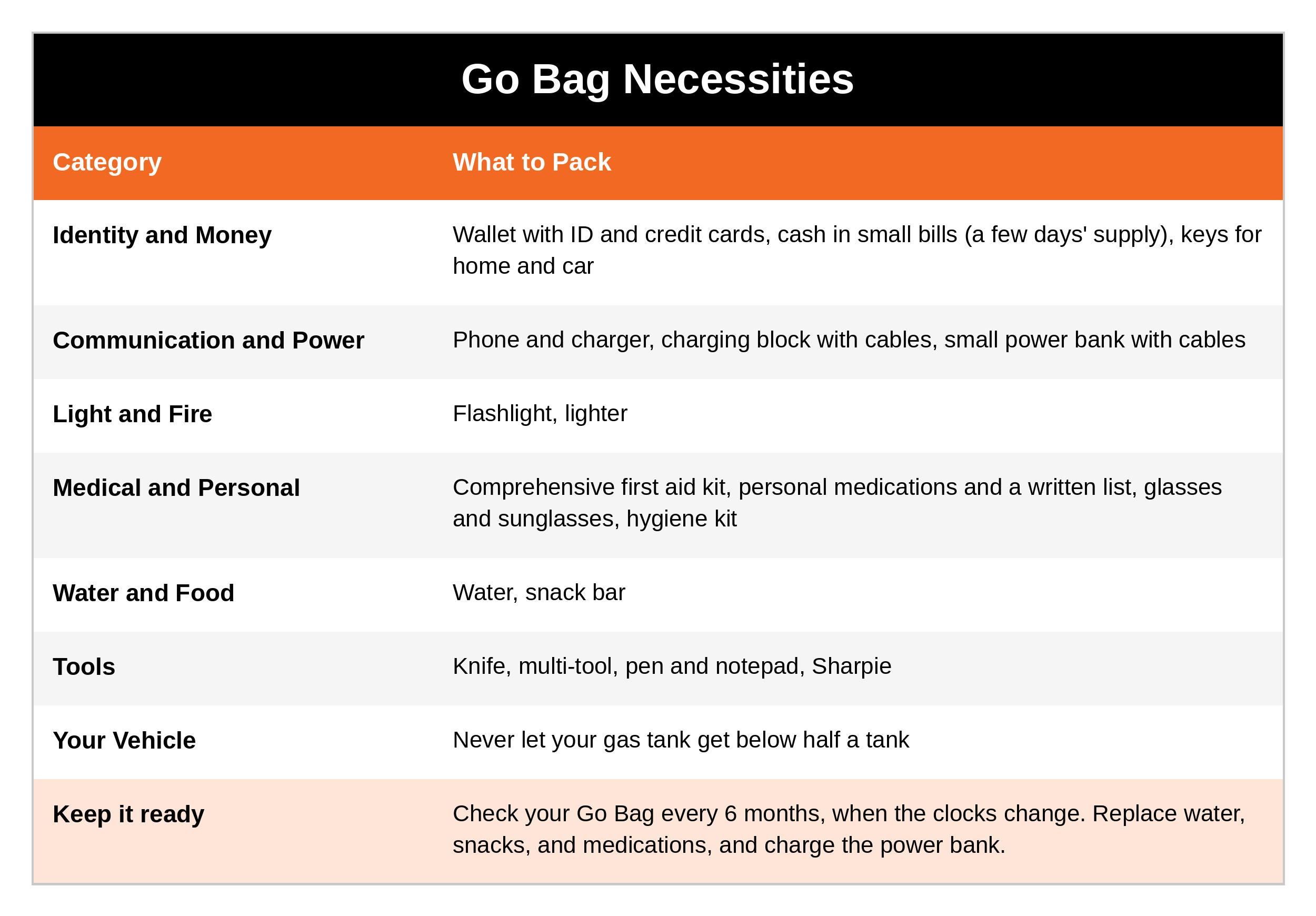
Go Bag Necessities
A Go Bag is an expansion of your Everyday Carry (EDC). It's a lightweight kit built for roughly 8 hours away from home, for times when you have to leave quickly or can't get back right away, but you fully plan to return once things settle down. Here's what goes in it, grouped by the job each item does.
Identity and Money
Wallet with ID and credit cards
Cash in small bills. A few days' supply is recommended. When the power is out, ATMs and card readers may be down, and nobody can make change for a $100 bill.
Keys for home and car. A spare set in the bag means you're never locked out of either one.
Communication and Power
Phone and charger
Small power bank with cables. A dead phone means no maps, no calls, and no emergency alerts.
Light and Fire
Flashlight. Don't count on your phone's light. You'll want the phone's battery for calls.
Lighter
Medical and Personal
Comprehensive first aid kit. (See my First Aid and Trauma Checklist for the full guide)
Personal medications. Pack a few days' worth, plus a written list of each medication and dose.
Glasses and sunglasses. If you rely on glasses or contacts, a backup pair matters.
Hygiene kit
Water and Food
Water
Snack bar. Something you'll actually eat, swapped out before it expires.
Tools
Knife
Multi-tool
Pen and notepad, plus a Sharpie. Write down the phone numbers that matter. If your phone dies, how many numbers do you actually know by heart? The Sharpie is for labeling, leaving a note on a door, or writing on almost anything.
Your Vehicle
Never let your gas tank get below half a tank. It's not something you pack, but it belongs on this list. When everyone is trying to leave at once, gas stations run dry or lose power fast. (See my Mobile Command Center Checklist for the full guide.)
The items above should be enough to take care of most situations you may encounter while away from your home.
Go Bag Expanded
If you want your Go Bag to handle more, these are the next items I add. Some depend on your training, your comfort level, and the laws where you live.
Trauma kit (tourniquet, chest seal, hemostatic gauze). These handle the kind of bleeding a basic first aid kit can't. A tourniquet only helps if you know how to use it, so take a Stop the Bleed class. It's often free and takes about an hour. The First Aid and Trauma series covers this in depth.
Chem light (glow stick). Light that doesn't need batteries, and an easy way to be seen.
Gloves (work gloves and nitrile gloves). Work gloves protect your hands from debris and broken glass. Nitrile gloves protect you and the person you're helping when you give first aid.
Dust mask or gaiter. These help with dust and debris. For wildfire smoke, pack an N95. The CDC says paper dust masks and bandanas won't protect your lungs from smoke particles.
6-in-1 screwdriver
Small channel locks
Zip ties
Pepper spray and other self-defense options. Check your state's laws first. Some states limit the size or type of spray, and the same goes for knives.
Personal alarm. Loud, simple, and legal almost everywhere.
Firearm and spare magazine (if you're comfortable and it's legal). As a firearms instructor, my goal is to teach people to never have to use their firearm. If you carry one, get trained, know your state's carry laws, and use a proper holster or a dedicated, secured compartment. Never leave a bag with a firearm unattended or in an unlocked car.
Where Your Go Bag Lives
A Go Bag only works if it's with you. Keep it where your day actually happens: in your car, by the door, or at your desk at work. If you have kids who are old enough, a small version in their school backpack (a water bottle, a snack, a list of phone numbers, and a small flashlight) goes a long way.
Keep It Ready
A bag you packed two years ago is not a bag you can count on. Check your Go Bag every 6 months. An easy way to remember is to do it when the clocks change, the same day you test your smoke detectors.
Replace water and snacks before they expire
Check medication dates and update your medication list
Charge the power bank and test the flashlight
Swap clothing and gear for the coming season
Refresh your cash if you've borrowed from it
Ask Yourself
If I couldn't get home for the next 8 hours, what's in my car or my bag right now?
If my phone died, could I reach my family? Do I know their numbers?
When is the last time I opened my bag and checked what's inside?
Remember
A Go Bag is your Everyday Carry with a little more staying power. Keep it light, keep it where your day happens, and check it twice a year.
Get Started Today
Grab the free Preparedness checklist bundle: the Go Bag Checklist, the Mobile Command Center Checklist, and the First Aid and Trauma Checklist. Print them, check them off, and keep them with your gear. [CTA: Comment or DM "KEYWORD" / or download it here: https://www.preparednotparanoid.com/preparedness]
Go Deeper
The Family Safety Toolkit. This post gives you the Go Bag essentials and the expanded add-ons. The Toolkit gives you the full printable Go Bag Checklist plus the Comprehensive Emergency Supply list, the Mobile Command Center Checklist, the First Aid and Trauma Checklist, and 17 more checklists covering every area of family safety, all for $19.99. [Get it here: https://www.preparednotparanoid.com/family-safety-toolkit]
The Family Emergency Preparedness Manual is coming soon.
Tools I recommend: The everyday carry gear, first aid kits, flashlights, and backup communications I recommend are in my Amazon store.
Everyday Carry: https://link.amazon/B08cbUYC1
First Aid: https://link.amazon/B01SD3sHS
Flashlights: https://link.amazon/B0giJW8RY
Backup Communications: https://link.amazon/B09z0lfEb
Related reading:
Go Bag and Emergency Bug-Out Bag, Introduction: Go Bag vs Bug-Out Bag https://www.preparednotparanoid.com/pnp-library/go-bag-intro
Go Bag and Emergency Bug-Out Bag, Part 2: Preparing to Leave Your Home https://www.preparednotparanoid.com/pnp-library/go-bag-lesson-2
Go Bag and Emergency Bug-Out Bag, Part 3: Comprehensive Emergency Supply List https://www.preparednotparanoid.com/pnp-library/go-bag-lesson-3
Setting Up Your Mobile Command Center: Introduction https://www.preparednotparanoid.com/pnp-library/mobile-command-intro
References
Ready.gov. Build A Kit.
Ready.gov. Financial Preparedness.
Ready.gov. Evacuation.
Centers for Disease Control and Prevention. Wildfire Smoke and Your Health: respirators and masks.
American College of Surgeons. Stop the Bleed.
Disclaimer
This article is for general informational and educational purposes only. It is not a substitute for professional emergency planning or training. Nothing here is legal advice. Laws on firearms, pepper spray, and knives vary by state and city, so check your local laws before you carry. Get proper training before carrying a firearm or using a tourniquet. Affiliate disclosure: I've linked to products from my Amazon store that I personally recommend. As an Amazon Associate, I earn from qualifying purchases, at no extra cost to you. Thank you for supporting my work.
If you are in immediate danger, call 911.
Awareness gives you time. Time gives you options.
The prepared protector is someone who's decided that loving someone means being ready for them, not just hoping things go fine.
Prepared Not Paranoid. Protecting the Most Vulnerable Among Us.