Why Every Family Safety Plan Needs More Than One Answer
By Larry Betz | Prepared Not Paranoid https://www.preparednotparanoid.com/
Not every problem is a gun problem. In fact, most problems aren't. A man following you across a dark parking lot, an aggressive dog on your morning walk, a stranger who won't take no for an answer at a gas station: none of those start as a life-or-death situation, and you need answers that fit them. That's where less-lethal self-defense options come in. In this series, we'll look at the tools that give you a way to stop a threat, create space, and get away without the commitment and consequences of deadly force.
As a firearms instructor, I'll tell you something that surprises a lot of people: my goal is to teach people to never have to use their firearm. If you carry a gun, remember that showing it when deadly force isn't justified can get you charged with a crime in many states. You need options below that line.
The Bad Guy Doesn't Want Three Things
Most criminals are looking for an easy win.
They do not want to:
Get caught
Take too long
Get hurt
Every tool in this series works on at least one of those. A bright light makes them feel seen. A loud alarm draws attention and makes it take too long. Pepper spray makes it hurt. When you understand what the bad guy is trying to avoid, you understand why simple tools work so well.
Every Tool Has a Place in Line
The most effective self-defense strategy is always awareness first. If you see a problem coming, you can avoid it. If you can't avoid it, you try to calm it down. If that fails, you create distance and get out. Tools only come in when those steps aren't enough, and the level of force must match the level of danger.
Here's what that ladder looks like.
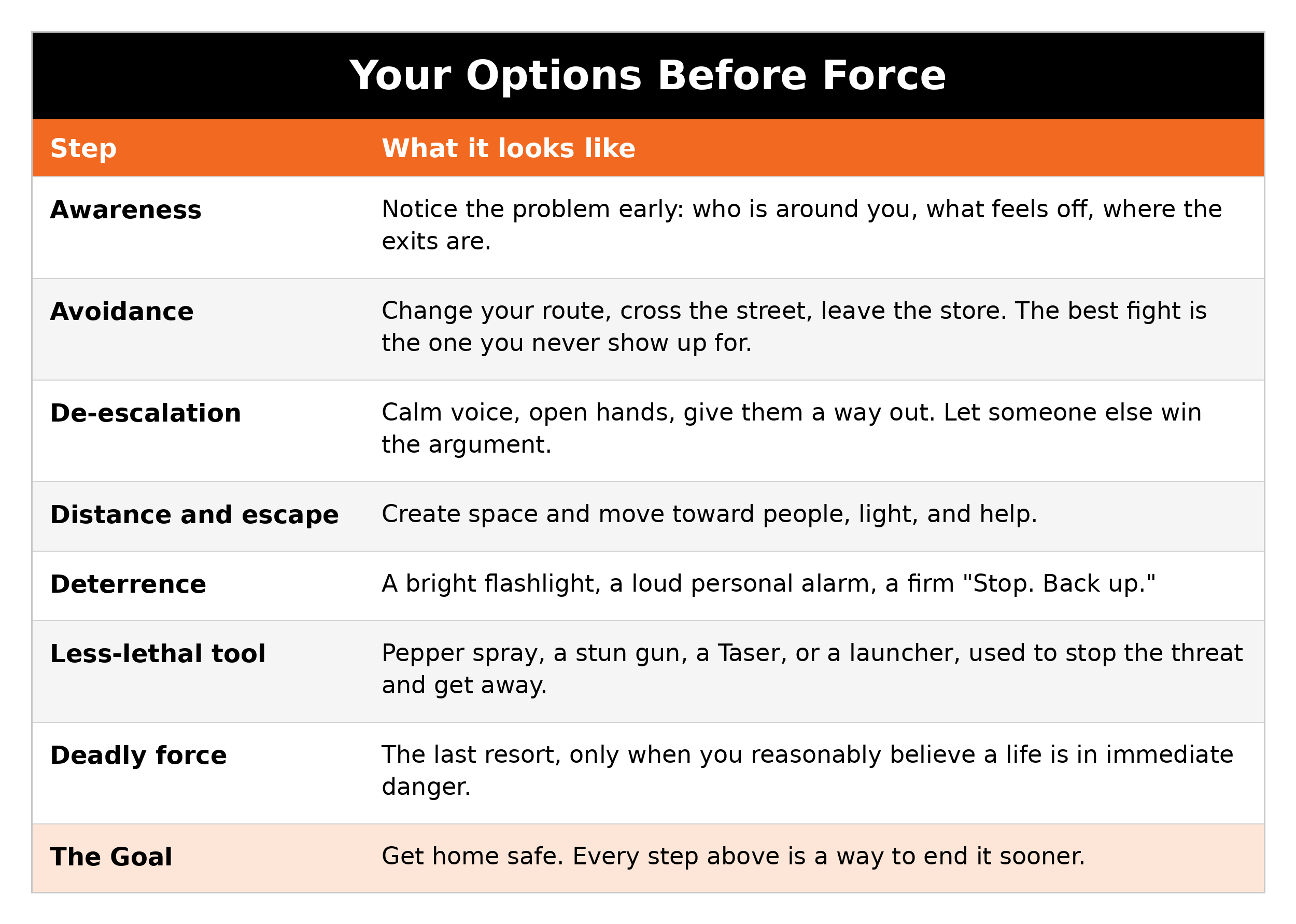
Notice where deadly force sits: at the very bottom, as the last resort. Everything above it is a way to end the situation sooner and get home to your family.
Use SCAN to Move Through Your Options
In my books, I teach a simple framework called SCAN. It's how you work your way down that ladder without freezing:
S - See your environment. Head up, phone down. Notice people, exits, and anything that feels out of place. This is the awareness step, and it's where most problems get solved.
C - Create space. Distance is your friend. Cross the street, step back, put a car or a shopping cart between you and the problem. Space buys you time, and time gives you options.
A - Act deliberately. Make a decision and commit to it: leave, use your voice, or reach for your tool. Don't wait to see what happens next.
N - Never doubt your gut feelings. If something feels wrong, it probably is. You don't need proof or permission to leave, say no, or get ready.
SCAN keeps you moving from awareness toward safety, and it's why the tools in this series are the last step, not the first.
Why Fewer Options Can Make You Faster
There's a principle called Hick's Law: the more choices you have, the longer it takes to make a decision. Under stress, that delay gets worse.
That's why I don't recommend loading your pockets and purse with every gadget on the market. Pick one or two tools that fit your life, carry them every day, and train with them until using them feels automatic. A pepper spray you've practiced with beats three tools you've never touched. Many of the tools in this series come with inert training versions, so you can practice safely at home.
"Less-Lethal," Not "Non-Lethal"
You'll hear these tools called "non-lethal," but "less-lethal" is the more honest term. Pepper spray, stun guns, Tasers, and launchers are designed to stop a threat without killing, but any of them can cause serious injury in the wrong circumstances. That's why they still need to be used only in true self-defense, and why the law looks at them seriously.
What's in This Series
Part 1: The Flashlight. The tool I recommend everyone carry, and how light affects your eyes and a threat's.
Part 2: How Pepper Spray Works and How to Choose One. OC strength, spray vs. gel, and which fits your life.
Part 3: Carrying and Using Pepper Spray. Where to carry it, how to practice, and what to do after you spray.
Part 4: Personal Alarms and Air Horns. Using noise to disrupt an attack and call for help.
Part 5: Stun Guns. How they work and their real limits.
Part 6: Tasers. Distance, darts, and why both have to hit.
Part 7: Pepper Ball Launchers. The Byrna and SABRE launchers.
Part 8: Laws and Travel. What's legal where you live and what you can fly with.
Part 9: Choosing the Right Tool. Matching the tool to the person and the situation.
Who These Tools Help Most
Less-lethal tools are especially valuable for the people we protect:
College students walking across campus at night
Runners, hikers, and dog walkers who spend time alone outdoors
Seniors who may not be able to run or fight back
Families at home who want options before a situation turns deadly
Anyone who can't or chooses not to carry a firearm
Rehearse It Before You Need It
Here's the hard truth: in a real ambush, there may be no time to reach any tool. That's why awareness and mental rehearsal matter more than any gear.
Make it a habit to run short "what if" scenarios during your day. Walking from your car to the grocery store, ask yourself: How would I react if someone approached me between two cars? What would I do if I were distracted loading groceries and someone came up behind me? Thinking it through ahead of time means you aren't starting from zero when it counts. The prepared protector doesn't wait for the emergency to decide what to do.
What to Say
Your voice is the first tool you always have. Use it before anything else:
To create space: "Stop. Back up."
To set a firm boundary: "I said no. Leave me alone."
To draw attention: "Get away from me!" (loud enough for others to hear)
A loud, clear command does two jobs: it tells the person you won't be an easy target, and it gets the attention of everyone around you.
Ask Yourself
If someone approached me tonight, what would I actually do first?
Do I carry one tool every day, and have I practiced with it?
Does everyone in my family, including my college student or aging parent, have an option that fits them?
Remember
Not every problem is a gun problem. SCAN your surroundings, use your voice, and let your tools help you create space and get home safe.
Get Started Today
[FREE DOWNLOAD: TBD. Suggested: Less-Lethal Tool Comparison, one page] [CTA: Comment or DM "KEYWORD" / or download it here: LINK]
Go Deeper
The Family Safety Toolkit. This series helps you choose the right tools. The Toolkit gives you 20 checklists covering every area of family safety and preparedness, from your home and vehicle to travel and your go bag, all for $19.99. [Get it here: https://www.preparednotparanoid.com/family-safety-toolkit]
The Family Emergency Preparedness Manual is coming soon.
Tools I recommend: The flashlights, pepper sprays, personal alarms, and other self-defense tools I recommend are in my Personal Safety Tools Amazon store. https://link.amazon/B0cVLeoJM
Related reading:
Less Than Lethal Self-Defense Options, Part 1: The Flashlight [LINK]
Less Than Lethal Self-Defense Options, Part 2: How Pepper Spray Works and How to Choose One [LINK]
Less Than Lethal Self-Defense Options, Part 9: Choosing the Right Tool [LINK]
References
Hick, W. E. "On the Rate of Gain of Information." Quarterly Journal of Experimental Psychology (1952).
Hyman, R. "Stimulus Information as a Determinant of Reaction Time." Journal of Experimental Psychology (1953).
U.S. Concealed Carry Association. Less-lethal self-defense weapons and terminology.
Disclaimer
These suggestions are intended to help you and your family build awareness, confidence, and safer decision-making habits. No safety plan, checklist, or tool can guarantee 100% protection. This article is for general informational purposes only and is not legal advice or a substitute for professional training. Use-of-force and self-defense laws vary by state and situation, so check your local laws and talk to a qualified attorney about your specific situation. Affiliate disclosure: I've linked to products from my Amazon store that I personally recommend. As an Amazon Associate, I earn from qualifying purchases, at no extra cost to you. Thank you for supporting my work.
If you are in immediate danger, get to safety and call 911.
Awareness gives you time. Time gives you options.
The prepared protector is someone who's decided that loving someone means being ready for them, not just hoping things go fine.
Prepared Not Paranoid. Protecting the Most Vulnerable Among Us.