Owning It Isn't the Same as Being Ready to Use It
By Larry Betz | Prepared Not Paranoid https://www.preparednotparanoid.com/
Most people who carry pepper spray have never actually sprayed it. It rides at the bottom of a purse or on a keychain for years, past its expiration date, and nobody has ever practiced opening the safety under stress. In Part 2, we covered how to choose the right spray. In this post, we'll cover how to use pepper spray: where to carry it, how to keep it working, how to practice, how to spray, and the most important part, your plan for what happens after.
Where to Carry It
A pepper spray you can't reach in two seconds is a pepper spray you don't have. Carry it where your hand can find it without looking:
In your hand when you're walking somewhere that feels risky, like a dark parking lot, a parking garage, or the walk from your car to your front door. This is the best place of all.
On a keychain or clip where your hand naturally falls, not buried in a bag.
On a hand strap if you run, hike, or walk the dog, so it's already in your hand.
In an outside pocket of your purse or backpack that you can open with one hand. The bottom of a purse is the worst place to carry it.
Keep it out of your car. This one matters for us here in Arizona. Pepper spray is a pressurized can. SABRE's own instructions say not to store it anywhere it may go above 120°F or below 32°F, and not to store it in your car, because extreme heat or cold can make the can leak or burst. A car parked in the summer sun gets far hotter than that. Carry it with you, and bring it inside.
Keep it away from small children. Store it up high or locked away at home, the same way you'd treat medication. To a little one, it can look like a toy.
Keep It Working
Check the expiration date on the canister. SABRE sprays and gels last about four years from the date they were made. After that, the pressure can drop, even if you've never used it.
Test-fire it about once a year. Go outside, with the wind at your back and nobody around, and give it a quick quarter-second burst toward the ground. You're checking for a steady stream with no sputtering or leaking.
Replace it after you use it in a real situation, after you test it if it sputters, or when it's expired. Pepper spray is cheap. Your safety isn't.
Practice Before You Need It
Under stress, you'll do what you've practiced, not what you meant to do. That's why I'm a big believer in inert training canisters. They spray water or a harmless liquid, so you can practice the real motions at home or in the backyard.
Practice these steps until they feel automatic:
Get it out from wherever you carry it.
Open the safety (the flip-top or twist lock) by feel, without looking.
Aim at a target's face.
Spray in short bursts.
Move off to the side and away.
Do it a few times a month. Practice from a walk, from your car door, and with your other hand too, in case you're holding a child, a bag, or keys.
Why Distance Matters: The 21-Foot Rule
Back in 1983, Sergeant Dennis Tueller tested how fast an attacker could close distance. His finding became known as the Tueller Drill: an average person can cover 21 feet in about 1.5 seconds.
Now think about your spray. Most pepper sprays reach about 8 to 12 feet, and gel reaches a little farther. That means if you wait until someone is close to start digging for your spray, you've already run out of time.
That's why the spray needs to be in your hand early, the moment something feels off. Getting it out doesn't mean you have to use it. It means you're ready. This is SCAN in action: See your environment, Create space, and Never doubt your gut feelings when something feels wrong.
How to Spray
If someone keeps coming after you've tried to leave and told them to stop:
Give a loud command first, if you can. "Stop! Back up!" It may stop them, and it tells everyone around you what's happening.
Aim for the face, especially the eyes. Sweep side to side across the eyes so a moving target still gets hit.
Use short bursts, about one second each, instead of emptying the can. Most small canisters have a limited number of bursts.
Move off to the side as you spray. Don't stand still, and don't walk forward into your own spray.
Watch the wind. If it's blowing toward you, gel or a stream is your friend. Spray and move out of the way.
Once the threat stops, you stop. Pepper spray is for defense, not punishment. Use only what you need, then leave.
Your Plan After You Spray
Spraying someone isn't the end of the situation. It's the start of your escape.
A Note From Larry
Remember, pepper spray is a tool. You still need a plan. Situational awareness is always your number one go-to. If you ever need to use this or any tool, ask yourself: what is my plan after I use it? Where will I go? Who will I call? In most situations, running might be your best option. The spray buys you a few seconds. Your plan is what gets you home.
Here's what that plan looks like:
Get away. Move toward people, light, and help: a store, a lobby, a busy street. Don't stay to see if it worked.
Call 911 as soon as you're safe.
Tell them what happened in a few clear words (see What to Say below).
Describe the person if you can: clothing, height, direction they went. If your spray had UV marking dye, tell the police.
Write down what happened as soon as you can, while it's fresh.
If you have questions about the legal side, talk to an attorney. Laws on self-defense vary by state.
What to Say
During the encounter: "Stop! Back up! Leave me alone!" (loud, so others hear)
To 911: "I was attacked. I used pepper spray to defend myself. I'm at [location]. I need police."
To anyone nearby: "That man attacked me. Please call 911."
Keep it short and simple. You're reporting that you were the one who was attacked.
If You Get Hit With It Too
It happens, especially in wind or close quarters. If you get pepper spray on yourself or a family member:
Don't rub your eyes. It spreads the oil and makes it worse.
Get to fresh air and face into the breeze.
Flush your eyes with cool water. Take out contact lenses.
Wash your skin with soap and water several times, then pat dry instead of rubbing.
Change your clothes and wash them separately.
Expect it to last about 30 minutes to several hours. It's miserable, but it passes.
Call Poison Control at 1-800-222-1222 for guidance, and call 911 if someone has serious trouble breathing, especially someone with asthma.
Put It All Together
Here's the whole plan on one page.
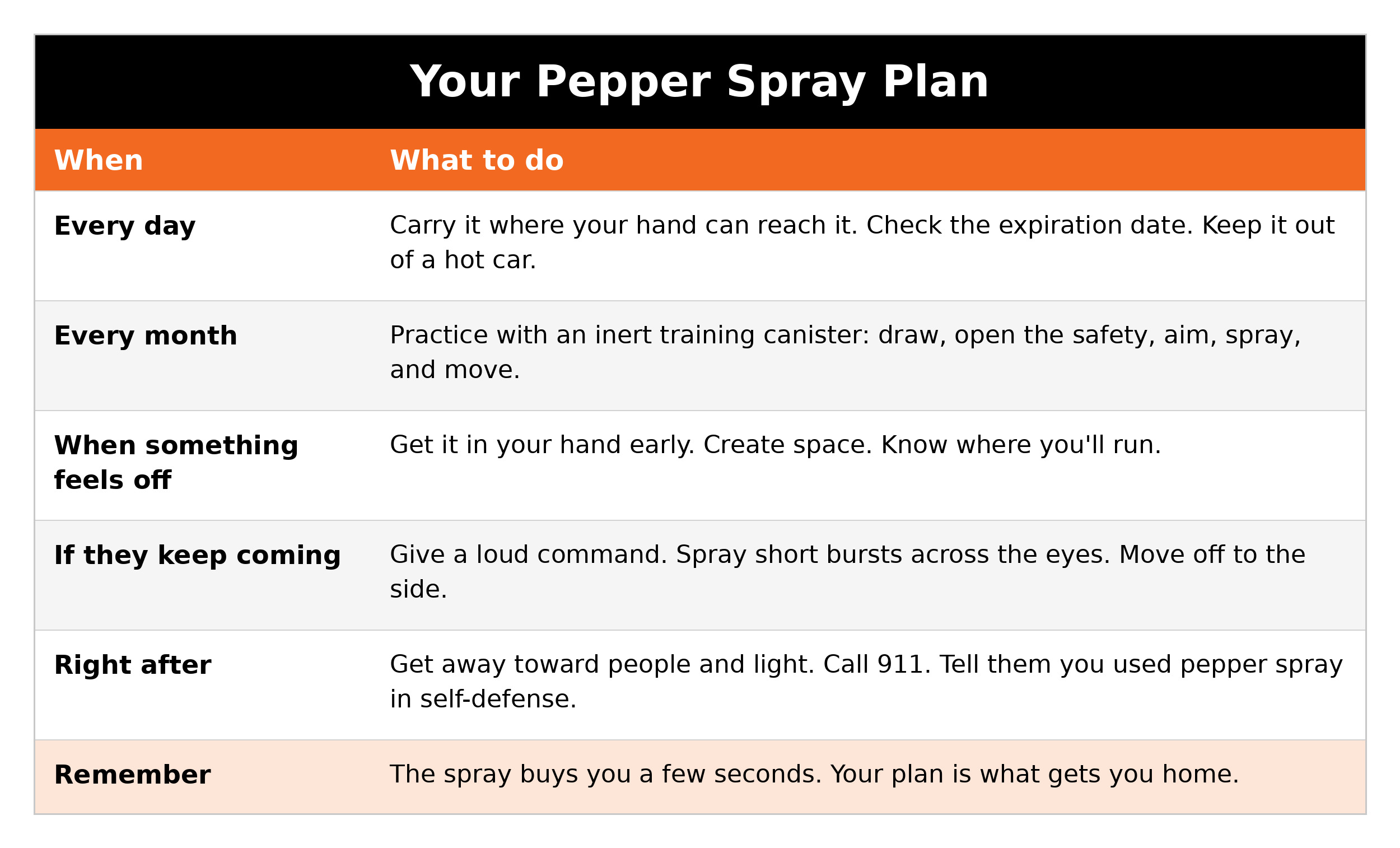
The prepared protector doesn't just buy the tool. They carry it, keep it working, practice with it, and know exactly what they'll do after they use it.
Ask Yourself
Could I get my pepper spray out and open the safety in two seconds without looking?
Is my spray expired, or sitting in a hot car right now?
If I had to use it tonight, where would I run, and who would I call?
Remember
Pepper spray buys you a few seconds. Your plan is what gets you home. Carry it where you can reach it, practice with an inert canister, get it in your hand early, spray, move, and get away.
Get Started Today
[FREE DOWNLOAD: TBD. Suggested: Less-Lethal Tool Comparison, one page] [CTA: Comment or DM "KEYWORD" / or download it here: LINK]
Go Deeper
The Family Safety Toolkit. This post gives you a plan for your pepper spray. The Toolkit gives you 20 checklists covering every area of family safety and preparedness, from personal safety and travel to your home and your go bag, all for $19.99. [Get it here: https://www.preparednotparanoid.com/family-safety-toolkit]
The Family Emergency Preparedness Manual is coming soon.
Tools I recommend: The pepper gels, sprays, and inert training canisters I recommend are in my Personal Safety Tools Amazon store. https://link.amazon/B0cVLeoJM
Related reading:
Less Than Lethal Self-Defense Options, Part 2: How Pepper Spray Works and How to Choose One [LINK]
Less Than Lethal Self-Defense Options, Part 4: Personal Alarms and Air Horns [LINK]
Less Than Lethal Self-Defense Options, Part 8: Laws and Travel [LINK]
References
SABRE. "How to Test Your Pepper Spray and Check the Expiration."
SABRE. Pepper spray product manual (storage temperatures and spray range).
Tueller, D. "How Close Is Too Close?" SWAT Magazine (1983).
Missouri Poison Center. Pepper spray exposure first aid.
Disclaimer
These suggestions are intended to help you and your family build awareness, confidence, and safer decision-making habits. No safety plan, checklist, or tool can guarantee 100% protection. This article is for general informational purposes only and is not legal advice, medical advice, or a substitute for professional training. Pepper spray laws vary by state, so check your local laws before you buy or carry. Use pepper spray only in true self-defense. Affiliate disclosure: I've linked to products from my Amazon store that I personally recommend. As an Amazon Associate, I earn from qualifying purchases, at no extra cost to you. Thank you for supporting my work.
If you are in immediate danger, get to safety and call 911.
Awareness gives you time. Time gives you options.
The prepared protector is someone who's decided that loving someone means being ready for them, not just hoping things go fine.
Prepared Not Paranoid. Protecting the Most Vulnerable Among Us.