Do You Know What You're Eating?
By Larry Betz | Prepared Not Paranoid https://www.preparednotparanoid.com/
Do you know what you are eating?
There have been significant advances in food preparation over the last century. Today, most of the shelf space in a typical supermarket is taken up by foods that are pre-packaged or prepared. They require little to no preparation before consumption. However, this convenience comes with a hidden cost. According to the CDC, 55 percent of the calories Americans eat now come from ultra-processed food, and for kids it's closer to two out of every three.
Many processed foods contain chemicals and additives that are either known to harm the human body or have been shown to cause adverse effects in laboratory animals. If these substances can harm animals in controlled studies, there's reason to believe they can harm humans as well, especially with regular exposure. The most concerning ingredients typically fall into three major categories: food additives, artificial sweeteners, and artificial colors. This series also goes beyond the kitchen, into the personal care products you put on your body, the chemicals that disrupt your hormones, and the microplastics that now turn up almost everywhere.
Increasingly, health experts and independent researchers agree: it's wise to minimize your exposure to synthetic chemicals in your food and household products. One of the most effective ways to reduce this exposure is by shopping primarily in the produce, dairy, and meat sections of your grocery store, areas where whole, minimally processed foods are more common. However, vigilance is still necessary. Harmful additives, antibiotics, and pesticide residues can still be found in conventionally produced meats, dairy products, and even some fruits and vegetables.
Whenever possible, choose organic, locally sourced, and pasture-raised options. But be aware: the label "Certified Organic" doesn't always mean what it used to. Many small, truly organic farms are being bought out by large food conglomerates (Big Agriculture), who often change production practices without publicizing it, while still using the organic label.
Stay vigilant. Know your farmer when you can. Question your labels. And stay informed, because what's allowed today might not be safe tomorrow.
The health of our nation is directly impacted by what we consume. The consumption of processed foods and additives contributes significantly to the healthcare system's burden as more people suffer from diseases related to poor dietary choices.
What's Changed Since This Series First Posted
"What's allowed today might not be safe tomorrow" turned out to be true faster than most people expected. Several chemicals on our original lists have been banned or are on their way out.
Here's where things stand as of October 2026.
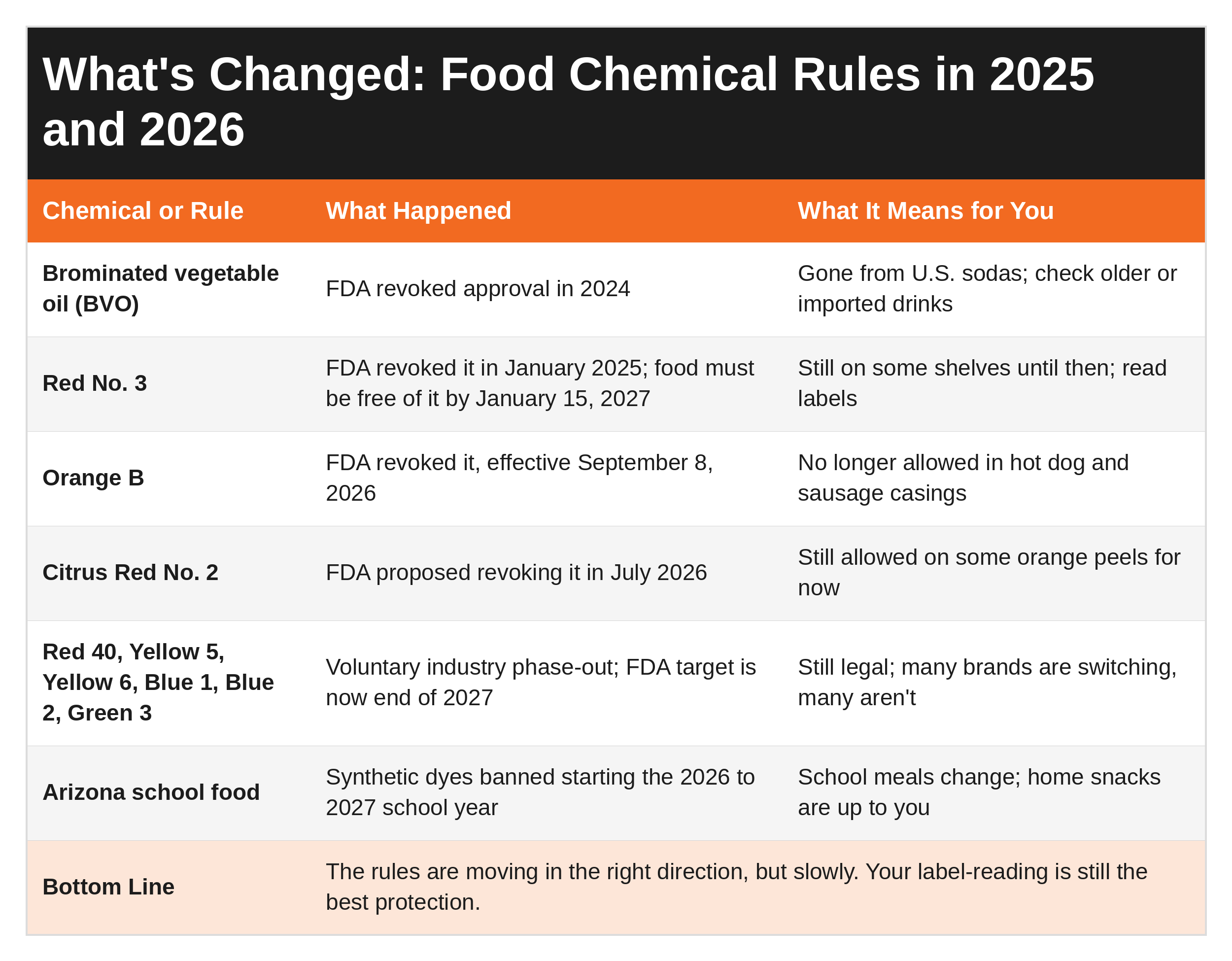
The takeaway: the rules are moving in the right direction, but slowly, and much of the change is voluntary. A dye that's "being phased out" is still legal and still on shelves. Your own label-reading is still your family's best protection.
Your Roadmap
This series started as five lessons. Food dyes and microplastics have changed so much that each now gets its own post.
Here's what's ahead.
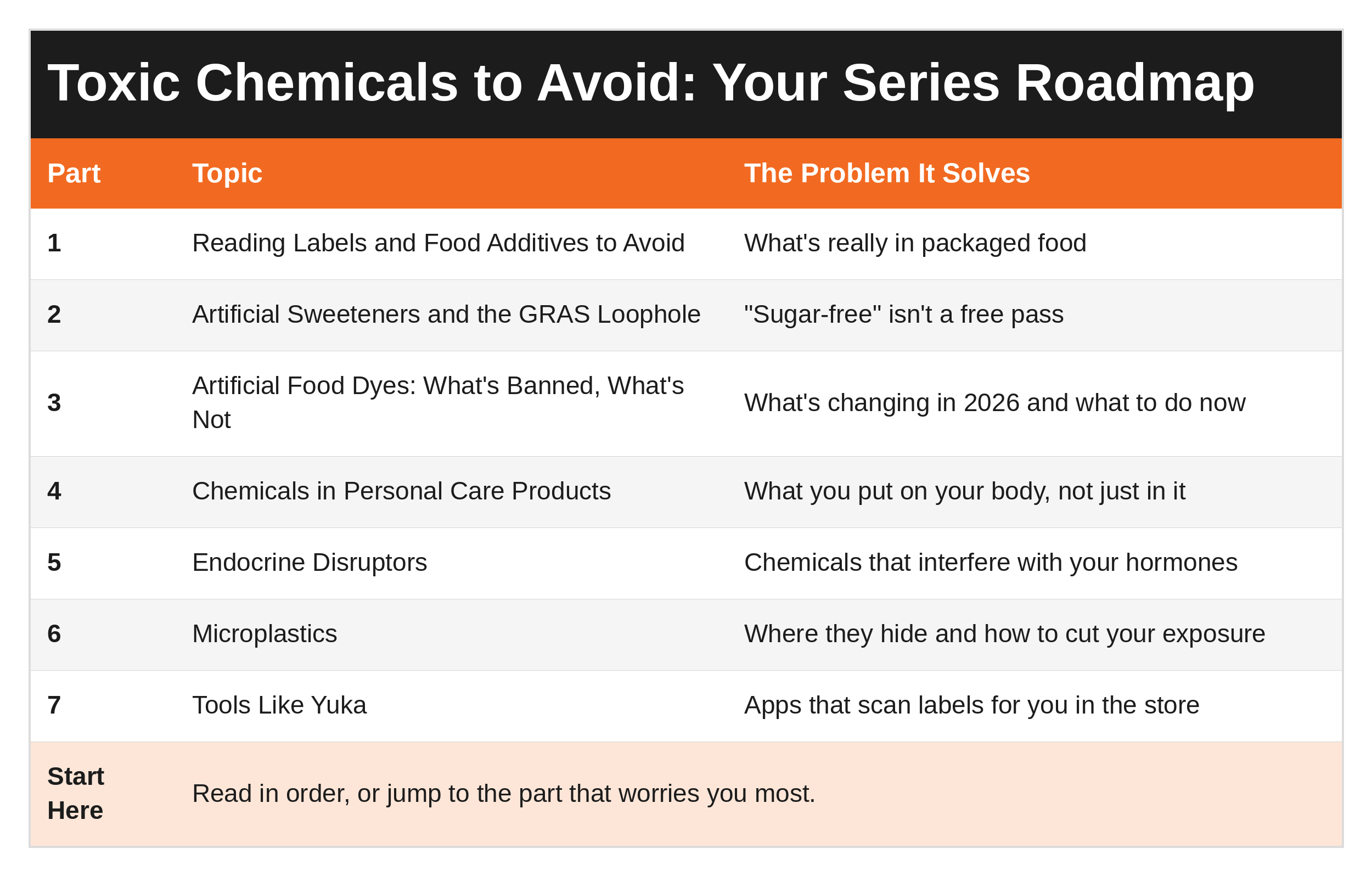
Part 1: Reading Labels and Food Additives to Avoid https://www.preparednotparanoid.com/pnp-library/toxic-chemicals-lesson-1
Part 2: Artificial Sweeteners and the GRAS Loophole https://www.preparednotparanoid.com/pnp-library/toxic-chemicals-lesson-1-9axkp
Part 3: Artificial Food Dyes: What's Banned, What's Not (coming soon)
Part 4: Chemicals in Personal Care Products https://www.preparednotparanoid.com/pnp-library/toxic-chemicals-lesson-1-9axkp-mxse9
Part 5: Endocrine Disruptors https://www.preparednotparanoid.com/pnp-library/toxic-chemicals-lesson-1-9axkp-mxse9-ekwcw
Part 6: Microplastics: Where They Hide and How to Cut Your Exposure (coming soon)
Part 7: Tools Like Yuka That Do the Work for You https://www.preparednotparanoid.com/pnp-library/toxic-chemicals-lesson-1-9axkp-mxse9-ekwcw-bdger
Why this matters for preparedness: in an emergency, you'll lean on packaged and shelf-stable food more than ever. Knowing which ingredients to leave on the shelf now means the pantry you build keeps your family healthy, not just fed.
Ask Yourself
How many of the foods in my pantry have ingredients I can't pronounce?
Do I know which dyes and additives are in the snacks my kids eat most?
Am I trusting the label on the front of the box, or reading the back?
Remember
You don't have to fear your grocery store. You just have to know what you're looking for. Read the label, shop the edges, and stay informed, because the rules keep changing.
Get Started Today
[FREE DOWNLOAD: TO BE CHOSEN AFTER THE BINDER REVIEW]
Go Deeper
The Prepared Not Paranoid Family Nutrition Guide. This series shows you what to watch for. The guide puts it all in one place: full chapters on food additives, artificial dyes, sweeteners, personal care products, endocrine disruptors, and microplastics, plus the "Ingredients to Avoid" wallet card and the One-Page Food Label Cheat Sheet for your next trip to the store. [Get it here: LINK]
Tools I recommend: The glass food storage, water filters, and cleaner household products I recommend are in my Amazon store. https://amzn.to/4yM747h
Related reading:
Nutrition Basics, Part 9: Ultra-Processed Foods https://www.preparednotparanoid.com/pnp-library/ultra-processed-foods
Nutrition Basics, Part 13: How to Read a Nutrition Facts Panel https://www.preparednotparanoid.com/pnp-library/nutrition-facts-label
Nutrition Basics, Part 14: Food Label Claims Decoded https://www.preparednotparanoid.com/pnp-library/nutrition-lesson-8
References
Centers for Disease Control and Prevention, National Center for Health Statistics. Ultra-processed Food Consumption in Youth and Adults: United States, August 2021 to August 2023. NCHS Data Brief No. 536, August 2025. https://www.cdc.gov/nchs/products/databriefs.htm
U.S. Food and Drug Administration. Brominated Vegetable Oil (BVO) final rule, July 2024.
U.S. Food and Drug Administration. FD&C Red No. 3 color additive listing revocation, January 2025.
RegBase. FDA Revokes Orange B and Moves on Citrus Red No. 2. Updated September 2026. https://regbase.com/analysis/orange-b-citrus-red-2-revocations/
Policy Canary. Red 40 (Allura Red) FDA Status 2026: Phase-Out, State Bans and Compliance. https://policycanary.io/ingredients/red-40
U.S. Department of Health and Human Services and FDA. Announcement on phasing out petroleum-based synthetic dyes, April 22, 2025.
Disclaimer
This article is for general informational and educational purposes only. It is not medical advice. If someone in your family has food allergies, sensitivities, or a medical condition, talk with your doctor about their diet. Affiliate disclosure: I've linked to products from my Amazon store that I personally recommend. As an Amazon Associate, I earn from qualifying purchases, at no extra cost to you. Thank you for supporting my work.
If someone has trouble breathing, swelling of the face or throat, or another severe reaction after eating, call 911.
Awareness gives you time. Time gives you options.
The prepared protector is someone who's decided that loving someone means being ready for them, not just hoping things go fine.
Prepared Not Paranoid. Protecting the Most Vulnerable Among Us.