The Protection Mindset Every Family Can Use
By Larry Betz | Prepared Not Paranoid https://www.preparednotparanoid.com/
Most families lock the front door, maybe put up a doorbell camera, and hope for the best. That's not a plan. That's a hope. This series shows you how to red cell your family: look at your home, your routines, and your online life the way someone with bad intentions would, so you can fix what they'd notice first.
When I was a Safety Director in the elevator industry, I never waited for an accident to tell me where the hazards were. I walked the job site looking for them. Where would someone trip? What would fail first? What would a tired mechanic skip at the end of a long shift?
You find the problem before it finds you.
Professional Protectors do the same thing, and they have a name for it. When they want to test a security plan, they look at it through the eyes of the person who wants to beat it. It's called red-celling.
This isn't about scaring you. It's about seeing what someone with bad intentions would see, so you get there first.
What Is Red-Celling?
Red-celling is the practice of thinking, planning, and testing like an adversary so you can spot your weaknesses before someone else does.
The question is simple:
"If someone wanted to hurt us, rob us, or scam us, how would they do it?"
If you can answer that question truthfully, you can usually take the steps to stop it.
Most families never ask it. They do a few of the obvious things and hope for the best. Hope isn't a plan. This question is where a plan starts.
Why It Works: Criminals Look for Easy
Most crime isn't a movie plot. It's a choice made by someone looking for the easiest opportunity with the lowest risk.
Researchers at the University of North Carolina at Charlotte surveyed 422 convicted burglars about how they chose their targets. About 83 percent said they would try to find out whether a home had an alarm before breaking in, and about 60 percent said an alarm would make them look for a different target.
Read that again.
They aren't looking for a house. They're looking for the easy house.
The same study found that about 41 percent said their burglaries were most often spur of the moment, and only about 12 percent said they typically planned them. Many of them decide in seconds, based on what they can see from the street.
That's good news for you. You don't have to build a fortress. You have to look like more trouble than you're worth. That's what red-celling helps you do.
How a Threat Picks a Target
Professional protectors study a pattern called the attack cycle. Whether it's a burglar, a scammer, or a predator, the steps look a lot alike:
Pick a target: someone or something that looks easy or valuable
Watch: learn routines, habits, and weak spots
Plan: choose the time and the method
Act
Get away
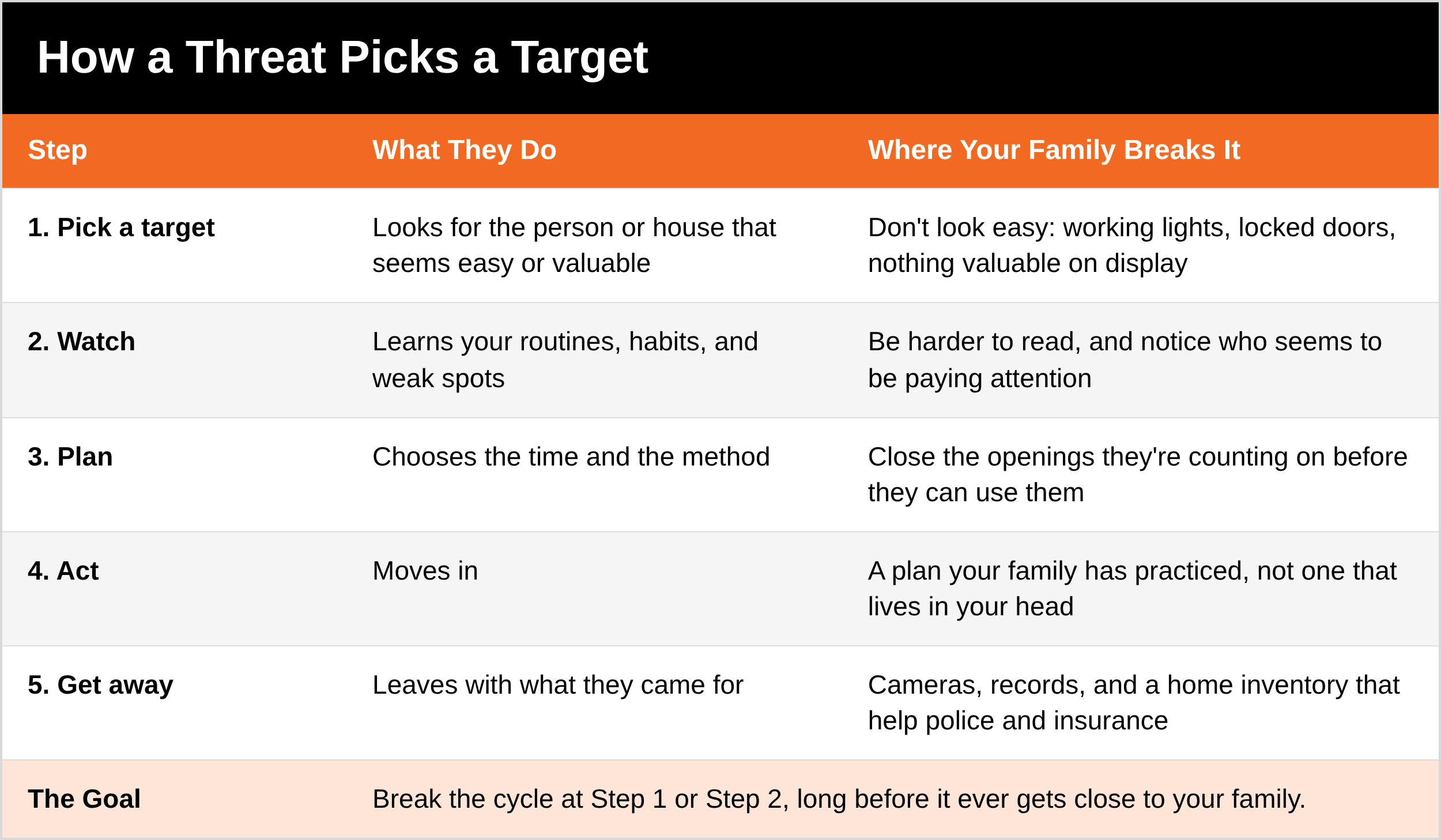
Here's what matters for your family. The impulsive threat decides at Step 1, based on what looks easy right now. The patient threat spends time at Step 2, and watching leaves clues. If your home doesn't look easy, and your patterns are hard to read, you've broken the cycle before it starts.
If you want to go deeper on how this cycle works, I break it down in [The Hostile Planning Cycle: LINK].
How to Red Cell Your Family: The Rules
This is a defensive exercise.
Keep it that way.
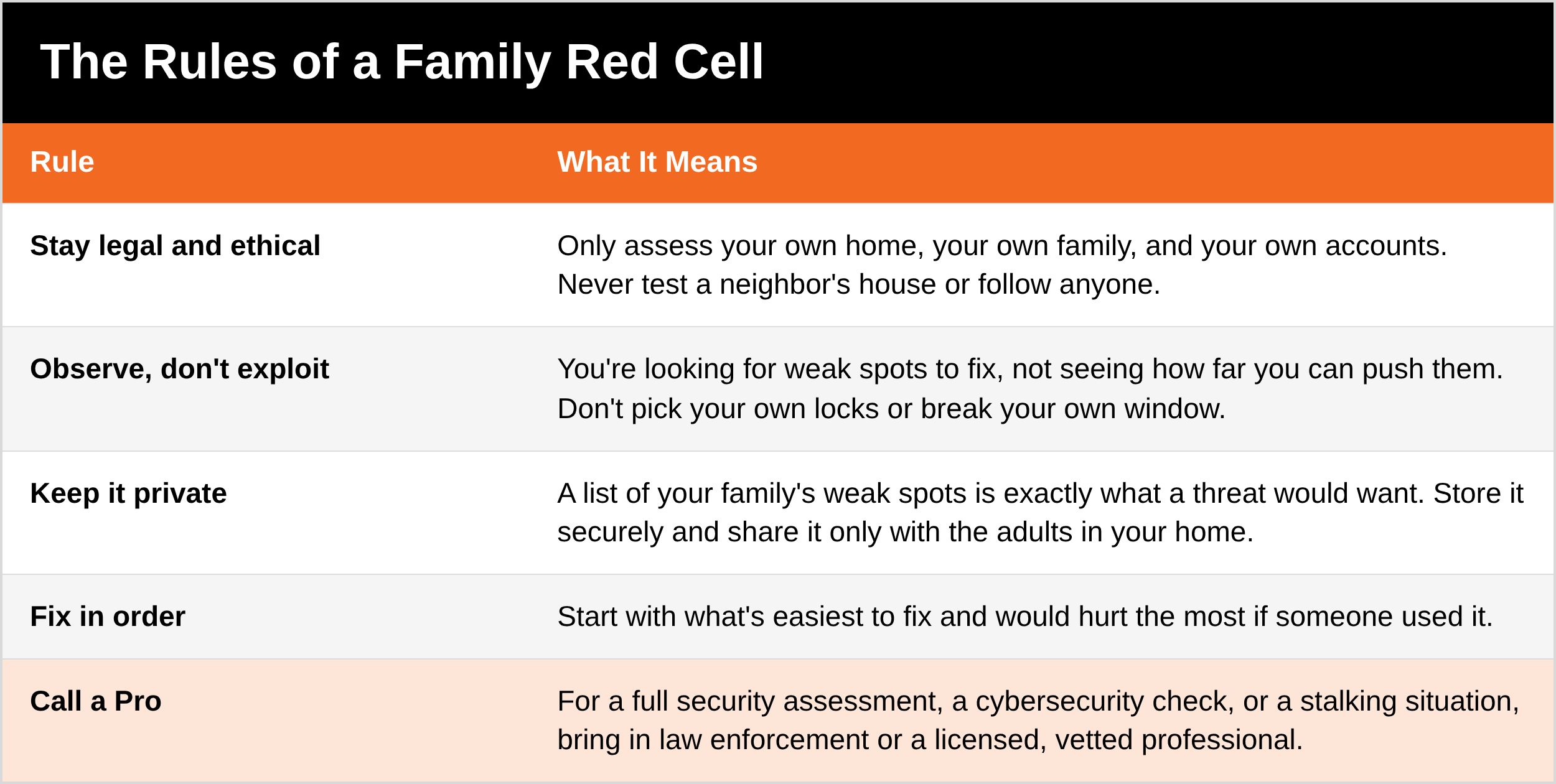
The rule people skip most is keeping it private. A written list of every weak spot in your home and routine is exactly what a threat would want. Don't leave it on the kitchen counter or in a shared note on the family tablet.
The Mindset: A Hard Target, Not a Fortress
When I teach firearms, I tell my students the goal is to never have to use one. If home defense is your priority, make your home a hard target so nobody picks it in the first place.
Red-celling is the same idea applied to your whole life. It isn't about suspecting everyone. It's about awareness.
The Prepared Protector doesn't wait for something to go wrong to find the weak spots. They go looking for them first, calmly, the same way a good safety director walks a job site before anyone gets hurt.
I teach a simple framework called SCAN in Navigating the Red Zone and Beyond, and it fits here too:
S: See your environment. Look at your home and habits the way a stranger would.
C: Create space. Put distance and barriers between your family and the easy opportunities.
A: Act deliberately. Fix what you find, in order of what matters most.
N: Never doubt your gut feelings. If something about your routine or your street feels off, it's worth a closer look.
What to Say
Red-celling works best when the whole family is in on it. The way you bring it up matters, especially with kids.
To your spouse or another adult in the house: "I'm not worried about anything specific. I just want us to look at our house and our habits the way a stranger would, and fix the easy stuff first."
To your kids: "This week we're going to be detectives on our own house. We're looking for anything we'd want to fix. You might spot something I miss."
Kids are often better at this than adults. They notice the side gate that never latches and the window nobody ever locks.
Ask Yourself
If someone watched our house for one week, what would they learn?
What's the one weak spot I already know about but haven't fixed?
Does everyone in my family know what to do if something goes wrong, or is it all in my head?
5 Quick Wins You Can Start Today
Ask the red cell question at dinner tonight. "If someone wanted to rob us or scam us, how would they do it?" Write down every answer.
Stand across the street for five minutes after dark. What looks easy? What can you see through the windows?
Write down the one weak spot you already know about, and put a date next to it for when it gets fixed this week.
Pick a private place for your findings, like a locked drawer or a password-protected file, before you start writing things down.
Take the free Red Cell Family Audit (below) so you know exactly where to focus as you read this series.
Remember: You don't need to be the strongest house on the block. You need to be the one that isn't worth the trouble.
What's Coming in This Series
Over seven parts, we'll red cell every part of your family's life:
Think Like the Threat (you're here)
Find Your Family's Tells: what your daily routine gives away
Red Cell Your House: your home through a burglar's eyes
Red Cell Your Digital Life: what the internet says about your family
Red Cell Your Circle: kids, schools, visitors, neighbors, and well-meaning relatives
Train Your Team: drills, code words, and what to do when it counts
Just in Case: turning what you found into a plan, and being ready to recover
Coming Up in Part 2
Find Your Family's Tells. Your routine is talking. We'll look at what it's saying, and who might be listening.
Get Started Today
Before you read Part 2, take my free Red Cell Family Audit. It's 74 yes-or-no questions across 8 areas of your family's life, from your routines and your house to your digital life, your circle, and your plan. It takes about 30 minutes, and your score shows you exactly where to focus as you read the rest of this series.
DM the word REDCELL on Instagram or Facebook and I'll send it to you. [Get it here: LINK]
Go Deeper
Red-celling starts with awareness: reading your environment, noticing what's out of place, and making calm decisions before you're under pressure. That's the foundation of my book Situational Awareness and Safe Family Travel Strategies. This post shows you how to start thinking like the threat. The book teaches you how to read your surroundings, stop being predictable, and spot trouble early, at home and on the road. [Get the book here: https://store.bookbaby.com/book/situational-awareness-and-safe-family-travel-strategies]
When you're ready to turn what you find into action, The Family Safety Toolkit gives you 20 ready-to-use checklists for your home, your kids, your parents, and your travel, including the Home Security Audit. [Get it here: LINK]
Tools I recommend: The locks, lights, and cameras I recommend for making your home a harder target are in my Amazon home store: https://link.amazon/B0g2prCgN
The Full Series
Part 1: Think Like the Threat (you're here)
Part 2: Find Your Family's Tells [LINK]
Part 3: Red Cell Your House [LINK]
Part 4: Red Cell Your Digital Life [LINK]
Part 5: Red Cell Your Circle [LINK]
Part 6: Train Your Team [LINK]
Part 7: Just in Case [LINK]
Related Reading
The Hostile Planning Cycle [LINK]
Situational Awareness, Part 1 [LINK]
Situational Awareness, Part 3: Awareness, Movement, and Vulnerability [LINK]
Situational Awareness, Part 6: Pre-Attack Indicators [LINK]
The Safest House on the Block, Part 2: How Criminals Pick a Home [LINK]
References
Kuhns, J. B., Blevins, K. R., and Lee, S. (2012). Understanding Decisions to Burglarize from the Offender's Perspective. University of North Carolina at Charlotte, Department of Criminal Justice and Criminology. Funded by the Alarm Industry Research and Educational Foundation. Summary: https://inside.charlotte.edu/news-features/2013-05-15/through-eyes-burglar-study-provides-insights-habits-and-motivations
Full report (hosted by SIAC): https://siacinc.org/wp-content/uploads/2022/04/Burglar-Survey-Study-Final-Report.pdf
Security Magazine. (2013). Study Says Convicted Burglars Confirm Value of Alarms, Other Deterrents. https://securitymagazine.com/articles/84343-study-says-convicted-burglars-confirm-value-of-alarms-other-deterrents
Betz, L. Navigating the Red Zone and Beyond (SCAN framework).
Disclaimer
These suggestions are intended to help you and your family build awareness, confidence, and safer decision-making habits. No safety plan, checklist, or training can guarantee 100% protection. There will always be people who try to exploit vulnerability, opportunity, trust, or positions of power. The goal is not to create fear, but to help guide families toward more informed, prepared, and practical safety decisions in everyday life. This article is not a substitute for a professional security assessment, legal advice, or law enforcement guidance. Only assess property and accounts you own or have permission to evaluate. Laws and rules vary, so check your state and county for the exact rules where you live. As an Amazon Associate, I earn from qualifying purchases.
If you believe your family is being watched or targeted, contact your local police. If you are in immediate danger, call 911.
Awareness gives you time. Time gives you options.
The Prepared Protector is someone who's decided that loving someone means being ready for them, not just hoping things go fine.
Prepared Not Paranoid. Protecting the Most Vulnerable Among Us.