How to Be a Hard Target, and What to Do If It Happens With Your Kids in the Car
By Larry Betz | Prepared Not Paranoid https://www.preparednotparanoid.com/
Carjacking is one of the most frightening crimes a driver can face. It isn't just a stolen car. It's a violent, often armed confrontation that can happen in seconds. Knowing the carjacking warning signs gives you those seconds back. This post shows you what to watch for, where it happens, and how to handle it if it ever happens with your family in the car.
Personally, I can't imagine the horror of being stopped at a red light and suddenly having a gun pointed at my head, or walking with my wife through a parking garage and being ambushed for our car. That's why I teach this.
The Good News and the Real Risk
Here's the honest picture. According to the Bureau of Justice Statistics, carjacking fell 78% from 1995 to 2021. Then it spiked. The Council on Criminal Justice found that carjackings in a sample of large cities nearly doubled from 2019 to 2023. Since then, the numbers have dropped sharply again, down 61% since 2023 in the Council's latest city sample.
So your personal risk is low, and lower than it was a few years ago. But carjacking is still a crime with a person sitting in the car, often with a weapon, and often with kids in the back seat. The right habits cost you almost nothing, and they can make all the difference.
Think Like a Hard Target
Criminals aren't looking for a challenge. They want an easy mark that doesn't put them at risk of getting hurt or caught. Your job is to look like more trouble than you're worth.
Doors locked, windows up. A carjacker wants easy access. He's much more likely to pick the convertible with the top down in the next lane.
Look aware. Phones, loud music, eating, putting on makeup: anything that pulls your attention makes you look like an easy target. An aware driver is a harder one.
Leave yourself an out. When you stop behind another car, leave enough room to see its rear tires touching the road. A car pinned in by traffic is a sitting duck, and criminals know it.
The Warning Signs
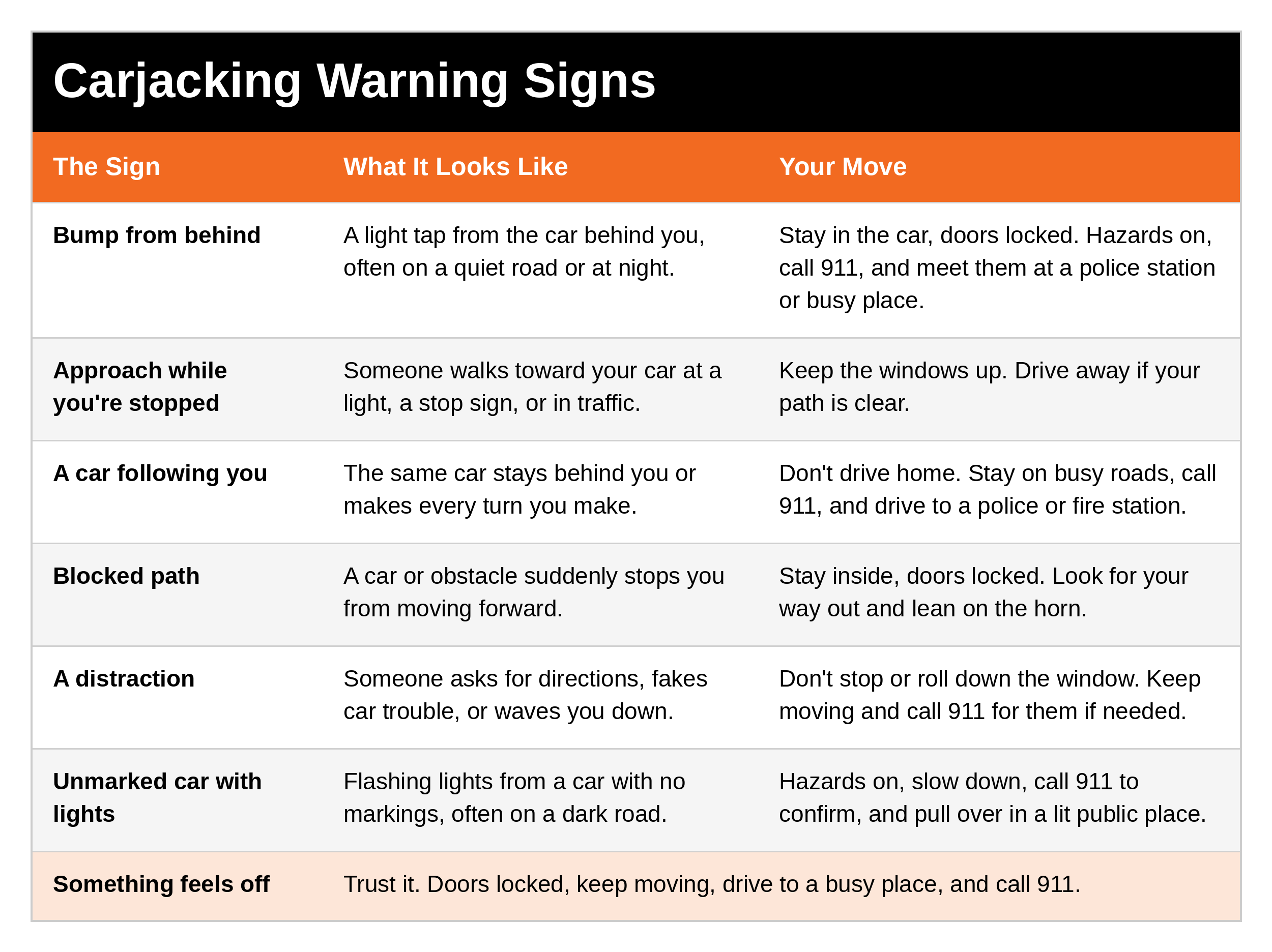
Most carjackings start with a setup: something that gets you to stop, open the door, or get out.
Here's what to watch for, and your move for each one.
The Bump From Behind
One of the most common tricks is a light bump from behind to get you to stop and get out to check the damage. If it doesn't feel right, stay in the car with the doors locked. Turn on your hazards, call 911, and tell them you'll meet the other driver at a police station or a busy, well-lit place.
When an Unmarked Car Turns On Its Lights
Police impersonators are real. If an unmarked car with flashing lights tries to pull you over and something doesn't feel right:
Turn on your hazards so they know you're cooperating.
Slow down, move to the right lane, and drive at or below the speed limit.
Call 911. Tell the dispatcher where you are and ask them to confirm it's a real officer.
Pull over in a well-lit, public place, like a gas station or a shopping center.
To do this, you have to know where you are. Road, direction, last exit or cross street. (Rules on unmarked cars vary, so check your state and county.)
Where Carjackings Happen
Carjackings can happen almost anywhere, but some places are higher risk because you're stopped, distracted, or getting in and out of the car.
Here are the spots to watch.
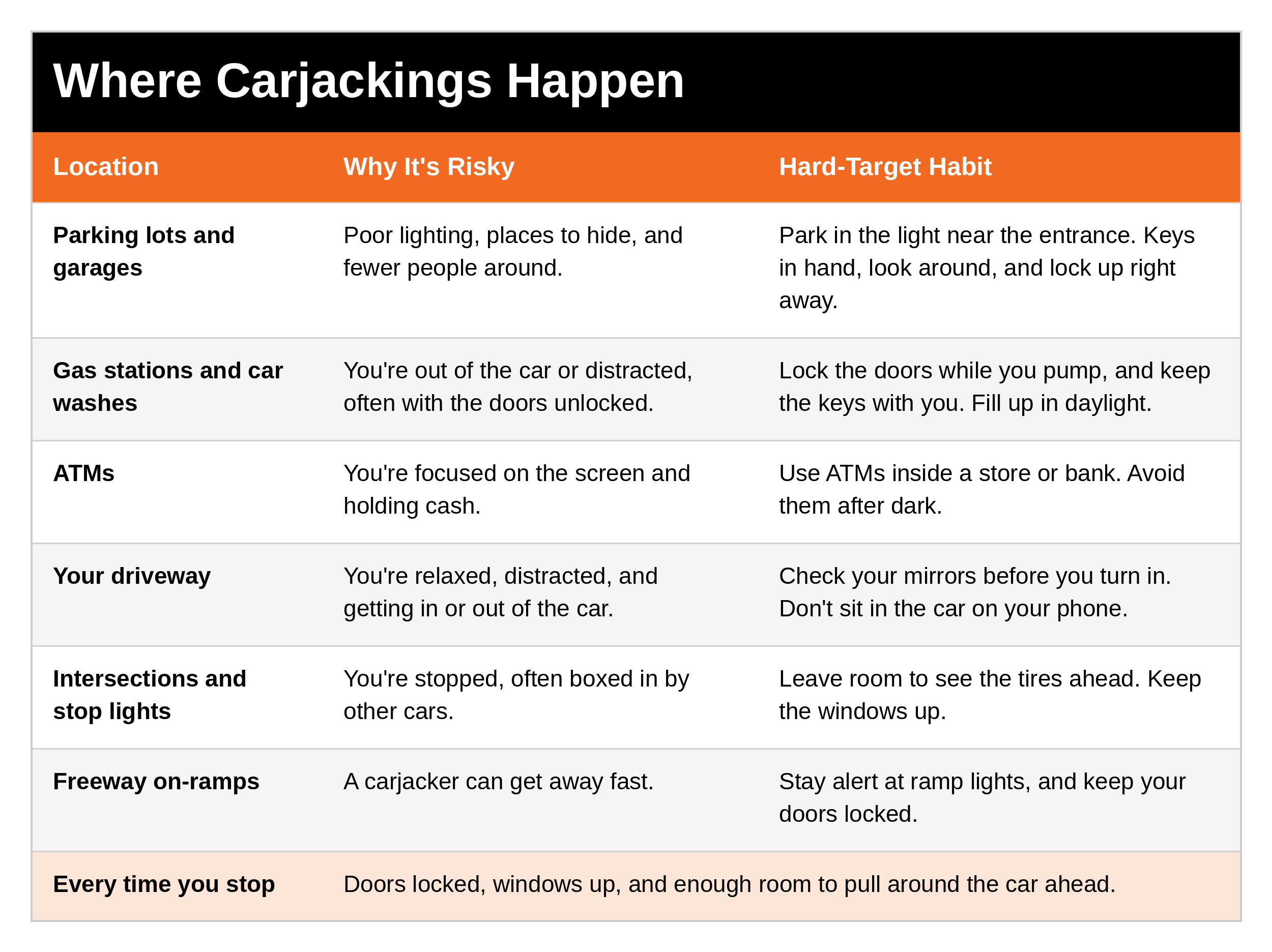
Some areas carry more risk than others. You can check crime reports for your area at CrimeMapping.com, though not every police department reports there.
The Two Places People Forget
If You Think You're Being Followed Home
Don't drive home. Stay calm and make a few extra turns on well-lit, busy roads to see if the car stays with you. If it does, drive to a police station, fire station, or a busy 24-hour business. Call 911 on the way and give your location and a description of the car. Keep your doors locked and don't stop until you feel safe.
Trust your instincts. If something feels off, it probably is.
If You're Blocked In Your Driveway
You pull into your driveway and a car pulls in right behind you. Stay in the car with the doors locked. Don't get out. Lean on the horn to draw attention and call 911 with your address and a description of the car. If you can safely reverse or drive over the curb to get out, be ready to do it.
Your driveway is a transition zone. Look in your mirrors before you turn in, and don't sit in the car on your phone once you're parked.
If It Happens With Your Kids in the Car
This is the scenario every parent fears, so let's talk about it plainly.
If someone with a weapon demands your car, give them the car. Your car can be replaced. You and your family can't. Most carjackers want the vehicle and want to get away fast. The Council on Criminal Justice reports that about 70% of carjackings involve no injury.
But your kids are not part of the deal.
Keep your hands where they can see them. Move slowly.
Tell them right away: "My child is in the back. I'm getting my child out."
Get the kids out, and get them away from the car. If your hands are full, an older child can unbuckle and climb out the side away from the carjacker.
Let the car go. Then get to safety and call 911.
Talk this through with your older kids once, calmly, like a fire drill. When kids know what to do, they're less scared.
A Note for Those Who Carry
If you carry a firearm, the car is not worth a gunfight. Your goal is to get your family out and get away, not to protect property. The same rule from Part 1 applies: escape, not engagement. Laws on use of force vary a lot, so check the exact laws in your state and county, and get proper training. This note is education only, not legal advice.
Play the "What If" Game
Everything starts with a scenario. While you run your everyday errands, ask yourself: "What if?" Stopped at a light, boxed in front and back, could you get out? Someone walks up to your car in a parking lot, which way would you go?
The more you rehearse it in your head, the more your habits change, and the faster you'll move if you ever need to.
What to Say
Safe and non-engaging
Say nothing. Keep the doors locked, the windows up, and keep moving.
To someone at your window: no response. Eyes forward. Drive away if your path is clear.
Setting boundaries
Through the closed window, loud: "Back away from the car."
To 911: "I think I'm being followed. I'm on [road], heading [direction], near [cross street]. It's a [color, make, model]."
If they persist
If they have a weapon: "Take it. My child is in the back. I'm getting my child out."
Hands visible, move slowly, get the kids out and away, then call 911.
SCAN It
S, See your environment: Check your mirrors, look around before you stop or get out, and notice anyone lingering near your car.
C, Create space: Leave room to see the tires ahead, and park where you can pull straight out.
A, Act deliberately: Keys in hand before you reach the car, doors locked as soon as you're in, and drive away when something isn't right.
N, Never doubt your gut feelings: If a bump, a stranger, or a car behind you feels wrong, don't wait to find out.
5 Quick Wins You Can Start Today
Lock the doors as soon as you get in. Before the seatbelt, before the phone.
See the tires. Leave room to pull around the car ahead at every stop.
Get organized before you walk out of the store, not next to your open car.
Look in your mirrors before you turn into your driveway.
Tell your kids the plan: "If anyone ever tries to take our car, we get out together and let it go."
Ask Yourself
Do I sit in parked cars on my phone with the doors unlocked?
If someone bumped me from behind on a quiet road tonight, would I get out?
Do my kids know what to do if a stranger ever demands our car?
Remember
A carjacker is looking for an easy target: distracted, unlocked, and boxed in. Be the opposite.
And if the worst ever happens, remember what matters. The car is just a car. Your family is everything.
The Prepared Protector is someone who's decided that loving someone means being ready for them, not just hoping things go fine. On the road, that means locked doors, room to move, and a plan your whole family knows.
Get Started Today
Get the free Travel Safety checklists. Simple, practical checklists for safer family trips, including the Rental Car Checklist. DM the word [KEYWORD] on Instagram or Facebook and I'll send them to you. [Get them here: LINK]
Go Deeper
Situational Awareness and Safe Family Travel Strategies. This post gives you the warning signs and the habits. The book shows you how criminals choose who to approach, more than 40 pre-event indicators, how to use your vehicle for cover if you ever have to get out, and protective strategies for parking lots, hotels and Airbnbs, family travel, and traveling overseas. [Get it here: https://store.bookbaby.com/book/situational-awareness-and-safe-family-travel-strategies]
Tools I recommend: The travel and vehicle safety gear I recommend is in my Travel Safety Amazon store. https://link.amazon/B023guhPk
Related reading:
Safe Family Travel, Part 1: Vehicle Safety and Road Rage [LINK]
Safe Family Travel, Part 2: Driving in Bad Weather and Road Hazards [LINK]
Situational Awareness, Part 7: De-Escalation [LINK]
Safe Family Travel, Part 4: Protective Strategies for Family Travel [LINK when posted]
References
Bureau of Justice Statistics. (2022). Carjacking Victimization, 1995 to 2021 (NCJ 305204). https://bjs.ojp.gov/carjacking-victimization-1995-2021
Council on Criminal Justice. (2024). Trends in Carjacking: What You Need to Know. https://counciloncj.org/trends-in-carjacking-what-you-need-to-know/
Council on Criminal Justice. (2026). Crime Trends in U.S. Cities: Year-End 2025 Update.
Police department guidance on unmarked police vehicles and police impersonators (for example, Montgomery County, MD Police).
Betz, L. Situational Awareness and Safe Family Travel Strategies (Lesson 2: Carjacking Indicators and Prevention).
Betz, L. Navigating the Red Zone and Beyond (SCAN framework).
Disclaimer
This article is for general informational and educational purposes only. It is not a guarantee of safety and is not a substitute for professional self-defense or firearms training, legal advice, or law enforcement guidance. Laws vary by state and county, so always check the exact laws where you live and travel. No behavior can prevent every crime, and responsibility for violence always belongs to the offender. Prepared Not Paranoid and Larry Betz are not responsible for the content of third-party websites or resources linked here. Affiliate disclosure: I've linked to products from my Amazon store that I personally recommend. As an Amazon Associate, I earn from qualifying purchases, at no extra cost to you. Thank you for supporting my work.
If you're in danger right now, get to a safe place and call 911.
Awareness gives you time. Time gives you options.
The Prepared Protector is someone who's decided that loving someone means being ready for them, not just hoping things go fine.
Prepared Not Paranoid. Protecting the Most Vulnerable Among Us.