You Can't Control the Weather. You Can Control How Ready You Are.
By Larry Betz | Prepared Not Paranoid https://www.preparednotparanoid.com/
Driving in bad weather with your family in the car is one of the most common risks you'll ever face on the road. You can't control the weather, but you can control how ready you are and how you respond. This post gives you the first moves that matter most.
In Part 1, the danger came from other drivers. This time, it comes from the road itself. Most of these situations follow the same rule: don't push through. Slow down, get to a safe place, and wait it out.
Check Before You Go
The best way to handle a storm on the road is to not be on the road when it hits. Ten minutes before you leave can save you hours, or much more.
Here's the quick version.
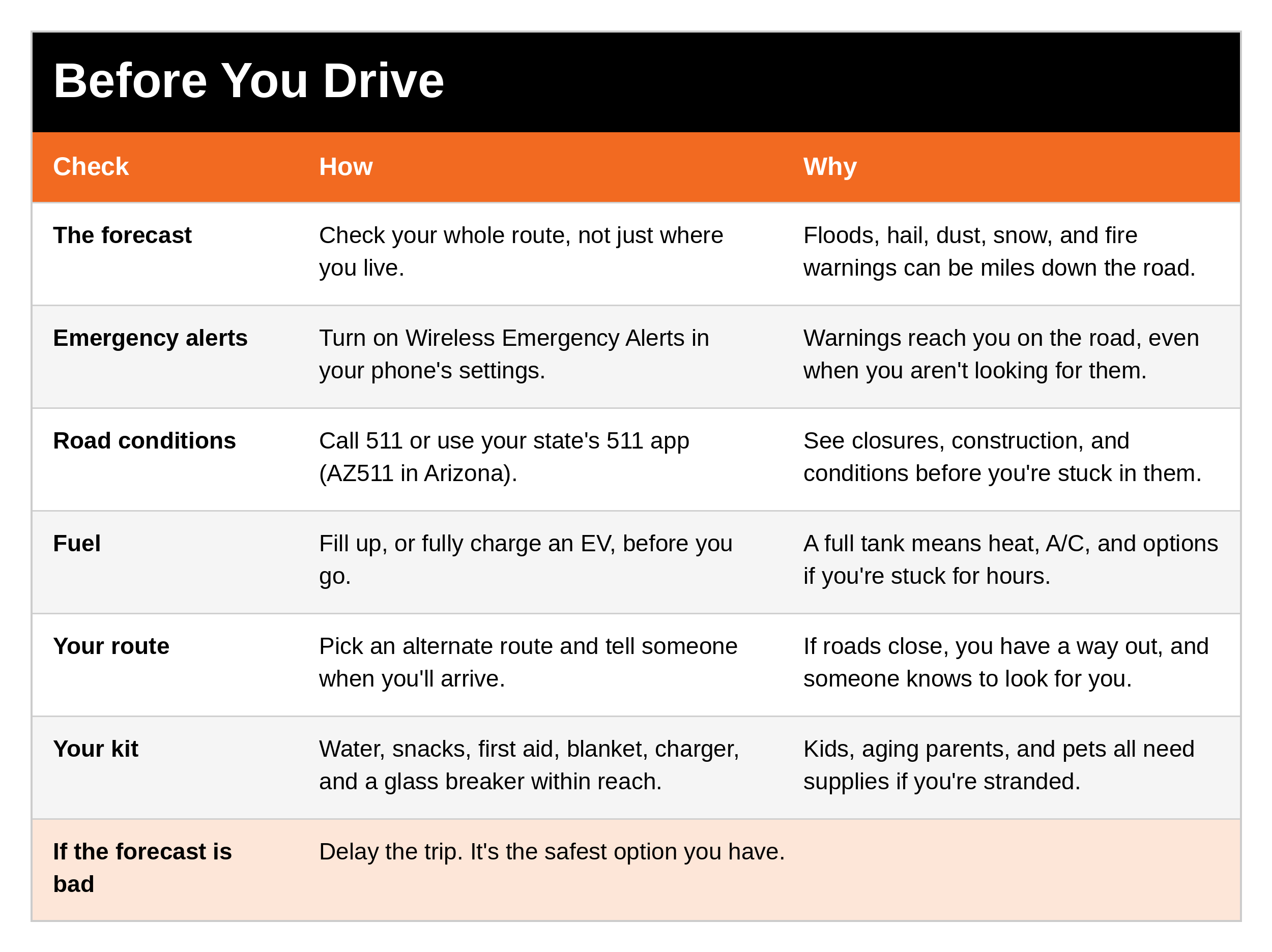
If the forecast is bad, delay the trip. It's the safest option you have, and the one most people skip.
If You Get Caught In It
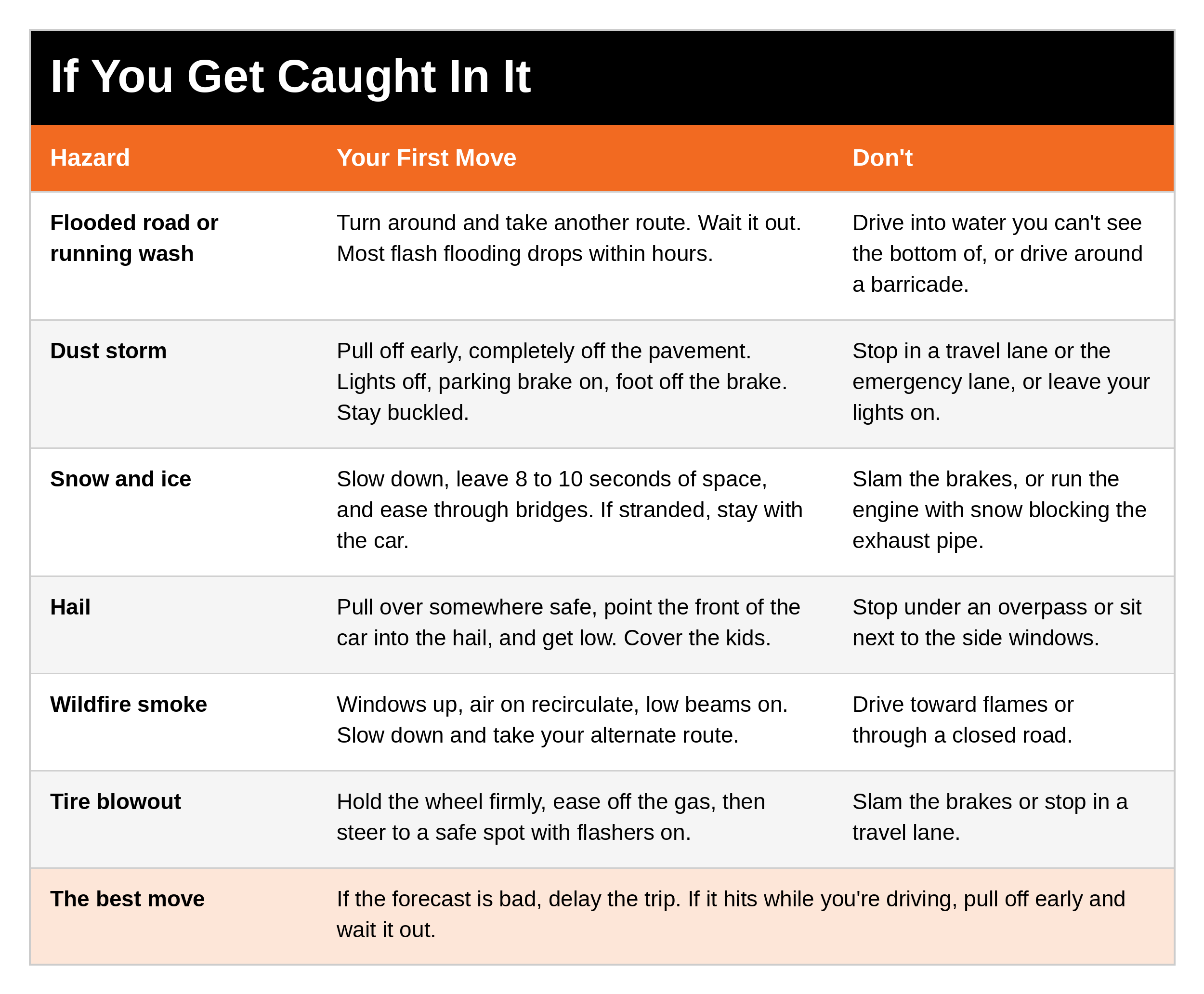
Sometimes the weather changes faster than the forecast. These are the five hazards families run into most.
Here's your first move for each one.
Flooding: Turn Around, Don't Drown
Water is far stronger than it looks. According to the National Weather Service, just 12 inches of rushing water can carry away most cars, and 2 feet can carry away SUVs and trucks. You can't see how deep it is, how fast it's moving, or whether the road is still there underneath.
Never drive through a flooded road or around a barricade. In the desert Southwest, a dry wash can turn into a river in minutes, even when it isn't raining where you are. Arizona's "Stupid Motorist Law" can even bill you up to $2,000 for your own rescue. Check the laws in your state and county, but your family is the real reason to turn around.
Dust Storms: Pull Aside, Stay Alive
The Arizona Department of Transportation (ADOT) teaches a simple rule for dust storms. Pull off early, before you can't see, and get completely off the pavement. Then turn off all your lights, set the parking brake, and take your foot off the brake pedal. If your lights are on, drivers behind you may follow them straight into your car. Stay buckled and wait it out. Most dust storms pass in 15 to 30 minutes.
Snow and Ice: Slow Down, Add Distance
Slow down before bridges and overpasses, because they freeze first. Give yourself much more room: at least 8 to 10 seconds behind the car ahead on snow and ice. If you get stranded, stay with your vehicle. Run the engine about 10 minutes an hour for heat, and keep the exhaust pipe clear of snow so carbon monoxide doesn't build up inside.
Hail: Point Your Windshield Into It
Your windshield is the strongest glass in your car. Your side windows usually aren't. If you get caught in hail, pull over somewhere safe (not under an overpass, where you'll block traffic), point the front of the car into the hail, and get low and away from the side windows. Cover your kids with a blanket or coat.
Wildfire Smoke: Recirculate and Reroute
Close the windows, set the air to recirculate, use your low beams, and leave more room. Never drive toward visible flames or through a closed road. If it gets worse ahead, take your alternate route. That's why you planned one.
When the Car Fails, Not the Weather
Sometimes the problem is the car. For a tire blowout, and almost every other failure, the rule is the same: steer first, slow down second, stop somewhere safe third.
Hold the wheel firmly with both hands. The car will pull toward the blown tire. Correct smoothly, not hard.
Don't slam on the brakes. Hard braking makes it harder to steer. Ease off the gas and let the car slow down.
Don't create a second emergency. Once the car is stable, turn on your flashers and keep going to the shoulder, an exit, or a parking lot. Avoid stopping in a travel lane.
Stay buckled until it's safe to get out, especially on a highway.
Mobile Command Center, Part 2 covers all 10 of the most common failures.
What to Say
In bad weather, the most important words are the ones you say to your own family
Before you leave
To someone at home: "We're taking [route]. We should be there by [time]. I'll text you when we arrive."
When it gets bad
To your family: "We're going to pull over and wait this out. Everybody stay buckled."
To the kids: "This is our plan. We're safe in the car."
If you need help
To 911: "We're stopped on [road] near [mile marker, exit, or landmark], heading [direction]. There are [number] of us, including [kids, an older parent, someone with a medical need]."
SCAN It
S, See your environment: Watch the sky, the road, and the alerts on your phone. Notice when visibility or traction starts to drop.
C, Create space: Slow down and add following distance as soon as conditions change.
A, Act deliberately: Pull off early, turn around at the water, and wait it out.
N, Never doubt your gut feelings: If the road ahead doesn't look right, it isn't worth it. Turn around.
5 Quick Wins You Can Start Today
Turn on Wireless Emergency Alerts in your phone's settings.
Save your state's 511 number or app for road conditions.
Check your tire pressure and look for bulges or worn tread.
Put a glass breaker within reach of the driver, not in the trunk.
Pack the car for the people in it: water, snacks, a blanket, and any medications for kids, aging parents, and pets.
Ask Yourself
Do I check the weather for my whole route, or just where I live?
Do I know what I'd do if a dust storm or a flooded road showed up ahead of me today?
If we got stuck for hours, does my car have what my family would need?
Remember
Nature always wins. Water, wind, and fire don't care how good a driver you are.
The smartest move in bad weather is usually the patient one: delay the trip, pull over early, turn around at the water, and wait it out.
The Prepared Protector is someone who's decided that loving someone means being ready for them, not just hoping things go fine. On the road, that means checking before you go and knowing your first move before you need it.
Get Started Today
Get the free Prepared Protector's Guide to Driving in Environmental Hazards. It covers all 15 hazards, including flash floods, hail, dust storms, lightning, earthquakes, tornadoes, and wildfires, plus what to do if 10 different parts of your car fail while you're driving. Keep it on your phone or in your glove box. DM the word [KEYWORD] on Instagram or Facebook and I'll send it to you. [Get it here: LINK]
Go Deeper
Situational Awareness and Safe Family Travel Strategies. This series gives you the short version. The book takes you further: how to read your environment, how criminals choose who to approach, vehicle safety and road rage, carjacking warning signs, parking lots, hotels and Airbnbs, and protective strategies for traveling with your family at home and overseas. [Get it here: https://store.bookbaby.com/book/situational-awareness-and-safe-family-travel-strategies]
Tools I recommend: The jump starters, tire gauges, glass breakers, and roadside emergency gear I recommend are in my Mobile Command Center Amazon store. https://link.amazon/B0ebnfoA3
Related reading:
Safe Family Travel, Part 1: Vehicle Safety and Road Rage [LINK]
Mobile Command Center, Part 1: Vehicle Maintenance [LINK]
Mobile Command Center, Part 2: When Something Fails While You're Driving [LINK]
References
National Weather Service. Turn Around, Don't Drown; Winter weather safety (stranded in a vehicle); Snow Squall Warnings.
Arizona Department of Transportation. Pull Aside, Stay Alive dust storm safety.
National Highway Traffic Safety Administration. Tire safety and blowout guidance.
Arizona Revised Statutes 28-910 (the "Stupid Motorist Law").
Betz, L. The Prepared Protector's Guide to Driving in Environmental Hazards.
Betz, L. Navigating the Red Zone and Beyond (SCAN framework).
Disclaimer
This article is for general informational and educational purposes only. It is not a substitute for professional driver training, your vehicle's owner's manual, or instructions from local officials. Conditions, laws, and emergency procedures vary by location, so check the rules in your state and county and always follow directions from law enforcement, emergency personnel, and your state's Department of Transportation. Prepared Not Paranoid and Larry Betz are not responsible for the content of third-party websites or resources linked here. Affiliate disclosure: I've linked to products from my Amazon store that I personally recommend. As an Amazon Associate, I earn from qualifying purchases, at no extra cost to you. Thank you for supporting my work.
If you're stranded, trapped, or anyone is hurt, call 911.
Awareness gives you time. Time gives you options.
The Prepared Protector is someone who's decided that loving someone means being ready for them, not just hoping things go fine.
Prepared Not Paranoid. Protecting the Most Vulnerable Among Us.